Making $9k/mo with a mobile app until platform risk took its toll

Building 10 iOS apps from his parents' house
I had a 9-to-5 but kinda forced myself to get fired. I wanted freedom from the mundane life and the satisfaction of building something of my own — my own little kingdom.
I started web development in 2022 by taking an HTML and CSS course. From there, I applied for the Apple Developer Academy in 2023-2024 and began building iOS apps. I love the idea of people using what I build on their phones.
I've built ten iOS apps now. Monthly revenue across those apps has been going up and down recently. The best month was $9k. Now, just a couple of months later, it's at $1.5k.
I still live with my parents, so my expenses are low. And I'm making enough to keep my expenses off their backs. Sometimes I do freelance for some extra cash, but I earn mostly from X and my products.
Building a temporary solution
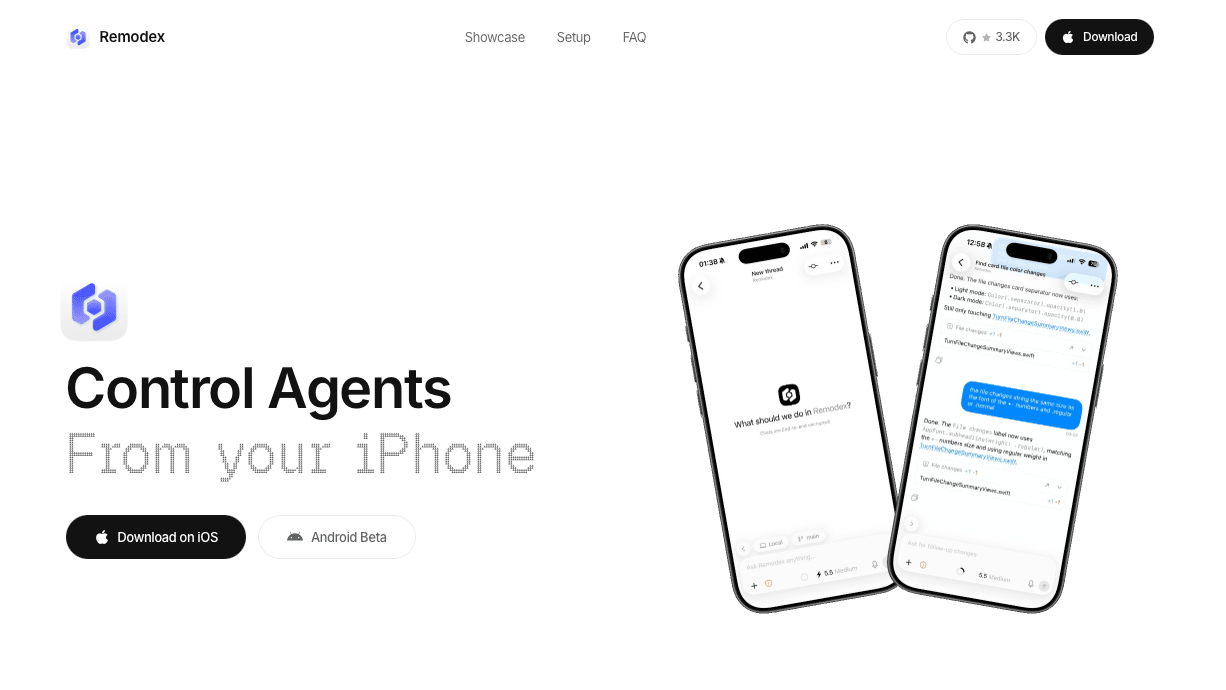
Most of my revenue comes from Remodex, but it was never meant to last. It was a temporary solution.
Remodex was the most-used viral solution for using Codex on a phone. But then OpenAI released their own version, as I knew they would. That's the reason for the decrease in revenue.
But it was super valuable in the interim. And I'm still trying to keep it alive with a soon-to-be-released update. Even now, it has some useful features that the Codex app doesn't have.
Other than that, I'm mostly focused on Synara, an open-source GUI/ADE for serious agentic work. You can run every coding agent in parallel and ship without losing context. It's still free, but a mobile app with a subscription is on the way!
Building v1.0 in two weeks
It took me one or two weeks to build v1.0 of Remodex, just me and my PC. I didn't sleep much, lost a ton of weight, and pushed like hell to bring the app out there as fast as possible.
Getting it done that quickly was a mind game. Sometimes I was carried by motivation. Sometimes it was momentum. Sometimes, it was just the fact that if I didn't do the work, nobody would do it for me.
Here's the stack:
Nextjs/Tanstack
TailwindCSS
Convex/Supabase
Stripe/Polar
SwiftUI
SwiftData
RevenueCat
Organic growth on X
I grow all my apps organically via X. I have nearly 11k followers, which is a big help.
I started by doing a lot of detailed, well-thought-out posts at first to grow an audience and go viral in the right way. I used Grok to find viral posts in my niche. Then, I used Claude to reshape my posts to make them more interesting.
But eventually, I started doing daily videos about my process and lessons learned. As of today, it has been 352 days of recording every single day.
Tired, happy, sad, sleepy, lacking motivation... I post a video. Every single day.
X growth isn't easy. There were days when X changed their algo and I went invisible, and it seemed as though all the progress I had made was worthless. It's a rollercoaster.
But it certainly paid off. Not only for my products, but also because I get paid as a creator. X changed my life, and it keeps on changing it — mostly in a good way.
Here are a few tips if you'd like to grow your following:
Use a clear profile picture so people know you're not a bot.
Have a clear bio so that people know exactly who they are looking at as soon as they open the profile.
Use images and videos because they perform better than normal text.
Make sure your posts are spaced out about 2-3 hours from each other.
Quote and repost your own content.
Reply a lot.
Other than X, I launched on Product Hunt, Tinylaunch, Uneed, and a few other places. I tried promoting on Reddit once, but they're super strict, so I refused to keep going there.
The mental struggle of indie hacking
Believe it or not, my most difficult challenges have been mental. Indie hacking really messes with your mind.
You're alone, trying to compete with giants. You're the only one who can bring this forward. And the only one who can sink it. It takes some nerve to do this. There will be sleepless nights. And you'll need to do some real deep talk with yourself to make it work.
You have to push yourself, especially at first. You need to show yourself that you've got this. You need to grow your confidence.
It requires a lot of work, but it's super worth it.
Some other things that helped me were:
Keeping this rational and coming at it from a problem-solving standpoint.
A lot of positive self-talk.
Talking to ChatGPT — but not in its usual sugar-coated way.
Physical activity, like workouts and walks to blow off steam.
Go all in on AI and building in public
My advice? Go all in on AI. This is clearly where we're headed.
I'd suggest that you let AI guide you to what you need to learn to be an indie hacker. Let it help you understand. Then, let it help you build.
From there, watch YouTube videos, talk to people who have more experience, and ask for feedback.
And share your progress in public — even if you think no one cares. Because soon enough, somebody will care, and that will motivate you like never before

Leave a Comment
Appreciate the honesty about the $9k → $1.5k drop — that's the platform-risk story most of us would rather not say out loud. Curious how you knew it was time to put your energy into Synara instead of trying to out-build the Codex app head-on. Was there a clear moment, or did it creep up on you? Also, 352 days is a serious streak. Real discipline
Your $9k-to-$1.5k swing is a useful reminder that platform risk can invalidate the problem framing, not just the distribution channel.
For a portfolio of apps, I’d classify each one by what is actually portable: the user-owned workflow or data, the demand source, and the platform capability being wrapped. Then set a trigger before the next shock: if one platform supplies most of the revenue or core capability, spend the next release cycle moving one valuable workflow toward an asset you control, such as a recurring process or a direct audience.
The 352-day posting streak is impressive, but I’d measure it by how much demand it moves from X into channels you can still reach when the algorithm changes. For Synara, what part of the workflow stays valuable if a platform you depend on ships the same feature next month?
I agree with this. The biggest lesson is that consistency alone is not enough if the platform controls the audience or core capability. I’d focus on turning the workflow into something portable, building direct demand, and reducing dependence on any single platform. For Synara, I think the most valuable part is the underlying workflow and user data, because those can remain useful even when the platform changes or competitors copy the feature. The real goal should be building an asset we control rather than simply growing on someone else’s platform.
Super relatable, especially the part about the mental toll and platform risk when giants like OpenAI ship your features. Massive respect for grinding 350+ days of daily videos. Consistency is the ultimate cheat code.
Really impressive journey, especially the consistency behind building 10 apps and documenting the process for 352 days.
What stood out to me most was the Remodex story. Building a product around an emerging opportunity, knowing it might be temporary, and still using that experience to move toward something bigger is a valuable lesson in itself.
The revenue drop from $9k to $1.5k must have been difficult, but I think your approach to treating it as part of the product journey rather than a failure is really important. The point about the mental side of indie hacking also resonates—building consistently when motivation disappears is probably harder than the technical side.
Curious to see where Synara goes from here. The idea of turning everything you've learned from Remodex into a longer-term product is interesting.
the amount of work we have to put in building some of these seems really small until we really start struggling
Recently I also want to build Apps and Saas products, but somehow always stuck at something.
Getting 'Sherlocked' by OpenAI is practically a rite of passage for AI wrappers at this point, but pivoting that momentum into Synara is a brilliant move. Building mobile clients for first-party APIs always carries extreme platform risk, whereas an open-source ADE for parallel agent execution tackles a much stickier developer problem. 352 consecutive days of daily video updates on X is insane discipline—curious, how are you handling state synchronization when running multiple coding agents in parallel without hitting context limits?
Can you answer one thing, for a person who wants to start fresh on X, and grow his profile, what he should be focusing on, and what kind of a roadmap should he be following for the next 2 months ?
Interesting approach. I think the biggest challenge with products like this is getting users to understand the value quickly. Would be interesting to know what has worked best for your early customer acquisition.
Have you thought about scaling those apps later?
Amazing work by them.
The “temporary solution” mindset is probably the most interesting part of this story. A lot of founders wait for the perfect long-term product, but you proved that shipping a useful solution quickly can create real revenue and, more importantly, give you the resources and experience to build the next thing.
The $9k peak followed by the drop to $1.5k is also a great reminder of how risky platform-dependent businesses can be. At the same time, making $9k from something you built in 1–2 weeks is pretty incredible.
I’m building (SpeakerRescue .Online) and I’m taking a similar lesson from my own journey: ship something useful first, learn from real users, and keep building assets that aren’t completely dependent on someone else’s platform.
Respect for actually shipping 10 apps instead of spending years trying to make the first one perfect. 👏
Best of luck to you
"Own your distribution or the platform owns you" is the line that landed for me. I build data/scraping tools, which is basically platform risk as a business model, every source can block you or change their markup overnight and you find out when a run fails, not when they announce it. Two things that have actually helped me hedge it: (1) a portfolio like his, lots of small independent products so no single "OpenAI moment" guts everything at once, and (2) competing on the one thing platforms rarely bother to do well themselves: reliability. When a source fights bots, most tools quietly fail ~30% of the time; being the one that just works becomes a real moat, because that's not a feature the platform owner cares to copy. The part I'm still worst at is the distribution side he nailed, 352 days of showing up in public. That audience is the asset that survived the revenue drop, and it's the hardest one to fake. Genuinely curious: when Remodex dropped, did the X audience convert to the next product right away, or did you have to re-earn their attention for a different use case?
The platform risk lesson here is huge. Going from $9k/month to $1.5k that quickly shows how dangerous it can be when your product depends heavily on another company’s roadmap. Still, getting that much value out of a temporary opportunity is a win in itself.
The platform-risk part hits hard. I'm building on the same fragile assumption — 46 KDP books + 5 AI tools, and every one of them depends on someone else's platform (Amazon, Render, the App Store equivalent). The revenue is tiny, but the lesson I keep hitting is the same: own your distribution or the platform owns you.What's your actual plan for derisking now that this happened? Diversifying channels, or building something platform-independent?
I agree with this perspective. Developers still need to explore and build instead of assuming AI will replace every opportunity. Even when a larger company or AI tool eventually offers a similar solution, the experience of testing an idea, understanding users, and solving a real problem creates valuable knowledge. The goal isn't to compete with giants on everything, but to find a specific problem, explore it deeply, and build something users genuinely need.
This was helpful
I am also interested to do this.
Exactly. A product doesn't have to exist forever to create real value. If a platform eventually builds the same feature, the experience, customer relationships, and lessons learned can become the foundation for the next opportunity. The key is recognizing the shift early, moving quickly, and staying focused on the underlying problem rather than becoming attached to one product.
The app generated around $9K per month, but heavy reliance on one platform made the business vulnerable to sudden policy or algorithm changes.
Diversifying traffic, revenue channels, and customer acquisition could help reduce platform risk and create more stability.
Really appreciate the honesty here, especially about Remodex's revenue drop once OpenAI shipped their own version — that's the platform-risk nightmare every solo builder worries about. Curious: since Symra is open-source, are you thinking about monetizing it differently (support/hosting/enterprise) specifically to avoid getting steamrolled the same way again? The "build v1.0 in two weeks, barely sleeping" phase resonates a lot — that grind is real.
$9k/mo is a great result for a solo/small app — congrats on getting there. I'm curious about the very beginning though: how did your first, say, 50-100 users actually find you? Trying to figure out distribution for my own small project right now and most advice I find is about scaling, not about the "zero to first users" part.
$9k/mo is seriously impressive for a solo or small app. Congratulations on getting there. I’m especially interested in the early stage too. How did you get your first 50–100 users? That zero-to-first-users phase seems much harder to figure out than scaling, and most advice focuses on growth after you already have traction. I’d really appreciate hearing what worked for you in the beginning.
Yeah, seems like nobody has a clean answer for that early phase — even people who've made it seem to figure it out mostly by trial and error. If you're building something too, curious what you're working on.
This post is a textbook example of the measurement blind spot that kills early-stage products: you measured what was in your control (app output - revenue), but not what wasn't (platform dependency - input constraints).
Emanuele built a $9k/mo app on top of OpenAI's API. His metric: monthly revenue. Working perfectly. $9k revenue meant $9k of successful optimization. Until OpenAI changed the input - released Codex directly - and suddenly the output metric became irrelevant.
The fix isn't to feel betrayed by platforms. It's to measure the boundary. Not just "revenue this month" but "revenue source fragility" - what percentage of this revenue depends on third-party behavior I don't control. When you measure both outputs AND input control, you see the $9k was actually 95% input risk that happened to pay off until it didn't.
Synara probably looks better on the measurement dashboard too - own platform, own risk boundary, aligned metrics. The hard part is measuring that boundary upfront.
The story of Remodex is a textbook example of platform risk, but the real takeaway here is the speed of execution. Building v1.0 in two weeks is incredibly fast, but it came at a heavy physical and mental cost.
This is the exact problem I am trying to solve. Most founders underestimate the "build cost" of getting a product to market. They spend weeks on boilerplate code — auth, admin panels, landing pages, database setup — before they can even validate the core idea.
That is why I built Nexus, my Next.js 16 starter kit. It ships with a 17-page admin panel, JWT auth, and 626 automated tests out of the box. The goal is to cut those 2 weeks of infrastructure work down to 2 hours, so founders can focus on the actual product and marketing, not lose weight over boilerplate code.
Curious, if you had to rebuild Remodex today from scratch, what percentage of those two weeks do you think you could have eliminated by starting with a boilerplate like Nexus?
How did you gain your first few users, what worked best for you?
Platform risk is real and underrated. I built my tool on Bolt + Supabase and already had one hosting rollback that nearly broke the site before launch. Your pivot story is a good reminder to own the distribution, not just the product. How long did the transition take before revenue recovered?
不错
This is a really honest breakdown — the platform risk part especially resonates. I'm building Rivox right now (invoicing/payments for freelancers and agencies working internationally), and it's made me think a lot about which parts of the business I actually control vs. what's sitting on someone else's platform decisions.
Curious — once you saw the platform risk materializing, did you consider diversifying to other app stores/platforms, or did it make more sense to pivot the business model entirely? Would love to hear how you thought through that trade-off.
cool
Nice bro 👌🏻
Great
What Id love to know is the operational side of the pivot did you keep the old $9k product running while building Synara, or did you have to fully switch focus and eat the revenue drop? That transition period seems like the hardest part.
it's always risky to make platform dependency solutions. Decade ago it was popular to make instagram solutions, and when instagram brought that features all of those apps was garbage
The biggest takeaway for me isn’t actually the $9k/month milestone — it’s the lesson about platform dependency. A product can be growing fast and still have a very fragile foundation if a platform owner can recreate its core value overnight.
The 352-day content streak and 11k+ audience may end up being more valuable long-term than Remodex itself, because that distribution isn’t tied to one product.
Building fast is clearly a huge advantage, but this is a great reminder to build something you can eventually own rather than just rent from a larger platform. Really interesting case study.
Really inspiring journey. The biggest takeaway for me is the importance of adapting quickly when the market changes. Building in public, staying consistent, and using AI to speed up learning and development can create real momentum. Synara sounds especially interesting for agentic workflows.
Same thing I am trying to do, I am building portfolio until few of them start making me handful of money
This resonates a lot with something I've been thinking about while building my own marketplace. I went the opposite direction from a single-feature wrapper — instead of one core product, I kept layering in independent revenue streams (subscriptions, a loyalty program, an affiliate integration, a couple of niche marketplace features) so no single piece carries the whole business.
It's slower to build than shipping one sharp wrapper fast, but reading this makes me think the tradeoff is real: a wrapper can hit $9k/mo faster, but it's also one policy change away from $1.5k. A messier, multi-stream setup grows slower but there's no single "OpenAI moment" that can gut it overnight.
Curious if Emanuele thinks about Synara the same way, or if speed-to-market is still worth the concentration risk at this stage.
The $9k → $1.5k drop is probably more valuable than the $9k milestone itself. It shows how quickly a product can become vulnerable when its core value depends on a platform you don't control. The interesting part is that the 352-day content streak and 11k audience survived the platform shift — distribution and audience can become the more durable asset. Great case study in why speed matters, but so does building something the platform can't easily replace.
352 days of recording and posting every single day is some serious consistency! I love the transparency and simplicity of how you tell your story; thanks for sharing. I loved it!
This hits the measurement paradox. Revenue looked great - $9k/mo is validation. But you were measuring the output of your app, not the health of your platform. OpenAI was the input you couldn't measure.
The insight: measuring only what's in your control blinds you to what you don't control. Revenue is in your control (initially). Platform risk is not. So you optimized for revenue and missed the actual constraint.
The fix is measuring the boundary - not just "do people buy" but "who controls the channel." Not just revenue, but revenue concentration. Not just traffic, but how much of your traffic comes from a platform you don't own.
Misalignment happens when teams measure different layers of the same system. You measured output, the market measured input risk. You need both signals to see the real picture.
The Remodex case is an excellent example demonstrating that a product does not need to be permanent. They seized an opportunity, launched their product within two weeks to generate revenue, and then flexibly adapted to changes in the platform. Furthermore, consistently posting every day for 352 days is truly remarkable. It shows that consistency plays a role just as important as the product itself.
Awesome case study! The reminder to go 'all in on AI' and move fast, even when big tech builds right behind you, is spot-on advice for indie hackers today. Keeping up a 350+ day video streak on X is top-tier consistency.
Awesome case study! The reminder to go 'all in on AI' and move fast, even when big tech builds right behind you, is spot-on advice for indie hackers today. Keeping up a 350+ day video streak on X is top-tier consistency.
Awesome case study! The reminder to go 'all in on AI' and move fast, even when big tech builds right behind you, is spot-on advice for indie hackers today. Keeping up a 350+ day video streak on X is top-tier consistency.
Getting hit by 'getting OpenAI-ed' is every AI founder's worst nightmare, but building Remodex in two weeks and riding that wave to a $9k peak month shows incredible speed and execution!
The pivot to Synara—focusing on a parallel agentic coding workspace—is a great strategic response. How are you designing the mobile app experience for Synara so developers can manage parallel AI agents on a smaller screen without getting overwhelmed by context switching?
Getting hit by 'getting OpenAI-ed' is every AI founder's worst nightmare, but building Remodex in two weeks and riding that wave to a $9k peak month shows incredible speed and execution!
The pivot to Synara—focusing on a parallel agentic coding workspace—is a great strategic response. How are you designing the mobile app experience for Synara so developers can manage parallel AI agents on a smaller screen without getting overwhelmed by context switching?
352 days of daily videos is the number that doesn't show up in the revenue chart. The $9k→$1.5k is the headline, but the 11k audience is what makes Synara a different kind of launch than a cold start.
Most founders think about distribution as a separate phase — build first, find an audience later. Emanuele was building the distribution channel the whole time, just in video form. When Synara launches, he's not starting from zero. He's converting an existing audience.
The open source bet is also the structurally correct response to platform risk. Remodex's moat was API access. Synara's moat is community contribution. Those have completely different vulnerability profiles. Hard to replace what you helped build.
The "10 apps, one took off" detail is the part that stuck with me more than the $9k number itself. That's the actual game, right — enough shots on goal that one catches, rather than betting everything on picking the right idea upfront. Makes the OpenAI hit sting less like a single point of failure and more like "one bet decayed, the portfolio didn't."
One thing I'm curious about: Synara being open source is a pretty different bet than Remodex was (closed wrapper, single platform dependency). Was that a deliberate lesson learned — i.e. open source as a hedge so the value isn't just "convenience on top of someone else's product" — or more about the ADE/dev-tool space just expecting that model? Curious how much of that decision was platform-risk-driven vs. just what the category demands.
Your question is the right one. My read is that it's probably both — the ADE/agentic tooling category does converge toward open source (hard to build community lock-in around a closed tool in that space), but not every founder consciously draws that connection after a platform hit. The fact that Emanuele moved to open source after the Remodex experience suggests he understood it as a hedge, not just a convention. Category dynamics gave him permission; the platform hit gave him the reason.
The platform risk part really caught my attention. $9k/month is a great spot to be, but if a large part of the business relies on a platform you do not control the revenue can still feel awfully fragile. ~
It was nice to see how quickly the first version got built, and how they dealt with everything that came after. It is one thing to get something to work in 2 weeks. Growing it healthily and coping with the mental aspect is another problem.
Most people don’t discuss this too often in the indie hacking space. Even if a business is operational, it may not be stable.
Sorry that OpenAI shipping the same idea hit the revenue. When a platform can eat the product, the next dollar often comes from a buyer who wants the workflow around it, not another clone of the feature. Curious who paid you at $9k, solo builders or teams that needed the extra layer?
Really appreciate the honesty here, especially admitting the $9k→$1.5k drop instead of just showcasing the peak.
The Remodex situation is a good case study in platform risk that's easy to underestimate when you're building fast. Wrapping a first-mover convenience layer around someone else's core product (OpenAI/Codex here) can work great short-term, but the platform owner catching up is almost inevitable once the use case proves itself. Feels like the real question going into Synara is: what's the durable wedge that isn't just "convenience until the platform closes the gap"?
Also curious about the X strategy — 352 days straight is wild discipline. Did you notice a lag between posting consistently and actual conversion to paying users, or was growth pretty linear with the posting cadence?
Such an honest breakdown of the rollercoaster of indie hacking—hitting $9k/mo solo is a massive milestone, and taking a hit from platform risk when OpenAI launched their native app is the nightmare scenario every wrapper/utility founder fears.
A few thoughts on how Emanuele is handling the transition and tactical takeaways for anyone building on top of major platforms:
1. Moats beyond UI wrappers: Moving toward proprietary features that first-party apps won't prioritize (like multi-agent parallel orchestration or custom local workflows) is key to surviving platform risk. Big tech native apps focus on mass-market simplicity, leaving specialized power-user workflows completely open for indie tools.
2. Audience as the durable asset: While app revenue fluctuated from $9k to $1.5k, the 352-day video streak and 11k followers on X are assets that a platform API change cannot erase. When you cultivate a loyal audience, launching product #11 (like Synara) starts with immediate momentum on day one.
3. Pacing & longevity: Building v1 in two sleepless weeks and posting daily videos for nearly a year proves immense grit, but establishing sustainable boundaries is as critical as shipping fast to avoid long-term founder burnout.
Kudos to Emanuele and James for sharing both the peak wins and the raw setbacks so transparently!
You make a point to go all in on AI, and I only started using it to build early in 2026. I feel like I was too late to be an early adopter, as a lot of people already made their millions from AI. But it feels weird and disorienting, because at times it feels like this is just the beginning and there's still time left to get ahead, and other times it feels like the end of AI is near and we should brace ourselves for what comes next instead.
The world moves and changes fast, and I really hope to invest time and money into emerging technologies instead of sitting on the sidelines and complaining like I have done for years.
Platform risk is the invisible tax on mobile app builders — you can be doing everything right and still get blindsided by a policy change. That's a brutal way to lose momentum at $9k/mo.
Platform risk is one of those things that looks fine on a P&L right up until it does not. Curious what the actual trigger was here, a policy change, an algorithm shift, or something account specific. That distinction matters a lot if you are ever trying to explain to someone else why revenue dropped, since “platform changed the rules” reads very differently than “we did something wrong.”