The category we almost had to delete, and what saved it
Three months after launch, our real estate category was the one everyone in the team was proud of. Highest listing count, most repeat posters, the category we screenshotted for the pitch deck.
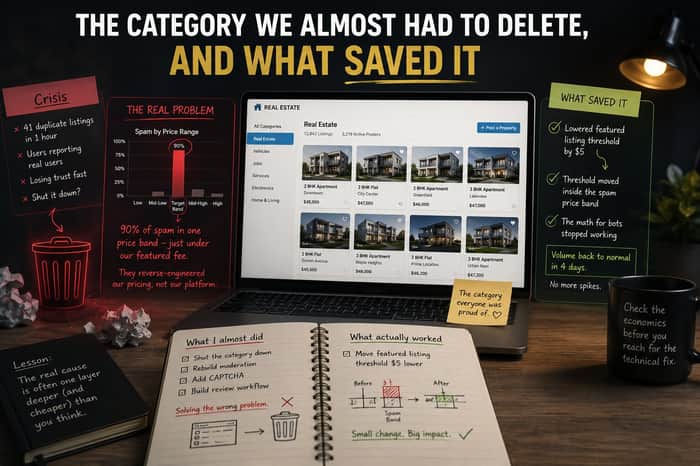
Then one Tuesday, forty-one nearly identical listings went up in under an hour. Same phrasing, same three stock photos rotated across different cities, prices dropped just low enough to bait a click. By the time I saw it, real users had already started reporting other real users' listings by mistake, because they couldn't tell which ones were fake anymore.
My first instinct was to shut the category down entirely and rebuild moderation from scratch. I actually drafted that email to the team.
What stopped me was pulling the actual data before sending it. I expected the spam to be evenly spread across categories. It wasn't. Ninety percent of it sat in exactly one price band — the range just under what our featured-listing fee required. Whoever was running the bots had reverse-engineered our own pricing tier, not our platform.
That was the moment the panic turned into a much smaller problem than I'd assumed. We weren't fighting spam everywhere. We were fighting one gap, at one price point, that made low-effort duplication worth the bots' time.
The fix embarrassed me a little, because of how small it was. We didn't touch moderation queues, didn't add CAPTCHA, didn't build a review workflow. We just moved the featured-listing threshold five dollars lower, so it sat inside the band the spam was clustering in instead of just above it. Overnight, the math that made duplicating forty-one listings worth it stopped working. The category didn't need smarter moderation. It needed a pricing edge to stop being a blind spot.
Listing volume in that category was back to normal within four days, and it never spiked like that again, in that category or any other.
What actually stayed with me is how close I came to solving the wrong problem. Deleting the category and rebuilding moderation would have fixed nothing, because the moderation wasn't broken. The economics underneath it were. I keep catching myself wanting to reach for the obvious technical fix before checking whether the real cause is something dumber and cheaper to fix, sitting one layer below where I was looking.
I'm curious whether anyone else running a marketplace or classifieds platform has had a spam or fraud spike trace back to something in your own pricing or fee structure rather than a moderation gap. It feels like the kind of thing that's obvious in hindsight and invisible while it's happening.

The "one layer below" instinct is the real lesson here. Same pattern shows up on Threads: bot-spammed threads rarely look fake in any single reply — the tells live in account economics (age, reply-to-post ratio, identical phrasing). We're building a tool that surfaces rising threads for creators, and the filter everyone expects is actually an economics read: is this thread alive because of real accounts, or because posting is free? Easy to build smarter moderation, hard to notice the real lever was cost.