The friend everyone asks for recommendations

A friend texts you. They are going to Spiti next month, and they know you went. What do you send them?
If you are like me, you send one link off the top of your head, and it is not the best one you know. The best one is somewhere in a folder with four thousand other links in it. You bookmarked it eighteen months ago because it was genuinely good. You have not opened it since, and you are not going to go looking for it now while someone is waiting on a reply.
So you send the mediocre link. Or you spend twenty minutes rebuilding a list by hand in a chat window, the same twenty minutes you spent the last time someone asked, because nothing you built then survived.
I did this for years before I noticed what it meant.
Saving and showing are not the same thing
Every tool I have used for saving links is built to help me find something again. Folders, tags, search, a graph view. All of it answers one question: where did I put that.
Here is the thing. I almost never want to find one specific link. I have opened maybe forty of my four thousand bookmarks a second time.
What I actually want, several times a month, is to hand someone the good version of what I know about something. That is a different job with different requirements, and no filing system helps with any of them.
It needs to be short. Nobody wants your forty links on a subject, they want your eight.
It needs an order. The third thing only makes sense after the first.
It needs to make sense to someone who was not there when you saved it. A folder named spiti-stuff full of bare URLs means something to you and nothing to anybody else.
And it needs to leave in one piece, as a thing you can send, not as forty links pasted one at a time.
A folder cannot do any of that. Not because it is badly designed, but because it was built for the other job.
So I built the other half
Kyurations is for the second pile. The things you save because you will want to show them to someone.
You save a link, a note or a file, from any site, in one click. It comes back looking like something rather than like a URL: the cover, who made it, where it came from, a couple of lines saying what it is. That last part is the whole trick. It is why something you saved in March still makes sense to you in September, and why a stranger can read your collection at all.

You do not file anything. Things you save that belong together find each other and propose themselves as a list, with a name. You rename it, drop the two that do not belong, drag them into an order that reads properly.
That last part is the only bit that is genuinely your job, and it is the bit that makes the collection worth anything. Choosing what to leave out is the whole skill. Nobody can automate the judgement of a person who has actually read the things.
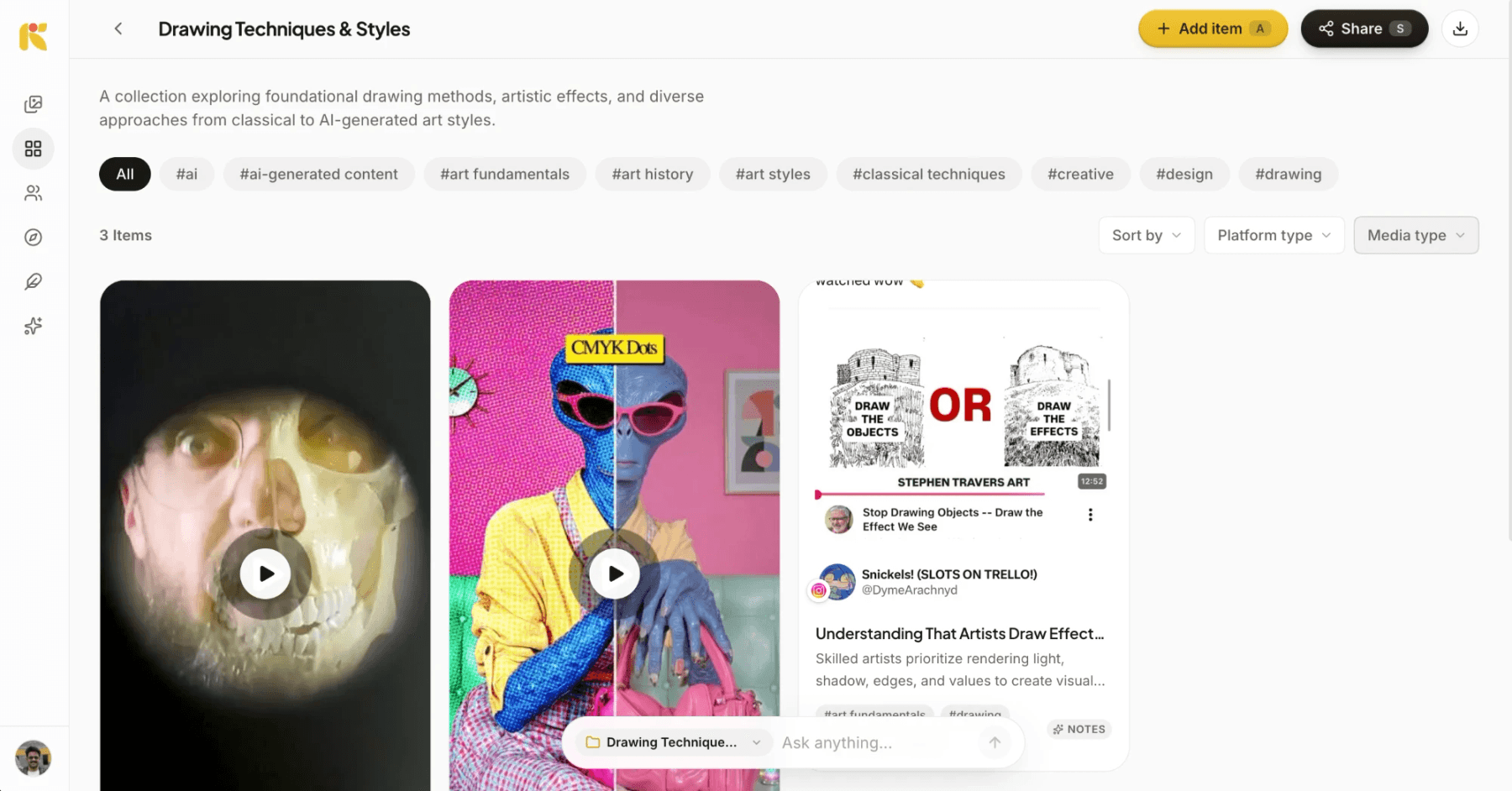
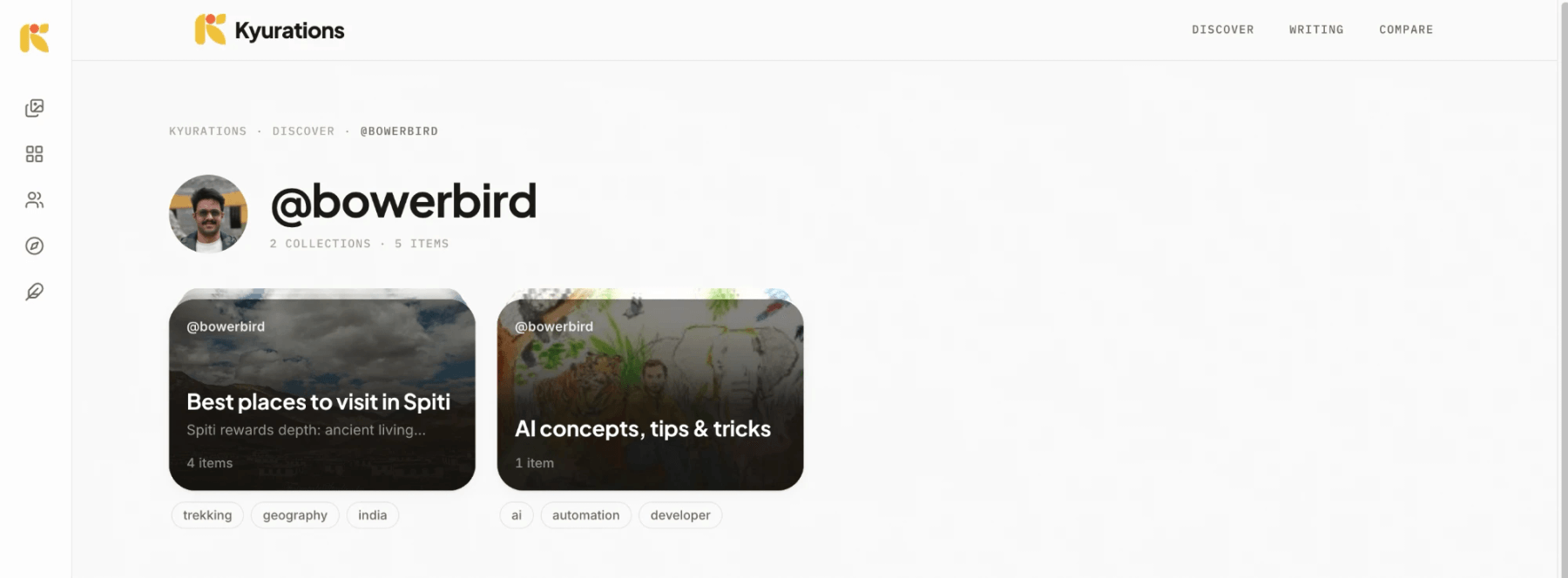
Then you publish it, and it becomes a page with your name on it that anyone can open. No signup wall for the person you send it to. One link, instead of twenty minutes in a chat window.
Next time someone asks about Spiti, you send the page. And unlike the twenty minutes, the page is still there the time after that.
You can ask your own collection questions
This one surprised me, and it is the feature I did not plan.
Once a few hundred things are in there, the collection knows things you have forgotten. So you can ask it. Not a search box, an actual question, and the answer comes back out of the things you saved rather than off the open web.
I asked mine what it had on building taste. It answered from a video I had saved months earlier and had no memory of saving, pulled out the specific argument the video makes, and cited the video so I could go and check it. Every claim in the answer points at an item of mine. If it cannot find it in your collection, it says so rather than inventing something.
Then it did something I did not expect. It looked at what I had gathered about Spiti and said the research was unusually complete for a saved collection: four sources covering the monastery circuit, the national park and the trailhead village, which suggested I was not dreaming about the trip, I was building a route.
It was right, and I had not noticed. That is the thing a pile of bookmarks cannot ever do for you, and it only works because the collection is small enough and considered enough to say something about you.
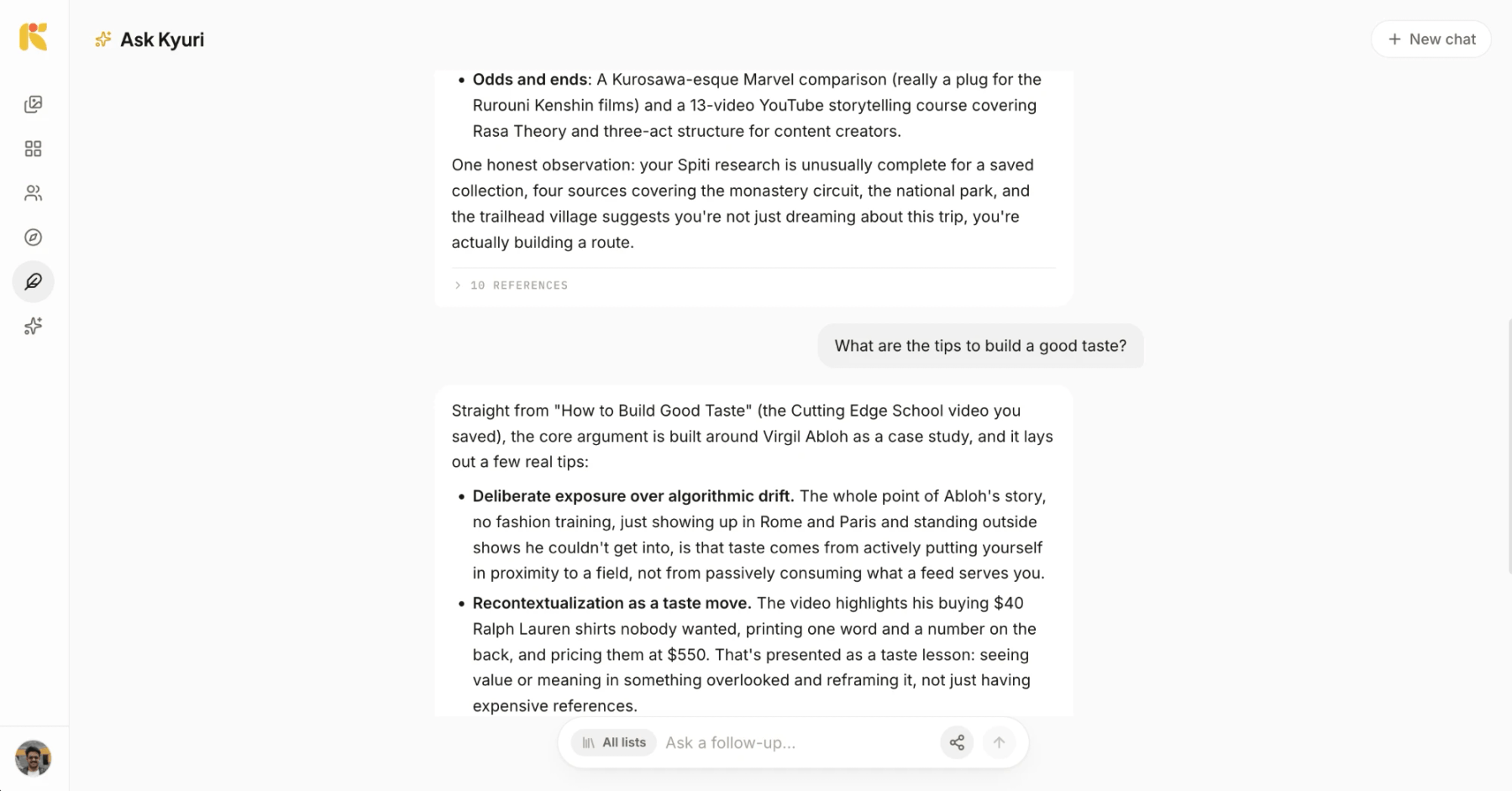
You can ask across everything, or narrow it to one collection.
Who this is not for
If you want an archive of everything you have ever seen, with fast search across a hundred thousand items, use a proper bookmark manager. Raindrop is very good and it has years of polish this does not.
If you want somewhere to write and link your own notes, use Obsidian or Notion. This is not a note-taking tool and I have deliberately kept it from becoming one. Every time I have been tempted, it would have made this a slightly worse version of something that already exists.
This is for the person your friends text before they buy, read or watch anything. You already do this sorting in your head. It just has nowhere to live.
The bird
The name comes from the bowerbird. It gathers bright things, shells and petals and bits of glass, and arranges them into a structure for no reason other than that the arrangement gets seen. It steps back, judges its own work, moves things around.
That is a fair description of what people with taste already do, and I could not find a tool built around it. Everything was built for hoarding. Nothing was built for showing.
Where it is now
It works. There is a Chrome extension for saving, collections publish as pages, and you can take everything out whenever you like, as Markdown, a spreadsheet, browser bookmarks or JSON. That last one is not a feature so much as a promise: a collection you cannot walk away with is not really yours.
What is missing, honestly: there is no way yet to bring in a bookmarks file from Chrome or Pocket, which is a strange gap in a tool that wants your collection, and it is what I am building next. There is no mobile app. And search across a very large library is slower than a dedicated bookmark manager, which is the tradeoff of having spent that time on the showing half instead.
If you are the person who gets asked for recommendations, I would like to know what you currently do about it. The chat window rebuild is what I could not stand any more, and I do not think I am unusual.
