The Future of Smart Homes: Technology That Is Changing Everyday Living
Introduction
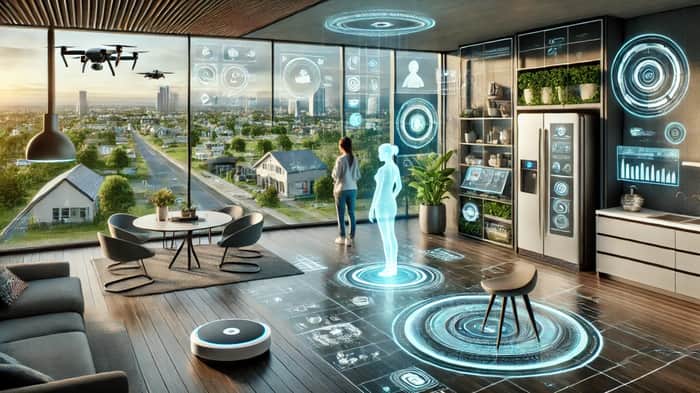
Nowadays, the concept of the smart home has evolved from a mere theory into a reality that plays an integral role in our lives. Connected thermostats, smart lighting, surveillance cameras at home, voice-controlled devices, automation robots, smart locks, and energy monitoring systems are all things we can find in our homes nowadays. However, the distinction between today's smart homes and those of the future lies not only in connectivity but also in interaction and learning patterns that help make decisions.
Due to the constant development in artificial intelligence (AI), Internet of Things (IoT), cloud computing, and sensing technologies, our environment at home will become highly integrated and responsive to people's needs. At the same time, it should be noted that many issues of privacy, security, and user control were underlined by researchers.
From Connected Devices to Intelligent Homes
Early smart houses relied mainly on connected individual devices. It was possible to control the temperature by using an application, turn off the light switches or watch the surveillance cameras remotely. The latest trend involves automating, meaning that many devices can work cooperatively and not separately. The United States Department of Energy has stressed that connected houses can include thermostats, various household devices, sensors and energy management tools. It can allow the residents to monitor their house and automate their actions.
It is very significant in the era when AI becomes incorporated into consumer technology. The necessity for the person to command every action can be substituted by analyzing the pattern of activities including occupancy, temperature preferences and usage of the energy resources.
AI Will Make Homes More Predictive
AI may turn out to be one of the key technologies that will help to shape up smart homes in the future. With the use of AI, a system can analyze the information collected by sensors and connected devices in order to recognize the patterns and assist with automated decisions.
Thus, for example, a smart thermostat may take advantage of the occupant information, temperature information and weather forecasts in order to balance the cooling and heating. DOE research talks about smart thermostat systems that have the ability to learn about the occupant schedule and features of the building and make the energy-efficient decisions keeping the comfort level of occupants in mind.
The same thing may be done in the future when it comes to other aspects of the smart home as well. The lighting system may be adjusted depending on the occupancy of the house and natural illumination. The appliances may be scheduled according to the electricity demands of the house.
Energy Efficiency Will Become a Major Priority
Matteo Valles of Vol Case believes smart home technology will be an essential element in energy management. Smart thermostats, smart meters, energy monitors, household devices, and electrical panels will enable people to have a clear idea about the use of electricity within their houses.
The Department of Energy has already been exploring the use of connected thermostats in order to increase residential energy efficiency. Such devices will be able to monitor energy usage in terms of heating and cooling systems, give feedback to the owners, and even react to peak electricity usage.
The most sophisticated energy management system will be capable of managing household devices along with renewable energy sources. DOE research on smart electrical panels considers systems aimed at reducing electricity expenses, ensuring better resilience, and coordinating electricity usage in a house.
Such an approach may turn out to be crucial when homes install photovoltaics, batteries, and electric vehicles. The future home will no longer just use energy when needed but will try to manage the process of generating, storing, and using electricity.
Interoperability Will Shape the Smart-Home Experience
David Cicarelli of Lake said, fragmentation has been one of the most significant issues faced by smart home technology historically. Users were required to assess whether the device was supported by a certain ecosystem before purchasing it. Various ecosystems, applications and communication protocols have made the so-called "smart" home quite complicated.
Interoperability standards like Matter attempt to solve this issue. According to the research about Matter, interoperability has been considered to be an issue of smart home technologies for a long time already and Matter is an effort to introduce a universal solution.Consumer Reports states that Matter seeks to ensure that connected products which support Matter are capable of operating across different ecosystems of smart homes, which means that compatibility becomes less important when selecting products.
While the issue of interoperability is being solved, industry adoption is still an ongoing process. The future smart home requires not only technologically advanced devices but also better integration. Ideally, consumers should be able to purchase products on the basis of their functionality, reliability, and cost, rather than the issue of compatibility.
Security and Privacy Cannot Be an Afterthought
The more connected a home gets, the more information it generates. Information is generated by smart cameras, speakers, locks, thermostats, and sensors, which disclose details about the habits of household members, their preferences, and the physical environment.
Privacy and security issues among smart-home owners were noted by researchers from the National Institute of Standards and Technology (NIST). Smart homeowners worry about their privacy and security; however, they often do not have enough awareness or capabilities to handle these issues properly.
A systematic review of literature on the digital harm caused by smart homes showed the risk factors associated with unauthorized access, privacy infringement, information manipulation, and cyberattacks on connected devices.
When smart homes connect to healthcare facilities, privacy and security issues become even more relevant. The NIST guide on integrating smart home technologies in telehealth applications for 2025 indicates that IoT devices used by consumers pose cybersecurity and privacy threats to the healthcare environment.
Thus, future smart homes will require better user authentication, software updates, encryption, transparency in data processing, and user controls. Moreover, security should be a fundamental characteristic of any product.
Smart Homes Could Support Health and Independent Living
An additional area worth exploring is that of using the smart home technology in health monitoring and independent living where sensors may be used to observe environmental factors as well as movement and activity and devices may enable remote services. It could be quite useful for seniors and those wishing to live independently. But the health applications would need special precautions as the data collected at home becomes sensitive if it is connected to any kind of health services. NIST's project on the hospital-at-home system shows how this is done.
The Future Will Be More Automated—but Not Completely Autonomous
But the future of smart homes will not just involve increasing numbers of gadgets. The general trend here is toward the creation of systems which integrate sensors, intelligence, connectivity and automation in one environment.
The future of smart homes will likely involve making the technology invisible. Rather than having homeowners manage numerous applications and devices, intelligent systems could handle all of these in the background. Lighting, heating and cooling, security, consumption of energy and home appliances could become integrated elements of one environment.
But convenience should be balanced with transparency and control. Consumers should know what kind of data is collected by their devices, where it is sent and what decisions are automated.
Conclusion
Smart home technologies are moving into a new era. AI is enabling predictive devices, interconnected energy systems are providing new efficiencies, interoperability standards are tackling fragmentation issues, and smart sensors are offering exciting potentials for security, comfort and independence. But the future of smart homes will not only involve technological advancements.
Privacy, cybersecurity, interoperability, cost-efficiency and consumer control will decide whether consumers trust these systems. In the end, the smartest home might not necessarily be the one that has the most connected devices. It would be the one where technology works seamlessly, conserves resources, secures data and makes consumers' lives better while allowing homeowners to control the system effortlessly.
