The Problem with Startup Advice
If you open the front page of indiehackers.com or a popular subreddit like r/entrepreneur or r/startups you are bombarded with unsolicited advice on how to build your next startup, raise money, increase your traffic, improve conversion rates or get a dinner with Elon Musk's grandma. Here are some recent examples of what I mean (I deleted the business names, I don’t want to call out anyone here):
MyCompany crossed $10k MRR! Here are my 10 most important learnings
From idea to 200+ users from 50+ countries in 72 hours.
Case Study: How We Grew OurCompany from 0 to 24,000 Monthly Organic Traffic in 8 Months [Step-by-Step Blueprint]
That's all well as long as you are not convinced that these posts will actually help you. Here is why.
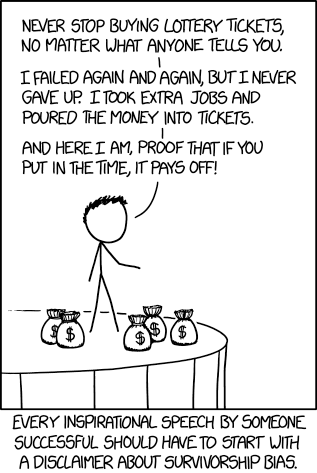
The problem is a called survivorship bias. In the second world war engineers of the US navy investigated where the amour of their planes could be improved. So, they looked at the regions where the planes that returned had the most bullet holes. The problem? They looked only at the planes that returned from the war zone. They only investigated the planes that were hit non-fatally because the planes that were shot down did not return, obviously.
The same holds true for startup advice.
We only read stories about startups that have succeeded. There may be hundreds of startups which incorporated this "awesome SEO strategy that improved our traffic over 200% in 6 days" and failed to improve their traffic, but no one writes about that (or at least no one reads it). There is a huge graveyard of startups that followed your awesome "step by step blueprint for landing your first 10 clients" but failed to find their first 10 clients.
This kind of advice gives the false illusion that startup success is predictable. That it is solvable like a mathematical equation. That's just wrong. Businesses live in a highly complex social environment. Businesses are about people. And people are highly unpredictable.
Even in the case where after implementing "this awesome startup tactic™" your traffic/DAU/MRR/whatever increased, it is hard to prove that it caused it. Causation is a fickle thing.
What can we do about it? How can we get actual advice about startups that is reliable? I honestly don't know. "Business administration" and "entrepreneurship" are no hard science like physics. Getting empirical data is hard if not impossible. And at the time you gathered enough data it might be useless again because so much has changed meanwhile.
The lean startup methodology comes the closest to a scientific method for building startups.
It may all come down to trial and error. You have to try things. You have to fail fast, faster than your competition. That's the only way you can weed out what works for you.
And that's where all this "startup porn" may come in handy again, due to two reasons.
First, it can be used for inspiration, to get an idea for the next "tactic" to test for yourself. But don’t be illusioned that it is a sure shot and will definitely improve the metric you care about. It’s only an idea that you have to test for yourself in your specific environment, under your specific circumstances (I'm always amused by the specificity in clickbait titles like "Increase your traffic by 246 % by this awesome tactic in 9h3m45s").
Second, "startup porn" may function as a type of motivation. Entrepreneurs need to be illusional about their ability to succeed (up to a certain point of course). The reality is that the vast majority of startups will fail. But that's not helpful when deciding to build one yourself.
Nonetheless, it is always important to keep in mind that you only read about the successful tip of the startup-iceberg. Again, the default outcome of building a startup is failure. In retrospective, it always seems obvious why you failed, but that's also just a cognitive bias called "hindsight bias" or "narrative fallacy". Backwards, the world is always more predictable than forwards. It's easy to find a narrative that fits the facts looking back, but that's not really helpful and potentially misleading. Often there are multiple stories that could have led to the same outcome given the same facts.
Don’t pressure yourself by thinking that more startups are successful than they really are, most startups will fail, but you won’t hear about it that easily.
Further reading (always my favorite section):
- The Incerto series by Nassim Nicholas Taleb (non affiliate link: https://amzn.to/3ukoupW)
- https://fs.blog/2016/04/narrative-fallacy/
- https://en.wikipedia.org/wiki/Survivorship_bias
- https://en.wikipedia.org/wiki/Hindsight_bias
- https://fs.blog/2019/12/survivorship-bias/
