Underdo your competition (-> basecamp)- who has done it?
When commenting on another post, I remembered the concept to underdo your competition. I learnt about it when reading a book (Getting real) by the basecamp founders.
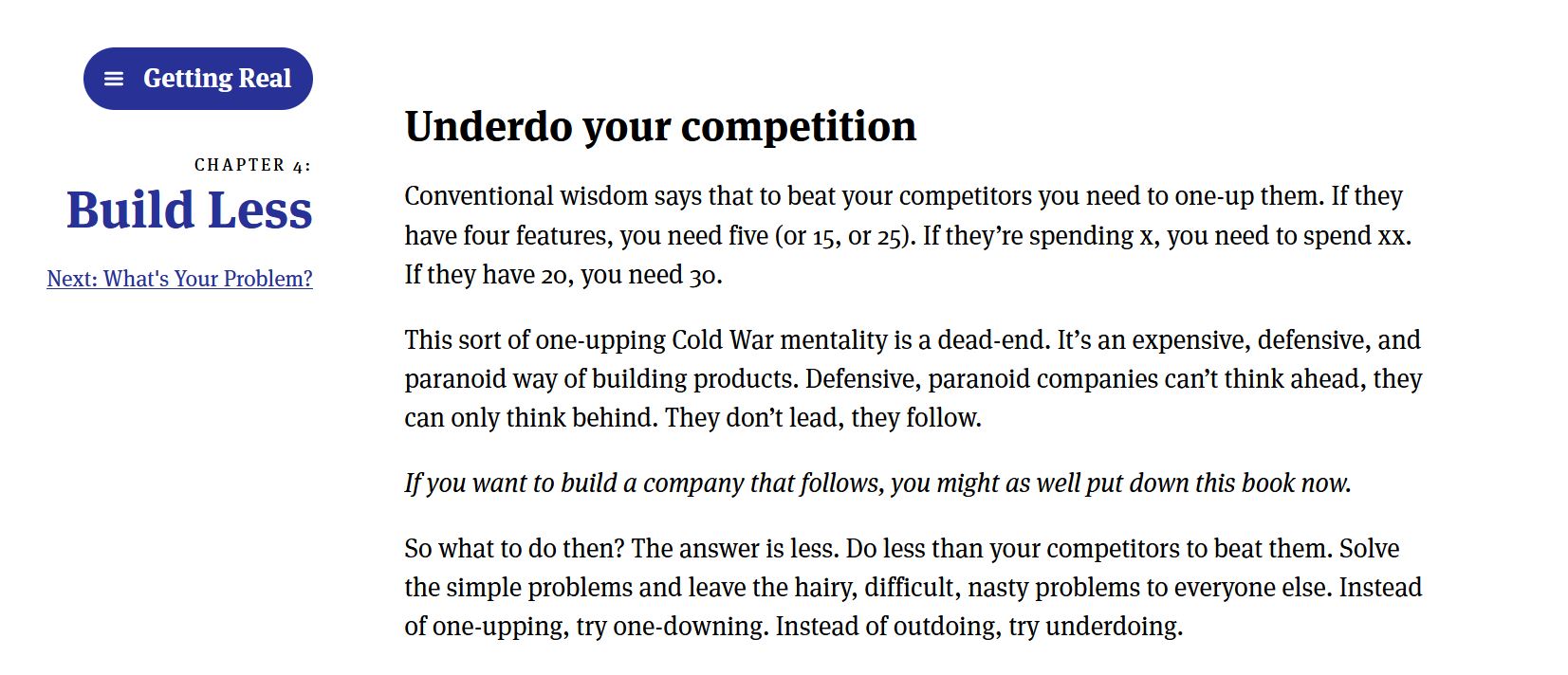
https://basecamp.com/gettingreal/02.1-build-less
Anybody, e.g. @flurly @mariemartens @thebigk @fer_momento @tilikang @Josuegio @sevenfortysix @verygoodplugins and others can share briefly their experience to have launched a project with less features than their established competitors?
Torsten
PS I just realise the book is available as free pdf from the basecamp website.
https://basecamp.com/gettingreal/getting-real.pdf
Recommended reading for every indiehacker.

My company (Less Annoying CRM) is built on the idea of underdoing your competition. It can definitely work, but I'd caution against taking that part of Getting Real too seriously.
It's important to understand the conditions in which Basecamp and Less Annoying CRM found success. Prior to 1999, pretty much all b2b software was for giant enterprises because they were the only ones who could afford mainframes for their offices. SaaS didn't exist yet.
Then Salesforce came along and basically invented SaaS by offering enterprise software that you could access via the web browser. All of a sudden, instead of every company needing their own mainframe, multiple companies could share a server in the cloud which made business software accessible to much smaller companies. But the software itself was still designed for large enterprises (Salesforce didn't really change anything about how CRM software worked, just the distribution model).
Almost immediately after that, Basecamp was launched. They were extremely early to SaaS, which was a huge part of their success. Not to take anything away from their product, but they were competing in an environment where pretty much all of the competition was complicated enterprise software, so by building less, they were able to make something simple and approachable for a previously underserved market.
LACRM has a similar story. We started in 2009 which was much later than Basecamp, but it was still early enough that most CRM software at the time was either (a) not web-based or (b) meant for giant enterprises. By underdoing the competition, we solved a major customer pain point which was that other CRMs were too complicated. Even with that success, we're still absolutely miniscule compared to Salesforce (we probably have something like .001% of the CRM market, if that).
Instead of saying you need to underdo your competition, I'd put it this way: You need to meaningfully improve on your competition in way that actually matters to customers. That could be by building a new feature no one else has. It could be by taking a different approach to the problem altogether. It could be by underdoing the competition, but only if there's a real customer pain point caused by the complexity of everything else that's out there. That approach can work, but as SaaS matures, I think there's less and less opportunity to underdo the competition because there are already simple solutions to all the major SaaS categories.
Thanks a lot, interesting insights from a long term perspective. When reading Getting real long time ago and remembering it now now I didn't really put this in the perspective that the SaaS market was still in its infancy and that underdoing was also underdoing mainframes by SaaS.
I somehow subconsciously also assumed that underdoing was also a way to be able to "underdo" the pricing, a self explanatory simple product and largely automated service should be cheaper to build and cheaper to maintain. So probably you're right that " there's less and less opportunity to underdo the competition " but let's hope that there are still some opportunities left.. ;-)
Maybe other founders having underdone the competition will join the discussion.
Adding @typpo (Textbelt) @guzguz @adriaanvanrossum @m5blum @laurits, it looks they are kind of underdoing their competiton, too.
We have underdone incumbents in the acquisition marketplace space by never charging commissions. All the big players like Flippa and Microacquire have taken venture capital and thus need to encroach on the payouts of sellers with 3-5% take rates in order to satisfy investors. We are bootstrapped and can stick to monetizing the buy-side by charging buyers fixed fees if they want to negotiate deals with sellers. This makes our platform more founder friendly and ensures a constant supply of great, profitable internet businesses listing anonymously on our marketplace for free.
At Simple Analytics, we have underdone the competition, Google Analytics, a lot. For example, we offer way fewer features. But people love our simplicity. It's a blessing. At the same time, there are definitely features that other competitors have and your customers will be asking for. It's still a challenge on what to focus on.
Thanks for tagging. Launching with less features was never a disadvantage for https://www.resumemaker.online/. I was trying to convey that less features and a more straightforward experience as the key benefit. After user interviews, I discovered that when creating resumes, features like multiple template design selection could be a struggle and users tended to face decision paralysis. The challenge was having to cut down many editing features that took me so much time to code!
Hi @ToPe, for Tally it was important that we offered (and still do) a generous free tier with unlimited forms and responses. This is something that competitors didn't do when we launched and was a big USP for us (even though we had less features)