Validation: app for staying on top of chores
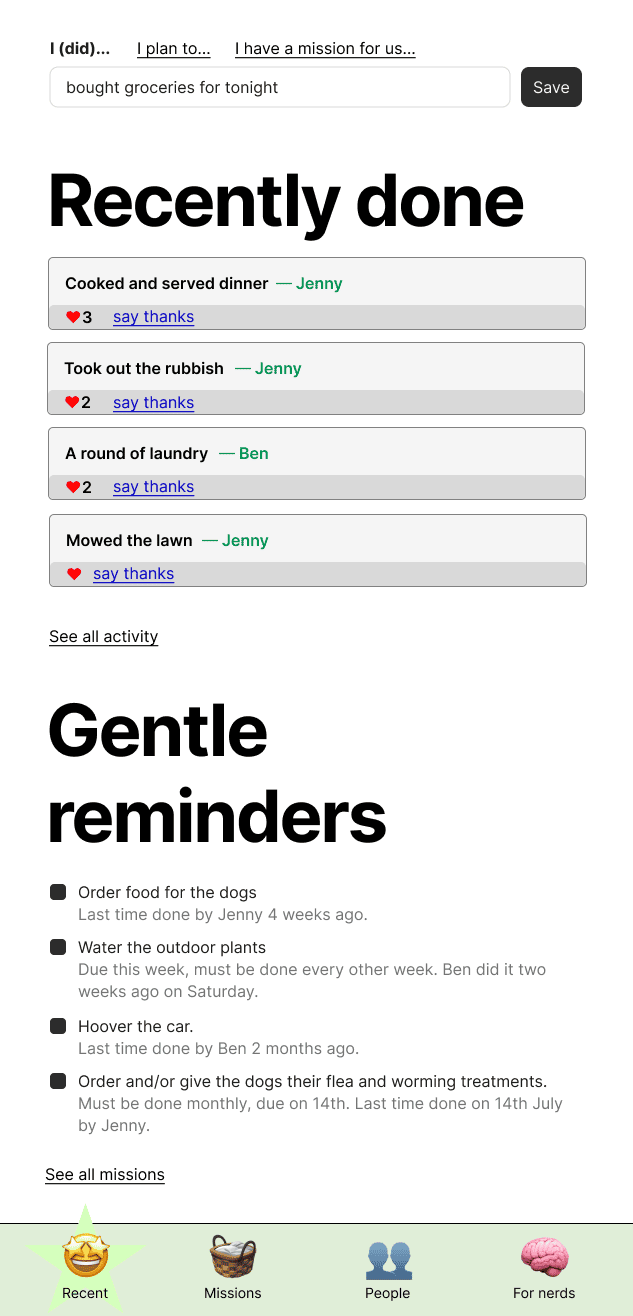
I live in a busy household. We have pets and plants and try to eat relatively healthy. Might not sound like a lot but it gets very busy at times, and some chores always fall behind or forgotten.
No reminders/todo app helped. They seem to be all too rigid and notification-focused.
"Do this now."
"You're overdue to..."
The app never gets the right context and gets ignored.
Chores aren't like tasks at work. They can be done late. Watering plants outdoors every other weeks doesn't mean every other Saturday at 10am, and if you're late you're overdue. It simply means "every other week at some point". No need to bring out the guilt, the red font. and the overdue warning.
Chores can be done even if they're not planned. Some are one-offs, some are regulars. Can't expect a chores app to be setup upfront with everything.
Chores can be somebody's but somebody else can do them too.
Logging and sharing when things get done seems more important than a list of things to do. Seeing things being done feels good, and being able to share achievements like this with the household is, in my view, very nice.
This is what I'm thinking in terms of app so far https://imgur.com/a/Lr52WnH
Do you live in a busy household? Do you use any app(s) for this? Which ones/ why not?
Do you think you/your household can benefit from something like this? Do you know someone who might?
How would you go about validating something like this without building it first?

The “ignored because it doesn’t match context” point is huge for Android utilities too. With Kinetic Override, I’m using exact workflow language as validation: if users can describe the repeated tap/swipe sequence they want to replay, the problem is concrete enough to build around.
Solid advice. Most of the ideas I have had are literally from solving my own problems.
And housekeeping isn't little work by the way, it can be very taxing! We've had people who downloaded goleko for housekeeping, believe it or not :)
Thanks! It's encouraging to know there is some interest in task management for housekeeping.
I'm probably not your target audience as this wouldn't help me. I've been using Todoist since 2018 and it works fine.
Recurring tasks can be assigned to individuals, and each task has an activity tracker so you can see who last actioned a specific task.
Watering plants for example, doesn't need a specific time attached, so don't attach one. I have the task date set to every Saturday, but it's under the 'weekly tasks' project (I have projects for recurring daily, weekly, monthly and yearly) and can be picked up at any time that week. Once it's ticked off for that week it will be assigned to the next Saturday. You can use filters to show all tasks due by the end of the week, so as long as you view by the weekly filter each day you wont need to set reminders.
I guess the biggest problem is that it's not obvious how you use some of these task managers. I find it very helpful to spend up to 15 minutes a week every Sunday organising what needs to be completed that week. You can also use that time to find out why your tasks are overdue - There's likely a good reason. Did Joe forget to water the plants that week? No, the weather is starting to move into Autumn and isn't that hot anymore, so maybe it's time to change that to a once every 2 week task.
Thanks for the reply. This was useful.
It might be the case that I just quit on any app before setting it up properly. It might be the case that a purpose-built app has some advantage still (making some stuff obvious).
Still thinking on how to validate before spending months building something decent, and how to position this well, and whether there's any money to be made whatsoever.
Make an advert on Facebook that directs traffic to a landing page with a fake door.
You can measure how many people leave their email.
Spend 100$ on it.
If you don't get more than 10 interested customers your value proposition or messaging is weak.
This will not 100% validate but it will give you confidence in proceeding with further work.
It's much better to spend 100 and save months of work if it doesn't take off.
And if it does work 100 is a small expense.
Is 100$ something that's a reasonable ad spend to potentially get enough clicks for validation? Is it worth bothering with this approach with less money, like £10 or £20?
I've done 100 on Google ads before and got one conversion. Needless to say the product didn't take off even after months of further work.
How validated would you feel your product advertised, you spent £10 and got 0 sign ups?
The idea is to spend enough that you would listen to the results and make a decision. If I could I would have spent more on ads on Google and Facebook. Because a few hundred is way less than months of work that leads nowhere.