What Are the Types of Artificial Intelligence?
Artificial Intelligence is no longer an alienating term; many of us are already well-acquainted with it since the concept has been well-integrated within our day-to-day lives. Everything is associated with technology, whether you are listening to your favourite song on Spotify or seeking assistance from Google Maps to reach your favourite destination in no time. Have you ever wondered how Alexa happens to remind us right at the time of leaving, in case you have a pre-booked appointment? Each of these and many more such cases is a proper example for AI or the use of AI, and like it or not, we have somehow become accustomed to all these disruptive technologies around us.
What is AI? Artificial Intelligence, popularly known as AI for short, is one of the most groundbreaking technologies that has completely transformed the way we do everything; from buying groceries to watching a movie, buying clothes and accessories, choosing home decor, the tech is involved everywhere in various forms, including smart gadgets as well as chatbots. Humans vouch for the tech because everything turns out to be easier and faster.
The tech has been a fixture of day-to-day life for millions of people for years, and it's not going to slow down any time soon. Different virtual assistants, such as Siri and Alexa, are some of the prime examples of how AI can support humans in numerous ways - so now you know how things are simpler and more convenient.
I am sure you must have heard about generative AI like ChatGPT, where the tech has an uncanny ability to mimic human responses and is available to everyone. Some of the interesting concepts, such as deep learning or machine learning, have also seeped into our professional as well as personal lives.
So basically, artificial intelligence is a machine or computing system’s ability to perform different kinds of tasks that would require human intelligence. So basically, this is a kind of programming system which assists in analysing data, makes decision making simpler by automatically learning from experiences, and can be guided by proper human input. AI is no longer just automation; it has managed to go beyond the obvious, including solving complex problems, thinking intuitively and minimising negative impacts.
The idea of artificial intelligence isn’t of today; it was established thousands of years ago, a time that included ancient philosophers who were mainly concerned about life and death. First, the word automation came into existence with an idea of conducting tasks independently without any need for human intervention, and we all know that automation is a Greek word which means “acting of one’s own will.” Several years later, the idea of a machine capable to function on its own began to be established.
It may be of interest to you to know that in 1900-1950In the early 1900s, there was a lot of media combustion which centred around AI. Several questions have been asked regarding whether it is possible to create an artificial brain or not. Even several creators have made different versions of what we now call robots. Moving forward, we will be focusing on some of the most recent developments in AI.
- Two researchers from Google came up with a neural network to recognise cats, and it was possible by simply showing unlabeled images, and you no longer have to incorporate any background information.
- Elon Musk, Stephen Hawking, and Steve Wozniak signed an open letter banning the development of autonomous weapons.
- Hanson Robotics came up with a humanoid robot named Sophia, yes, the first robot citizen developed with a realistic human appearance and ability to see as well as replicate emotions and even communicate seamlessly if there is a necessity.
- Alibaba came up with language-processing AI, which was meant to beat human intellect, especially in reading and comprehension tests.
- OpenAI developed DALL-E, which can process and understand images enough to produce accurate captions.
What is Machine learning technology?
Machine learning is a subset of AI that enables different AI systems to make relevant predictions, and all the decisions made are based on the basis of data. So what these systems usually do. They manage to continuously enhance as they process more and more information, as they process more information and for that, it doesn’t need to be explicitly programmed, especially for tasks on a different basis. Some of the common examples of AI - recommendation engines are probably used by Amazon and Netflix to recommend purchases and shows, spam filters and autonomous vehicles.
It is rightly said that machine learning makes sure AI technology uses supervised, unsupervised, and reinforcement Learning. Supervised learning is using labelled data sets to predict relevant outcomes, which are commonly used in email spam detection. Whereas unsupervised learning is done from unlabeled data, this is usually meant to spot relevant patterns and structures. Unsupervised data is commonly used in customer segmentation, alongside recommendation engines, to personalise marketing strategies based on grouped characteristics and past behaviours. Lastly, it is reinforcement learning, which means the tech successfully interacts with an environment to make relevant decisions and receive feedback through lots and lots of rewards and penalties.
This is what machine learning is, now moving on to deep learning. Deep learning is a specialised subset of machine learning that uses neural networks. Now, what these neural networks are, they are a series of multi-layered interconnected nodes modelled after the human brain - it is possible to analyse even the most complex patterns in the large datasets. Deep learning, as the name implies, is the advanced form of AI that successfully enables different systems to process and interpret unstructured data with unprecedented accuracy. Some of the common examples of deep learning include Self-driving cars, facial recognition, and language translations.
Understanding the working of Artificial Intelligence
AI usually works by simulating intelligent behaviour to conduct a wide range of tasks and activities irrespective of different levels of autonomy. The process isn’t simple at all; it incorporates a wide range of steps that can assist machines to learn and making accurate decisions like never before.
- Data collection - Lots and lots of data is collected by AI systems, and in return, these rely on large sets of data which features anything and everything, including images, text or sensor readings. AI can be taught to identify cats, and a dataset is collected in relevance to the same.
- Process and learning - The technology uses algorithms to analyse data and identify patterns. The tech learns to recognise key features like a cat’s shape, ears or whiskers, helping it understand the data.
- Model training - The AI model is considered to use lots and lots of data and adjust its internal settings accordingly; this is how accurate predictions are made. Day by day, the model becomes more accurate and better when it comes to recognising new examples.
- Decision making - Once trained properly, the tech can use what it has learned, and this is what assists in making decisions seamlessly.
- Feedback and improvement - The tech itself has potential to improve through different methods, and feedback is the best one. AI even receives awards and penalties, which leads to better decision-making over time.
Types of Artificial Intelligence
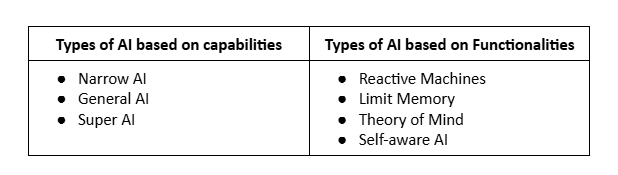
What do we understand by the concept of types of AI? Well, even the disruptive technology is classified among different AI systems, which are based on different capabilities as well as functionalities. By going through these categories, it is possible to have a better understanding of how the technology evolves from simple task-based systems to move into more advanced forms featuring unmatchable capability of human-like intelligence and decision making.
Types of AI based on Capabilities
When I say AI on the basis of capabilities, it means focusing on how intelligent an AI system can be. Basically, here you will get to know how much the potential of intelligent AI is. Does it limit itself to the creation of task-specific systems or advanced systems, or does it feature the capacity to match or exceed human thinking?
Narrow AI
Artificial Narrow Intelligence, often known as narrow AI or weak AI, is one of the most relevant types of AI that you will come across today. Apart from this, almost all other forms of AI are pretty theoretical. This particular type can be trained to perform even a single or narrow task, and it works way faster and better than a human mind can do.
The type of artificial intelligence has the potential to perform outside of its well-defined tasks. More importantly, what happens here is that it targets a single subset of cognitive abilities and advances. Some of the best-known examples to consider when we talk about narrow AI are Siri, Amazon’s Alexa and IBM Watson. And it may be of interest to you to know that OpenAI’s ChatGPT is called a form of Narrow AI.
- Voice assistants such as Siri and Alexa
- Facial recognition and security
- Recommendation engines like Netflix
So what might go wrong here? Despite being highly efficient on specific tasks, the type of AI cannot function beyond its pre-defined scope. So, in simple words, the system doesn’t have any kind of understanding or awareness.
General AI
The next type of artificial intelligence is general AI. It is strong AI or Artificial General Intelligence (AGI), which refers to different kinds of machines that possess the ability to think, learn, and apply all the gathered knowledge can be applied across different tasks, seems familiar, right? The AI works exactly like humans; in fact, this type isn’t limited to a specific kind of jobs or tasks. As the name implies, general AI or Strong AI is about transferring what it learns from one situation to another and even adapting to a new set of challenges, and for that, they no longer need assistance from humans.
Unfortunately, this type of concept is pretty limited to theory, since it isn’t fully developed, especially when machines are so versatile and automated.
- Robots learning new skills autonomously
- AI is diagnosing complex medical issues
- Systems capable of coding, cooking or driving
Super AI
Another interesting theoretical concept which AI technology has the potential to surpass human intelligence. Super AI is commonly known as artificial superintelligence and, like AGI, is absolutely theoretical. This type of AI means it has the potential to think, reason, learn, make judgments, and possess cognitive abilities, so yes, it is way better than humans in very many ways.
The processing of Super AI is completely beyond the point of understanding human sentiments and experiences to feel emotions, have needs and possess beliefs and desires of their own.
- Potential to surpass humans in almost every field
- The type of AI can be creative and assist in making relevant decisions
- The Super AI raises several ethical and control concerns
Now this type is a hypothetical concept; however, it is still in the development phase.
Types of AI based on Functionality
Reactive Machines
As the name implies, reactive machines are purely reactionary. It means they are meant to respond to all kinds of requests and tasks, especially immediate requests. The only concern here is that these Reactive machines don’t carry potential to store memory. The following type of AI is meant to learn from past experiences and works wonders in regard to enhanced functionality via experiences.
In addition to all this, reactive machines tend to respond to a limited combination of inputs. No wonder this is the most fundamental type of AI found. Now you must be wondering where these reactive machines can be used? Well, the type is used to take care of numerous autonomous functions; filtering spam from your email inbox or even recommending items on the basis of your shopping history. The only downside that cannot be ignored is that Reactive machines cannot assist in building previous knowledge or perform more complex and complicated tasks.
Moreover, reactive machines don’t tend to improve or adapt over a period of time; however, the question remains the same: should they be considered the foundation of more advanced AI systems? Developers can easily access and assist in integrating static machine learning models- all thanks to open-source platforms like GitHub.
- IBM Deep Blue: This is the best example of a reactive machine, where Deep Blue can read real-time cues to beat Russian chess grandmaster Garry Kasparov in a 1997 chess match.
- Netflix Recommendation Engine- Another classic example of a reactive machine where several media platforms, such as Netflix, use different AI-powered recommendation engines, where it is possible to process relevant data from a user’s watch history to determine and suggest what they would be most likely to watch next.
Limited Memory in AI
The next type of AI is pretty different from the previous one, limited memory does store past data and assists in using that data to make relevant predictions like never before. In simple words, the following type of AI actively builds its own limited, short-term knowledge base as well as performs relevant tasks depending on that knowledge.
Deep learning is what lies at the core of limited memory in AI. So as a result, the AI successfully imitates the functions of neurons in the human brain. So what happens next, it is possible for machines to absorb data from different experiences and learn from them. As a result, overall efficiency can be improved, which also leads to better actions and outcomes over a period of time.
Though limited memory AI can store past data for a specific amount of time, it cannot retain that data in a library of past experiences to use over a longer time period. So basically, the following type of AI works in two ways:
- A space where a team trains a model on new data
- The AI environment is developed in a way where models are trained automatically and can be renewed in terms of model usage and behaviour.
Here’s a step-by-step procedure to take into account: right from training data to building a model, making relevant predictions, gaining proper feedback, creating accurate data based on the feedback, and lastly, continuing to iterate on this cycle. Limited memory AI can be applied in a broad range of scenarios, including small-scale applications, chatbots, self-driving cars and many more.
- Chatbots and Virtual Assistants - Chatbots and virtual assistants are some of the best examples of limited memory AI. Since the tech is meant to mimic human conversations, users tend to interact more with these systems and can assist in learning from the data and remember the details about the user; this is how relevant and personalised responses are offered.
- Self-driving cars - Another classic example is self-driving cars; these machines tend to observe as well as process environmental data as they hit the road. Also, the AI assists well in predicting when they need to turn, stop or avoid an obstacle.
- Generative AI- Different sets of tools, such as ChatGPT, Bard and DeepAI, work on limited memory AI to predict the next word, a phrase or any visual element.
So everything else is great, but limited memory AI lacks in terms of long-term memory.
Theory of mind
The next interesting type to take into account is the theory of mind. As the name implies, the theory of mind mainly refers to the ability to recognise as well as interpret the emotions of others in no time. I am sure from the name itself, you must have guessed how the term is relevant to psychology, where we find this uncanny how we happen to read the room or read each other's emotions and predict what exactly they will be doing in the future. Since it’s just a theory, it hasn’t been achieved yet, but sooner or later, the theory of mind will be a substantial milestone in the AI’s development space.
Imagine how it would be if we happened to have a word with an AI that is emotionally intelligent? I am sure it will bring lots and lots of positive changes to the current world; at the same time, it even poses risks. Since emotional cues are so nuanced, it would take a long time for AI machines to perfect reading them.
Emotion AI is a theory of mind AI, and still, it is in the development phase, but who knows, the future might be making the most of the technology. So in a nutshell, theory of mind is all about understanding human emotions, beliefs, and intentions and offering highly sophisticated and responsive interaction.
- Human-robot interaction detecting emotions
- Collaborative robots in healthcare are adapting to patient needs.
Self-awareness of AI
This is the grand finale in the ever-evolving changes of AI; it is mainly about designing systems that have a sense of self, a conscious understanding of their existence. Self-aware AI hasn’t existed yet; it is a full-fledged functional AI class that is used to surpass all capabilities of the super AI. Now, what happens if one day it is achieved, it would have the ability to understand its own internal conditions and traits with human emotions as well as thoughts. In simple words, the type of AI will have its own set of emotions, needs and beliefs.
Overall, this type of AI represents a stage that goes beyond the theory of mind and is meant to sense the feelings of others as well as a sense of self.
- Fully autonomous moral decision-making systems
- AI is pursuing goals independently based on an understanding of the environment.
Additional capabilities of AI
Computer vision
Apart from the aforementioned types, there are several additional applications of the AI technology, such as computer vision. This is a type that can be seamlessly trained in terms of interpreting and analysing the visual world. It is possible for intelligent machines to identify and classify objects within images and video footage. Some of the popular examples of computer vision include image recognition, object detection, object tracking, facial recognition, and content-based image retrieval.
Robotics
The next capability to take into account is robotics. With the help of narrow AI, robotics can assist in taking care of all relevant tasks, including materials handling, assembly and quality inspections. Not just that, the healthcare industry uses robotics to assist surgeons in monitoring relevant vitals and detecting all the potential issues during the procedures.
Apart from healthcare and manufacturing, even agriculture, where robotics can assist in conducting several tasks such as pruning, moving, thinning, seeding and spraying.
Expert Systems
Lastly, you will come across different expert systems, but you have no idea that they incorporate Narrow AI capabilities which can be trained to successfully emulate human-decision making procedure. These systems have a tendency to evaluate large tons of data to uncover trends and patterns to make relevant decisions. Businesses can predict future events and understand why the events that happened in the past occurred in the first place.
Conclusion
And we are done for now! You see the present, the future, everything is pretty rosy when we are talking about AI. It is rightly said that the future of AI holds remarkable possibilities. However, even these positives are obvious, AI technology does happen to create ethical issues and concerns that can affect society as a whole, touching on privacy, bias, government regulation, and security, so all it needs to proper amount of care and control, and millions of lives can be improved.
I hope the aforementioned information is interesting and worth considering. In case you still have any more doubts or concerns, feel free to mention them in the comment section below.
