What Makes Fake Images Detectable? Understanding Properties That Generalize
Every AI image detector is making a bet: that no matter how good a generator gets, it will still leave something behind — some artifact a human eye misses but a model can catch. The harder question, and the one that actually determines whether a detector still works next year, is what that something is, and whether it holds up across generators the detector has never seen before. That question has a name in computer vision research: generalization, and it's the real dividing line between AI image detector tools that age well and ones that quietly stop working the moment a new model ships.
The Local-Artifact Insight
A foundational study on this question, from researchers at MIT and Adobe, took a patch-based approach to the problem: instead of asking a classifier to judge a whole image at once, they deliberately limited its receptive field so it could only look at small local patches — and then mapped which regions of a fake image were easiest to flag. What they found reframes how detection actually works. Global structure — the overall composition, pose, or scene layout of an image — varies enormously across different generators and datasets, so a detector trained to spot flaws in overall structure tends to fail the moment it sees a new generator's output. Local texture-level errors, by contrast, transfer far better: subtle inconsistencies in fine detail — hair strands, skin texture, the edges where teeth meet lips — showed up across model architectures the classifier had never trained on.
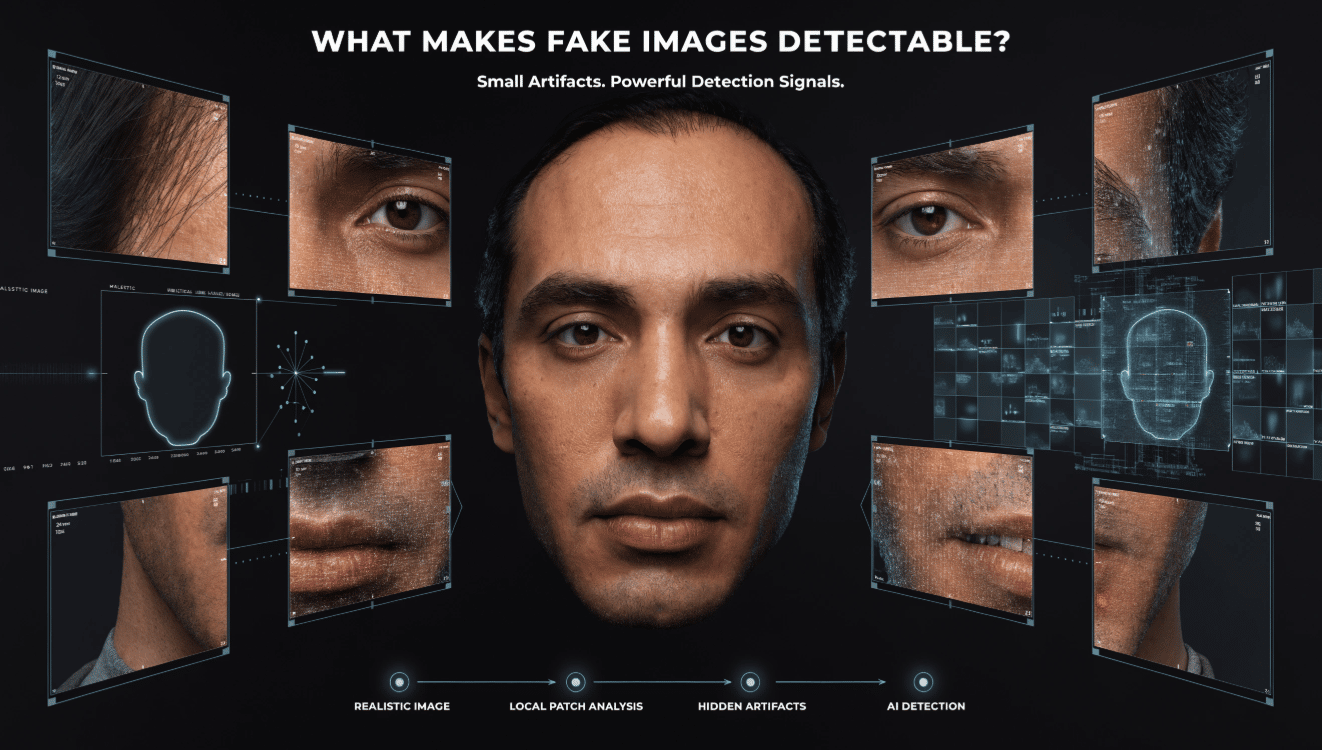
That's the core insight worth understanding: the properties that generalize across generators aren't the big, obvious flaws. They're small, localized, and easy to miss visually, which is exactly why they survive as a detection signal even as generators get better at everything else.
Generators Can't Fully Erase Their Own Artifacts
The same research pushed the idea further with a stress test: what happens if you adversarially fine-tune the image generator specifically to defeat the fake-image classifier? Even then, the generator couldn't produce a coherent fake without leaving traces in certain patches. The researchers described this as evidence that creating a fake image with literally zero local artifacts is difficult for current generative architectures — not impossible in principle, but a real structural constraint on how these models render fine detail.
That finding matters for anyone using a detector today, because it explains why detection hasn't collapsed even as generation quality has visibly improved. It also comes with an honest caveat from the same research: detection is described as a constant adversarial game, and no method is "completely bulletproof" — better generators, out-of-distribution images, and adversarial attacks can all still defeat a given detector. That framing has aged well; it's essentially the same conclusion more recent 2026 detection surveys and robustness challenges keep arriving at from different angles.
Why This Still Matters in 2026
Generative models have moved a long way past the GAN-era systems this kind of research first studied, but the underlying dynamic hasn't changed. Diffusion-based generators like Midjourney v6, Stable Diffusion XL, and DALL·E 3 still tend to struggle with the same category of fine, localized detail — texture consistency, lighting and shadow physics at small scale, and the geometric relationships between features like eyes, teeth, and hands. Detectors that lean on these local, generalizable properties tend to hold up better across new model releases than detectors trained narrowly on one generator's global output patterns.
This is also why single-signal detection is increasingly seen as a weak strategy. A detector tuned to catch one generator's specific fingerprint may score extremely well in benchmarks against that generator and then fail badly the moment a new one is released. The research on generalizable properties points toward combining several types of local and structural evidence rather than betting on any single artifact.
How CudekAI Applies This
CudekAI's AI Image Detector is built around exactly this idea of stacking multiple, independent detection signals rather than relying on one. It runs analysis across pixel patterns, texture consistency, lighting and shadow physics, facial feature geometry, object relationships, color mapping, and noise fingerprinting in the same scan — which mirrors the local-versus-global distinction researchers have identified as the real driver of generalization. Texture consistency and facial feature geometry, in particular, are checking exactly the kind of fine, localized detail that tends to transfer across generators, rather than judging an image on its overall plausibility alone.
CudekAI also cross-references results against generator-specific signatures for DALL·E 3, Midjourney v6, Stable Diffusion XL, Bing Image Creator, Adobe Firefly, and Leonardo.AI — layering fingerprint-style detection on top of the more generalizable local-artifact analysis. That combination is a practical response to the same problem the research describes: no single property, however reliable, survives every new generator on its own. It also extends into deepfake and manipulated-document detection, and offers a free tier for testing the tool against your own images before relying on it. Independent testing has placed its accuracy around 94%.
The Honest Limit
None of this makes any detector permanent. The research is explicit that detection is adversarial and ongoing — as generators improve, the detectable properties shift, and today's reliable signal can weaken tomorrow. What generalizes best, based on the evidence, is not any single trick but the underlying approach: look for small, local inconsistencies rather than judging an image by its overall plausibility, and combine multiple signals rather than trusting one. That's the practical takeaway for anyone choosing an AI image detector — the tools worth trusting are the ones built around that principle, not the ones optimized for a single benchmark score against today's generators.

