When Dollars Disappear: The Stablecoin Lifeline for Emerging Markets
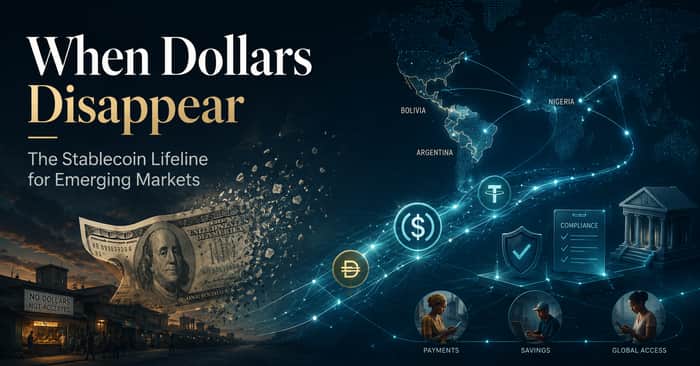
How Bolivia, Nigeria, and Argentina Could Bypass Banking Gatekeepers—If They Can Navigate the Licensing Maze
Bolivia’s chronic US dollar shortage has created a perfect storm: rising inflation, black-market dollar premiums, and growing economic instability.
The obvious solution? Stablecoin infrastructure.
The complex reality? Licensing sponsorship and regulatory compliance can make or break these initiatives.
For emerging markets facing dollar shortages, stablecoins like USDT and USDC are often presented as a faster, more accessible alternative to traditional banking rails. But the real question is not whether the technology exists. It does. The harder question is whether companies can build stablecoin-powered payment infrastructure in a way that is licensed, compliant, and legally sustainable.
We turned this into a 10-minute deep-dive podcast using real case studies from Bolivia, Nigeria, and Argentina.
What we cover in the episode
- Why traditional correspondent banking fails these markets
- How USDT and USDC could provide dollar access without Fed dependency
- The critical licensing frameworks needed for legitimate operation
- Why most “crypto solutions” ignore the hardest part: compliance
For anyone building cross-border payment solutions in emerging markets, this isn’t theory. It is the regulatory roadmap you need.
Key takeaways from the episode
-
Currency crises create a survival problem, not just a banking problem
When local currencies lose value and banks restrict access to foreign exchange, businesses still need to pay suppliers, import goods, settle invoices, and preserve purchasing power. This is where informal alternatives begin to emerge. -
Stablecoins are becoming a dollar-access layer in emerging markets
In markets where USD access is limited, stablecoins like USDT and USDC are increasingly used as a practical substitute for holding or moving dollar value. For many users, this is not about crypto speculation. It is about accessing a more stable unit of value when traditional banking rails are unavailable or unreliable. -
Black-market exchange rates become part of the payment system
When official exchange rates do not reflect market reality, parallel markets often take over. Businesses and individuals may end up relying on informal dollar pricing and alternative settlement channels simply to keep commerce moving. -
Informal stablecoin networks can move faster than banks, but they carry serious risk
Entrepreneurs are stepping in to bridge liquidity gaps, often using stablecoins to move value across borders quickly and cheaply. But when these flows involve receiving, converting, or transmitting money on behalf of others, they can trigger money transmitter, MSB, AML, and local licensing obligations. -
The real opportunity is not “crypto without regulation”
The episode’s bigger point is that technology alone is not enough. Stablecoins may solve the speed and access problem, but businesses still need a compliant structure if they want to operate at scale. -
License sponsorship may become the bridge between demand and legality
For companies that cannot obtain every license directly, working with licensed entities or regulated sponsors may offer a more realistic path. This allows businesses to build payment or stablecoin-enabled services without ignoring the legal framework. -
The future belongs to compliant infrastructure builders
The demand for dollar access in emerging markets is real and growing. But the winners will not be the companies that simply move around regulation. They will be the ones that understand local constraints, build the right partnerships, and create compliant rails for stablecoin-powered payments.
Listen to the discussion here
https://youtu.be/0m9KCM3-UbA?si=uZh2Wz7Tr7VP3A6P
The dollar shortage crisis isn’t going away
Central banks in emerging markets are trapped between impossible choices: drain reserves defending their currency or watch their economies suffer from dollar shortages.
Stablecoins offer a third path, but only for those willing to do the regulatory homework.
The winners won’t be the fastest movers or the biggest players. They’ll be the ones who understand that in regulated finance, compliance isn’t a checkbox. It is the entire business model.
The infrastructure is ready. The demand is real. The only question is who will build the bridges first.
Need help navigating stablecoin, licensing, or payment infrastructure?
Faisal Khan LLC helps fintechs, payment companies, digital asset businesses, and cross-border operators understand licensing pathways, regulated partnerships, and compliant payment structures across complex markets.
If this is relevant to what you are building, book a free 15-minute discovery call.
About the Author
Faisal Khan is the CEO of Faisal Khan LLC and has spent years working in the cross-border payments, banking, licensing, remittance, and fintech infrastructure space. His work focuses on helping companies navigate banking access, money transmission licensing, crypto infrastructure, compliance, payout corridors, and international financial operations.
He is also the founder of DealHarbor, a marketplace focused on regulated financial services opportunities, and MoneyWiki, a growing knowledge platform covering banking, payments, licensing, and financial systems globally.
