Where my first SaaS users came from: seven channels in three months, ranked by share
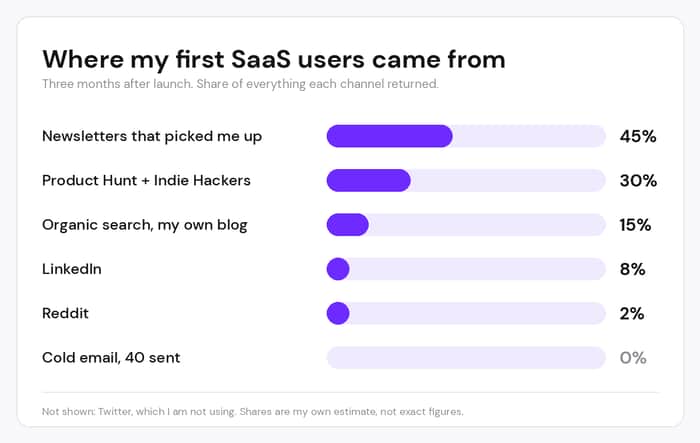
I launched IvaBot at the end of May. It is an SEO and AI visibility tool, pay as you go, no subscription. I am an SEO consultant, not an engineer, and this is my first SaaS. The percentages below are share of what each channel returned, not absolute numbers, but the ranking is honest.
45% — Newsletters that picked me up. Best of everything, by a distance. One mention sent more traffic than every other channel combined over the same period. I did not pitch for it, it happened off the back of a launch, and that is exactly what bothers me: the thing that worked best is the thing I have never deliberately tried to repeat.
30% — Product Hunt and Indie Hackers. Best of what I control. Roughly two thirds of all my signups trace back to the launch month. Just as valuable: the warmest comments and the most useful feedback I have had anywhere came from these two. Where I went wrong was treating the launch as a finish line. My Product Hunt product page sat for three months without categories, so it never showed up in their search or in any collection. I only fixed that this week.
15% — Organic search on my own blog. The only channel I am confident about, and the slowest. Every article is written from my own data rather than from research. Organic traffic grows steadily and it is the one line on the chart that does not depend on an event. I expect the conversion rate from it to stay low, because people arrive to read rather than to sign up, but it builds my name at the same time, and that has value beyond signups.
8% — LinkedIn. Middling for users, strong for everything else. Almost no direct signups. But the interesting connections happen there, and it is doing more for my name than anything else. Clear pattern: posts about a result with a number in it get roughly ten times the reach of posts announcing product updates.
2% — Reddit. Somewhere between middling and zero. I get alerts when people ask about things I know, and I answer properly without mentioning the product, because the subreddits that matter ban that quickly. Good conversations, no users. A long game, not a channel.
0% — Cold email. Zero, and not close. Forty personalised emails, each with an actual audit of the recipient's site and specific advice, not a template. One reply: a request to be removed from my mailing list. That was the whole harvest.
Not doing: Twitter. Personal reasons, and I am comfortable with the trade.
Where I am stuck. Everything is still spikes. An event happens, signups appear, then it goes flat. Three months in, I have no baseline of steady signups at all.
Two questions for anyone further along:
How long did it take you to get from spikes to a steady trickle, the point where signups arrive on a normal Tuesday with nothing launched?
And what would you strengthen in my position? My instinct is to go after newsletters deliberately, since that is the one thing that outperformed everything without me trying. Curious whether that is obvious from the outside or obviously wrong.

That's awesome to hear about your journey with IvaBot! For my own project, Scaleblogger, I also had success in finding initial users through various channels. Here's a quick breakdown of what worked for me:
Product Hunt: Like you mentioned, it's a great place to launch. Make sure to engage with the community and respond to feedback; it pays off.
Indie Hackers: Apart from listing on forums, sharing insights and being genuinely involved in discussions has helped me build relationships and drive traffic back to my product.
SEO Content: I focused on creating valuable, SEO-optimized content around my target audience's pain points. By using Scaleblogger, I automated many aspects of this, which freed up time for community engagement.
Social Media Groups/Forums: Engaging in niche communities on platforms like Facebook and Reddit for SEO experts helped me connect with potential users who were actively looking for solutions.
Email Outreach: After identifying some potential users, sending personalized emails with insights or offering them a free trial was effective in converting leads, especially if I had a specific case for how Scaleblogger could solve their problems.
Referrals: Encouraging initial users to refer friends through incentives worked wonders for expanding my user base.
Webinars and Workshops: Hosting free webinars that positioned me as a thought leader in SEO and showing how Scaleblogger can streamline content strategies attracted interest from businesses.
For us indie founders, it's all about leveraging every interaction for growth. It sounds like you’re on the right track with your mix of platforms. Good luck with IvaBot!
Thanks. The one I am still chasing is timing, so let me ask it directly: how long from launch until you had signups arriving on an ordinary day with nothing published or launched, and how long after that until payments did the same? Months, roughly.
And on cold email, mine returned nothing, but I now think I had the wrong audience rather than the wrong channel. Who did you send to, and did you write before or after they had heard of you?
The most actionable thing in your own data is the line you flagged as bothering you: 45% from newsletters you never pitched. That's not luck, that's an untested channel with one accidental data point. Newsletter curators are individuals with a weekly hole to fill, and almost nobody makes their job easy. What works is sending the finished item, not a request: a 3-sentence blurb in their format, one screenshot, one concrete number, and an explicit "no reply needed, use it or bin it." Ten of those a month is a couple of hours and it's the only way to find out whether 45% repeats.
On spikes vs trickle: the honest answer from most people I've asked is 6–12 months, and it's almost always search or a recurring publication that produces the Tuesday signups. You already have the slow compounding one running. What I'd strengthen isn't a new channel, it's the gap between your blog (15%, builds name, converts badly) and having no owned audience — put an email capture on the articles. Then a launch spike doesn't evaporate; it becomes a list you can reach on a normal Tuesday.
Cold email at 0% after 40 personalised sends with real audits is worth trusting. That's not a volume problem, that's the channel telling you SEO consultants don't buy from strangers' inboxes.
The blurb format is the part I can act on, because it turns the newsletter question into something falsifiable. AtlasHQ's point below sharpened what I had only noticed: the curator picked me up in the same week Product Hunt did, so the 45% may be an echo of the launch rather than a channel of its own. If that is right, ten finished blurbs sent in a quiet month return nothing. If they return something, the theory is wrong and newsletters are a real channel I can run on purpose. Either answer is worth the couple of hours, so I will run it in a month with no launch, since that is the only condition under which the result means anything.
On capture you have the shape right, though the leak is narrower than having no list. Roughly one visitor in ten reaches a list I own and about half of those run something. What is missing is capture for people who never register, which is most of a spike.
On cold email I would put the fault one level below the channel. I wrote to small local businesses, who do not have the vocabulary for what I sell. The people who do are SaaS teams and other SEO consultants, and I had not worked that out when I sent those forty.
One back at you: when a curator used one of your finished blurbs, did they have something else to point at that week, or did the blurb stand on its own?
ranking channels by share is useful, but i would add the effort and quality behind each share. one channel may bring most signups while another brings fewer people who activate, return, or refer someone. a simple table with time spent, activated users, and retained users would make the ranking more actionable than signup volume alone. it might also reveal a small channel worth protecting before scaling the biggest one.
Fair, and I would build that table if I could. Two things stop me right now. About a third of my traffic lands with no source attached, because I never tagged my links, so activation and retention cannot be traced back to a channel with any confidence. And at my volume the cohorts are too small for the numbers to mean anything, one person returning would swing a channel from zero to a third.
Tagging is the fix and it is on me. What I can already see without it matches your point though: LinkedIn brings almost no signups but the best conversations, and Reddit brings none at all yet produces the sharpest questions. On signup volume both look like noise, on quality neither is.
Which of those three columns would you track first if you could only keep one? I would guess activation, since retention needs more time than I have data for.