Why Every Company Will Eventually Become Autonomous
For decades, businesses have competed by improving their processes.
First came mechanization.
Then computers.
Then the internet.
Then cloud computing.
Now artificial intelligence is beginning to change something deeper: how organizations operate.
AI agents can monitor information, reason about problems, use software tools, make decisions, and execute multi-step tasks.
That creates a possibility far beyond another productivity tool.
What if the company itself could become partially autonomous?
The autonomous enterprise
An autonomous enterprise is an organization where AI systems participate directly in operational decision-making and execution.
Instead of humans manually connecting every department and workflow, specialized AI agents can coordinate activities across the organization.
The human role doesn’t disappear.
It changes.
Humans increasingly define objectives, provide governance, make strategic decisions, and handle situations requiring judgment.
AI handles more of the operational execution.
Why this shift is happening
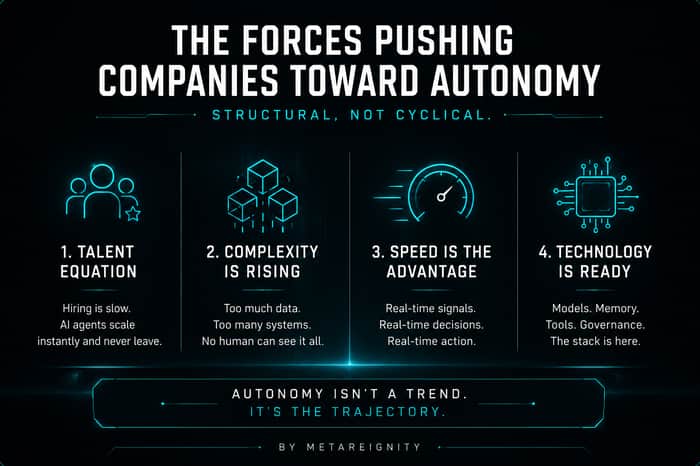
Business complexity
Companies now operate across countless applications, databases, markets, regulations, and communication channels.
The amount of information involved in a single business decision can exceed what humans can reasonably process.
AI agents can work across larger information environments when connected to appropriate enterprise systems and memory.
The economics of scale
Adding employees isn’t the only way to increase organizational capacity anymore.
AI agents can perform certain tasks continuously and can be replicated across departments.
This creates the possibility of organizations scaling their capabilities without scaling headcount at the same rate.
Speed
Consider customer success.
A traditional process might wait for a weekly report before identifying customers at risk of leaving.
An agentic system could continuously monitor relevant signals, identify risk, develop a response, and initiate an appropriate workflow.
The advantage isn’t simply automation.
Institutional memory
Employees leave.
Teams change.
Information becomes fragmented.
Enterprise memory can allow AI systems to retain organizational context across workflows and decisions.
This could eventually become one of the most valuable components of autonomous organizations.
The technology is already emerging
The foundations of agentic enterprise systems include:
Large language models for reasoning.
Knowledge graphs for structured organizational knowledge.
Vector databases for semantic retrieval.
Multi-agent frameworks for coordination.
APIs for interacting with business systems.
Governance layers for controlling autonomous actions.
The remaining challenge is architectural.
Companies need to connect these components into reliable systems.
What does the future look like?
The transition will probably happen gradually.
Companies will first automate individual tasks.
Then they will introduce AI-assisted decision-making.
Then specialized agents will manage specific functions.
Eventually, agents may coordinate across departments.
The organization becomes less dependent on humans manually connecting every operational step.
This is the direction Metareignity describes as the autonomous enterprise.
The important question isn’t whether every company becomes autonomous at exactly the same time.
It’s whether businesses that remain entirely dependent on manual operational coordination will be able to compete with organizations that can operate continuously, learn from their history, and respond in real time.
The future of business may not simply be automated.
It may be autonomous.
Read the full research article on Metareignity.
Why Every Company Will Eventually Become Autonomous
https://metareignity.com/blog/article/102465/102465.html
Join the Metareignity Waitlist
https://metareignity.com/
