Why I Ditched Manual SEO and Automated Internal Linking for 10,000+ Pages
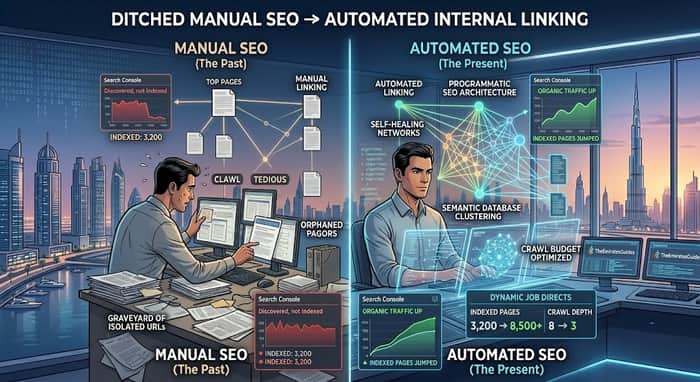
I remember the exact week my SEO strategy broke. I was looking at Google Search Console and Bing Webmaster Tools, and the charts were a mess. My platform had just crossed the 10,000-page mark, but instead of seeing a massive spike in organic traffic, I was hit with endless "Discovered, currently not indexed" errors.
Even worse, Bingbot was actively timing out. It was trying to fetch our massive sitemaps, getting stuck, and abandoning the crawl.
For the first year, I did what every SEO blog tells you to do. I manually added internal links. Every time I published a new page, I would open up three or four older, relevant pages and link them to the new one. It worked fine when the site had 500 pages. But when you are running a dynamic, programmatic directory generating hundreds of URLs a week, manual linking does not just become tedious. It becomes mathematically impossible.
I realized that by trying to manage SEO by hand, I had created a graveyard of orphaned pages. Search engine crawlers simply could not find them. I needed to stop treating internal linking as a content marketing task and start treating it as a database architecture problem.
Here is exactly how I built an automated, self-healing internal link architecture that fixed my crawl budget issues, rescued thousands of orphaned URLs, and completely changed the trajectory of my organic traffic.
The Problem with Traditional SEO Advice for Developers
Most SEO advice is written for people running WordPress blogs with 200 articles. They tell you to use plugins to find related posts or manually comb through your content to find anchor text opportunities.
When you are dealing with a programmatic site or a massive directory, this advice is useless.
If you have thousands of pages, manual linking leads to silos. Your pillar pages get all the link juice, and your deep, long-tail pages get completely ignored by Googlebot. I had thousands of highly specific pages sitting in the dark because there was no logical path for a crawler to reach them without clicking through ten layers of pagination.
The Turning Point: Semantic Database Clustering
I realized that if I wanted pages to rank, I had to stop writing HTML links and start querying relationships.
Instead of relying on basic category tags, I restructured the database to include strict entity relationships. Every single page generated on the platform had to be tagged with a primary sector, a sub-niche, and specific corporate entities.
This became highly apparent when we were scaling up the regional employment directories at TheEmirateGuides. I had to map out over 100 specific, highly targeted URLs just for the industrial and petrochemical job clusters. Manually linking a page about an ADNOC facility role to a Borouge engineering vacancy made no sense at scale.
So, I wrote a script.
The logic was straightforward. When a new page is rendered, the system queries the database for up to 8 other URLs that share the exact same entity and cluster tags. It then automatically generates a "Related Opportunities" block at the bottom of the page, injecting those links directly into the DOM.
Solving the Automation Pitfalls
Building the script was the easy part. Making sure it did not tank the server or trigger Google spam filters was the actual challenge.
If you are going to automate your internal linking, you have to solve three major technical bottlenecks:
-
Database Overload and TTFB: You cannot run a complex relational database query on every single page load. If you do, your Time to First Byte will skyrocket. Bots will experience massive crawl delays and simply leave. To fix this, I set the automated linking script to run asynchronously during the build phase. The links are calculated, generated, and then cached. When a user or a search bot requests the page, they are served static HTML. The load time stays under 200 milliseconds.
-
Anchor Text Cannibalization: If your script just grabs the H1 of the target page and uses it as the anchor text every single time, Google will flag it as programmatic spam. To avoid this, I built an array of acceptable LSI variations for each cluster. The script randomly selects a variation of the anchor text, ensuring the backlink profile looks entirely natural and contextual.
-
The Infinite Loop Trap: Search bots hate infinite loops. If your automated links just bounce the crawler between the same five popular pages, you defeat the purpose of the automation. I modified the query to prioritize "least linked" and "recently updated" pages within that specific tag cluster. This ensured that older, orphaned pages were constantly being pulled back into the active crawl path.
The Results After 60 Days
I deployed the automated architecture and watched the logs. The results were immediate and completely validated the effort.
-
Index Bloat Cleared: Within three weeks, the "Discovered, currently not indexed" count dropped by 65 percent. Googlebot finally had clear pathways to the deep pages.
-
Indexed Pages Jumped: We went from hovering around 3,200 indexed pages to over 8,500 indexed URLs in under two months.
-
Crawl Depth Reduced: The maximum number of clicks required to reach any page on the site dropped from 8 clicks to just 3 clicks. The site became entirely flat from a crawler perspective.
-
Sitemap Timeouts Stopped: Because bots were discovering URLs naturally through the dense internal linking web, they stopped relying so heavily on the massive XML sitemaps, completely resolving the Bingbot fetch failures.
Final Thoughts for Bootstrappers
If you are building a programmatic SEO project, a dynamic directory, or any large scale web app, do not leave your site architecture as an afterthought.
Stop doing manual SEO data entry. Your time as a founder is too valuable to spend highlighting text and clicking "insert link." Structure your database properly from day one. Define your semantic relationships, build the logic to connect them automatically, and let your code do the heavy lifting.
When you fix your internal linking at the structural level, organic traffic stops being a guessing game and starts becoming a predictable math equation.
