Why is it still so hard to find a calendar that handles a non-linear life?
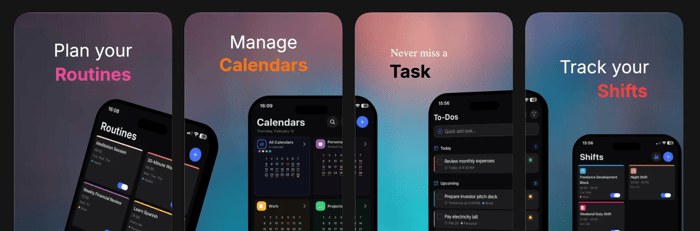
If you don't work a standard 9-to-5, most productivity tools are actually a burden.
The typical "calendar + task manager" setup assumes your day is a blank canvas. But for freelancers, shift workers, or anyone managing a complex routine, the reality is much messier. You end up juggling three different apps just to figure out when you’re actually free.
Oria is taking a different approach to this. Instead of forcing you to bend your life to fit a corporate calendar, it’s built specifically to bridge the gap between shift scheduling, routine tracking, your events and task management.
A few things that stand out about the workflow:
- The Integration: It treats your routines, shifts, events and tasks as a single, unified flow rather than separate silos.
- Zero Noise: It’s built for focus. No unnecessary features or "productivity theater"—just the tools needed to manage a non-standard schedule.
- Privacy as a Default: In an era where every app wants your data, Oria is built on a privacy-first philosophy. Your schedule stays local and private, which is a rare find these days.
If you’ve struggled to find a tool that actually understands your lifestyle without the clutter of big-tech apps, this is definitely worth a look.
Check it out on the App Store: Oria - Shift & Routine Planner

This is a real pain — especially for people who don’t live on a clean 9–5 grid.
The interesting part isn’t just solving it functionally, it’s how you position it.
Right now it still reads like “another calendar app, but better adapted.”
But what you’re actually describing feels closer to a life-structure layer than a calendar.
That distinction matters a lot, because tools like this usually win or lose on how instantly the idea clicks in someone’s head.
Curious — are you thinking of this as a better calendar, or as a new category entirely?
Thanks for the review. I see Oria as an advanced calendar that includes events, tasks , routines and shifts tabs which you can manage them entirely in seperate calendars or you can use them with the same calendar. It is an entirely different system but at the same time it feels very natural
Yeah I get that — structurally it’s more advanced than a normal calendar.
I think the gap is more in how it lands for someone seeing it the first time.
When people hear “calendar,” they already have a fixed mental model.
So even if the system is different, they still interpret it the same way.
That’s why I was asking — because what you’re describing feels closer to something like “life operating system” than a calendar.
Do you want people to think “better calendar,” or something entirely new when they hear it?
I think better calendar is safer to touch people
Safer for entry, yes.
But that only works if “better calendar” is the hook, not the box.
If people file it as just another calendar in the first 3 seconds, you lose the part that actually makes it different.
Usually the win is:
familiar enough to understand fast
distinct enough to not get mentally grouped with Google Calendar clones
So “better calendar” is probably the adoption bridge.
It just shouldn’t be the long-term category.
Hey — this is a really clear take on a real problem. Most tools are definitely built around a “clean 9–5 grid” that just doesn’t match how people actually work.
The unified flow (shifts + routines + tasks) is a strong angle — especially for people juggling irregular schedules.
Curious, how are you thinking about onboarding? That feels like the hardest part here since users need to map a pretty complex reality into the system.
Also — I’m running a small experiment with early-stage builders working on workflow/productivity tools like this.
$19 entry, winner gets a Tokyo trip (flights + hotel). Round 01 is live (100 cap).
This resonates deeply for solopreneurs specifically. The 9-5 calendar model assumes a fixed context, but when you're running clients, building products, and doing admin all in the same day, time management needs to be relational not just sequential.
The real gap I see: calendars don't connect to the rest of your ops. A client call at 2pm should pull from your CRM, tie to a project, and update your weekly review - but instead it's just a standalone block.
Building a Solopreneur Notion OS for this - a linked system where your weekly review connects to projects, clients, and revenue in one place. Curious what workarounds you've found for the non-linear scheduling problem.