Why Motadata Retired Four Product Editions and Shipped One
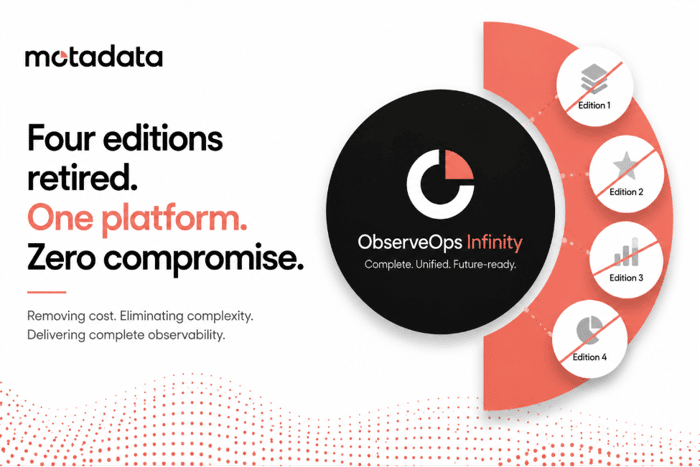
Most product simplification announcements are additions wearing a disguise. Editions get renamed, a tier is folded into another tier, and the comparison grid grows a column somewhere else.
Motadata's newest release does something less common. The company has removed four things and not replaced them with anything, and it has done so in a way that costs it revenue it was previously collecting.
ObserveOps Infinity became generally available in August 2026. Here is what was actually taken out.
Decision One: Treat a Market Cost Increase as a Product Defect
Server, memory and storage prices have risen sharply worldwide. Observability software is one of the more infrastructure-hungry things a company runs, so that increase lands on the customer's hardware bill rather than on the software line.
The default response across the industry has been to pass it through. Motadata's engineering team was given the opposite brief: make the hardware footprint the design constraint for the release and reduce it.
The work covered ingest paths, storage layout, rollup strategy, index structures and collector efficiency. The reported outcome is an indicative 30 to 40 percent lower hardware requirement for an equivalent deployment, at the same device counts, the same retention and the same query behaviour. The company describes that as workload-dependent and sizes each deployment individually rather than quoting the range in a proposal.
The interesting part is what this optimises for. Hardware is not a line Motadata bills. Reducing it improves the customer's total cost while adding nothing to the vendor's revenue, which is the sort of investment that only makes sense if you are optimising for the total cost of the relationship rather than the size of the next invoice.
Decision Two: Put the Expensive Thing in the Base
The footprint reduction was made possible by a new component. ObserveOps Infinity introduces an observability pipeline sitting between telemetry sources and storage.
It parses logs, events, traps, flows and metrics into structured fields at ingest. It filters, normalises, reduces, redacts, masks, samples and routes data while it is in motion. It attaches configuration item, site, owner, environment and service context before anything lands. It tiers retention by policy across full fidelity, aggregated and dropped. And it absorbs bursts during event storms instead of dropping data during them.
This is the kind of component that most vendors would sell separately. It is technically substantial, it is the thing architects respect most in the release, and it has an obvious price tag attached to it.
Motadata put it in the base platform with no separate licence line. The stated reasoning is that the pipeline is what makes a customer's footprint smaller, and metering the mechanism that reduces cost would defeat the purpose of building it.
Decision Three: Delete the Pricing Ladder
The company previously sold its observability platform in four editions, with feature comparison grids and upgrade walls between customers and capability they had already deployed the platform for.
All four are gone. There is now one edition containing the complete platform from day one: monitoring across network, server and virtualisation, topology, service level objectives, dashboards, AIOps, correlation, runbook automation, integrations, the pipeline and security controls including single sign-on, multi-factor authentication and role-based access control. The base is metered by monitored device, and optional modules for flow, log, network configuration management, application performance monitoring and real user monitoring attach in any combination.
An upsell path was deleted here. Every customer who would previously have been sold an upgrade to reach a capability now already has it.
Alongside that, log and flow licensing moved from a per gigabyte per day model to a per source model. This is a transfer of risk from the customer to the vendor, stated plainly. Under volume pricing, a chattier application or a debug flag left enabled increases the bill without anyone deciding to spend more. Under source pricing, the licence stays flat while the data grows, and the vendor absorbs the variance.
Existing customers on the retired editions are not being made to migrate. Contracts continue as written.
Decision Four: Ship the Groundwork, Withhold the Promise
The release is positioned as preparation for agentic AI, and this is where the restraint is most visible.
Motadata's argument is that autonomous systems in IT operations fail not on model quality but on the data underneath: telemetry that is unstructured, events with no ownership or service context, and actions whose blast radius nobody can define. Those problems are solved below the AI layer, which is what the first three decisions address.
Shipped today are structured and enriched telemetry, governed retention and masking, correlation and anomaly detection, and runbook automation with an approval workflow. Not shipped is the agentic layer. The company has declined to give dates, feature names or demonstrations of unreleased capability, and routes roadmap questions to its product management team rather than letting sales improvise.
The only forward commitment is a narrow one: agentic capabilities will release onto the same platform and the same licence, so a customer deploying today does not re-platform to adopt them.
What is on offer here is a sequence rather than a feature list. Each removal made the next one possible, and that ordering is the whole of the release.
ObserveOps Infinity is generally available from August 2026.

The interesting part is that the simplification goes beyond packaging—the product decisions are all reinforcing the same outcome: lower operational cost and less pricing complexity. Putting the pipeline into the base platform also makes the value proposition much easier to understand.