Why You Must Clean Your URLs Before Sharing Them
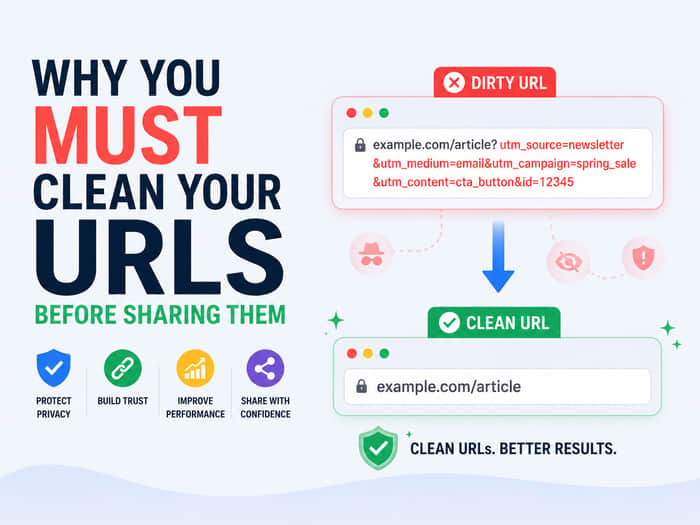
Whenever we find something interesting online, our first instinct is to share it. We copy the link, drop it into a text message or social media post, and hit send. But have you ever actually looked at the link you are sharing?
If you are like most people, you probably ignore the massive wall of random characters attached to the end of the web address. Unfortunately, those characters are not random. They are sophisticated tracking mechanisms, and sharing them blindly is a major privacy risk.
Here is exactly why you need to start cleaning your URLs before you send them out into the world.
The Invisible Threat Hidden in Plain Sight
When you click a link from an email newsletter, a social media ad, or a search engine, the website you land on rarely just gives you the plain web address. Instead, they attach a unique identifier to the URL.
This identifier acts like a digital barcode. It tells the website exactly who you are, where you came from, and what campaign prompted you to click. Marketers heavily rely on these identifiers, and over 60% of the internet uses URL parameters for marketing attribution.
While this might seem like standard business practice, it crosses the line when you copy that link and send it to a friend.
How Cross-Site Tracking Actually Works
Let us look at a real-world scenario. You are scrolling through a social media app and see an ad for a new pair of shoes. You click the ad, and the platform attaches a unique tracking code (like an fbclid) to the URL. This code is tied directly to your user profile.
You decide you want a second opinion, so you copy the link from your browser and text it to a friend.
When your friend clicks that link on their phone, the shoe website reads the tracking code. Because the code was originally generated for you, the website's analytics platform assumes that you are the one browsing the site again. Worse, if your friend ends up buying the shoes, the advertising network links their purchase behavior to your profile.
By sharing an uncleaned link, you are actively helping data brokers build more accurate, invasive profiles of both you and the people you care about. Maintaining digital hygiene means recognizing that cleanliness is next to cybersecurity.
The Security and Phishing Angle
Privacy is not the only concern here. Massive, cluttered URLs actually pose a tangible security risk.
Cybercriminals know that internet users have been conditioned to ignore the jumble of characters at the end of a link. Because we expect links to look messy and confusing, we rarely scrutinize them. This makes it incredibly easy for bad actors to hide malicious redirects or fake domains within a wall of legitimate-looking text.
Research shows that taking the time to clean up URLs before sharing them can cut cognitive load by 27% and reduce the risk of phishing by 4.3 times. When a link is short, clean, and transparent, it is much easier to verify that it is safe to click. If a friend sends you a pristine link that just says example.com/shoes, you know exactly where you are going. If they send you a paragraph of code, you are clicking on blind faith.
Aesthetic and Cognitive Benefits
Beyond the very real privacy and security threats, we need to talk about basic digital etiquette.
Dropping a 400-character URL into a group chat is the digital equivalent of shouting. It takes up the entire screen, breaks up the flow of conversation, and looks completely unprofessional. If you are sharing links in a business setting, sending messy URLs can make you look technologically illiterate.
Here are the practical benefits of keeping your links clean:
- Better Readability: Clean links clearly communicate what the destination page is about.
- Fewer Broken Links: Extremely long URLs are prone to breaking when copied and pasted across different devices or platforms with character limits.
- Increased Trust: People are simply more likely to click on a link that looks clean and recognizable.
How to Protect Yourself
You do not need to be a cybersecurity expert to stop passing tracking data around the internet. The easiest and most reliable method is to use a dedicated URL cleaner before you share anything.
These tools are incredibly simple to use. You copy the massive link you want to share, paste it into the cleaner, and it automatically strips away all the known tracking parameters, affiliate tags, and user IDs. You are left with a pristine, safe link that routes exactly where it is supposed to go, without bringing any of your personal data along for the ride.
It is a small habit to build, but in an era where our data is constantly being harvested and sold, taking control of the links you share is one of the easiest ways to protect yourself and your network. Stop sharing your digital barcodes, and start sharing clean links.
