Your brain forgets progress surprisingly fast.
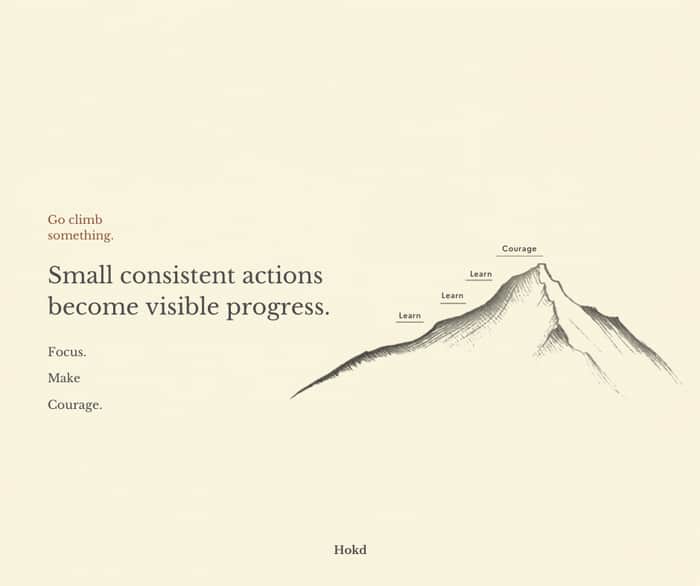
Do you think productivity apps accidentally make people feel worse over time?
I’ve spent years trying productivity systems that mostly made me feel more pressured — not more focused.
More streaks.
More notifications.
More pressure to optimize every hour of the day.
But real long-term work rarely feels like that.
Most meaningful things are built through small consistent actions that often don’t feel impressive in the moment: showing up again, learning, trying, recovering focus, continuing anyway.
I have a background in Digital Psychology and originally built this system for myself because I wanted something that encouraged consistency without turning life into a constant optimization loop.
Over time, that system became Hokd.
https://www.balane.app/en/apps/hokd
Not as another hustle app or dopamine machine, but as a quieter way to make progress visible again.
You log what you actually did:
Focus.
Make.
Learn.
Courage.
And over time, your work literally becomes a climb.
I’m building Hokd as an independent indie project and currently opening 500 Testing Access spots:
1 year of Hokd Pro for free for early users who genuinely want to use the app and share honest feedback.
https://apps.apple.com/redeem?ctx=offercodes&id=6761093616&code=HOKDLAUNCH
Curious how people here see this:
Do most productivity systems actually help long-term consistency — or do they mostly create pressure?

I think many productivity apps help in the “good week” but fail after the first slip.
The pressure is not always bad. Sometimes pressure is exactly what makes a goal feel real. But if the system only adds pressure and does not help people recover when they miss a day, it can turn into guilt and avoidance pretty quickly.
For me the interesting question is not just “does this help me stay consistent?”
It is:
“What happens when I stop being consistent for a few days?”
That restart moment is where most tools seem weak.
Curious how you think about that with Hokd: is the goal to reduce pressure completely, or to make pressure feel less punishing?
I designed around exactly that question. The goal isn't to remove
pressure — pressure from wanting the thing is just caring. What goes is
the punishment: streaks, guilt counters, the reset-to-zero after a slip.
The restart moment is the whole point. In Hokd you never go back to
zero. What you logged is altitude you already climbed; a gap is a flat
stretch on the mountain, not a fall down it. Coming back isn't "start
over," it's "continue from here."
And the bad stretch isn't blank. You can pull a summary over any time
range — it shows what still formed while you thought nothing happened.
That's usually the thing that gets you moving again.
Pressure stays. Punishment goes.
Genuine question back: when you've personally come off a bad few days —
what actually pulled you back in? A tool, or something the tool never
captured? I keep finding the real restart trigger is offline and the
app's job is just to not get in the way.
This is so real. The trough of sorrow in any project isn't just emotional - it's also informational. You genuinely can't remember that you had the exact same doubt 3 weeks ago and pushed through it, because that progress isn't recorded anywhere.
For solopreneurs especially, the forgetting problem compounds. No team to reflect back what's changed. No standup to force a recap. Just you vs. a project that feels like it's going nowhere, with no record of how far you've actually come.
The fix is a weekly review system tied to a decisions log - so you can look back and see 'this time last month, you were worried about X, and you solved it by Y.' Building exactly this into a Solopreneur Notion OS. Would love to know what you do to combat the progress-forgetting problem.
This is one of the most underrated reasons solo founders burn out - not because they aren't making progress, but because they have no system for seeing it.
The week that feels like 'nothing happened' often has 3 customer conversations, 2 features shipped, 1 big decision made. But if those aren't captured anywhere, your brain discounts them by Friday.
The weekly review habit exists specifically to fight this: a 20-minute structured review where you look back at what actually moved, what decisions you made and why, what's in your pipeline. Not for productivity theater - for cognitive protection. Knowing you made real progress is what sustains the motivation to keep going through the slow weeks.
A decisions log is the underrated piece most founders skip. You made a choice about pricing, positioning, or a feature three months ago. Do you remember why? If not, you'll make the same mistake twice. Writing it down takes 2 minutes and saves you 2 weeks of re-learning.
The decisions-log is the part most people skip and shouldn't — that's the layer I built into Hokd directly.
But I intentionally kept it lightweight instead of turning it into a full founder OS.
I noticed the more friction a system has, the faster reflection turns into overthinking.
These days I mostly use Hokd on my phone, even though there's a Mac app. I keep a simple daily target on my iPhone homescreen and write down short things throughout the day.
Over time that changed the way progress feels: lighter, less chaotic, less theoretical.
I spend less time looping on hypothetical decisions and more time actually moving.
So the logs are intentionally human:
"Pricing decision made. Feels right."
or
"10 rough customer calls, but learned what to improve for the next 10."
The goal of hokd isn't perfect documentation — it's preserving momentum without adding friction.
Curious — in your Notion OS, what ended up mattering more long-term: the detailed documentation itself, or simply having a lightweight way to see movement again during bad weeks?
This is a good angle because you’re not positioning Hokd as another productivity tracker. The stronger idea is emotional continuity: helping people remember that small, quiet effort is still progress before their brain discounts it.
That is different from streaks, timers, or task apps. Most productivity tools make users feel behind. Hokd seems more about making consistency visible without adding pressure, which is a much healthier frame.
One thing I’d watch is the name Hokd. It is short, but it feels a bit unclear and hard to emotionally read for a product built around progress, calm consistency, and self-support. If this grows beyond an indie app into a broader wellbeing/productivity brand, Lyriso.com would probably carry the softer long-term support angle better.
Interesting point — curious what specifically makes Hokd feel emotionally “harder” to you compared to something softer like Lyriso?
Was it the sound of the name itself, the spelling, or the association it creates when you first read it?
Genuinely interested because naming is one of those things where you lose objectivity pretty quickly while building.
Good question. It is mostly the sound and first-read feeling.
Hokd is short, which is useful, but it feels a little clipped and mechanical when you read it. The missing vowel makes the brain work for a second, and the “kd” ending has a harder stop. That can work for a sharp utility, but for something built around calm progress, self-support, and emotional continuity, it feels slightly colder than the product idea.
Lyriso feels softer because it has more open sounds and a smoother rhythm. It reads less like a task app and more like something that could hold a broader support/wellbeing layer over time.
That distinction matters because your product is not just helping people track effort. It is helping them feel that quiet consistency still counts. The name should probably reduce pressure, not add friction.
Hokd can work as an indie app name. But if this becomes a larger calm productivity or wellbeing brand, I’d pressure-test whether the name emotionally matches the outcome you want users to feel.
That's actually a very thoughtful breakdown, appreciate it.
I can see the “clipped/mechanical” association you're describing now — especially the hard stop at the end. Funny thing is I almost leaned into that contrast intentionally without fully articulating it.
The product is emotionally softer, but the act itself still has a bit of resistance and effort to it. Hokd was supposed to feel more like “holding onto the wall” than a calm wellness space.
But your point about emotional matching is valid, especially if the scope ever grows broader than the current product.
Definitely something I'll keep pressure-testing over time.
That makes sense. “Holding onto the wall” is a strong metaphor for the current product, and I can see why Hokd fits that resistance/effort layer.
The part I’d separate is current wedge versus long-term brand.
Hokd can work while this is a focused indie app around effort and consistency. But if you already see even a chance of this becoming a broader calm productivity or wellbeing layer, I would not leave the future name completely open.
That is where Lyriso matters. It does not force you to rebrand today, but it gives you a softer long-term brand to build toward if the product expands beyond the current app.
The risk with waiting is that once users, app listings, content, and product memory build around Hokd, switching becomes harder exactly when the broader emotional brand starts mattering more.
So I would treat it less like “rename now” and more like “secure the name that gives you the option to grow cleanly.”
If Lyriso feels like the right broader direction, happy to discuss privately and keep it simple.
That’s actually where I kept getting stuck myself when exploring softer alternatives like "Evoa".
Names like that sound pleasant immediately, but they also start relatively empty — the product has to build almost all of the emotional meaning over time.
Hokd felt different because it already carried some psychological tension and association on its own: holding on, staying attached, continuing despite friction.
And since the core idea behind the app is helping people stay connected to their own progress long enough to continue, that ended up feeling more aligned to me than a completely clean-slate name.
Your defense of Hokd actually makes sense, and I would not dismiss it.
The name has tension, which fits the current product if the core feeling is “holding on through resistance.” That is different from a soft wellness name, and it may be more honest for the first version.
The bigger question is whether the landing page, category frame, and first impression make that tension feel intentional or accidentally cold.
That is the exact kind of thing I can audit properly.
I do focused naming/positioning audits for early products: current name strength, emotional fit, category risk, domain perception, whether the name can scale, and what the stronger brand direction should be before more users, app listings, and public memory build around it.
For Hokd specifically, I’d pressure-test whether the current name should stay, whether the copy needs to soften it, and where a name like Lyriso would only make sense if the product expands into a broader support/wellbeing layer.
Not a long consulting thing. Just a sharp written breakdown you can use before committing more deeply to the current brand direction.
I’m doing a few of these at $99 while refining the format.
Best place to discuss privately:
https://www.linkedin.com/in/aryan-y-0163b0278/
That’s a fair defense of Hokd, and I actually think your reasoning makes sense for the current wedge.
If the product is mainly about holding on through resistance, Hokd carries that tension better than a completely clean-slate wellness name.
The question I’d separate is not “is Hokd bad?” but “what version of the product are you naming for?”
For the focused indie app, Hokd has meaning.
But if this ever expands into a broader emotional support, calm productivity, or wellbeing layer, the name may start carrying more friction than the product itself. At that point, users are not just buying the idea of holding on. They are buying relief, continuity, self-trust, and softer support.
That is where Lyriso still feels stronger to me. Not because Hokd cannot work now, but because Lyriso gives the broader product more emotional range later.
I would not rush a rename just for aesthetics. But if Lyriso genuinely feels like a possible long-term direction, I would not leave it completely open while Hokd builds public memory. Securing the future name early gives you optionality without forcing the brand switch today.
The "restart moment" framing really resonates — that's exactly where most tools fail and it's rarely talked about.
What you're describing with Hokd sounds like a great idea — making progress visible without making absence punishing.
I've been wrestling with something similar building Just One Step — my bet was to strip history out entirely, just "what's one small thing right now?". Starting to test so we will see if it's the right call.
Curious whether Hokd shows you your gaps or smooths over them?
Shown, not smoothed — but deliberately not punished. Gaps render as flat
sections in the climb, so the honesty is there visually; you can see you
stopped. What's missing is the guilt mechanic that usually rides along
with that visibility.
Your "Just One Step" bet is interesting because it's the opposite end of
the same problem — you strip history to kill the weight of the past, I
keep history but strip the punishment from it. Curious what your early
testers do at the restart moment with no history at all — does the
absence help, or do they miss the proof they showed up before?
That framing is really sharp.
One reason Just One Step strips history is because I was wary of surfacing steps someone didn't complete. The moment you show a list of things that didn't happen, you've reintroduced the guilt mechanic even without meaning to. So the absence isn't accidental — it's deliberately avoiding the reminder of what didn't get done.
To your question about early testers — honestly I don't have enough of them yet to know. But my instinct is that for the kind of person Just One Step is built for, the absence is a relief rather than a loss. The proof they need is just that they started today, not that they showed up last Tuesday.
I think we agree on the core and just solve it differently. You strip history
so the undone can't accuse anyone. Hokd never shows what you didn't do either
— only what you did; a gap is just a quiet flat stretch, never a list. Both
fair answers to the same fear.
The one thing I can't resolve about your bet: a record isn't only weight, it's
also a cue — people return partly because the thing is sitting there waiting.
Strip it and the only trigger left is the user remembering on their own —
which is the first thing to go in exactly the rough stretch you most want them
back. Is something else carrying that (a notification, a fixed ritual), or is
the bet that "I'll just remember" is enough for your user?
Maybe my earlier comments didn't tell the complete story. The history is stripped by default, but the return trigger isn't left to memory alone — Just One Step has a scheduled reminder mechanic that brings the user back. So the cue is there, it's just a 'nudge at a set time' rather than a visible record sitting waiting for them.
Both fair answers to the same fear, as you said.
I actually think we’re pretty close philosophically.
Hokd also tries to reduce restart friction heavily — you can continue exactly where you left off without getting punished or buried under backlog.
The part I became interested in though is that people often don’t just lose momentum — they lose the feeling that they were progressing at all.
So beyond reminders or restart mechanics, Hokd tries to keep progress visible over time without turning gaps into failure states.