Your demo day pitch has a hard time limit. Here's a free tool that keeps you inside it
If you've ever pitched at a demo day, you know the specific horror of the moderator standing up while you're still three slides from your ask.
Indie hackers present more than we admit: demo days, investor calls, podcast interviews, webinars for our own audience, conference talks about how we built the thing. And almost all of it happens under a hard time limit, with no instruments.
I built a free tool for exactly this. It's called Speaker Copilot, and it does three things.
1. It runs your timing so you don't have to.
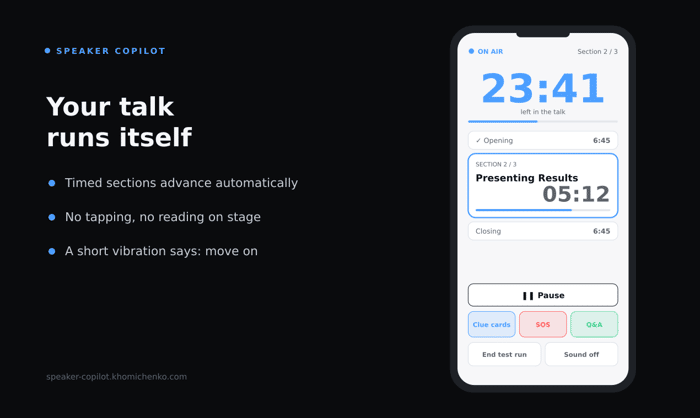
You split your talk into sections by percentage before you start: 15% problem, 55% product, 15% traction, 15% ask. On stage, sections advance automatically and your phone vibrates once when it's time to move on. No glancing at a clock, no mental math while pitching.
The percentage part matters more than it sounds. Organizers cut you from 10 minutes to 6 at the last second constantly. You change one number and every section rescales itself.
2. It hands you a sentence when you blank out.
Three card decks, one tap away. The SOS deck covers six specific on-stage emergencies: you lost your train of thought, you need a few seconds to think, you don't have the number they're asking for, you're running out of time, tech failure, hostile question.
Each holds ready phrases. "I don't have that number with me. I'll verify it and follow up afterward." Unremarkable on paper. On stage, having it available beats improvising something brilliant that never arrives.
The Q&A deck does the same for the questions after: how to answer when you know it, when you need a moment, and how to say "I don't know" without losing the room.
3. It tells you when you're actually ready.
This is the part I think indie hackers will appreciate most, because it's just instrumentation applied to a soft skill.
You set a rehearsal goal (10 runs by default). After each timed run, you rate yourself on five criteria and write one line about what to fix. The app tracks your average against a readiness target you choose. My last preparation went 2.80 → 3.20 → 3.60 → 4.00 → 4.40 across ten runs.
"I practiced a few times" is a feeling. A rising number is data. When the live talk happens, it gets its own separate score, so you can see the gap between rehearsal and reality.
Practical details: free, no account, no signup, works completely offline (venue wifi is a myth), installs to your home screen, everything stored locally on your device. Open source. Two demo talks are built in so you can see a full preparation cycle in two minutes without typing anything.
Try it: https://speaker-copilot.khomichenko.com
Code: https://github.com/volodymyr-khomichenko/speaker-copilot
Genuine question for anyone here who pitches: what do you actually do today to stay on time? I've heard everything from "a friend waves at me" to "I just accept I'll run over." Whatever you use shapes what I build next.
One thing worth mentioning: we're live on Product Hunt today. I'm not here to ask for votes — honest feedback is worth more to me at this stage, especially the critical kind. If you try it and something feels wrong, that's the comment I want: https://www.producthunt.com/products/speaker-copilot

Answering your actual question: I split the talk into sections with a target clock time written next to each, then only glance at the wall clock at the section boundaries the trap is checking constantly and speeding up mid-sentence. Your rehearsal score trend (2.80 to 4.40 over ten runs) is the most interesting piece to me, because it turns "am I ready" into something you can stop at rather than rehearse forever. The one risk with auto-advancing sections is that a good talk sometimes needs to run long on the problem because the room is engaged, so a "borrow time from a later section" gesture would be worth having.
Thanks for the feedback. If you have any questions, feel free to ask and I’ll be happy to clarify.
Regarding the automatic section changes, this was designed intentionally to ensure there is always a clear beginning, middle, and end.
Of course, if you want to break the content down into smaller, more specific sections, you need to be careful. As you mentioned, there’s a risk of making one section too long while cutting another one too short. So I’d only split the content further when the boundaries between sections are clearly defined.
Otherwise, it’s better to keep it as one or two larger parts. However, I would generally recommend using three sections: an introduction, the main part, and a conclusion. From there, you can adjust the structure depending on the content.
This is still the first version, and I’m continuing to work on improving it. If you have any specific suggestions on what could be improved, please let me know.
You asked for the critical version, so here it is: the instrument is measuring itself. A self-rated score going from 2.80 → 4.40 over ten runs can’t tell you whether you actually improved or simply got more generous with your ratings. Rating drift and skill improvement look identical from inside the loop. The good news is that your design already has the fix, because the live-talk score is the one metric anchored to something external. I’d use the rehearsal self-ratings as a calibration signal against that anchor. If the last three rehearsal scores consistently predict the live score, the self-rating is probably telling you something useful. If they consistently run high, then you’ve measured your optimism rather than your readiness.
“Instrumentation applied to a soft skill” is exactly the right framing. It just needs one reference point outside the loop. And the tool itself (offline PWA, no signup, open source) is exactly the right shape for this.
Thanks for the feedback. Yes, of course, a lot of this is subjective, and there’s always room for improvement. At the same time, it’s important for speakers to be self-critical. Otherwise, they may think their presentation went well when, in reality, there are significant areas to improve. A live session can help reveal those gaps and provide a more objective perspective.
So I completely agree with you on that. If you have any other suggestions on how we could improve the product, I’d be very happy to hear them.
i use kimi ai and z ai.. prefer chinese ai... im american but on hsk 3 ))