
ConvertKit
Email Marketing for Bloggers

Now that our 8th ConvertKit team retreat is wrapped up, we often get questions about profit sharing.
By running with a relatively small team for our revenue ($20M ARR & 48 people) we are able to distribute profits in addition to the equity grants.
We're over $1.8M total now!
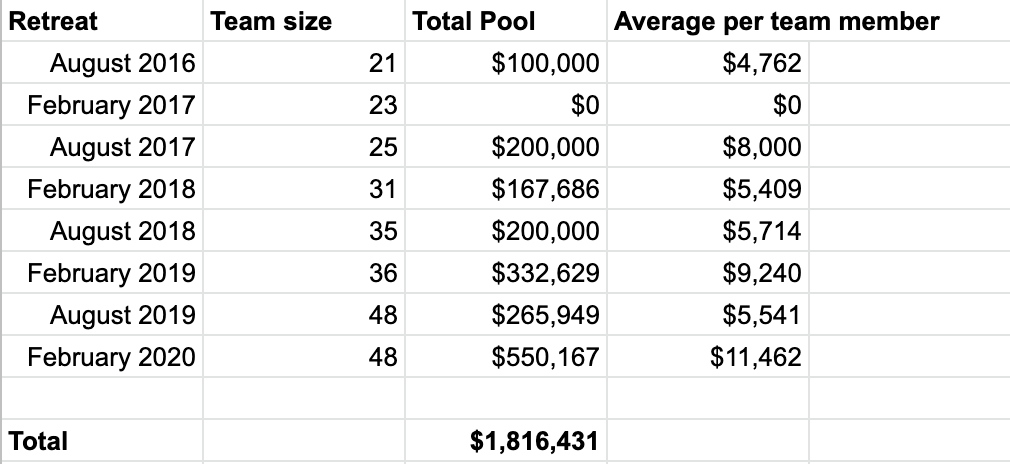
The total profit sharing pool depends on how much profit we do in the six month period. 52% of all the company profits go into this pool.
In 2019 we spent aggressively to grow the team in the first half of the year and made far more profits in the second half.
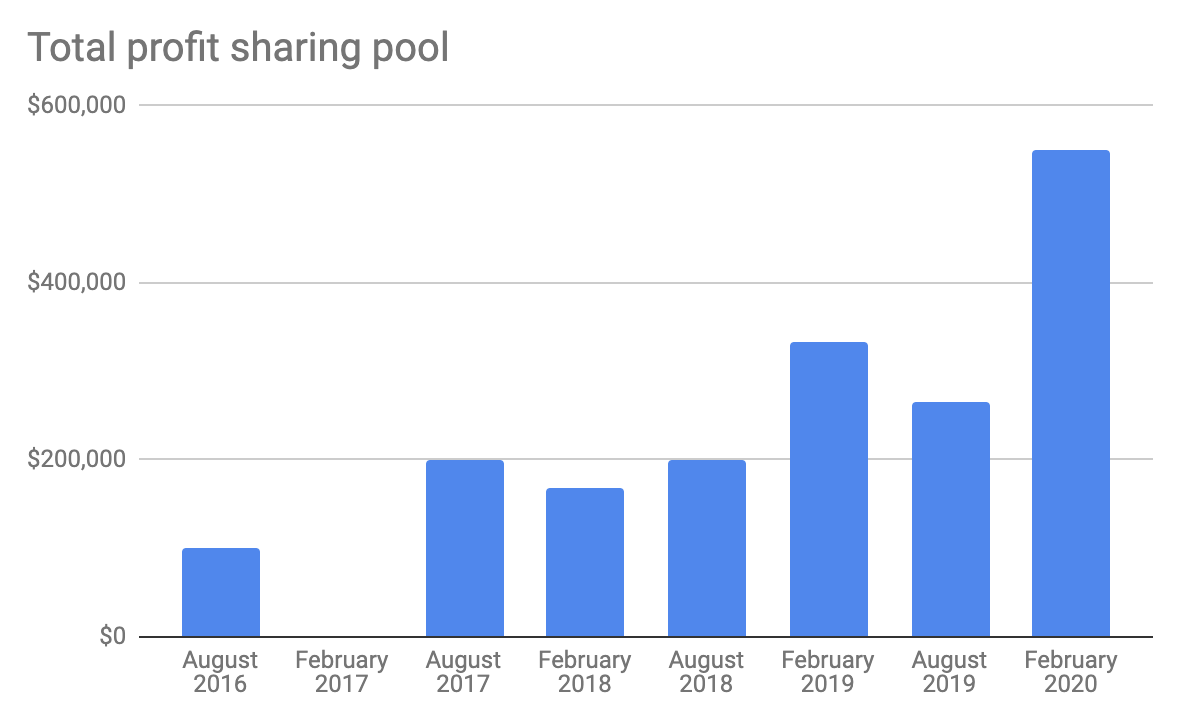
Because we had double the pool size and the same size of team (we were -1 and +1 on team members for no net change) the average check we handed out this week was $11,462!
This is 25% based on time with the company, 75% consistent for everyone. The largest was nearly $16k!
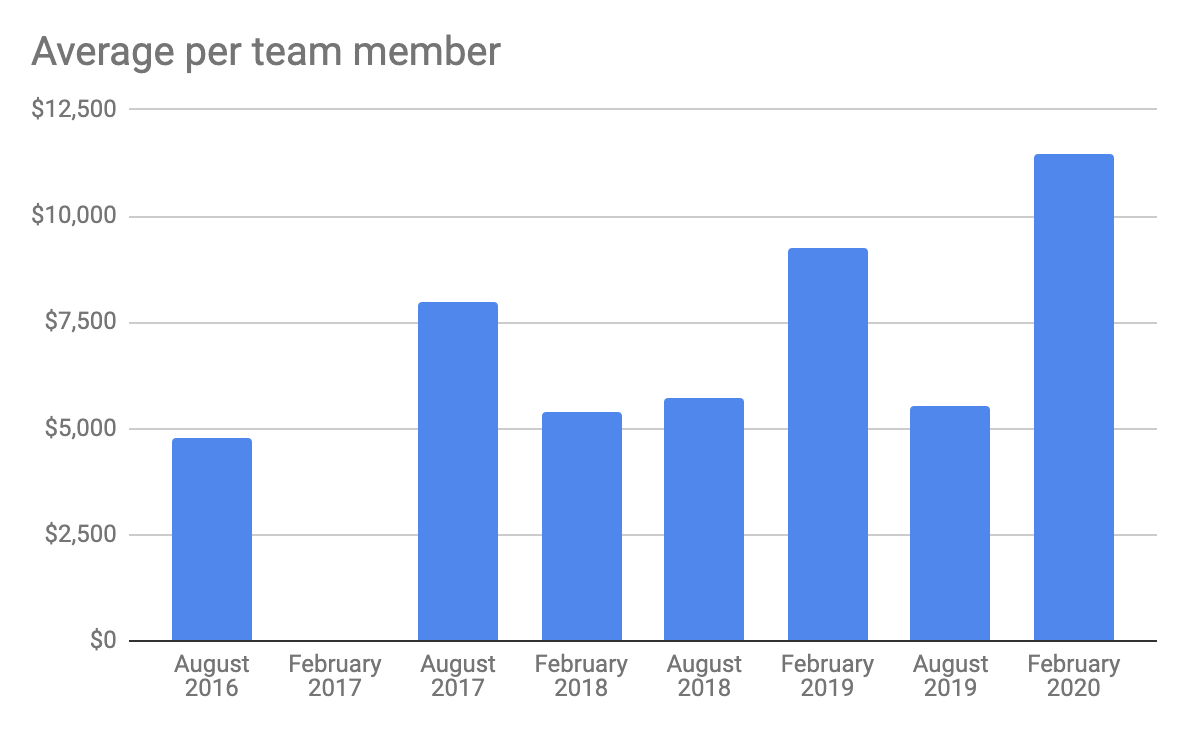
Originally the formula included a bonus for performance, but the team decided to remove that so everyone is rewarded equally. We all win together.
Low performance is handled separately from profit sharing.
In 2020 we made a deliberate decision to lower profit in order to launch and grow a free plan. The team is all in on making the short term trade-off for the chance of long-term gains!
Original Twitter thread: https://twitter.com/nathanbarry/status/1231227773114441728

We crossed $17M ARR this week. I'm really proud of the team! This time 4 years ago was $10k MRR.
But the bigger accomplishment is—for the first time ever—we grew by more than $50k in net new MRR for two months in a row!
We've also steadily cut churn in half over the past few years. One big change was moving to credit cards not required for trials. Revenue decreased, but it cut churn significantly.
All the metrics are here: http://convertkit.baremetrics.com
-
4
Congrats! Thanks for sharing. Can you explain a bit more about moving to credit cards and the consequences? Why did it cut the churn? Thanks.
-
5
We used to require all accounts paid from the beginning (no trial). A few years ago we switched to a free trial that still required a credit card. Then last summer we went with a free trial where you add a credit card at the end.
We got a lot more trials coming in (up to 7,000 or 8,000 per month), but revenue took a short term hit. Ultimately after a lot more tests we are fairly certain it makes us more money to stick with not requiring credit cards for trials, but the change is so close it's hard to be sure.
But one change is that it has cut our churn down a decent amount since those trials that never add a credit card never appear as churn in Baremetrics.
We still have a long way to go in reducing our net churn, which is a big focus now.
-
1
Thanks for sharing your insights. It's very helpful. Good luck!
-
-
1
Congrats Nathan! Also curious, as we are actually thinking of switching from no CC required to CC required for trials.
-
1
It's a tough call. We had the hardest time making an accurate decision based on data. I've seen companies go either way. Personally we want to get more leads in and keep refining our onboarding, so we went with no CC even though the data wasn't conclusive.
-
1
Why? You think it attracting a lot of users who are not potentially going to pay?
-
-
1
interested in this as well.
-
3
This comment was deleted 6 years ago
-
1
It makes sense! Thanks for the explanation!
-
-
-
3
Remember your talk with Justin Jackson from 2013-2014 when you were scrapping funds to keep it afloat. Congrats mate, just mind-blowing.
-
1
Thanks! A lot can change in 4 years!
-
-
1
Congrats, Nathan. Big fan of ConvertKit
-
1
@NathanBarry congrats for the stunning growth over the last years and thank you for your transparency while running Convertkit as an open startup!
I've had a look at the m-o-m evolution of MRR in Baremetrics and see a huge jump / change from Sept to Oct 2015. What did you specifically attribute that to?
Would be thankful if you could share so we might learn what worked so well and try it out in our businesses. 🙏
-
1
Congrats again Nathan.
Been following through your personal blog over this period.
Your content actually inspired me to write 2000+ words per day
for 40 days in a row, for the very first time. And that still serve
as portfolio that bring me clients till this day. -
1
Congratulations. I just heard Sahil mention you on a podcast the other day, as one of the notable creators that started on Gumroad, and now run a company larger than Gumroad itself.
Also, thanks for doing the creator conference. I saw Casey's talk. It was great!
-
1
Yep! I believe I was the first independent creator to sell over $10,000 on Gumroad.
-
1
p.s. Curious, but what value do you find in putting all your user/revenue metric in public using Barametrics? I mean, I certainly enjoy looking at them, but how did you make a decision to put it all out there?
-
1
Good question. It's one of my core values and how I give back to the startup community. Here's a full post about it: https://nathanbarry.com/ignore/
-
1
Love Rand's answer. It makes perfect sense. Make a decision once, and you never have to worry about being correct on any decisions that follow. I might adopt that! Thanks.
-
-
-
-
1
Pardon the silly question. $17k in new MRR added?
-
1
This is so awesome, congratulations!
I'm going to launch my blog this month and want you to know that your resources are extremely valuable. I'm looking forward to being your customer and I'm sure this will be a great experience.
-
1
Hey thanks! Drop me a link when you get the blog launched.
-
-
1
This comment was deleted 6 months ago


5 Comments
"Originally the formula included a bonus for performance, but the team decided to remove that so everyone is rewarded equally. We all win together."
From the perspective of an employee if you consider the incentives from a game theory perspective if the choices are:
Its quite obvious why it would be in some individuals best interest for it to be #1, but is this the best set of incentives on the whole to motivate people to maximize their energies on an individual level?
If an individual believes that if they work harder than their peers and meet these performance expectations and drive growth to the company that their bonus will reflect that, then each of them will work harder within their individual capacity to drive growth so that they in turn can have more.
But when the incentives tell them: even if you exceed your performance expectations and work harder then everyone else to enable the growth of the company, the benefit will be spread evenly among everyone - your not taking into account the potentially disparate individual efforts and performance which resulted in that growth and when you do that the individuals will learn that they don't really stand to gain as much for what they have to pay (with their time, stress, effort, responsibility, accountability, risk) and hence not work as hard as they otherwise might have - they might just work enough the meet basic expectations (or slightly above) and perhaps try to lower them to make them easier to meet but not really try to maximize their individual efforts and performance to the level that it could possibly be. This often results in the exodus of the top performers who leave to find more rewarding work, and if this kind of culture of stagnation is allowed to fester, there is no easy way of going back.
This is really cool. Profit sharing is the way to go give every employee a skin in the game.
What is the profit sharing formula by the way. Length of time in company * their level or something ?
Thanks Nate for sharing. This is really interesting to see, and I imagine you have low attrition because of the model. Keep up the great work!
I assume they do not get a salary then right? It is strictly based off of company profits? (I have never heard of this, just wondering.)
Thanks a ton for sharing this, Nate. This is clutch and something I hope our company can offer to our team in the near future :)
This comment was deleted 3 years ago