
LeafyPod’s AI-Powered Plante
LeafyPod’s AI-powered Planter, showcased at CES 2025!

HTVRONT Glitter Heat Transfer Vinyl: This premium heat transfer material allows for the application of a bright glow and the addition of a luxurious surface to custom designs. It sticks really well to fabric, creating very attractive prints that are still visible, resistant, and fashionable even after numerous washes.
Add sparkle at once to your work with HTVRONT Glitter Heat Transfer Vinyl. Its audacious appearance and easy application make simple designs into shining masterpieces that really shine through.

HTVRONT Glitter Heat Transfer Vinyl is a material that is easy to use and gives any piece a richer look and feel. Its vibrant designs that are created to be durable and attractive on t-shirts, bags, and other products would be a perfect fit and add to your custom clothes.
Simple to use regardless of the level of skill
The ease of use is one of the best qualities of HTVRONT Glitter Heat Transfer Vinyl. This glitter HTV cuts, weeds, and applies easily, unlike other types of vinyl, which are tricky to deal with. Novices can work at the professional level when they do not feel frustrated, and when experienced craftsmen can allocate more time and effort in accordance with more difficult projects. The uniform texture and sticking ability have guaranteed that the designs stick without failure or any form of failure, which makes it a dependable medium of creativity at all levels.
The Shine Planning Intensive Vibration and Long Shine
The glitter in HTVRONT HTV is bright and also long-lasting. When it is used on fabric, the sparkle can last months of wow since it remains vivid after a series of washings. This strength enables its use in a personal project as well as in products to be sold in the market. This mixture of glittery brilliance and long-term functioning makes creators believe that their design is going to be beautiful and will keep its attractiveness with time.
Best in terms of a wide range of projects
HTVRINT Glitter Heat Transfer Vinyl can be used in very many ways and situations. You can apply any of them on a t-shirt, a sweatshirt, a tote bag, a hat, an apron, or cushion covers; thus, this allows a person to put these obliterations all over an inside home item. Its flexibility will enable you to venture into other creative options, including custom gifts to company items. They can be subtle and glittery or make a statement with glitter; this HTV can support a large variety of design concepts and so should be a reliable addition to the product of any crafter.
Quality Heat Transfer Operation
When working with glitter vinyl, it is important to determine the quality of the process of adhesive and heat transfer. HTVRONT HTV is developed to take the heat press or iron application without fading the sparkle or texture. It does not bubble, peel, or fade and sticks to fabrics evenly. This dependability guarantees that all the designs appear smooth and businesslike and that creators receive a predictable and fulfilling output with every project.
Incentivizing Innovativeness and Customization
In the case of HTVRONT Glitter HTV, there is no limit to creativity. Crafters are able to blend colors or use designs or add glitter with other forms of HTV to create textures and effects. This content can be endlessly adapted to an individual, which makes each work unique and unique. Glitter vinyl can be used on birthday gifts, team uniforms, or even the merchandise at the boutique, and it provides a personal touch to the whole design.
Materials of high safe quality and safety
Having heat transfer vinyl is important in terms of safety and quality, and HTVRONT guarantees both. The vinyl is not toxic and can be readily manipulated and safely used with standard heat press or at-home iron settings. It is also of premium quality, which results in reduced frustration of the weeding and application, meaning that the creation process can be easier and enjoyable to all who craft, regardless of whether at home or in a small business environment.
The Metamorphosis of Everyday Designs
Even plain designs are given a new twist with the addition of glitter. HTVRONT Glitter Heat Transfer Vinyl imparts a glittering upgrade to the humble shapes and structures so that the designs become eye-catching and catchy to the observer. This change allows your projects to be popular as well as to be attractive. It is an insignificant element that makes a huge difference, as your individual creations will look professional and polished.
Conclusion
To sum up, HTVRONT Glitter Heat Transfer Vinyl: Sparkle That Transforms Every Design is a perfect device that can be used by a person who wants to make their design sparkling, full of personal touch, and having a durable bright effect. It is easy to use, can be applied to various things, and its sparkle is long-lasting; that is why it is suitable for both beginners and advanced crafters.
It could be the development of gifts, customization of clothing, or the manufacture of merchandise that goes to market, but HTVRONT Glitter HTV is sure that any design has a luster and is durable. With such an excellent quality of vinyl in your hobby work, your crafting work can have a whole new experience where you can get exciting results that can still be remembered.
FAQs:
1: What is the list of surfaces with which I can apply HTVRONT Glitter Heat Transfer Vinyl?
It is best applied to such fabrics as t-shirts, sweatshirts, tote bags, and hats and even to a portion of the home decor.
2: Do non-skilled individuals find it easy to use HTVRONT Glitter HTV?
Yeah, nevertheless, for the total beginner, utilizing it is easier be it weeding, cutting, or the planting itself; professional results will be achieved.
3: Does the glitter remain after washing?
Definitely, the glitter is long-lasting and must have a structure that will ensure the glitter does not lose its glitter and sticking power when washed several times.


Healthcare is shifting. The fee-for-service model focused on quantity over quality, leading to higher costs and poor patient outcomes. Value-Based Care turns this model upside down, putting patient health, prevention, and long-term wellness as the primary focus instead of the number of procedures.
This change is practical. Healthcare organizations using value-based care report higher patient satisfaction, fewer readmissions, and better chronic disease management. New tools, smarter data strategies, and a fundamental reevaluation of care team collaboration are needed in the shift. Providers, payers, and patients can use the knowledge of these models to maneuver a system that is built around better health and not an expensive number of services.
What is Value-Based Care?
Value-Based Care is a healthcare delivery model where providers receive payment based on patient health outcomes rather than the volume of services delivered.
Rather than billing for every test, procedure, or appointment, providers are incentivized to keep patients healthy:
Preventing diseases before they develop
Managing chronic conditions effectively
Reducing unnecessary emergency room visits
Coordinating care across multiple providers
The model motivates healthcare teams to pay attention to preventive care, early interventions, and ongoing monitoring.
Why Traditional Fee-for-Service Models Fall Short
Fee-for-service healthcare rewards the volume of services rather than patient outcomes. The providers receive compensation on each scan, surgery, or consultation, irrespective of patient improvement. This payment plan has inherent issues that compromise quality care and spur wasteful expenditure.
This creates problems:
Overtreatment becomes profitable
Preventive care gets overlooked
Patients receive fragmented care from disconnected specialists
Costs spiral without improving health outcomes
No single provider owns the patient's complete health picture
A patient with diabetes might see multiple specialists without anyone coordinating their overall treatment plan. Tests get repeated. Medication conflicts.
Core Principles of Value-Based Care Models
Value-based systems operate on principles that differ from traditional healthcare delivery. The principles direct the interactions between providers, the payers, and the patients during the care journey.
Patient-Centered Outcomes
Everything starts with the patient. Value-based models measure success through health improvements, not procedure counts.
Providers track:
Disease progression rates
Quality of life metrics
Patient satisfaction scores
Functional health status
Care Coordination Across Settings
Hospitals, clinics, specialists, and primary care physicians work as one team.
Key coordination elements:
Shared electronic health records
Regular team meetings about complex patients
Standardized treatment protocols
Clear communication channels
Preventive and Proactive Care
Stopping problems before they start saves money and improves lives.
This means:
Regular health screenings
Lifestyle counseling
Chronic disease management programs
Early intervention for at-risk populations
Data-Driven Decision Making
Providers use real-time information to identify care gaps and intervene before patients’ conditions worsen. Analytics reveals trends that individual providers may miss.
Common Value-Based Care Models
Value-based care has been introduced in healthcare organizations using multiple frameworks that have been proven successful. Both models have a variation in the payment structures and accountability measures depending on the capabilities of organizations and the populations of patients.
Accountable Care Organizations (ACOs)
ACOs unite hospitals, doctors, and other providers into networks responsible for patient populations.
ACOs focus on:
Reducing hospital readmissions
Improving preventive care rates
Coordinating care transitions
Managing high-risk patients
If they deliver quality care while reducing costs, they share the savings.
Bundled Payments
Instead of billing separately for every service, providers receive one payment covering an entire episode of care.
This includes:
Pre-surgery consultations
The procedure itself
Hospital stay
Post-operative care
Rehabilitation services
Patient-Centered Medical Homes (PCMH)
Primary care practices become comprehensive care hubs.
PCMH characteristics:
Extended office hours for accessibility
Care teams, including nurses and health coaches
Proactive outreach to patients
Enhanced care for chronic conditions
Capitation Models
Providers receive fixed payments per patient per month, regardless of services used. This incentivizes keeping patients healthy rather than maximizing visits.
Benefits of Value-Based Care for Providers
Healthcare organizations adopting these models experience operational and financial advantages that transform how they deliver care. Revenue becomes more predictable through fixed payments or shared savings arrangements.
Key advantages:
Staff satisfaction improves with more meaningful patient interactions
Technology investments pay off through streamlined workflows
Quality metrics strengthen reputation and attract more patients
Value-based care companies provide platforms that automate reporting and surface actionable insights
High-performing providers gain competitive advantages by demonstrating superior outcomes.
How Patients Benefit from Value-Based Care
The use of value-based models by healthcare providers results in, in practice, tangible benefits to patients in their healthcare journey. Shifting from isolated visits to continuous care improves the patient experience.
More Time with Providers
Appointments feel less rushed. Doctors address multiple concerns in one visit rather than scheduling separate appointments for each issue.
Better Chronic Disease Management
Patients with diabetes, heart disease, or asthma receive:
Regular monitoring between appointments
Personalized care plans
Medication management support
Lifestyle coaching
Lower Out-of-Pocket Costs
Preventive care and early interventions reduce expensive emergency visits and hospitalizations. Many value-based plans waive copays for preventive services.
Coordinated Care Experience
No more repeating medical history to each new specialist. Providers access complete health records and communicate about treatment plans.
Implementation Challenges and Solutions
The process of shifting to value-based care poses challenges that should be tackled at an organizational level. To overcome the obstacle of technological barriers, cultural resistance, data quality issues, and financial risk management must be addressed at the same time to achieve success.
Technology Integration Barriers
Many healthcare organizations struggle with outdated systems that don't communicate with each other.
Solutions include:
Adopting interoperable digital health platforms
Standardizing data formats across systems
Training staff on new technologies
Partnering with value-based care solutions providers
Cultural Resistance
Shifting from volume-based to value-based mindsets requires organizational change management.
Effective strategies:
Engaging physicians early in planning
Demonstrating financial benefits through pilot programs
Celebrating early wins publicly
Providing ongoing education and support
Data Quality and Analytics
Value-based care depends on accurate, timely data.
Organizations must:
Establish data governance policies
Invest in analytics capabilities
Train staff on proper documentation
Regularly audit data accuracy
Key Technologies Enabling Value-Based Care
The implementation of value-based care is successful when there is technology infrastructure. The appropriate platforms are able to combine and identify care gaps, involve patients, and organize care teams.
Population Health Management Platforms
These systems aggregate data from multiple sources to create comprehensive patient profiles.
Core capabilities:
Patient stratification by risk level
Care gap identification
Automated outreach scheduling
Performance dashboard tracking
Persivia CareSpace® is an example of such an approach, as it integrates data without third-party reliance obtained through different sources and allows rapid implementation and complete transparency.
Predictive Analytics Tools
Machine learning algorithms predict which patients will likely experience complications, readmissions, or disease progression.
This reduces:
Emergency department visits
Hospital admissions
Disease complications
Overall healthcare costs
Patient Engagement Solutions
Mobile apps and patient portals keep individuals connected to their care teams between visits.
Features include:
Appointment scheduling
Medication reminders
Secure messaging with providers
Health education resources
Symptom tracking tools
Care Coordination Software
These platforms facilitate communication among care team members.
Teams can:
Share notes and treatment plans
Assign follow-up tasks
Monitor patient transitions between settings
Alert providers about critical events
Measuring Success in Value-Based Care
There are various performance dimensions of value-based care being monitored by organizations. Quality measures include clinical quality, financial performance, patient experience, and results in population health.
Quality Metrics
Organizations track clinical quality measures across patient populations.
Common metrics:
Blood pressure control rates in hypertensive patients
Hemoglobin A1C levels in diabetics
Cancer screening completion rates
Immunization rates
Medication adherence percentages
Financial Performance Indicators
Value-based contracts include financial benchmarks that determine shared savings or penalties.
Key indicators:
Total cost of care per patient
Hospital readmission rates
Emergency department utilization
Specialty care referral rates
Patient Experience Scores
Patient satisfaction surveys measure care quality from the consumer perspective.
Assessed areas:
Communication with providers
Access to care
Care coordination
Overall satisfaction ratings
Building a Value-Based Care Strategy
Effective change requires careful planning and execution. The organizations have to analyze their position, formulate clear objectives, choose suitable models, invest in technology, involve employees, and scale down.
Assess Current State
Organizations must understand their starting point before transformation.
Key assessment areas:
Current quality performance metrics
Cost per patient benchmarks
Technology infrastructure capabilities
Staff readiness for change
Payer contract mix
Define Clear Goals
Specific, measurable objectives guide implementation efforts.
Example goals:
Reduce hospital readmissions within defined timeframes
Improve disease control rates to meet benchmark targets
Achieve cost savings while maintaining quality standards
Enhance patient satisfaction scores
Invest in Technology Infrastructure
Value-based care solutions provide the data aggregation, analytics, and workflow tools necessary for success.
Essential technology components:
Electronic health record systems
Population health management platforms
Patient engagement tools
Analytics and reporting capabilities
Start Small and Scale
Pilot programs allow organizations to test approaches and refine strategies before full deployment.
Pilot program elements:
Select a manageable patient population
Define clear success metrics
Establish regular review cycles
Document lessons learned
Expand based on results
Care Team Roles in Value-Based Models
Value-based care involves multiple professionals who need to put in specialized expertise. Doctors serving as primary care providers organize the general health, and physicians work as care managers to fill the gap between appointments.
Key roles include:
Primary care physicians create comprehensive care plans and coordinate specialist referrals
Care managers contact high-risk patients regularly and address social determinants of health
Nurses conduct wellness visits and provide patient education
Behavioral health specialists address depression, anxiety, and substance use disorders
Pharmacists provide medication therapy management and cost-effective recommendations
Every team member contributes to coordinated, outcome-driven care.
Bottom Line
Value-Based Care is the alternative to the fragmentation of care delivery based on volume and the creation of coordinated, outcome-based systems. Those organizations that implement these models have improved patient outcomes, reduced expenses, and achieved smoother care even with the necessary technology and workflow rearrangements.
Persivia CareSpace® unifies data, provides AI-driven insights, and supports population health, accelerating value-based care adoption. Organizations often achieve measurable results within 60-90 days using the platform, which provides full data transparency, real-time analytics, and automated care programs.
FAQs
1. What is the main difference between fee-for-service and value-based care?
Fee-for-service compensates providers for each service delivered, while value-based care rewards providers for improving patient outcomes. Instead of focusing on volume, value-based models emphasize preventive care, coordinated services, and measurable quality improvements.
2. Do patients pay more under value-based care models?
No, patients usually pay less because preventive care and early interventions reduce emergency visits, hospital stays, and repeated procedures. Many value-based plans also remove copays for essential preventive services.
3. Can small physician practices participate in value-based care?
Yes, small practices can join Value-Based Care programs through ACOs or partnerships with larger networks. Modern platforms like CareSpace® simplify participation by providing shared infrastructure, data analytics, and administrative support.
4. How long does it take to implement value-based care?
Timelines vary based on organizational readiness and existing systems. However, organizations using advanced platforms often achieve initial deployment in as little as 60–90 days, with ongoing improvements continuing as programs scale.
5. What happens if a provider doesn’t meet quality benchmarks?
Providers may miss out on shared-savings opportunities or face penalties in risk-bearing contracts. Many organizations begin with upside-only arrangements, allowing them to earn incentives without financial risk as they build capability and confidence in value-based care.

In recent years, digital technology has transformed the ways people assess, understand, and interact with their own appearance. The rise of artificial intelligence has led to an explosion of online tools designed to analyze faces, provide personalized insights, and even offer aesthetic evaluations. Among the most widely used of these are pretty scale tools and face shape detector. Though they may appear lighthearted on the surface, these tools are built on sophisticated frameworks involving geometry, computer vision, and deep learning. To use them well and interpret them responsibly, it helps to understand exactly what they do, what they measure, and where their limitations lie.
Understanding the Concept of Pretty Scale Tools
A pretty scale tool is a system that evaluates the visual characteristics of a face and produces a numerical score intended to reflect attractiveness. The user submits a photograph, and the tool analyzes the facial features using a series of predefined criteria. The idea behind pretty scale systems is rooted in the notion that human beauty follows certain mathematical proportions. Throughout history, artists, architects, and philosophers have explored the idea that symmetry and harmonious ratios contribute to what people perceive as beautiful. Modern digital tools adapt these classical ideas and apply them algorithmically.
To conduct their analysis, pretty scale tools rely on facial landmark detection. This method identifies key points on the face, such as the centers of the eyes, the corners of the mouth, the contours of the jawline, and the edges of the nose. Once these points are mapped, the system measures distances and angles. It examines proportional relationships such as the space between the eyes, the symmetry of facial halves, the height of the forehead relative to the chin, and the width of the cheekbones compared to the jaw. These measurements are then compared against templates created through either mathematical formulas or datasets gathered from photographs considered aesthetically pleasing by the tool’s creators.
When the process is complete, the tool assigns a score that supposedly reflects how closely the facial measurements align with the tool’s concept of ideal proportions. While this score can be entertaining, it is important to remember that it is not an absolute or universal judgment of attractiveness. Beauty is deeply subjective and influenced by cultural, historical, and personal perspectives. What a pretty scale tool measures is only mathematical symmetry, not the richness of human appeal.
What Face Shape Detectors Aim to Reveal
Whereas a pretty scale tool attempts to judge beauty mathematically, a face shape detector serves a more practical and descriptive purpose. Instead of offering a rating, it identifies the geometric shape that the user’s face most closely resembles. These shapes typically include oval, round, square, heart, diamond, oblong, and occasionally other variations. Face shape categorization has long been used in beauty and fashion industries because certain styling choices can enhance or balance particular shapes. For example, certain haircut styles complement an oval face, while specific glasses frames suit a square or heart-shaped face more effectively.
Just like pretty scale tools, face shape detectors rely on facial landmark detection to gather data. The system identifies the width of the forehead, the prominence of the cheekbones, the structure of the jaw, and the length of the face. By comparing these metrics, the algorithm determines the closest matching category. A round face might display equal height and width with soft contours. A square face often features angular lines and similar width across the forehead and jaw. An oval face usually has a gently tapering structure and a greater length than width.
Face shape detectors are generally less emotionally charged than pretty scale tools because their purpose is not to evaluate attractiveness but to describe structure. This descriptive nature makes them useful for practical applications, such as choosing hairstyles, designing makeup looks, selecting eyeglasses, or grooming facial hair. These tools offer guidance rather than judgment, helping users make aesthetic decisions suited to their natural features.
How These Technologies Analyze Facial Structure
Despite serving different functions, pretty scale tools and face shape detectors share a common technological foundation. The core of both systems is facial analysis powered by artificial intelligence. Modern tools typically employ machine learning models that have been trained on vast datasets of faces. These datasets help the tools learn to detect key landmarks consistently, even under varied lighting conditions, camera angles, or facial expressions.
The process begins with image preprocessing. The tool first identifies the presence of a face within the photograph. Then it detects landmarks and plots their positions. Algorithms calculate distances between points, assess ratios, determine angles, and analyze symmetry. These measurements form a structural map of the face. In pretty scale tools, this map is assessed for alignment with the tool’s aesthetic model. In face shape detectors, it is compared with geometric shape patterns.
The accuracy of these tools depends heavily on the quality of the image provided. Clear lighting, minimal shadows, and a forward-facing position help ensure that the tool interprets the face correctly. Any obstruction, such as hair covering the jawline or accessories casting shadows, can distort the analysis.
How to Use a Pretty Scale Tool Effectively
Using a pretty scale tool is usually simple. Most platforms allow the user to upload a photo directly or take one using the device’s camera. To achieve the most accurate reading, it is best to use a neutral expression, direct eye contact with the camera, and a well-lit environment. The tool will then process the image and return a score along with comments about symmetry or proportions.
However, users should approach these results with caution. The score reflects only one limited interpretation of beauty, based on mathematical calculations rather than human nuance. Features such as warmth, personality, confidence, or emotional expression play enormous roles in how people perceive attractiveness, but these qualities cannot be measured by geometric analysis. Understanding these limitations helps users enjoy the tool without taking its results too seriously.
There is also a privacy aspect to consider. Uploading photos to online platforms carries risks, especially when the tools involve biometric data. Users should always check the privacy policy to ensure that images are not stored, shared, or used for training without consent.
How to Use a Face Shape Detector for Personal Styling
Face shape detectors offer a more practical and actionable form of facial analysis. To use one effectively, the user should pull their hair back so the natural contours of the face are visible. A straight-on photograph with balanced lighting will help the system detect key features accurately.
Once the detector has identified the face shape, the information can be applied to styling decisions. Hairstylists commonly use face shape analysis to recommend cuts that complement or balance the client’s natural structure. Makeup techniques such as contouring and highlighting often rely on face shape to enhance certain features. Eyewear brands also use face shape detection in virtual fitting tools to recommend the most flattering frames. Even facial hair grooming for men frequently incorporates face shape analysis to create symmetry and definition.
Although these categories can be helpful, they should not be viewed as rigid or confining. Many people fall between multiple shapes. A face may appear square in some angles and oval in others. The purpose of face shape detection is to offer guidance, not impose strict rules.
The Social and Psychological Dimensions of Facial Analysis Tools
The popularity of pretty scale tools and face shape detectors reflects a growing cultural fascination with self-image and digital evaluation. Social media has intensified the focus on appearance, making people more aware of how they present themselves visually. Pretty scale tools, in particular, can evoke strong emotional reactions. A high score may offer momentary validation, while a low score may cause unnecessary self-doubt, especially among younger users.
It is important to keep in mind that these tools cannot measure true beauty, which is a blend of physical attributes, character, expression, and individuality. Their scoring systems are simplistic compared to the complexity of human perception. Approaching them with a sense of curiosity rather than judgment reduces the psychological impact.
Face shape detectors, while less emotionally sensitive, still shape perceptions of appearance. They can become helpful tools for self-understanding when used with an open mind. Rather than suggesting that any shape is superior, they provide a framework for making aesthetic decisions that enhance natural structure.
The Future Direction of Facial Analysis Technology
As artificial intelligence continues to grow more advanced, facial analysis tools are likely to become increasingly refined. Future pretty scale tools may move away from rigid scoring systems and instead offer personalized insights focused on understanding proportions rather than labeling beauty. Ethical considerations will continue to influence their development, emphasizing user consent, transparency, and mental well-being.
Face shape detection will likely become even more integrated into shopping apps, beauty platforms, and virtual fitting technologies. With the rise of augmented reality, users may soon receive real-time face shape analysis that dynamically adjusts as they experiment with hairstyles, accessories, or makeup looks.
Conclusion
Pretty scale tools and face shape detectors are two distinct but related forms of facial analysis powered by modern artificial intelligence. A pretty scale tool attempts to measure attractiveness using symmetry and proportion, while a face shape detector identifies the geometric structure of the face to guide styling choices. Both offer intriguing insights, but they must be used thoughtfully and responsibly. Understanding what they actually measure—and what they cannot—helps users engage with these tools constructively. Rather than defining beauty or determining identity, they serve as digital aids that can inform, entertain, and inspire a deeper appreciation of one’s unique features.
H1: How to Recover an Unsaved Word Document: Step-By-Step

Nothing is more frustrating than accidentally closing a Word document without saving. A sudden computer crash or freeze can also cause your document to disappear unexpectedly. It might feel like a nightmare, but all hope isn't lost. Microsoft Word and Windows offer built-in recovery options to help you get your file back, and if that's not enough, you can also rely on dedicated unsaved Word recovery software. Here, we'll walk you step by step through how to recover an unsaved Word document in Windows. Let's get going!
Method 1: Restore from Document Recovery Pane
One of the easiest ways to recover an unsaved Word document is by using the Document Recovery pane. If Word crashes or your computer shuts down unexpectedly, this feature usually pops up automatically the next time you start Word. Here's how to make the most of it:
Step 1: Open Microsoft Word, and then check the Document Recovery pane on the left.
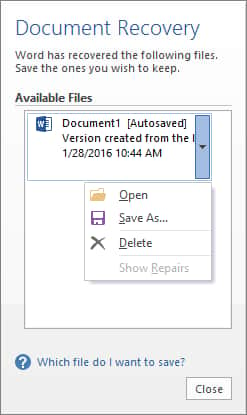
Step 2: Locate the file you want to recover.
Step 3: Once opened, go to File > Save As.
Note: If you manually close a document without saving it, this method won't work, as Word assumes you intentionally discarded the file.
Method 2: Recover Unsaved Word Document with 4DDiG
Still unsure how to recover unsaved Word documents on Windows 11/10? Tools like Tenorshare 4DDiG can help you recover unsaved, deleted, corrupted, hidden, or lost MS Office files from over 2,000 storage devices. With advanced algorithms, it scans Word's AutoRecover folder and other possible locations to locate your unsaved files.
Additionally, this data recovery software is fully compatible with all major Windows operating systems, including Windows 7, 8, 10, and 11. Thanks to its intuitive interface, you can recover unsaved documents without any technical skills. Here's a step-by-step guide on how to recover unsaved documents in Word using 4DDiG:
Step 1: To begin, install and open the unsaved Word recovery tool on your PC. On the main screen, you'll see a list of available drives. Choose the disk containing your Word files were lost (e.g., C: drive) followed by clicking on the "Scan" button.
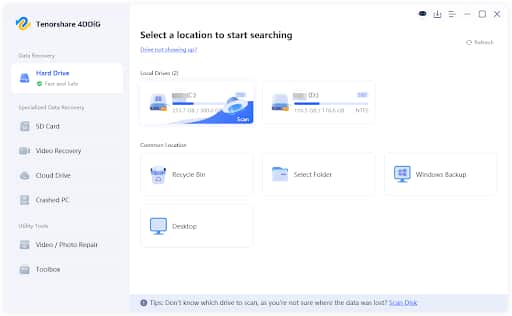
Step 2: After the scan completes, look at the left-hand panel and click on the "Type" tab. Select "Unsaved Documents" to display only the Word files that were not saved.
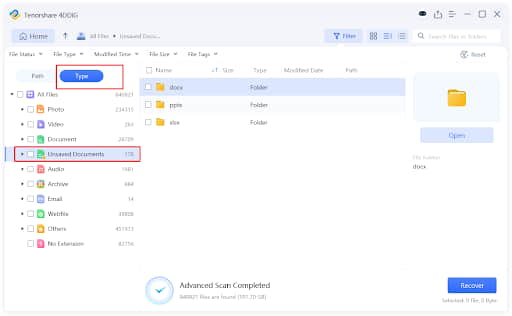
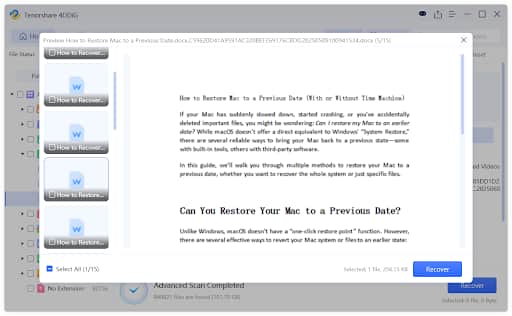
Step 3: Double-click on each file to preview its contents and make sure it's the one you wish to restore. Once you've selected the desired files, click "Recover" in the lower right corner.
Method 3: Recover Unsaved Word Document Using AutoRecover
AutoRecover is Word's built-in lifesaver — it automatically saves temporary copies of your document every few minutes. Its main job is to help you recover your work after a crash or unexpected shutdown, but it also comes in handy if you accidentally close a document without saving. Most importantly, AutoRecover is turned on by default in most cases.
Here's how to recover unsaved documents in Word with the aid of AutoRecover:
Step 1: Launch the Microsoft Word app, and then go to File > Info > Manage Document. Pick "Recover Unsaved Documents" from the dropdown.
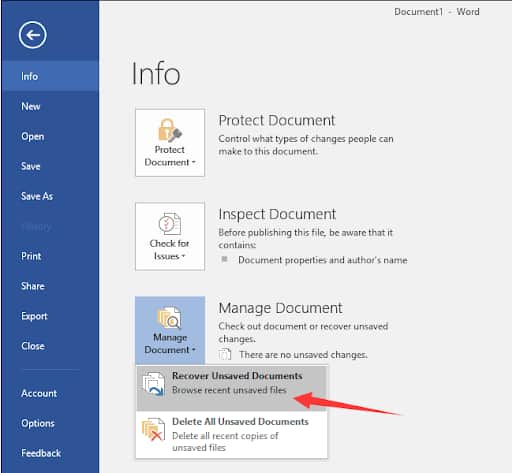
Step 2: Look for files with the .asd extension. Click on the one you want to recover and select "Open."
Step 3: Then, click "File" in the top-left corner and select "Save."
Method 4: Recover Unsaved Word Document from Temporary Files
On some occasions, Word doesn't get the chance to save an AutoRecover copy. So, the next unsaved Word document recovery method you should try is to check temporary files that Windows creates behind the scenes.
These files often disappear after a computer restart or after a certain period, so the sooner you check them, the better your chances of recovery. To do so:
Step 1: Press Win + E to open Windows File Explorer. Then navigate to the following path:
C:\Users\[Your Username]\AppData\Local\Temp
Step 2: Locate files with the .tmp or .wbk extensions. You'll need to open each of these files in Word to preview them.
Step 3: Once you find the file you need, save it in a safe spot on your computer.
Method 5: Check Cloud Backups
If you forget to save a Word document while editing in the cloud, there's no need to worry. Documents stored in OneDrive or SharePoint are automatically saved in real-time through AutoSave, and previous versions are kept, making it easy to restore your work. Please note that this feature requires a valid Microsoft 365 subscription.
Extended Part: Tips to Keep Your Word Documents Safe
While it's quite possible to recover an unsaved Word document, it's always better to prevent data loss in the first place. Here are some simple tips to make sure you never have to worry about how to recover unsaved Word documents on Windows 10/11 again:
Enable AutoRecover: Make sure AutoRecover is turned on and consider shortening the save interval so Word backs up your work more frequently.
Back up regularly: Keep copies of important Word files on an external drive or cloud storage.
Use Word for the web: Edit and save documents online to keep them safe in OneDrive.
Use antivirus protection: Keep Windows Defender or other antivirus tools updated to prevent file corruption.
Know your recovery options: Learn how to use AutoSave, AutoRecover, and recovery tools before you actually need them.
Conclusion
There are multiple ways to recover an unsaved Word document, and your chances of success are much higher if you act quickly after noticing the issue. Plus, try not to continue using the drive where your unsaved document was stored before recovery. To prevent this from happening again, make sure AutoSave is enabled in Word and consider using cloud storage like OneDrive for real-time backups.
How to Recover Unsaved Word Document FAQ
Q1: Can You Recover an Unsaved Word Document?
In most cases, the answer is yes. Word has a built-in AutoRecover feature that can help you recover unsaved documents. You can access it by going to File > Info > Manage Document > Recover Unsaved Documents. If you haven't enabled this valuable feature, you can also try using a professional document recovery tool.
Q2: What Causes Word Documents to Become Unsaved?
Word documents can become unsaved due to several reasons, including:
Unexpected computer crashes or power outages
Word application crashes or freezes
Forgetting to manually save the document
Disabling AutoSave or AutoRecover
Q3: How to Recover an Unsaved Word Document after Computer Restarts?
If you have AutoRecover enabled, then you're in luck. Just reopen the Word app, and it will automatically display a Document Recovery pane with your unsaved files. From there, you can select the version you want to restore and continue working as usual.
-
1
Losing an unsaved Word document is something almost everyone has dealt with, and your breakdown of all recovery methods is clear and easy to follow. The step-by-step approach for AutoRecover, Temp files, and cloud backups makes the whole process less stressful.
The inclusion of 4DDiG as an alternative is good too, especially for cases where Word’s built-in tools fail.


Cryptocurrency trading has evolved dramatically over the past few years, with perpetual futures emerging as one of the most popular instruments for active traders. If you are searching for the best perpetual futures platform in the US, BYDFi has become a notable contender. But how does it perform, and is it suitable for both beginners and experienced traders? This article dives deep into BYDFi’s features, advantages, and considerations, helping you make an informed decision.
What Are Perpetual Futures?
Before evaluating BYDFi, it’s important to understand perpetual futures. Unlike traditional futures contracts, perpetual futures do not have an expiry date. This means traders can hold positions indefinitely, as long as they maintain margin requirements. The ability to leverage trades and manage risk efficiently makes perpetual futures appealing to traders looking to maximize potential profits in volatile cryptocurrency markets.
BYDFi Overview
BYDFi is a cryptocurrency trading platform that has gained attention in the US market for its robust suite of features tailored to futures trading. The platform caters to both newcomers and seasoned traders by offering intuitive interfaces, strong security protocols, and competitive trading conditions. BYDFi supports a wide range of cryptocurrency pairs, allowing traders to explore multiple opportunities in the derivatives market.
Key Features of BYDFi
1. Wide Range of Futures Contracts
BYDFi offers an extensive selection of futures contracts, covering popular cryptocurrencies like Bitcoin (BTC), Ethereum (ETH), and many altcoins. This variety ensures that traders can diversify their portfolios and take advantage of market fluctuations across different assets.
2. High Leverage Options
One of the most appealing aspects of BYDFi is its leverage capabilities. Traders can access leverage up to 200x, enabling them to amplify potential gains. While high leverage comes with increased risk, BYDFi provides tools to manage exposure, such as stop-loss and take-profit orders, which are crucial for responsible trading.
3. User-Friendly Interface
BYDFi prioritizes user experience. The platform’s design is intuitive, making it accessible to beginners without compromising advanced features for professional traders. Charts are clear, and executing trades is straightforward, ensuring that users can navigate the platform efficiently.
4. Strong Security Measures
Security is a top concern in cryptocurrency trading. BYDFi implements industry-standard security measures, including two-factor authentication (2FA), cold storage for funds, and encryption protocols. These measures provide traders with confidence that their assets are protected against unauthorized access and cyber threats.
5. Low Trading Fees
Competitive fees are essential for traders aiming to maximize profits. BYDFi offers low trading fees compared to many other US-based platforms. Lower fees mean traders retain more of their gains, which is particularly important when engaging in high-frequency or leveraged trading.
6. Fast Trading Engine
Speed is critical in futures trading, where market conditions can change in seconds. BYDFi’s trading engine is designed to handle high volumes with minimal latency, ensuring that orders are executed promptly. This efficiency reduces slippage and enhances trading accuracy, a vital feature for active traders.
7. Accessibility for US Traders
Not all cryptocurrency exchanges accept US users due to regulatory complexities. BYDFi stands out as a platform that is accessible to traders in the US, offering a compliant and reliable environment for perpetual futures trading.
Advantages of Using BYDFi
Diversification Opportunities: With a wide range of trading pairs, BYDFi allows traders to spread their risk across different cryptocurrencies.
High Profit Potential: Leverage up to 200x can significantly increase profit potential, especially for traders who effectively manage risk.
Ease of Use: The platform is beginner-friendly while still offering advanced features for experienced traders.
Security and Reliability: Strong security protocols protect users’ assets and personal information.
Efficient Execution: A fast trading engine ensures orders are executed quickly, minimizing the risk of slippage.
Considerations When Trading on BYDFi
While BYDFi offers numerous benefits, it’s important to understand the risks and limitations:
High Leverage Risks: Leverage magnifies both gains and losses. Traders must have a solid risk management strategy to avoid significant losses.
Volatility of Cryptocurrencies: Perpetual futures trading involves volatile markets, which can result in rapid price swings. It is essential to stay informed and monitor positions actively.
Learning Curve for Beginners: Although BYDFi is user-friendly, new traders should familiarize themselves with futures trading concepts, margin requirements, and risk management tools.
Educational Resources and Support
BYDFi provides educational materials and responsive customer support to assist traders. Tutorials, guides, and real-time support help users understand platform features, trading strategies, and risk management techniques. This commitment to education is particularly valuable for traders looking to enhance their skills and trade more confidently.
How BYDFi Compares to Other Platforms
When evaluating the best perpetual futures platform in the US, BYDFi stands out in several areas:
Accessibility: Unlike some international exchanges, BYDFi accepts US users, making it a rare option in a highly regulated market.
Leverage and Contract Variety: The platform offers some of the highest leverage options available, coupled with a broad selection of futures contracts.
Fee Structure: BYDFi’s competitive fees make it an attractive choice compared to platforms that charge higher trading fees.
Security: Many users prioritize security, and BYDFi’s multi-layered approach to protecting funds and data provides peace of mind.
BYDFi marked a major milestone in 2025 by announcing a multi-year partnership with Newcastle United, positioning itself as the Premier League club's Official Crypto Exchange Partner. This collaboration not only expands BYDFi's international brand awareness but also strengthens its commitment to building a trustworthy and influential global cryptocurrency ecosystem.
While other platforms may excel in certain areas, BYDFi offers a well-rounded combination of features, security, and accessibility, making it a strong choice for US-based traders.
Getting Started on BYDFi
Starting with BYDFi is straightforward:
Create an Account: Sign up with your email address and complete identity verification as required for US users.
Deposit Funds: Add cryptocurrency or fiat to your account using supported deposit methods.
Explore the Platform: Familiarize yourself with the trading interface, order types, and available futures contracts.
Develop a Strategy: Plan your trades, set stop-loss and take-profit levels, and manage leverage carefully.
Execute Trades: Start trading and monitor positions using the platform’s tools and charts.
By following these steps, both beginners and experienced traders can take advantage of BYDFi’s features safely and effectively.
Conclusion
For traders seeking the best perpetual futures platform in the US, BYDFi offers a comprehensive, secure, and user-friendly solution. Its combination of high leverage, wide contract selection, competitive fees, and robust security measures makes it a strong contender in the competitive landscape of cryptocurrency futures trading. While trading always involves risk, BYDFi equips traders with the tools and resources needed to navigate volatile markets with confidence.
Whether you are a beginner exploring futures for the first time or a seasoned trader looking for a reliable platform with high leverage and fast execution, BYDFi provides a balanced and accessible trading environment designed to meet diverse trading needs.
Criminal law is one of the most intricate and high-stakes fields in the legal system. Every decision, every argument, and every interpretation can determine a person’s freedom or future. Yet criminal cases often involve staggering volumes of data, ranging from witness testimony and police reports to forensic evidence and precedent-based case laws. Sorting through this information manually has long been a challenge, consuming valuable time and increasing risks of oversight or bias. In recent years, Legal AI has emerged as a transformative solution that helps lawyers, judges, and legal researchers navigate these complexities with precision and efficiency.
Artificial intelligence is no longer just a concept in technology circles. Its practical applications are touching nearly every branch of law, and criminal justice is one of the most promising areas of adoption. From assisting defense teams in case research to analyzing patterns in sentencing outcomes, Legal AI tools are redefining how criminal cases are handled. These systems can review vast datasets, flag inconsistencies, and support human decision-making in ways that enhance both accuracy and fairness.
The Role of AI in Modern Criminal Law
Criminal law relies heavily on facts and evidence, as well as precedents established through previous cases. Traditional case preparation requires weeks or even months of research, but AI streamlines this process by rapidly analyzing volumes of legal texts, evidence lists, and prior rulings. For example, AI platforms can quickly identify similar cases, summarize their outcomes, and assess how specific arguments or defenses performed historically.
One of the advantages of adopting ai legal systems is their ability to detect hidden connections across massive data collections. They not only locate precedents but also highlight underlying patterns, such as judicial tendencies or procedural anomalies. This helps lawyers craft factually supported arguments, anticipate opposing moves, and make informed strategic decisions well before trial begins.
Data-Driven Defense Strategies
Public defenders and private defense attorneys can benefit immensely from AI-assisted research. In many jurisdictions, defense teams struggle with heavy caseloads and limited resources. AI technology addresses this by automating tasks that once demanded tedious manual review. These systems can evaluate large sets of police records, analyze suspect profiles, or identify discrepancies in eyewitness accounts in a fraction of the time traditional methods would take.
AI can also assist in finding mitigating factors that strengthen a defendant’s case. By referencing similar cases where defendants benefited from certain legal arguments, AI systems can recommend evidence types or precedents to support leniency. This data-driven approach saves time, enhances quality, and enables defenders to focus their efforts where it matters most—advocating effectively for their client’s rights and ensuring due process.
Enhancing Prosecution Efficiency through AI
Prosecutors juggle multiple cases simultaneously and must prepare thoroughly to present their arguments. Legal AI tools enable them to streamline case preparation while ensuring adherence to ethical standards. For instance, prosecutors can use AI algorithms to analyze body camera footage, police reports, and forensic findings for consistency and relevance. These tools can also uncover patterns of behavior by suspects across multiple incidents, enabling the prosecution to construct stronger narratives.
Additionally, predictive models help prosecutors estimate potential defense strategies based on historical case data. This allows for better preparation, strategy diversification, and improved case management. The technology assists in categorizing evidence logically and supports informed decision-making throughout the trial process.
Improving Legal Research and Citation Accuracy
Accurate citations form the foundation of persuasive legal arguments. In criminal law, misquoting or referencing an outdated precedent can weaken a case. AI systems ensure that all references used in a legal argument come directly from verified and updated databases. This minimizes the chances of citing irrelevant or superseded cases.
Moreover, AI applications in legal research promote transparency. Each suggested case or legal reference includes an accessible trail for verification. Such explainable AI mechanisms assure lawyers and judges that the system’s findings are grounded in factual, up-to-date information rather than assumptions. This makes the research process both faster and more trustworthy.
Predictive Analytics and Sentencing Patterns
Another emerging application of Legal AI in criminal law is predictive analytics. Predictive systems analyze large historical datasets to identify sentencing patterns based on factors such as crime type, defendant background, jurisdiction, and precedent. This allows legal professionals to assess sentencing risks and outcomes in advance, leading to more informed legal strategies.
For example, an attorney could use predictive AI models to estimate whether a client might be eligible for probation rather than imprisonment based on past sentencing trends. Judges can use similar tools to ensure consistency in decision-making by comparing cases with statistically equivalent parameters. These applications help reduce disparities in sentencing and promote fairer judicial processes.
Drafting Sentencing Memoranda with Precision
Sentencing memoranda are critical components of criminal proceedings. They guide judges in understanding a defendant’s circumstances, the nature of the offense, and arguments for mitigating or aggravating factors. Preparing these documents requires highly detailed writing, backed by accurate data and carefully chosen precedents. Legal AI simplifies this process by generating structured outlines, referencing relevant cases, and summarizing key points from trial records.
The technology does not replace lawyers but acts as a drafting assistant. It automates the mechanical aspects of organizing facts, while attorneys retain control over argumentation and tone. This collaboration ensures that every sentencing memorandum presented reflects deep legal reasoning supported by verified, case-specific evidence.
AI in Post-Conviction Reviews and Appeals
After sentencing, defendants often pursue appeals or post-conviction relief based on newly discovered evidence or legal errors. AI helps streamline this stage by scanning records for inconsistencies or potential grounds for appeal. AI-driven systems can compare trial transcripts, identify procedural differences between similar cases, and highlight issues worth re-examining, such as errors in jury instructions or mishandled evidence.
This ability to reanalyze case material quickly reduces costs and improves access to justice. Many individuals who lack strong legal representation can benefit from AI-supported systems that democratize the reviewing process. As courts and legal organizations increasingly adopt these technologies, the quality and availability of post-conviction review are expected to improve significantly.
Enhancing Objectivity in Bail Decisions
Bail decisions often involve subjective assessment of flight risk, community safety, and prior conduct. Legal AI models, trained on past bail determinations, can assist judges by offering data-supported insights. These systems evaluate objective criteria such as past appearances, residence stability, and criminal history to suggest fair bail conditions.
While final decisions always rest with the judge, AI ensures that recommendations are consistent with established patterns and free from human bias. This supports more equitable treatment across different demographics, addressing one of the longstanding challenges in criminal justice systems.
The Role of AI in Investigations
AI’s applications in criminal law extend beyond courtrooms into the investigative phase as well. Law enforcement agencies now use AI tools to identify suspects, recognize faces in surveillance footage, and detect document tampering. By automating parts of the investigation process, AI helps officers focus on case-solving rather than administrative tasks.
However, such use requires ethical monitoring. Transparency and accountability mechanisms must ensure that AI findings are validated before being introduced as evidence. Proper training data, human oversight, and unbiased algorithms are essential to preserve the fairness of investigations and uphold constitutional protections.
Ethical Considerations and Safeguards
With the rapid advancement of AI technology, ethical boundaries in criminal justice must be carefully maintained. Over-reliance on algorithms can lead to wrongful assumptions if models are not monitored appropriately. Legal AI developers, therefore, focus on creating explainable systems where each output can be traced to its source.
Furthermore, ensuring data privacy is critical. Criminal case data often involves sensitive personal information. AI solutions must comply with strict data protection laws and follow confidentiality protocols. Many modern ai for legal systems incorporate encryption, access control, and anonymization features to safeguard sensitive data while still enabling efficient legal analysis.
Streamlining Administrative Workflows
Criminal cases often involve a tremendous amount of paperwork, including arrest records, witness statements, and legal notices. Managing these documents manually consumes time and increases the risk of clerical mistakes. AI-based document management systems automatically categorize, label, and store these files for easy retrieval.
The result is a more organized workflow and smoother collaboration among legal teams. Court clerks, attorneys, and administrative staff all benefit from integrated document tracking and automated updates, improving overall efficiency in case management.
AI Integration with Judicial Decision-Making
Judicial bodies are experimenting with AI support systems designed to aid in drafting judgments and analyzing legal reasoning patterns. These systems can map argument structures and check consistency with legal principles, helping ensure that judicial decisions align with legislative intent and precedential guidance.
In jurisdictions with high caseloads, this support can reduce delays and improve case handling efficiency. Judges using ai legal systems report that AI-assisted summarization and precedent analysis save significant amounts of time without undermining their independent judgment or discretion.
The Future of Legal AI in Criminal Justice
The future of Legal AI in criminal law is both promising and complex. Newer AI models will integrate multi-modal data such as audio testimonies, forensic visuals, and social context analysis. Instead of relying solely on text, they will process a wider array of evidence, creating deeper insights into case facts. These developments could lead to AI systems offering real-time legal assistance in court, suggesting relevant statutes or arguments as cases unfold.
Nonetheless, human oversight will remain essential. The technology is an aid, not a replacement for legal reasoning or ethical decision-making. Its greatest strength lies in enhancing human capabilities while ensuring factual accuracy. As technology evolves, the relationship between AI and the legal profession will become more collaborative and transparent, bringing about a more just and efficient criminal justice system.
Conclusion
Legal AI represents a transformative shift in how criminal law is practiced, researched, and administered. From crafting defense strategies to preparing sentencing memoranda, its applications span the entire criminal process. It delivers efficiency, ensures factual accuracy, and promotes fairness across proceedings. When applied responsibly, this technology helps reduce workload pressure, enhances accuracy in decisions, and broadens access to justice.
The evolution of AI-driven law is just beginning. By adopting ai for legal solutions focused on transparency, accountability, and ethical integrity, the legal industry stands on the brink of a new era—one where justice is informed by data yet guided by human judgment.
In today’s digital era, video content has become the most powerful storytelling medium across industries. From YouTube creators and eLearning professionals to global brands and marketers, everyone is leveraging video to communicate ideas, build audiences, and expand reach. But one major barrier still stands between creators and a truly global audience — language. Fortunately, with the rise of advanced artificial intelligence, it’s now easier than ever to translate your videos with AI and connect with viewers around the world.
The Global Demand for Multilingual Video Content
Over 75% of online users prefer consuming digital content in their native language. This means that even the most engaging video loses impact if it’s not understood. Traditional translation and dubbing methods are expensive, time-consuming, and require specialized human expertise. But AI is changing that. By using powerful machine learning algorithms, natural language processing (NLP), and neural voice synthesis, modern tools can translate your videos with AI in minutes—making global distribution faster, cheaper, and more efficient.
How AI Video Translation Works
When you translate your videos with AI, the process goes far beyond simple text translation. The technology analyzes spoken dialogue, detects language patterns, and generates subtitles or even full voice-overs in multiple languages. Here’s how it typically works:
Speech Recognition: AI first converts spoken language in your video into text using automatic speech recognition (ASR).
Translation: The text is then translated into the target language using deep-learning-based translation models.
Voice Generation: With advanced voice cloning and text-to-speech technology, AI can reproduce the original speaker’s tone and emotion in another language.
Synchronization: Finally, AI ensures that subtitles or dubbed voices are time-synced perfectly with the video, maintaining a natural viewing experience.
This end-to-end process enables creators to publish content that feels authentic and culturally relevant to audiences worldwide.
Why You Should Translate Your Videos with AI
AI translation isn’t just a technical upgrade — it’s a strategic advantage. Here are a few compelling reasons why you should translate your videos with AI:
Reach a Global Audience: Break language barriers and tap into new markets effortlessly.
Boost Engagement and Retention: Viewers are more likely to stay engaged when they can consume content in their native language.
Save Time and Money: AI-driven translation drastically reduces the need for manual transcription and voice-over labor.
Enhance Accessibility: Subtitles and multi-language audio make your videos more inclusive for non-native speakers and the hearing-impaired.
Consistency and Scalability: Once your content pipeline is AI-optimized, you can translate hours of footage quickly and uniformly.
Real-World Applications of AI Video Translation
The impact of AI video translation extends across industries:
Content Creators: YouTubers and podcasters can localize their videos to reach international fans.
Education and eLearning: Institutions can deliver multilingual training modules and online courses.
Corporate Training: Global companies can provide consistent onboarding materials in every employee’s language.
Media and Entertainment: Streaming platforms can quickly adapt shows and films for regional audiences.
Healthcare and Government: Public information videos can be made more accessible to diverse populations.
Best Practices for Translating Your Videos with AI
To get the best results when you translate your videos with AI, it’s important to follow a few best practices:
Use Clear Audio: Good sound quality helps AI tools accurately recognize and process speech.
Keep Sentences Concise: Shorter phrases improve translation accuracy.
Avoid Background Noise: Clean audio ensures better transcription and timing synchronization.
Review and Edit Outputs: While AI is powerful, human oversight ensures cultural and contextual accuracy.
Leverage AI Platforms with Voice Cloning: For a truly natural feel, use AI tools capable of maintaining speaker tone and style.
The Future of AI Video Translation
As AI continues to evolve, the next wave of innovation is already emerging — real-time translation, lip-syncing technology, and voice cloning are redefining what’s possible. Soon, creators will be able to broadcast live in multiple languages simultaneously, offering personalized experiences for every viewer around the world.
In this future, you won’t need to be multilingual to go global. With advanced AI, your content can speak every language — literally.
Final Thoughts
The ability to translate your videos with AI represents more than a technological breakthrough; it’s a cultural bridge. Whether you’re an educator, marketer, or influencer, AI-powered translation allows your message to travel farther, faster, and more authentically than ever before. As global audiences grow more connected, embracing AI video translation isn’t just an option — it’s the key to thriving in a truly borderless digital world.
-
1
This is a great breakdown video translation is quietly becoming one of the biggest unlocks for creators.
The moment you remove the language barrier, the same piece of content can suddenly perform 5–10× better in regions creators never even considered.
What stood out to me is the shift you mentioned from “translation” to true localization.
Creators aren’t just looking for literal subtitles they want emotional tone, pacing, and cultural nuance to feel native.
That’s where AI is finally starting to feel transformative.
I’m building something in the creator workflow space too, and this resonates a lot:
distribution scales only when creation becomes frictionless.
Translation is becoming one of those hidden superpowers that widen the creator’s reach without adding extra work.
Really enjoyed this would love to see which markets responded the strongest during your experiments.


The luxury yacht lifestyle has become crystal clear water, sunbathing decks, and VIP parties. The luxury yacht lifestyle has become one of the most sought-after experiences among modern-day humans. The maritime elite scene offers, whether you are quiet life seekers, or career explorers, unique opportunities that are miles away from ordinary vacation experiences.
What Defines the Luxury Yacht Lifestyle?
The luxury yacht lifestyle represents more than just sailing on expensive vessels. It encompasses a complete ecosystem of experiences, professional opportunities, and social connections that exist within the world's most exclusive maritime circles. From the Mediterranean's turquoise coastlines to the Caribbean's pristine beaches, this lifestyle combines adventure, sophistication, and unparalleled access to high-end environments.
Those immersed in this world experience first-class accommodations, gourmet dining prepared by private chefs, and attendance at invitation-only events where networking happens naturally. The luxury yacht lifestyle creates environments where meaningful connections form against backdrops of stunning seascapes and carefully curated experiences.
The Financial Landscape of Yacht Careers
To truly understand the economic reality of working in luxury yachts, you would also consider the earning potential as an impressive feature. The salaries of professional crew members usually range in between $10,000 and $100,000 per month, which depends upon the person's position, the level of his/her experience, and the quality of the yacht. The highest salaries go to the most senior positions while the least experienced positions still offer salaries that are higher than many of the land-based jobs.
However, aside from the basic salaries, the annual earnings can be greatly increased by the guests' generous gratuities if the guests are satisfied. Tips alone during the peak charter seasons might equate one to three months of salary for many Yacht crew professionals. Moreover, the usual living costs are entirely eliminated as the crew members do not pay for accommodation, meals, or travel; hence a large portion of their income becomes savings.
The Reality Behind Premium Yacht Experiences
Social media often depicts the most glamorous moments, but in a successful environment, there are specific skills and professionalism that cannot be shaken. Emotional intelligence is considered to be one of the most invaluable assets as handling different characters in a limited space requires superb inter-personal skills. The techniques of conflict resolution, anticipating needs before they are communicated, and the ability to remain calm under pressure are the ones that distinguish the successful professionals from the ones who find it hard to cope.
The corporeal necessities must also be considered seriously. It is difficult to not become discouraged by long working hours, erratic timings, and constant availability which even the most committed people find difficult to cope with. Nevertheless, the issues that come with working in a fast-paced environment are nothing but the challenge of proving one's worth and creating a remarkable professional reputation for oneself for those who are already in such environments.
Essential Skills for Success
One of the most important things in a yachting career is mastering hospitality excellence. Understanding fine dining service, wine knowledge and the subtle art of being present yet unobtrusive are among the key aspects of hospitality excellence. The technical skills needed for a particular position may vary but they might include navigation, maintenance, water sports instruction, or culinary expertise.
Being able to speak multiple languages is a plus since the professionals who can communicate in different languages will have no problem with international guests. Cultural awareness and adaptability will make it easy to communicate with the guests no matter what their background or even the guests' expectations. The ones who keep on improving their skills are the ones who are always needed in the industry.
Building Connections in Exclusive Maritime Circles
The social dimension of yacht culture creates unique networking opportunities. Through elite introductions and organic interactions, professionals build relationships with influential individuals from various industries. These connections often extend beyond the yacht itself, leading to mentorship opportunities, business partnerships, or career advancement in unexpected directions.
Successful networking in these environments requires authenticity and genuine interest in others. Rather than approaching interactions transactionally, those who build lasting relationships focus on creating value, demonstrating reliability, and maintaining discretion. The yachting world values trustworthiness above all else, as privacy remains paramount for high-net-worth individuals.
Networking with High-Net-Worth Individuals
Having a good knowledge of rich tourists' tastes and predictions makes every encounter better and more pleasant. Affluent people prefer to interact with professionals who can tell what they might need, who can have a witty dialogue during the right times, and who can maintain the distance. The skill to decipher social signals and change your style as per the situation is of great worth.
The majority of very successful workers create specific areas of competence which make them more attractive—maybe being particularly good in organizing trips, having sophisticated tastes in art, or being excellent in water sports. Such attributes provide guests with unforgettable moments of the kind that they will relate to service of the highest quality, thus giving rise to recommendations, as well as getting the same guests return.
Professional Opportunities in the Yachting World
The marine sector presents a variety of job opportunities that are not limited to the usual crew positions. All the sectors like event coordination, yacht management, charter brokerage, and hospitality consulting rely upon or take advantage of maritime experience. Professionals with the know-how in social media can be hired in yacht marketing or luxury lifestyle content creation, and others may drift into adjacent sectors like high-end travel planning or exclusive club management.
People with an entrepreneurial spirit use their yachting experience to start businesses catering to this market. Knowing the industry intricacies from within gives the start-ups a better chance in the market. Examples of such services include specialized provisioning to crew training programs.
Beyond the Glamour: Real Expectations
Keeping realistic expectations will guarantee that people involved in yachting careers will be satisfied with that lifestyle for a long time. The lifestyle is not easy, it consists of sacrifices—long periods away from family and friends, little personal space, and difficulty in keeping relationships up-to-date due to frequent traveling. The seasonal employment pattern dictates that one has to plan for income variations and possibly look for a job in the off-season.
Nevertheless, very often the advantages outweigh the drawbacks. In fact, the professionals mention that they underwent amazing personal development, got to see the world from different perspectives through the travel, and enjoyed the feeling of being able to do difficult things. Moreover, the gains in terms of experiences and human contacts created possibilities that are not available in traditional career paths.
Taking Action: Your Path to Maritime Excellence
Initiating your luxury yacht journey through yachting demands tactful preparation. First and foremost, check out the trustworthy training institutions that hand out certificates accepted all over the place. STCW certification is a must and along with it, your market worth gets even higher if you possess qualifications in fields like hospitality, navigation, or specialized skills.
Creating a professional portfolio that displays pertinent experience, even if it comes from land-based hospitality positions, is a good way to show your skills. Talking to people who are currently in the industry informs you about the opportunities and expectations. Many yacht pros who are now successful have little to no past experience in the field and they started by going to industry events, joining online communities, and contacting crew agencies that focus on placements.
Take into consideration the option of taking seasonal jobs or doing day-work first to get some experience before you are ready to sign a full-time contract. This way you can find out if the lifestyle is appropriate for your personality and career aspirations while at the same time making industry contacts and getting references.
Creating Your Professional Brand
In the contemporary digital world, a neat online presence has become a prerequisite. It is critical to ensure that social media profiles are showing the same level of professionalism and discretion, as potential employers are constantly checking the online footprints of candidates. Show the accomplishments, certifications, and references that support your skills but still be careful about client confidentiality.
Additionally, participation in continuous training, language courses, or specialized certifications assures your position in the job market. The most successful people will always look at their careers as a long process of learning and growth rather than a one-time destination.
Frequently Asked Questions
What qualifications do I need to work on luxury yachts?
The primary qualifications consist of STCW certification, medical fitness documents, and prior experience in hospitality or maritime operations. Training certifications in specific areas such as culinary arts, water sports teaching, or technical maintenance will be an advantage in the job market. In addition, it is common that good references and no criminal record are other requirements for most jobs.
How long are typical contracts in yachting?
The contracts are very different depending on the ship and the job. A few of the maritime crew are working only in the summer for 6-8 months, and some are daily workers all year round. Yachts that are mainly for chartering may have their busiest times in the high season; meanwhile, luxury yachts might keep their schedules in sync with the owners' travels all year long.
Can I maintain a stable personal life while working on yachts?
Looking after personal relations together with yachting careers need a conscious effort. Numerous experts make it with the help of unambiguous talks, periodic video conferences, and taking full advantage of being together during time off. Some pairs are in the same boat and work in the same place, whereas others come up with rotating schedules that provide long stays at home between contracts.
What's the difference between working on private versus charter yachts?
Private yachts are usually owned by one person only and their visitors, which bring more stable timetable and also employer's closer long-term relationships. Charter yachts have different guests coming to them all the time, which means variety and usually earning potential through tips but at the same time entails being adaptable to constantly shifting likes and personalities.
How important is appearance in the yachting industry?
Private yachts are usually owned by one person only and their visitors, which bring more stable timetable and also employer's closer long-term relationships. Charter yachts have different guests coming to them all the time, which means variety and usually earning potential through tips but at the same time entails being adaptable to constantly shifting likes and personalities.
What career advancement opportunities exist in yachting?
Advancement paths are progressing through junior to senior positions within your specialty, and transitioning into management roles such as chief steward or first officer, or moving to yacht management companies. Some of the professionals take their experience to luxury hospitality management, event planning, or even starting their own businesses for the maritime luxury market.
Is the luxury yacht lifestyle only about parties and glamour?
Although exclusive events and stunning locations are the main attractions, the truth is that it is a lot of hard work, long hours, and stressful situations. It takes to reconcile the pleasurable side with professional duties, constant learning, and switching to difficult situations while keeping high service standards.
When ChatGPT burst onto the academic scene in late 2022, it felt as though someone had dumped a semi-truck of perfectly punctuated prose onto every campus. Two years later, teachers, integrity officers, and even students themselves are still asking the same question: “How can I tell if this paper was written by a human or an AI?” I’ve spent the past eighteen months reading hundreds of suspicious essays, cross-checking them with detectors, and talking to colleagues who do the same. Below are the five red flags we spot most often, along with a few caveats, because no single clue is foolproof.
1. The Formulaic Five-Paragraph Skeleton
Open an essay and see a crisp introduction that ends with a tidy three-point thesis; three body paragraphs that each begin with “First,” “Second,” and “Finally”; and a conclusion that starts with “In summary”? That structure almost screams ChatGPT. The model’s default training heavily emphasizes clarity and organization, so it tends to serve up the classic five-paragraph template even for assignments that ask for something less rigid.
A Smodin’s AI Detector often flags essays with this kind of overly balanced symmetry, since such mechanical precision is a hallmark of machine-generated text. Human writers certainly use formulas too, but they usually bend the template. A sophomore might drift into an anecdotal hook, forget a topic sentence, or conflate two supporting points. Real drafts are a bit messy. ChatGPTs are suspiciously symmetrical, like a sandcastle made with the same bucket every time.
Why It Matters for Authenticity
That rigid outline isn’t inherently “bad” writing, but it often signals that the author did not wrestle with ideas organically. If your assignment asks for original synthesis or exploratory thinking, an identikit structure suggests the student let the AI do the heavy lifting.
2. Suspiciously Polished Yet Surface-Level Content
A second giveaway is the sheen of grammatical perfection paired with shallow insight. ChatGPT seldom misspells a word, mangles a comma, or mixes verb tenses. What it does miss is depth. You’ll see statements like, “Climate change is a significant global challenge that requires multifaceted solutions,” followed by three paragraphs that merely rehash public-facing facts.
Ask yourself: Does the essay make nuanced connections to course readings, lecture points, or recent class discussions? Can you hear the student’s personal wrestling with the material? If the prose reads like an elegantly wrapped present containing very little substance, an AI may have wrapped it.
3. Phantom Citations and Hallucinated Data
Artificial intelligence models continue to hallucinate sources that compose articles, authors or page numbers that are non-existent. I have already opened an essay that references the journal named The Journal of Environmental Sociology, Vol. 42, Issue 3 (2023) which stops at 36. False URLs or DOIs, references with the correct year and the incorrect title, and page numbers that exceed the length of the journal all raise some red flags.
When we spot even one phantom citation, we dig further. Roughly 60 percent of the time (in my department’s informal tally), the rest of the essay turns out to be AI-generated as well. Students who rely wholly on ChatGPT often paste the references section straight from the model output without cross-checking.
4. Repetition and Redundancy in Phrasing
Another classic marker is micro-level redundancy. The essay might cycle through the same transitional phrase, “Furthermore,” “In addition,” “Moreover,” almost every other sentence. You may also notice tautological constructions like “each and every,” “various different,” or “past history” peppered through the draft.
Humans certainly repeat themselves, but we usually vary transitions out of sheer boredom or pick up colloquialisms from speech. ChatGPT sticks to a small, safe set of connectors unless explicitly told otherwise. A quick search for duplicated bigrams (two-word combinations) in a suspect essay often yields far more hits than in genuine student writing.
5. Inconsistent Voice and Style Jumps
Last but not least, be aware of the mechanical shift of tone. A paragraph may start with a joke-one-liner, followed by a headlong plunge into the most formal of registers: “Later on, the consequences of said phenomenon are expressed... In my case, these jolts occur when a student prompts ChatGPT to add humor or sound academic in two separate prompts and composes the results together.
Humans do blend styles, but usually with transitional phrases or an intentional rhetorical effect. AI-spliced text jumps without warning, like a movie scene missing a few frames. Also look for first-person pronouns appearing once and never again, or references to personal experiences that don’t match the student’s background.
Putting the Clues Together
No single sign is a conviction. A meticulous human could write a flawless five-paragraph essay; a distracted student might accidentally paste a wrong citation. The trick is pattern recognition. Two or three of the red flags above, in combination, raise the probability that ChatGPT did the bulk of the drafting.
When in doubt, I do three things:
Run the text through a reputable AI detector as a preliminary screen.
Ask the student more questions about where they got their information and how they wrote it.
Compare the submission with previous writing samples from the same student.
Consistency across those checks is more convincing than any automated score.
The Limits of AI Detectors (and How to Handle Them)
Even the best detectors still miss about 10-20 percent of AI text and produce false positives, especially on shorter passages. That’s why I treat them like a breathalyzer: a helpful indicator, not the judge and jury. If results hover in the “maybe” zone, I lean on oral defenses, revision logs, and classroom writing samples for triangulation.
For institutions that need fast triage, platforms such as Smodin bundle an AI Content Detector, plagiarism scanning, and rewriting tools in one place. More on that below.
Frequently Asked Questions (and How Smodin Helps)
I have 50 essays to grade tonight. How can I quickly spot potential ChatGPT use without reading every footnote first?
Smodin’s AI Content Detector flags passages with high probabilities of AI authorship in seconds, letting you prioritize which essays deserve a closer manual look.
A student claims the detector gave a false positive. What now?
Smodin stores a scan report you can share with the student. Combine that report with Smodin’s plagiarism checker and their draft history (if you require version uploads) to build a fuller picture before making an integrity ruling.
Some essays look AI-ish but pass every detector. Am I helpless?
Not necessarily. Drop the essay into Smodin’s AI Humanizer to see how much the text changes. If the tool can “humanize” it dramatically without altering meaning, that’s indirect evidence the original was machine-like.
Can students use Smodin ethically?
Absolutely. Students can draft in their own words, then run the text through Smodin’s rewriting or citation generator to polish language and ensure reference accuracy without outsourcing the thinking.
My school already pays for plagiarism software. Do I really need another subscription?
Traditional plagiarism tools only compare against existing sources. Smodin supplements by detecting AI-generated text content that, by definition, hasn’t been published elsewhere, filling a growing gap in academic integrity workflows.


When it comes to blogging, competition is tough, and ranking evergreen content can take months. But there is a smart shortcut that many bloggers ignore — seasonal content SEO. I discovered its power accidentally, and today I’m sharing exactly how Christmas seasonal content helped me drive massive organic traffic without paid promotions, and how you can do the same.
This guide covers my full process, including keyword research, content planning, optimization, promotion, and the results I achieved using Christmas-based content — so you can apply the same strategy for your website.
1. Understanding the Power of Seasonal Content
Seasonal content is based on events, occasions, festivals, holidays, christmas or trends that repeat every year. Unlike evergreen content, this type of content spikes during specific dates, and Christmas is one of the biggest global search events online.
Every December, millions of people search for:
Christmas wishes, quotes, greetings, messages, wishes
Gift ideas & shopping lists
Outfits, hairstyles, and beauty ideas
Captions, status, and festive visuals
Party ideas, games, food, and decorations
Office and business related Christmas messages
Since there is massive traffic potential with comparatively lower competition, Christmas content becomes a goldmine if you plan early.
2. Why I Selected Christmas as My Seasonal SEO Strategy
Here are the reasons that convinced me:
✔ Global festival → huge audience
✔ High search volume every year
✔ Works for multiple niches (fashion, beauty, quotes, gifts, business)
✔ Evergreen seasonal — traffic returns yearly
✔ Low to medium competition if properly targeted
✔ Huge sharing potential on social platforms
✔ High CPC for some commercial keywords
Also, unlike local festivals, Christmas is celebrated worldwide, making it a strong keyword opportunity for international traffic, especially from US, UK, Canada, and Australia, which means higher RPM & revenue if monetized.
3. My Christmas Content Planning Strategy
To make this work, I followed a proper system instead of randomly publishing articles.
Step 1: Keyword Research
I used simple tools that are free or freemium:
Google Trends
Google Search Bar Suggestions
People Also Ask (PAA)
Pinterest Trends
AnswerThePublic
Ubersuggest (optional)
I focused on both short-tail + long-tail keywords such as:
Christmas wishes for family
Christmas business messages
Christmas hairstyle ideas
Christmas gift quotes
Christmas messages for clients
Step 2: Content Calendar
Timing matters.
Best publishing time:
✔ 40–60 days before Christmas → indexing + ranking time
✔ Update old content every November
Step 3: Content Angle & Structure
I built different content formats for wider search coverage:
Wishes & Messages
Quotes & captions
Hairstyle & fashion ideas
Professional/business greetings
Trend-based lists
Step-by-step guides
This diversified approach allowed me to capture multiple audiences.
4. The Content Creation Framework I Used
Here is how I wrote my articles to make them valuable, emotional, and shareable:
✔ Clear and relevant headlines
Each article started with a strong and purposeful headline that directly matched user intent.
✔ Easy-to-read formatting
I used short paragraphs, bullet points, and emotional words to boost readability.
✔ Use of NLP keywords
Instead of keyword stuffing, I added naturally related semantic phrases.
✔ Emotional engagement
Since festive content is emotional, I used a warm, positive, and personal tone.
Examples of engagement elements:
“You can copy and share these lines instantly”
“Perfect for sending to family, friends, and colleagues”
“Feel free to modify these wishes according to your relationship”
5. My On-Page Optimization Process
To increase ranking probability, I applied the following SEO techniques inside the article:
✔ Optimized title + meta + first 100 words
✔ Internal linking to relevant articles
✔ Included FAQs + schema
✔ Used table of contents for UX improvement
✔ Added HD images or relevant copyright-safe visuals
✔ Used proper heading hierarchy (H1 > H2 > H3)
Additionally, I ensured that every article had:
Strong introduction
Helpful content
Calls-to-action
Social sharing triggers
6. Promotion Strategy: How I Boosted Initial Visibility
Publishing alone is not enough — promotion triggers growth.
Here’s what I did:
Social Media Promotion
Shared snippets, quotes, and carousel graphics on:
Facebook groups
Stories and WhatsApp status
Pinterest boards
Instagram captions and reels
Internal Linking Boost
Linked Christmas content from relevant old posts to push visibility.
Engagement Platforms
Answered related questions on:
Quora
Reddit communities
This helped bring initial visits and helped Google test and rank my pages faster.
7. The Results: Traffic Growth & Success
Within a few weeks, I noticed:
✔ Sudden rise in impressions
✔ Faster indexing compared to normal posts
✔ Steady increase in clicks
✔ Long-tail keywords performing well
✔ Traffic peak between December 20–25
Even after Christmas, some articles continued to rank due to LSI keywords, giving evergreen micro-traffic.
But the best part?
I now update those posts every November and they rank even better each year, without rewriting from scratch.
8. Lessons Learned (Key Takeaways)
Here is what I realized from this experiment:
Seasonal content works if posted early
You must update content every year
Social shareability matters more than perfection
Internal linking boosts ranking
Titles and meta descriptions influence CTR
Long-tail keywords win over competitive short keywords
Combining seasonal + evergreen strategy is best
9. Tips if You Want to Try Seasonal Content Strategy
Here are my recommendations for beginners:
✔ Start early, minimum 30–45 days before
✔ Pick 1 major and 1–2 supporting micro topics
✔ Don’t copy — create unique angles
✔ Add FAQs and schema
✔ Update every year
11. FAQs
Q1: Is seasonal content good for SEO?
Yes, if published early and properly optimized, seasonal content ranks faster and generates high-volume traffic.
Q2: Will seasonal content bring long-term traffic?
Seasonal content peaks during events but can bring yearly returning traffic if updated regularly.
Q3: Which type of seasonal content performs best?
Helpful, emotional, sharable, and problem-solving content such as wishes, messages, captions, gift ideas, and outfit guides.
Q4: Do I need backlinks for seasonal content?
Not necessarily — with proper keyword research and on-page SEO, seasonal content can rank even with low backlinks.
Q5: How can I monetize seasonal traffic?
Display ads, affiliate gift products, eBooks, printables, email signup funnels.
10. Final Conclusion
Christmas seasonal content proved to be one of the smartest SEO experiments I ever tried. It not only brought me organic traffic but also helped me understand how timing, search intent, and content relevance can turn a single festival into a powerful traffic source.
Seasonal content may not bring daily traffic forever, but if it's consistently updated, it becomes annual recurring traffic, meaning reward without recreating the same work again.
So if you are a blogger, affiliate marketer, or content creator, don’t ignore seasonal SEO — it might become your next breakthrough strategy.
-
1
“Hey! I really liked your breakdown of Christmas seasonal content — especially the part about using visuals for social sharing.
I’m a graphic designer who creates Christmas banners, flyers, and festive promo graphics.
If you ever want eye-catching visuals to promote your Christmas posts across Pinterest, IG, or FB groups, I’d love to help.Even a few strong designs can boost clicks + shares.
Happy to show you examples if you'd like!”
Comment