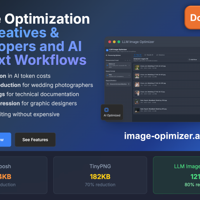
LLM Image Optimizer
Save 80% on AI Token Cost when using images for context.
I just published a new blog post explaining how LLM Image Optimizer upgrades Yoast’s SEO superpowers—this time, for your images.
The Story
I’ve been relying on Yoast for years—it nails content SEO, but always felt like one half of the puzzle. It flags missing alt text or image issues, but you still have to manually optimize, batch compress, or write metadata. That’s a lot of unpaid work.
So I built LLM Image Optimizer. It finally gives Yoast the missing muscle:
Batch optimises hundreds of images—compress, resize, convert, you name it
AI‑generated alt texts, captions, titles, descriptions based on real image analysis
Strips bloated EXIF data to speed up pages and improve privacy
Integrates back into WordPress so optimised images slide right back into your Media Library LLM Image Optimizer
What Changed
Now my site loads faster, delivers richer metadata, and ranks better — image SEO on steroids. Yoast handles most of the writing; LLM Image Optimizer handles the visuals and provides the proper image metadata.
Why It Matters
Sites with fast, metadata‑rich images rank higher and perform better
AI-generated metadata means no more “IMG_1234.jpg” alt disasters
It saves hours of manual optimisation work
Check out the full breakdown here: “Supercharge Yoast…” blog post

Ever uploaded a photo and thought: “Cool, just sharing a nice picture”?
Well… your image probably also whispered:
“This was taken on Dave’s iPhone 12, f/1.8, ISO 320.”
“BTW, here are the GPS coordinates of Dave’s living room.”
“Timestamp: Saturday night, 2am, don’t ask.”
Yeah, images are snitches. And nobody likes a snitch.
That’s why I built a one-click “Strip Metadata” button in LLM Image Optimizer. Hit it once and—POOF—your files stop oversharing.
✅ No more GPS leaks
✅ No extra 20KB bloat slowing your site
✅ No extra AI tokens wasted on junk data
✅ Just clean, fast, good-looking pixels
The best part: your photo looks exactly the same, minus the embarrassing backstory—EXIF gone, pixels untouched..
I like to think of it as digital deodorant. Doesn’t change who you are, just makes you more pleasant to be around.
👉 Do you strip EXIF metadata from your images already, or would you only do it if it was this easy?
-----------------------------------------------------------------------------------------------------------------
I’m building LLM Image Optimizer in public — would love your feedback. Give it a spin here: LLM Image Optimizer
-----------------------------------------------------------------------------------------------------------------
We’ve just shipped a big feature in LLM Image Optimizer: AI-generated compression presets — powered entirely by local models.
That means:
✅ Zero ongoing costs (no subscription required)
✅ Complete privacy (no uploads to third-party servers)
✅ Offline capability (works anywhere, even in the field)
✅ Unlimited usage (no API quotas or rate limits)
Compared to cloud services like Optidash, our approach gives you full control with no strings attached.
Would love feedback from fellow builders: do you prefer the predictability of local software or the convenience of cloud APIs?
I’ve been working on a project called LLM Image Optimizer, and this week I launched something that feels like a big step forward → the WordPress plugin.
Why WordPress? Because 43% of the web runs on it, and most of the creatives I spoke with (photographers, portfolio designers, small agencies) were either:
– stuck with slow sites because of heavy images
– or overpaying for SaaS subscriptions just to make their portfolios load faster.
This new plugin lets you:
– Optimise & watermark images directly on desktop.
– Pull your media library for selecting images to optimize.
– Push them straight into WordPress in one flow.
– Updates your Wordpress instantly.
– Batch create SEO meda data for your images alt, title and captions etc.
– Make portfolios load 2–3x faster and boost Core Web Vitals.
The vision is to keep LLM Image Optimizer simple but powerful → compression, editing, watermarking, and AI optimisation in one desktop app, without recurring fees.
Would love to hear from others who’ve built WP integrations → did it help with adoption?
The LLM Image Optimizer app started out as a tool designed to cut AI token costs when using images as context, reducing file size, cropping and compressing really helps to save you money over the long term, something I didn't grasp at first.
Apps like Cursor AI allow users to add images as context, I find this tool really useful for getting the LLM to understand my needs as sometimes just text gets long winded and the LLM gets confused!
But my real problem was the workflow, I would screen grab an image, take it in to photoshop or another image editing app, crop it, resize it to a size that was small and still readable, then save that image to my desktop and then drag that in to the Cursor context, sometimes I would just screen shot the image and bypass the whole process because I couldn't be bothered with the workflow! Lazy I know until I realised that was actually costing me money!
Also as a wedding photographer I had another need for such an app, one that gave me control of my images for online portfolios, I need images to be small enough so that they load fast, save on bandwidth and look great on screen too, yes I could use a CDN for some of this but everything costs too much money.
So I started fleshing out the idea to see what was possible, within a few hours I had a good test app that kind of did the trick but it needed more tools like crop, resize, annotations, watermarks and QR codes, image editing, batch editing and even screen capture all in one powerful platform.
I love using Tiny PNG for a while because of the batch editing but it lacks settings, and the Squoosh tool is also great but lacks batch editing, and none of these tools have screen capture built in either, so LLM Image Optimizer provides users with the best of everything in one package!
My LLM workflow now is "Command+S+Shit" from the app, it grabs the image or I can select an area, and then I just click "Start Processing" Boom! in no time at all this has made me even more productive, the great thing is I can click a button and place the image as context in no time, either as the actual optimized image or as base64, its super powerful and saves me time, and expensive LLM token costs.
Whats next for the app?
Well its an ongoing app that has a ton of features planned, drawing and painting, colour picker to build colour pallets from images, more filters and effects, and I am also building out the API for public use.
if you like the sound of LLM Image Optimizer then why not check out the app and give me your feedback at https://image-optimizer.app
-
1
This is a great approach. Token costs are the hidden killer for AI products - especially when you're using images as context. We went through the same thing at our company and ended up pulling all our AI billing into one place with aicosts.ai to get visibility into exactly which features were burning the most tokens. The image optimization angle is smart. Most teams dont realize that reducing input token count by even 30-50% on image-heavy prompts can cut costs dramatically without any quality loss. What model are you using for the optimization?
-
1
I've found you here as well! This is a great breakdown of the problem and how you solved it. Now I'll try it out
-
1
Thank you. Let me know how it goes.
-


21 Comments
Really cool project. SEO is definitely changing fast, and I think tools like this show how much we need to adapt our techniques. LLMS are becoming a huge part of it — not just for content but also for image and metadata optimisation. I tried experimenting with LLMs on my own site too, and the difference in how quickly I could generate useful metadata was huge. Excited to see where this trend goes.
Closing the gap between content and image SEO is a game changer...
This was such an insightful read! I’ve often felt that while Yoast does a great job with on-page SEO, image optimization always needed an extra layer. Your approach of bridging that gap with the LLM Image Optimizer is really smart—it not only boosts visibility but also ensures accessibility and faster loading times. At Brolly Academy, I’m currently exploring the Embedded Systems Course in Hyderabad, and the way they describe it really resonates: Learn Best Embedded Systems Course in Hyderabad Online Training with our comprehensive course. Learn hardware and software integration for real-time Projects. Just like your solution fills a missing link in SEO, this kind of practical, project-based learning fills the gap between theory and real-world application.
Thanks so much for the thoughtful comment. Yoast and similar tools do a brilliant job with on-page SEO, but images often get overlooked even though they have such a big impact on speed, accessibility, and discoverability. That “missing link” analogy with practical, project-based learning is spot on — it’s all about taking something theoretical and making it work in the real world.
I’ll definitely check out what you’re working on with Brolly Academy too — sounds like you’re applying the same philosophy of bridging knowledge with execution. Always great to see that mindset across different fields 🚀
Really interesting approach. Image SEO often gets overlooked, even though visuals play such a big role in rankings and user experience. The idea of connecting LLMs with image optimization feels like the missing piece—bridging alt text, context, and metadata in a way that tools like Yoast haven’t fully solved. Excited to see how this evolves, especially for people managing content-heavy sites.
Thanks so much, Totally agree — images are such a huge part of both rankings and user experience, but they often end up being the “afterthought” in SEO.
That’s exactly why I built LLM Image Optimizer — to take that missing piece and make it practical: not just compression, but context-aware alt text, smart filenames, and metadata that actually tie images into your content strategy.
Yoast does an amazing job on the text side, but pairing it with image optimisation is where content-heavy sites (blogs, portfolios, e-commerce) can really level up.
I’ll keep sharing updates as it develops — would love to hear how you currently handle images on your site(s).
Love this! I mainly use Notion with Super.so for my portfolio (250 posts). I know this is WordPress-focused—any tips or workarounds to apply similar image SEO optimization for Notion sites?
Thanks! You’re right, LLM Image Optimizer has a super tight WordPress integration, but it’s not limited to WordPress. I also use it continuously as part of my coding workflow using cursor as it 1, cuts down the response time when using images as context and 2 reduces token costs so I get more bang for my buck during some development tasks.
At its core though it’s a desktop app that:
Batch compresses & resizes images
Provides screen capture and image editing
Annotations and watermarking
Auto-generates alt text, titles, captions
Strips EXIF data for faster load & privacy
You can run all of that on your Notion assets folder before uploading. Since Notion/Super don’t give you deep SEO controls, the best workaround is:
Optimise + rename your images locally with LLM IO (smart filenames help indexing)
Add descriptive alt text manually when embedding into Notion (using LLM IO’s AI-generated tags as copy-paste)
Keep file sizes lean to avoid Super slowing down with 250 posts
It won’t be as seamless as WordPress, but you’ll still get the speed + metadata benefits and make your portfolio more search-friendly.
Thank you so much for explaining everything in detail! I’m subscribing to the free plan to try it on my Notion portfolio images and see how it helps optimize my posts and speed up my site.
Thats great to hear, let me know if you need any help.
I tried downloading the desktop app, but I’m running into an error and can’t get it to install.
Ahh thats frustrating. What OS are you on, I will send you a new file and an upgrade from free for testing and reporting your findings, could you email me at support@image-optimizer.app with a screenshot of the error? Thank you.
Thanks...tomorrow i will take a screenshot and mail you from my this id content@sonusaaswriter.com
Hey Ive added a blog post to the website just for Notion users.
https://www.image-optimizer.app/blog/how-to-optimise-images-for-seo-in-notion-with-llm-image-optimizer
Thank you! :)
I’ll test your tool tomorrow, and once I’ve used it, I’ll create a Reddit post about your product. I post SaaS insights there twice a week, so after getting some experience with your tool, I can share my thoughts with the Reddit community as well. I’ll need a bit of time though, as my Notion folder isn’t live yet and the schema and interlinks are still pending.
Use PixSEO AI to automatically optimize your images for SEO. It handles everything—ALT text generation, image compression, smart file naming (no more
img-13233.jpeg, nowman-driving-car.webp), EXIF data removal, resizing, and more.Thanks for explaining! It’s been a long day for me—posting on six sites—so I’ll check out PixSEO AI tomorrow and then get back to you as well :)
Thanks for sharing PixSEO — looks like we’re both tackling the same pain points
What I’ve tried to do with LLM Image Optimizer is keep it desktop-first and completely private (no need to upload images to third-party servers). That way users get:
Zero ongoing costs (no SaaS subscription) $59.00 for lifetime use!
Offline capability (works without internet)
Full control of their files (nothing leaves their machine unless they push to WordPress)
Direct WordPress integration (pull images from your Media Library, optimise them in bulk, and push them back fully SEO-ready)
So it’s a slightly different philosophy: SaaS vs desktop. Both useful depending on the workflow people prefer.
SEO has become the most competitive domain worldwide, and many LLM model marketing tools are also introduced with remarks that say the marketing can be done so aggressively that LLM models can trace it, the tool that saves repetitive work for the masses.
Thanks for the comment
You’re right — SEO is insanely competitive, and there are loads of AI/LLM tools popping up that promise “aggressive” shortcuts. I think a lot of that ends up being noise, or even counter-productive if Google/LLMs can spot it as artificial.
What I’m trying to do with LLM Image Optimizer is keep it practical and useful: instead of spamming content, it saves people from the repetitive grind of batch-optimising images, stripping data, and writing alt text/captions. Stuff that’s important for SEO, accessibility, and performance — but painful to do manually.
So yeah, it’s less about chasing SEO hacks and more about giving site owners a workflow that actually saves time and helps their sites perform better.
Firm and formal mindset and execution, kudos to your future ambitions.