
Migroot
Your visa paperwork glow-up: from nightmare to a game

Happy Friday, builders! Just wanted to share a fun insight from this week.
We launched a free tool to check if two countries have a double tax agreement — a super simple yes/no checker for digital nomads.
Honestly, it didn’t feel like a big deal at first. It was just a tiny lead magnet we threw together to drive some traffic.
But it actually took off on Reddit — and now people are asking for a version that also checks social security agreements (like whether your contributions are recognized between countries).
Take a look — it’s a fun little thing: https://www.migroot.io/double-taxation
Curious — what would you add next? Any related pain points you think we’re missing?

Happy Monday, IndieHackers! I'm Kate, building migroot.io a product that makes visa preparation easier and lowers the internal resistance you feel when dealing with endless bureaucracy.
Today we launched a cool new micro-product: a simple, free tool that answers two important questions about tax:
Does your home country have a double taxation agreement with the country you’re planning to move to?
Which countries have a double taxation agreement with your home country in general?
Here’s a quick look at how it works:


Happy Monday, Indie Hackers! I’m Kate — building migroot.io, a platform that simplifies document prep and relocation for digital nomads.
Quick story on how one button nearly tanked our freemium experiment.
When we first launched the free DIY visa tracker, our signup button said:
👉 “Continue to checkout”

Guess what?
Zero conversions. People didn’t click it. At all.
We changed it to:
👉 “Create Account”
…and boom — people started signing up.

Here’s the twist:
The auth tool we use only offered “Con” as a default. No idea why — it’s literally a blocker for freemium users. Wild.
Moral of the story?
Words matter. Especially on buttons.
Tiny details can kill or save your funnel.
Have you had something similar happen? Would love to hear your UX horror stories 👀👇
-
1
What a great post! Thanks for sharing this. It is so important to look at every aspect of a site and what it does, how it feels, how it functions, who is it for and how it makes them feel. So, true what you said. "Words matter. Especially on buttons."!
I was QA manager for an automotive glass manufacturer years ago and not only did we focus on the specs, we focused on the message as well. I find it incredibly interesting that there isn't a big push to help indie developers do QA for their products.
I'm about to change that.
Thanks again for this. Very encouraging. -
1
Wow! this is such a powerful reminder of how small tweaks can make a massive difference. Love how transparent you are with the lesson too. Definitely rethinking my own CTA buttons now!
-
1
This post is gold. It’s crazy how something as small as a button can silently sabotage conversions — and we don’t even realize it until we dig deep. Really appreciate how openly you shared the problem and the fix. It’s a reminder that in product-building, even the tiniest details carry weight. Loved the clarity in your breakdown — learned a lot!
-
1
2 years ago I was running an AB test, to check if changing such button label from “create account” to “create free account” would make a difference.
Inconclusive!
-
1
That's a fact. Psychology is what it's all about, and most of it is super subtle.
Button size, shape, color, font, and text are all factors that will affect how many ppl click it.
Keep tweaking things!


Happy Friday, Indie Hackers! I’m Kate, working on Migroot.io — a product that helps digital nomads simplify visa paperwork and kill the fear of bureaucracy.
On March 31, we launched our freemium experiment:
A basic DIY plan that’s completely free for the digital nomad visas in:
🇪🇸 Spain
🇵🇹 Portugal
🇮🇹 Italy
🇧🇷 Brazil
🇹🇭 Thailand
🇮🇩 Indonesia
Time for some early learnings:
🟢 What’s working:
– New users (and some great convos with them!)
– New paid accounts
– First reposts from free users
🔴 What’s not:
– Free users want more details, but aren’t ready to pay
– Lower motivation to explore the product deeply
Takeaway:
So far, it feels like freemium is working for us. It’s easier to pay after you’ve tried the product, know what it does, and trust the team behind it.
Next steps? Better activation flows and — finally — a proper demo video!
Stay tuned 🚀
-
1
Wah! Nice
-
1
Nice work, Kate!
Do you have deeper insights on why free users are not ready to pay? One idea that came to mind is that they might not all be aware of the relocation pains that they will face. Perhaps some sort of clear explanation of each countries pain would help?
Anyway, sounds like a cool product that is solving real user pains!


Hey Indie Hackers! I'm Kate, building migroot.io — a project that helps people handle the bureaucratic mess of visas and relocation more easily, especially for digital nomads and remote workers.
We recently got this great question under one of our posts:
"How are you planning to handle the friction around trust?
When people search for help in new places, trust is usually the first hurdle, especially with newer platforms."
And honestly — such a valid point. Gaining user trust is one of the hardest things when you’re just starting out, especially when your product involves uploading sensitive documents like visa papers or IDs.
Here’s what we’re doing so far:
We were Product of the Day #2 on Product Hunt — a small but meaningful social proof that shows we’re legit and not just another shady platform.
We embedded reviews from Product Hunt (for now). I personally think Trustpilot converts better, and we’ll switch once we gather more testimonials.
We’re writing helpful content on our blog and growing a small but loyal social audience. (Would love your support — we’re on Instagram and LinkedIn! 😍).
I’m sharing our founder journey both here and on LinkedIn, and we’re planning to go deeper into Reddit next.
And of course, I’m always happy to jump on a quick call or give a live demo to anyone who's unsure — transparency is key when you're early.
But yes, building trust is a real challenge. Especially when your product touches something as personal as immigration.
Curious to hear — how have you approached the trust hurdle in your own projects?
-
1
I think you hit the nail on the head when you said, "transparency is key when you're early". To me, transparency is the critical aspect when starting out but also as you grow. For what I'm starting, I happily share my product with clients as an example of what I do. I also think it is critical to not only portray yourself as professional but be professional. Honestly, its pretty simple.
-
1
Trust has been an important part of our product since we deal with connections between founders and investors. The best way was through creating personal relationships with a few of our users and showing others that our software works. Also offer it in goodwill versus monetary at the start to show you're in it for the right reasons.


Happy Friday, makers!
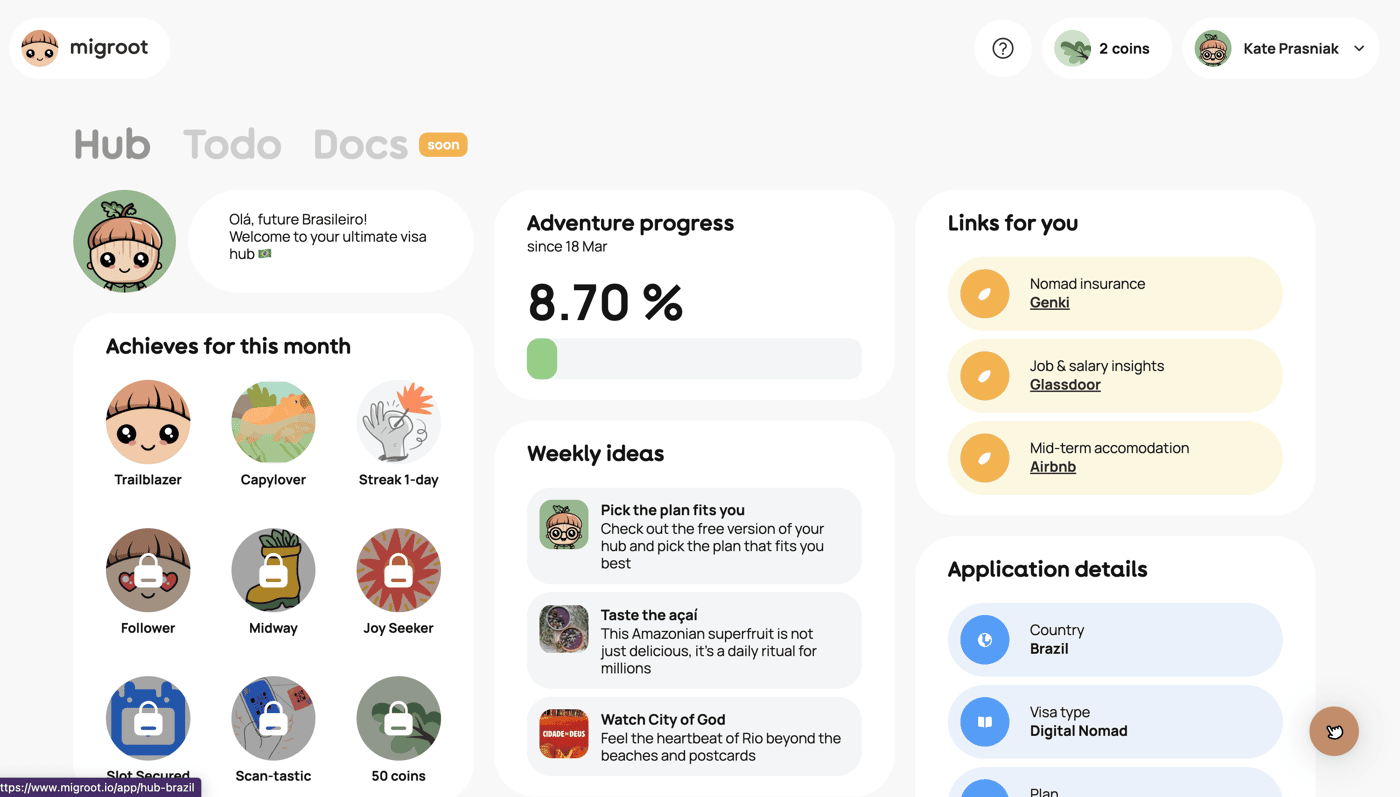
We’ve got a new leader in registrations at migroot.io this week: Brazil 🇧🇷
26 new users signed up this week to get help with Brazil’s digital nomad visa — that’s more than any other country we support right now.
Why Brazil?
My guess:
• Low barrier to entry — just $1,500/month in remote income or $18K in savings
• Great time zone overlap for those working with US clients
• Gaining traction among early-stage makers from Pakistan, India, Bangladesh, and the Philippines — where $1.5K/month might be your Chrome extension revenue 😅
Next week, I’ll dig deeper with some user interviews and share why makers are choosing Brazil — stay tuned.
In the meantime, we just published a free step-by-step guide to Brazil’s digital nomad visa. And yep, our free plan is still open if you want to start organizing your documents with a clean, no-BS interface.
-
1
Really nice approach , love the simplicity of the concept.
One thing I’m curious about: how are you planning to handle the friction around trust?
When people search for help in new places, trust is usually the first hurdle, especially with newer platforms.
-
1
What a great question! We’re planning to feature a testimonials section (right now it's pulling from Product Hunt, soon it’ll be from Trustpilot), and having been Product of the Day gives us a bit of social proof too.
We might even convince a couple of our clients to record video testimonials.
What would convince you?
-


Happy Wednesday, makers! I'm Kate — building migroot.io to make moving to a new country less overwhelming (especially for families like mine!).
Today’s a celebration post from our small team 🎉
One of our blog posts — Spain Digital Nomad Visa 2025: Your Epic Quest Guide! — recently got picked up by GPT chat recommendations… and boom! Our site traffic jumped 3.5x almost overnight.
We’re still not 100% sure what triggered the spike, but here’s what we did do:
Wrote genuinely useful content — not fluff. We included links to official government sources.
Did human editing — not just AI-generated posts. Actual eyes on every line.
Encouraged readers to share if they found it helpful (and they did 💛).
Fact-checked with real immigration lawyers — especially for legal details and numbers.
We're not doing any SEO magic, no backlink tricks. Just honest, helpful content.
What about your experience? Has GPT or Perplexity brought you any unexpected traffic? Any hacks or patterns you’ve noticed?
-
2
Super inspiring to see GPT recs boost real, helpful work. Makes me wonder how to increase those chances myself. Thanks for sharing!
-
1
Yes, our domain is less than six months old. The key is—don’t give up!
-
-
2
Thats insane, the key is finding out how does AI select your post. Based on my experience it probably does a bing search. If you analyse the chatgpt when it does search you will find it takes the user query and breaks it into search queries.
Aslong as your post comes up in the search query in bing, I think GPT will pick it up.-
1
That's interesting—why do you think it was Bing specifically?
-
1
Well because Microsoft owns a great share in OpenAI. Microsoft invested $13 Billion into OpenAI and also heres the reply from Chatgpt when asked:
Questions: How closely do you work with Microsoft services compared to Google Services? answer in 2 sentences. I mean in terms of web searching
Answer: In terms of web searching, I work more closely with Microsoft services through Bing Search, which powers my real-time search capabilities. I don’t have direct access to Google Search, so I can’t pull results from it or interact with its search API.
-
-
-
2
That’s an encouraging signal. Thoughtful content backed by real sources clearly stands out—even to AI. Kudos to your team for doing it right. Thanks.
-
1
Thank you! We're thrilled—it's a brand new domain, and honestly, I wasn’t expecting much traffic from search or GPT yet.
-
-
1
I've literally just been thinking about something very similar to this. Since we know that ChatGPT trains on your content if you don't opt-out, could we potentially feed it information that is helpful to us so it "learns" that our business exists?
-
1
This is great, congratulations! Using GPT/AI tools as a marketing channel is going to change the game for many marketing teams down the road
-
1
yep :)
-


Happy Monday, Indie Hackers! We’re continuing the freemium experiment on Migroot.io — a platform that helps digital nomads cut through visa bureaucracy and remove all that nasty friction from the relocation process.
Even though some folks in the comments said our freemium experiment was doomed to fail, we’re sticking to the plan. Gotta love the process, right?
Guess which country turned out to be the most popular among users applying for a digital nomad visa? (That’s the only visa we’ve opened access to so far.)
Portugal 🇵🇹.
Didn’t see that coming — but we’re leaning in.
Here’s what we’ve done and what’s coming this week:
🍷 We added a full relocation guide for Portugal — more value for users, better SEO for us. Win-win.
💃 We’re improving user activation — tweaking our "Do you qualify?" quest to make it more engaging and helpful.
🍷 We’re polishing the freemium flow — making the dashboard more fun, more interactive, and more useful for free users.
What are you working on this week? Let’s share and keep each other accountable
-
1
This is such a solid update — really admire how you're committed to the freemium model and continuously improving the user experience. The Portugal relocation guide sounds like a great SEO move too.
I'm actually working with clients on user onboarding, freemium strategy, and SEO optimization, so if you're ever looking for an outside perspective or support on refining those flows, happy to chat or brainstorm ideas!
Let’s keep the momentum going this week — love seeing progress like this in the community.

Hey Indie Hackers! I’m Kate from migroot.io — we help people relocate with less chaos.
One of the top questions we get from founders and indie makers is:
“Where do I get remote work while I bootstrap?”
Because let’s be real — sometimes you need income while your SaaS is pre-revenue,
or proof of remote work for that visa you’re planning to use when you move to Spain or Thailand. 🌍
Here are 5 lesser-known sources to find solid remote gigs — no Upwork noise, no recruiter spam:
1.) employ.work – Curated jobs from VC-backed startups. Think Notion docs, early-stage teams, and async-first cultures. Mostly EU/UK and global roles.
2.) Y Combinator Jobs – Not all are remote, but many YC startups are flexible or remote-first. Worth filtering through for cool roles.
3.) Arc.dev – Focused on remote dev roles with smart AI matching. Great if you’re looking to code for someone while coding for yourself.
4.) Pangian – Community-vibes remote job board with a values-driven approach. Often overlooked, but worth checking regularly.
5.) Remocate.app – Find a remote job that lets you move anywhere. Especially good for those planning to relocate in the next 6–12 months.
💡 If you're bootstrapping and need stable remote income to keep going — these can seriously help


At migroot.io, we believe great startups are borderless. Many of them are started by immigrants — and that’s not a coincidence. According to Dealroom’s 2025 report, 48% of CEE scaleups eventually move their HQ — chasing capital, markets, or talent.
We just read the latest Dealroom report on Central and Eastern European startups — and it confirmed what we already knew: talent moves, and the smartest ideas move with it. Here’s what stood out:
📦 48% of CEE scaleups move their HQ abroad
Founders go global — usually to the US or UK — for easier access to capital and markets. But they keep their R&D back home. Talent doesn’t disappear, it scales.
🚀 The CEE region grew faster than Western Europe (15.5x vs 7x in EV)
Despite getting way less funding per capita, CEE is punching way above its weight. It's the startup world's underdog story — bootstrapped, product-led, and global from day one.
🧠 SaaS dominates, but AI and DefenseTech are catching up
Enterprise software is still king, but sectors like AI, energy hardware, and security tech are booming — especially in Ukraine, Estonia, and Poland.
🦄 CEE produces unicorns differently
Bootstrapped unicorns are far more common here than in the rest of Europe. It’s not about who raises more — it’s about who builds smarter.
And you — have you ever relocated for work or your startup? From where to where?
8 Comments
I love hearing stories like this. It motivates me so much. I wish I could come up with something I don't expect nothing of only for it to become something big.
Yeah, I love reading that kind of stuff from other folks too
Hi Kate, nice idea. Do you have any plan to relase the service as api? People can find it useful.
Possibly, yes — especially if we at least add countries for social security coverage and include more details.
Sounds interesting, I'll try it
I'm glad to hear that! What did you think of it?
Thats great and creative how are you going to spread the word
thank you!