
Mujo AI
Easy way to create trendy content for social media and e-com

Hey Indie Hackers — I’m Nikolai, founder of Mujo AI.
After way too many “we’ll launch next week” weeks… we’re finally live on Product Hunt today:
Product Hunt Launch
What Mujo AI does :
You upload ONE decent product photo → Mujo AI builds a full marketplace-ready listing kit:
a cohesive gallery (hero → benefits → lifestyle → comparison, not random images)
ready-to-use copy (title, bullets, description)
everything stays consistent with a brand system (colors/fonts/tone)
and if you have many SKUs, you can scale it with Bulk (templates for whole galleries, not single images)
Why we built it:
Commerce content isn’t “generate one nice image”.
It’s “make 20 images that tell a story, fit platform rules, export cleanly, and repeat for 50 variants without losing your mind”.
There’s a free plan (no credit card). If you drop a comment with your use case, I’ll reply with a suggested workflow and help you get a first listing out fast.
Thanks — and yes, it feels surreal to finally hit “launch”.

That's it)


…and how we’re building the last mile of it at Mujo AI.
We still treat the smartphone like a magic wand. You notice you’re down to two decent plates. Or your run ends with the same cracked bottle you’ve been tolerating for months. The ritual starts: unlock, search, scroll, compare, read reviews, add to cart, get distracted, abandon.

Most of the time, it’s not that you don’t want the thing.
It’s that the system makes you work for it. This isn’t a “users are lazy” problem.
It’s a system-design problem. Our tools sit next to our lives instead of living inside them.
LLMs didn’t fix shopping. They just moved the friction.
Open any chat model and type:
“Pick a TV for me.”
You’ll get a plausible answer… that quietly assumes a bunch of things it doesn’t know:
your room size and viewing distance,
how much glare you get during the day,
what ports your existing gear needs,
whether you hate motion smoothing and soap-opera effect,
if you care more about sports than movies.
You can prompt forever:
“Add constraint X.”
“Make it cheaper.”
“I already have a Sonos setup.”
Or the system could just know you.
Two big gaps keep us stuck in “phone + search + tabs” land:
Sensing. Devices don’t really see what we see. They don’t know your 2018 foot massager is dying, that your kid has outgrown their car seat, that your only frying pan is permanently warped.
Actuation. Even when something knows, it can’t act. You still get a search results page, not a decision. You still have to compare, filter, and format the choice into something you trust.
LLMs helped with language. They didn’t change the surrounding system.
We’re already testing the new interface — it just looks awkward
The next interface for commerce won’t be “a better app”.
It will be ambient systems: small devices plus models that see, listen and suggest in the background.
You can see early prototypes already:
AI pins that promise “AI on your lapel” instead of in your hand — and then struggle with latency, reliability and basic UX.
Smart glasses that quietly add a camera and multimodal AI, so they can recognize objects and answer questions about what you’re looking at while you walk.
Headsets and wearables that are starting to treat “what you see and do all day” as a primary signal, not an afterthought.
On the pure software side, shopping assistants inside marketplaces that answer “what’s a good option for X?” instead of making you type keyword puzzles.
And when third-party agents started automating shopping in the browser “as a human”, some marketplaces moved fast to shut them down.
The direction of travel is obvious:
less screen, more agent
less typing, more context
fewer “sessions”, more continuous understanding
We’re just still in the ugly-prototype era.
What ambient commerce actually has to do
If you strip the hype away, an ambient commerce system has four jobs:
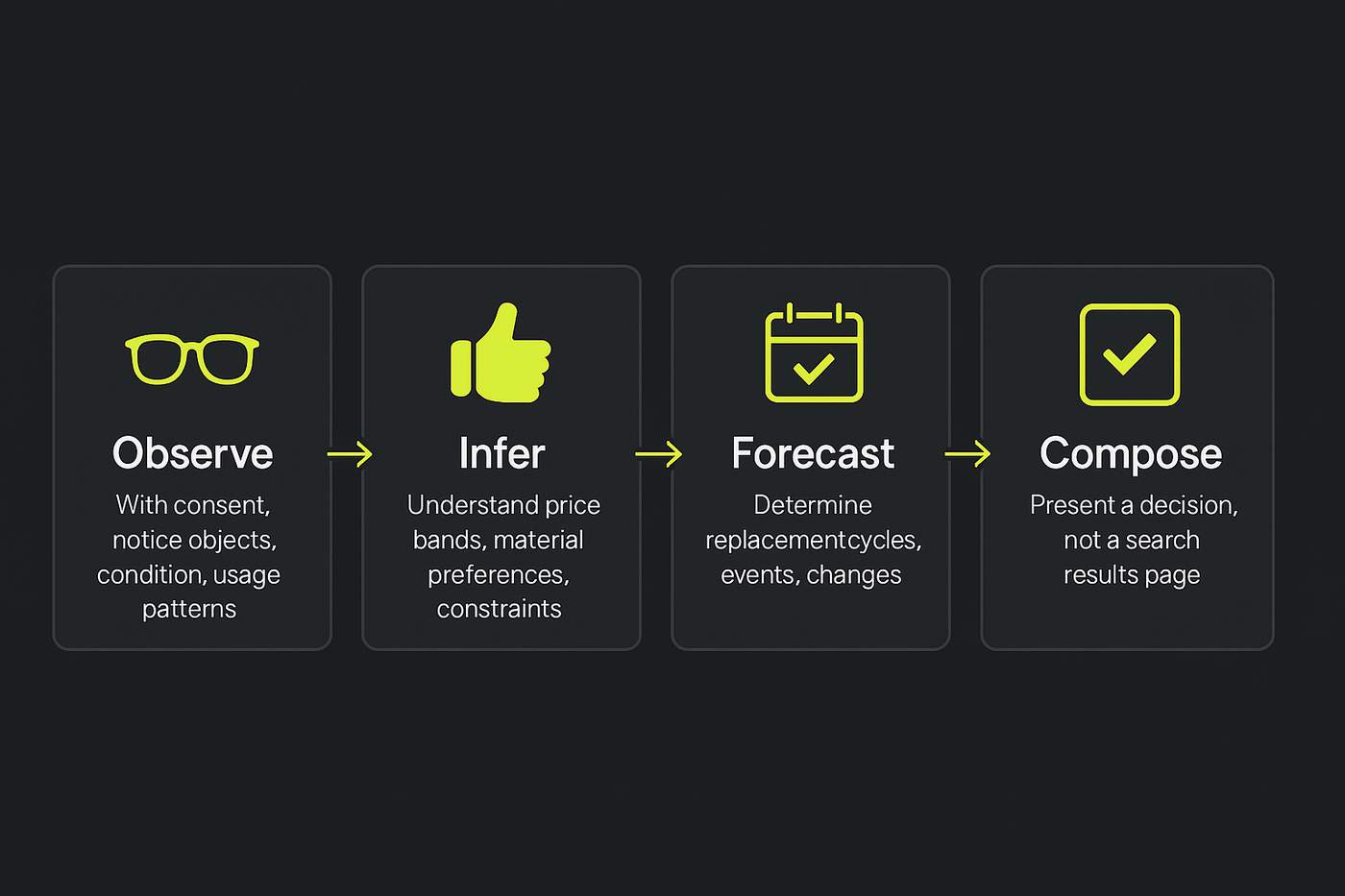
Observe your environment — with consent.
Glasses, pins, watches, home sensors: anything that can notice objects, condition, location, usage patterns.Infer your preferences.
Your real price bands. Brands you avoid. Materials you won’t tolerate. Constraints like “dishwasher-safe, no plastic”, “carry-on size only”, “works in a small apartment”.Forecast your needs.
Replacement cycles, seasonality, upcoming events, life changes. Not just “you bought a tent, here’s more tents” — but “you bought a tent, your calendar shows a trip, your shoes are worn out, here’s what’s missing”.Compose a decision, not a results page.
Instead of “here are 812 water bottles”, it should say:“You’re running with a cracked bottle. Here are three that match your style, fit your usual budget, clip to your bag, and don’t retain smell. Here’s the quick why for each.”
You glance. You nod. Done.
That’s ambient algorithms with taste.
Why this matters for commerce (beyond “cool gadgets”)
There are entire categories you’ll never search for because you don’t even know they exist — or you only remember them when it’s already annoying.
If the system sees you run three times a week, carry a bag with a carabiner, and hate bottles that smell, it can propose a better bottle before you articulate the problem.
If it infers wear and tear from how often you use that foot massager, it can flag the upgrade model that actually solves your pain points.
If it notices you only have two intact plates and a dinner on the calendar, it can nudge you with a short list that fits your kitchen, dishwasher, and taste.
The conversion uplift doesn’t come from louder ads or bigger hero banners.
It comes from timing + relevance + almost zero effort.
But even if all this sensing and inference works, there’s a boring, brutal problem left.
The last mile is not search. It’s creative.
Even if an ambient agent knows exactly what you need, something still has to persuade you:
visuals that match your taste and constraints,
copy that answers your objections instead of repeating the spec sheet,
formatting that fits marketplace rules and passes AI / computer-vision checks.
That’s the “last mile” we’re focused on at Mujo AI:
taking a product signal and generating a complete, on-brand listing — gallery + copy — that’s actually ready to ship.
Not:
a random pretty picture,
or text that ignores layout,
or a template that breaks on mobile.
A proper listing is a mini-funnel:
Hero → Benefits → Proof / Comparison → Lifestyle → Variants,
with titles and bullets that fit, read easily on mobile, obey rules, and don’t hallucinate.
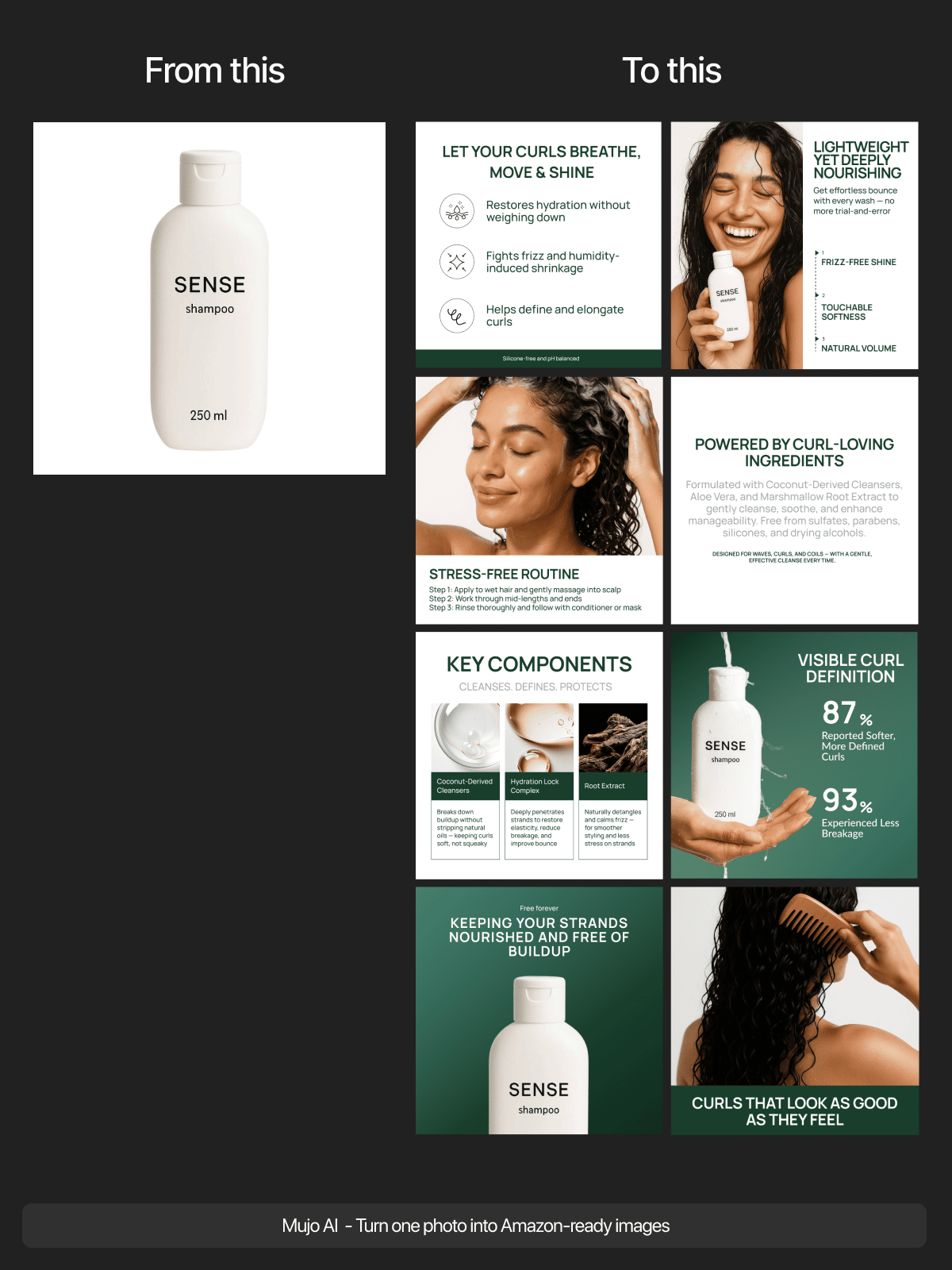
Marketplace algorithms and shoppers both respond to that structure, whether they consciously notice it or not.
A few concrete vignettes (you’ll recognize these)
Running shoes: Your watch sees your mileage creeping up and your gait data shows mild over-pronation, so instead of 200 models the system serves a 3-option card tuned to your distance, gait and price band.
Home office kit: Your laptop camera has watched your neck angle all day and your watch flags wrist strain, so it assembles a small ergonomic bundle—stand, mouse, light bar—already laid out in a listing that explains what actually gets better for your body.
Kids’ car seat: Photos and height logs show your kid has outgrown their seat and local rules say it’s time to change, so you get a short, compliant comparison of three models that fit your car, budget and safety preferences.
In each vignette, the creative,images + copy, does the last bit of work your brain still needs: “Yes, this is for me.”
Where Mujo fits in (and why we started “from the end”)
We began with the output, not the sensors:
From one product photo → a complete listing (gallery + copy), ready for Amazon/Shopify/Etsy.
No prompt marathons. No stitching tools. No guessing.
Why start here? Because the minute ambient systems exist, they’ll need a reliable way to compose persuasive, compliant, on-brand creatives at scale. That’s a harder problem than it sounds:
Copy ↔ layout fit: Headlines that actually fit; bullets that scan on mobile.
Visual legibility: Text-on-image contrast and safe areas that pass AI/computer-vision checks.
Variant lock: Strawberry vs peach stays identical in angle/light/geometry; only label/color change.
Exports that “download & post”: 1:1, 4:5, A+ modules, filenames, ZIP structure—all done.
That’s the engine we’re building.
How Mujo AI works today
Understand the product & buyer via Agent: detect use cases, audiences, and the real benefits behind the specs.
Write titles, bullets and descriptions that fit: generate and refine marketplace-compliant copy in a structured copy editor, tuned for length, clarity and platform guidelines.
Generate the gallery as a funnel in seconds: hero, benefits, comparison, lifestyle and more — not just a random photo dump.
Edit in the Mujo Design Editor: tweak layouts, swap scenes and adjust copy in an e-commerce-first, drag-and-drop editor where everything stays layered and reusable.
Reuse at scale with Bulk: save a project as a template and apply it to dozens of SKUs — Mujo AI rewrites the copy and regenerates scenes per product while keeping structure, fonts, colors and tone of voice.
Export: download marketplace-ready sets with the right ratios, formats and file structure, or keep iterating inside Mujo AI.
And yes, on the roadmap (and already partly in testing): richer multi-photo input, deeper brand kits, smarter Bulk flows for collections and bundles, team roles and permissions, and social-first exports.
-
2
Looking ahead, this feels like a big leap for commerce UX. I wonder if there are regions or user segments where this will lag (older users, privacy-sensitive segments). Thanks for sharing the prototype direction and for pulling the curtain back on the ‘last mile’ work
-
2
Great read. Love the idea that real commerce begins long before a screen is involved. The sensing–actuation gap is such an under-discussed bottleneck.
-
1
Yeah, that point hit me too. We talk so much about UI polish, but barely about the gap between noticing a need and acting on it
-


Hey IH 👋
We finally shipped Bulk. It might look like a weekly drop, but we actually spent longer on Bulk than on the rest of the platform combined. Generating one product is easy. Building a system that scales across many SKUs with lots of moving parts is hard.

We needed one place to control many variables: listing copy (description, bullet points), text that appears on slides, the images themselves, image styles, and fonts. There was no blueprint for this. So we stitched our own monster together 🧪⚡️ and battle tested it. The result feels great. Please try it.
How Bulk works 🧰
Think of Bulk as templates for entire galleries, not single images. One row is one listing. A template locks the layout and style so you can swap products without redesign🚀
Make one listing you love with the quiz.
Save it as a template.
Open the Bulk table. Each row is a listing.
Duplicate the row, change the Product cell, hit Generate.
We rewrite the copy, rebuild the scenes with the new product, and keep your layout, typography, and style perfectly consistent.
Ship it, then repeat for the next SKU.
Mug to thermos in one click
Same funnel, same slide order, same look. New copy. New images. New product.
Try it 👇
Access reliability ✅
Also we fixed verification code delivery and added a backup provider. If one route fails, the fallback sends the code. You can also sign in with Google. Fewer blocks when you need to get work done.
-
1
Congratulations on your launch. It looks impressive! What channels are you exploring to attract early users?
-
1
Generates a complete gallery set instantly, not just single images. Saves hours on creating a structured sales funnel (hero → benefits → comparison). A real pipeline for marketplaces, not just random pictures.
-
1
The output is spot-on: no fluff in the text, and all marketplace specs (sizes, safe zones) are correct. The price is a steal compared to freelancers. Works perfectly for Amazon, Etsy, and Shopify.


Shipping a single SKU in 2025 isn’t “open ChatGPT and ship.”
It’s a grind of gallery-funnel logic, brand rules, re-exports, and variant hell - repeated for dozens of SKUs:
Gallery ≠ album. You need a funnel: hero → benefits → proof → lifestyle → comparison.
Brand precision: colors, fonts, tone, iconography must match across SKUs/marketplaces.
Variant hell: change “strawberry” to “vanilla” but keep angle, scale, layout locked; re-export 1:1, 4:5, A+, mobile cuts.
Copy ↔ layout conflict: great bullets don’t fit; shorten → loses meaning, lengthen → breaks layout.
Ops drag: filenames, compression, localization, versioning. “One more tweak” = 100s of manual steps.
We built Mujo because the promise of LLMs + image models is speed — but commerce needs consistency, structure, and exports, not random cool shots.

What we’re building
Mujo AI — a design agent that turns one product photo into a complete, marketplace-ready listing content:
Detects audiences & use-cases, maps features → writes titles, bullets, descriptions.
Generates a gallery as a funnel: hero, benefits, comparison, lifestyle with text-on-image graphics.
Keeps brand system on by default: colors, fonts, tone.
Engineered for marketplace (Amazon, Shopify, TikTok Shop, etc.) AI/CV review
No prompt ping-pong. No Photoshop marathons. Just outcomes.
This isn’t “click once → random images.” It’s a logic layer that thinks like a designer and executes like ops.
Why now (and why us)
LLMs/diffusion models are great at one-off assets; commerce needs sets that tell a story and obey platform rules.
Small teams deserve agency-level output without hiring an agency.
We’ve done this work inside agencies for years; the pain is real, repeatable, and solvable with systems.
Early beta users (including our first paid) report a drastic drop in time-per-SKU once the gallery is framed as rules, not a blank canvas.

How it works (end-to-end)
Upload one clean product photo.
Agent proposes benefits, audiences, copy, and visual style.
Confirm/tweak → click Generate.
Get a cohesive gallery set + copy.
Export. Download marketplace-ready sets in a click. Layered files = fast edits. Post wherever you need.
Who gets the most value
Amazon/Shopify sellers shipping many SKUs.
Designers/creators who need fast ideation + bulk adaptations.
Agencies & VAs productizing listing optimization.
Solo founders who want “big-brand” consistency on small budgets.
Looking for IH feedback on

First-mile onboarding: too many questions or too few?
Copy controls: tone strictness, bullet length, claims vs. proof — what matters day-to-day?
Export presets: which platforms/aspects are non-negotiable for you?
Variant workflow: best way to lock geometry while swapping label/color?
Pricing model: credits per project vs. per image — what feels no-brainer?
A small thank-you
Drop a comment with your pain point or teardown request — I’ll DM 500 credits (≈ 1 month of Pro, $60 value) to the first IH folks who chime in.
One link
mujoai.com — Open Free Beta. no credit card
-
3
This is super well thought-out.
I’m curious how you handle brand fonts and color matching — do you extract them automatically from the uploaded photo or set them manually per project?
Either way, this looks like a huge time-saver for small ecom teams!-
1
This was a big one for us—we built a matcher that auto-pulls colors, recommends palette + fonts by audience/style, and supports manual overrides or a strict brand kit mode.
-
-
2
Such a sharp observation of real ecom pain points...
-
1
Thanks, Parag! Beyond today’s pain points, this becomes a necessity: creative at scale → true personalization → happier customers.
-
-
2
Big shift for small sellers and indie brands 🙌🏽
-
1
Thanks! It’s not just for small sellers-bigger brands with hundreds or thousands of SKUs need this too. Appreciate you checking it out! 💙
-
-
1
There don't appear to be any similar alternatives at the moment. It's not merely about standalone images; it's an end-to-end workflow designed exclusively for marketplace needs.
-
1
It seems that no real analogues exist yet. These aren't just images, but a fully functional pipeline tailored for marketplaces.
Are there short step-by-step tutorials/checklists planned within the product?
-
1
Recommendations for agencies are excellent, and most importantly, they provide ready-to-use prompt examples.
I’d love to know if step-by-step instructions for the products will be available later on?
-
1
Are you planning an affiliate/referral program for agencies and content creators?
-
1
Are there any plans for tutorials, video lessons, or checklists for the service? This would help users achieve an even higher quality final product.
-
1
The “gallery as a funnel” logic really comes through. It’s not just a set of pictures, but a sequence that leads to a purchase.
-
1
Exactly!gallery ≠ slideshow. Marketplaces already lean on CV/reco algorithms that thrive on this structure
-
-
1
Oh, this AI product seems to be especially suitable for businesses or shops operating on e-commerce platforms. Very useful. How many people are using this technology now?
-
1
Totally! We’re at ~600 beta users right now. No official launch yet—we’re gearing up for a public release soon. 🙂
-


Comment