
PostAutopsy
The brutally honest LinkedIn editor. Write. Get roasted. Rew
Most LinkedIn Advice Is Wrong. Here's What Actually Works in 2025.
Stop following outdated LinkedIn strategies. The algorithm changed.
I've grown to 21K followers on LinkedIn.
Not by following the standard advice. By testing what actually works in 2025.
Here's what changed, what's broken, and what you should do instead.
What Everyone Still Tells You (That's Wrong)
❌ "Post every day"
Wrong. The algorithm doesn't reward frequency anymore. It rewards engagement depth.
3 posts per week with high engagement > 7 posts per week with low engagement.
What actually works: Post 3-4x per week. Focus on quality over quantity. Give each post time to breathe.
❌ "Use 5-10 hashtags"
Wrong. Hashtags have minimal impact on reach in 2025. The algorithm prioritizes content quality and engagement signals, not hashtags.
What actually works: Use 3-5 relevant hashtags max. Focus on your hook and CTA instead.
❌ "Engagement pods will boost your reach"
Wrong. LinkedIn's algorithm detects pod behavior. Generic "great post!" comments from the same people hurt more than help.
What actually works: Genuine engagement from people who actually care about your content. One meaningful comment > ten generic ones.
❌ "Post motivational content to grow fast"
Wrong. Motivational content gets likes from people who'll never be your customers. You're building the wrong audience.
What actually works: Post about specific problems in your niche. Attract fewer people, but the right people.
❌ "Video performs best"
Wrong. In 2025, carousels outperform video on LinkedIn.
Carousels: 24.42% average engagement
Video: Lower than carousels
Text: 6.67% engagement
What actually works: Carousels. They increase dwell time, which the algorithm loves.
What The Algorithm Actually Rewards in 2025
1. Dwell Time
How long someone stays on your post matters most.
Carousels force people to swipe. More time = more reach.
2. Comments Over Likes
Comments are 15x more valuable than likes for algorithmic reach.
One thoughtful comment > 15 likes.
3. The First 60-120 Minutes
The algorithm tests your post in the first 1-2 hours. High engagement = wider distribution.
If you post and disappear for 4 hours, you've already lost.
4. Meaningful Interaction
"Great post!" doesn't count. The algorithm looks for:
Multi-sentence comments
Questions asked
Conversations started
Back-and-forth replies
5. Native Content
External links in posts kill reach. The algorithm wants to keep people on LinkedIn.
Add links in the first comment instead.
The Hook Reality
90% of posts fail at the hook.
Your first 3 lines show up in the feed. That's all you get to make someone stop scrolling.
Generic hooks that fail:
"I want to share something with you today..."
"Here are my thoughts on..."
"Today I learned..."
"I'm excited to announce..."
Hooks that work:
Specific numbers: "I spent $4,800 before I learned this..."
Surprising stats: "92% of LinkedIn posts fail because..."
Bold claims: "Most LinkedIn advice is wrong."
Pattern interrupts: "Stop posting on LinkedIn. (Here's why)"
Test: Read your first line. Would YOU stop scrolling? Be honest.
The CTA Problem
Most CTAs are lazy:
"What do you think?"
"Thoughts?"
"Agree?"
These get courtesy likes. Not real engagement.
CTAs that drive comments:
"Which would you choose: X or Y? Why?"
"Have you faced this problem? How did you solve it?"
"What would you add to this list?"
"Where am I wrong on this?"
Specific questions get specific answers. Specific answers = engagement.
The Carousel Format
If you're not using carousels, you're leaving 3x engagement on the table.
Why carousels work:
People swipe through them (increases dwell time)
Algorithm sees longer engagement
Post gets pushed to more people
They're saveable/shareable
Simple structure:
Hook slide (stop the scroll)
Credibility slide (why listen to you)
Value slides (one insight per slide)
CTA slide (drive comments)
Make them in Canva or PowerPoint. Export as PDF. Upload as document.
The First 2-Hour Rule
When you post, set a 2-hour timer.
Your only job for those 2 hours:
Reply to every comment
Ask follow-up questions
Keep conversations going
Tag relevant people (expands reach)
This is when the algorithm decides your post's fate.
High engagement in first 2 hours = wide distribution. Low engagement = post dies.
Most people post and ghost. That's why they fail.
What Actually Grows You
Not this:
Posting daily
Generic content
Chasing followers
Engagement pods
Copying viral posts
This:
Posting strategically (3-4x/week)
Specific, valuable content
Attracting the right audience
Genuine engagement
Original perspective
Quality followers who engage > large audience that ignores you.
The Content Framework
Every post should do one thing:
Teach something specific and actionable.
Not inspire. Not motivate. Not announce.
Teach.
Framework:
Hook (specific problem or insight)
Context (why it matters)
Value (what they can use today)
Proof (data, example, result)
CTA (specific question)
That's it. Keep it simple.
Why PostAutopsy Exists
After growing to 21K followers, I realized most people can't objectively score their own content.
You think your hook is strong because you know the context.
Your audience scrolls because they don't.
PostAutopsy analyzes your post before you publish:
Hook strength (/10)
Clarity (/10)
Emotion (/10)
Structure (/10)
CTA quality (/10)
Novelty (/10)
Total score out of 10. If you're below 8, it tells you exactly what's weak.
Then it rewrites it using AI to maximize engagement.
5,046 posts analyzed by real users.
It's the objective feedback you need before hitting publish.
Common Mistakes I See Daily
1. Burying the hook
First line is generic. Real insight is in paragraph 3.
By then, I've already scrolled.
2. No clear value
Post is about you. Not for me.
I don't care about your journey unless there's a lesson I can use.
3. Weak or missing CTA
Post ends with "thoughts?" or nothing.
No engagement driver = no comments = no reach.
4. Wall of text
No line breaks. Dense paragraphs. Impossible to skim on mobile.
67% of LinkedIn is mobile. Make it scannable.
5. Posting and ghosting
They post at 9 AM. Check back at 5 PM.
The algorithm already decided the post was dead at 11 AM.
The 30-Day Test
Week 1:
Optimize your profile (headline, about, featured)
Create one carousel (6-8 slides, one lesson)
Post it, engage hard for 2 hours
Track: comments, not likes
Week 2:
Post 3 times (test different hooks)
Reply to every comment within 2 hours
Spend 30 min/day commenting on others' posts
Track: what gets real engagement
Week 3:
Create 2 more carousels
Double down on hooks that worked
Start using PostAutopsy to score before posting
Track: profile views, connection requests
Week 4:
Analyze what worked
Build a content system
Plan next 30 days
Track: meaningful conversations, not vanity metrics
What Success Looks Like
Not this:
10K followers
500 likes per post
Tons of impressions
This:
Engaged audience (even if smaller)
Real DM conversations
People asking about your product
Quality connections
I'd rather have 1,000 engaged followers than 10,000 who scroll past.
The Reality Check
LinkedIn in 2026 is not about:
Going viral
Posting daily
Follower count
Likes and vanity metrics
It's about:
Providing consistent value
Attracting the right people
Building real relationships
Converting attention to customers
Most people optimize for the wrong thing.
Bottom Line
Stop following outdated advice.
The algorithm changed. Your strategy should too.
Use carousels (24.42% engagement vs 6.67%)
Post 3-4x per week (quality over quantity)
Focus first 2 hours (make or break window)
Write strong hooks (first 3 lines decide everything)
Ask specific CTAs (drive real comments)
Score your content before posting (use PostAutopsy)
Simple strategy. Execution is everything.
PostAutopsy: Score your LinkedIn posts before publishing. Know what's weak before the algorithm does.
Try it: postautopsy.com
Connect: linkedin.com/in/arunachalam-numismatician
Questions? Drop them below. I respond to every comment.
Built by someone who tested everything and kept what worked.

What indie hackers get wrong about building an audience
You're doing everything the "experts" tell you:
✓ Posting consistently (3-5x per week) ✓ Building in public (sharing your journey) ✓ Engaging with others (commenting daily) ✓ Using hashtags (5-7 per post) ✓ Being authentic (sharing wins and losses)
And your follower count barely moves.
Because everyone's giving you the same advice. And everyone's following it.
The problem isn't what you're doing. It's how you're thinking about it.
The Backwards Approach
Most indie hackers treat LinkedIn like this:
Build something
Post about it
Wait for people to care
Repeat
This is backwards.
You're creating content ABOUT your product instead of creating content THAT your ideal customer needs.
The Real Question Nobody Asks
Before you write your next LinkedIn post, ask yourself:
"If this post performs well, who will it attract?"
Not "Will it get likes?" Not "Will it go viral?"
Who will it bring into your orbit?
Because here's what matters: audience quality > audience size.
The Uncomfortable Truth
I've seen indie hackers with:
10K followers and $0 MRR
500 followers and $5K MRR
The difference? The second one attracted the right people.
Your LinkedIn isn't a vanity metric dashboard. It's a customer acquisition channel.
Most indie hackers forget this.
What High-Converting Indie Hackers Do Differently
They don't post about their product. They post about the problem their product solves.
Example:
Low-converting post: "We just added a new feature to our project management tool! Now you can create custom workflows with drag-and-drop functionality. Check it out!"
Who does this attract? Nobody. Because nobody wakes up wanting "drag-and-drop functionality."
High-converting post: "I watched our designer recreate the same 12-step process 47 times last week.
Each time: screenshot, upload, tag, comment, export, archive...
I built a button that does it once.
Here's why automation isn't about saving time. It's about saving sanity."
This attracts people who have that exact pain. Your ideal customers.
The Content Shift
Stop thinking: "What do I want to say about my product?"
Start thinking: "What does my ideal customer need to hear today?"
Shift 1: From Product to Problem
Before: "Our tool has X feature" After: "Here's how to solve Y problem (even without tools)"
Shift 2: From Metrics to Meaning
Before: "We hit 1K users!" After: "The user who made me rethink everything said..."
Shift 3: From Updates to Utility
Before: "Here's what we shipped this week" After: "Here's what I learned building this week"
Shift 4: From Selling to Teaching
Before: "Try our product" After: "Try this approach (this is how we built it into our product)"
The Algorithm Doesn't Care About Your Product
LinkedIn's algorithm in 2025 optimizes for one thing: keeping people on LinkedIn.
It doesn't care about:
How hard you worked
How cool your product is
How consistent you are
How much you deserve success
It cares about:
Did people stop scrolling? (Hook quality)
Did they stay? (Dwell time)
Did they engage? (Comments)
Did they come back? (Follow-up)
Your content is competing with everything else in someone's feed.
Product announcements lose to valuable insights every time.
Why Your Posts Aren't Converting
Let me guess your last few posts:
"Excited to announce..."
"Here's what I learned this week..."
"Building in public: day X..."
"Just shipped..."
"Thanks for the support..."
These aren't bad posts. They're just not strategic.
They're not written for your customer. They're written for you.
The Strategic Framework
Every LinkedIn post should serve one of three purposes:
Purpose 1: ATTRACT
Pull in your ideal customer by addressing their specific pain point.
Example: "You're not bad at cold outreach. Your ICP is wrong.
Here's how I figured out mine after 200 rejections..."
Purpose 2: NURTURE
Build trust by teaching something valuable (unrelated to your product).
Example: "The best product feedback I ever got came from someone who never used our product.
Here's why I now interview churned users more than active ones..."
Purpose 3: CONVERT
Direct people toward your solution (sparingly - maybe 1 in every 10 posts).
Example: "I've spent 6 months building a solution to [specific problem]. 47 people are using it now.
Here's what they're saying..."
Most indie hackers do 80% convert, 20% attract, 0% nurture.
It should be: 50% attract, 40% nurture, 10% convert.
The Content Scoring System You're Missing
Before you post, you need to know if it's actually good.
Not "do I like it?" — "will it work?"
Score each post:
Hook: Does the first line make someone stop scrolling? (/10)
Relevance: Does my ideal customer care about this? (/10)
Value: Will they know something actionable after reading? (/10)
Emotion: Does it make them feel something? (/10)
CTA: Does it invite meaningful engagement? (/10)
Clarity: Can they skim it in 30 seconds? (/10)
If you're below 8/10 on any of these, don't post it.
But here's the problem: most indie hackers can't objectively score their own content.
You're too close to it. You think your hook is strong because you know the context.
You need an outside perspective.
This Is Why PostAutopsy Exists
You're writing content between code sessions. Between customer calls. Between fighting fires.
You don't have time to second-guess every post.
PostAutopsy does it for you:
Scores your hook, clarity, novelty, emotion, structure, CTA
Tells you exactly what's weak (brutally honest)
Rewrites it using AI to maximize engagement
Ensures you're hitting 8+/10 before you publish
Example:
You write: "Working on some exciting updates for the product. Should be launching next week. Stay tuned!"
PostAutopsy scores it: 2/10
Hook: 1/10 (generic, no specificity)
Relevance: 2/10 (who cares about "updates"?)
Value: 0/10 (reader gets nothing)
CTA: 0/10 (no engagement driver)
PostAutopsy rewrites: "I almost launched with the wrong pricing model.
Would've cost us 60% of potential revenue.
A customer told me 'I'd pay 10x for this if it solved [specific thing].'
That one sentence changed our entire roadmap.
When was the last time customer feedback completely shifted your direction?"
New score: 8.5/10
Same information. Different angle. 10x engagement.
The Mindset Shift
Stop asking: "What should I post?"
Start asking: "What does my ideal customer need to see today?"
Stop asking: "How do I get more followers?"
Start asking: "How do I attract the RIGHT followers?"
Stop asking: "Is this post good?"
Start asking: "Will this post convert?"
Building in public is powerful. But only if the right people are watching.
What's Actually Working Right Now
Based on indie hackers who are converting LinkedIn into revenue:
1. Problem-First Content
Lead with the pain point. Your product is the footnote.
2. Micro-Lessons Format
"Here's one thing I learned today about [customer pain point]"
Better than "Here's 10 things I learned this month"
3. Customer Story Posts
"A user told me..." performs better than "I built..."
4. Behind-the-Scenes Decision Making
"Here's why I chose X over Y" beats "We chose X"
5. Contrarian Takes (If You Can Defend Them)
"Everyone says do X. Here's why I did Y instead."
6. Failure Forensics
"This didn't work. Here's the data. Here's what I learned."
Notice the pattern? None of these are about the product. All of them attract the right people.
The 30-Day Perspective Shift
Week 1: Audit
Review your last 20 posts
For each one, ask: "Would my ideal customer care about this?"
Calculate your attract/nurture/convert ratio
Notice the pattern
Week 2: Research
Spend 30 min/day reading posts from successful indie hackers
What problems are they addressing?
How do they structure their hooks?
What CTAs drive comments?
Week 3: Test
Write 5 posts focused on customer problems (not your product)
Score each one before posting
Only post 8+/10
Track engagement difference
Week 4: Optimize
Double down on what's working
Use PostAutopsy to refine every post
Start building a content system
The Brutal Reality Check
If your LinkedIn posts aren't converting into:
DMs from potential customers
Sign-ups for your product
Conversations about pain points
Real business relationships
Then you're building the wrong audience.
And building the wrong audience is worse than having no audience.
Because it tricks you into thinking you're making progress when you're not.
The ROI of Better Content
Scenario A: Current Approach
Post 4x/week = 16 posts/month
Average engagement: 20 likes, 2 comments
Followers attracted: Random
Customer conversations: 0-1/month
Time wasted: ~8 hours
Scenario B: Strategic Approach
Post 3x/week = 12 posts/month
Average engagement: 40 likes, 15 comments
Followers attracted: Ideal customers
Customer conversations: 5-8/month
Time saved: ~4 hours (less posting, better results)
The difference? Each post is scored and optimized before publishing.
What High-Performing Indie Hackers Do
They treat every LinkedIn post like a mini landing page:
Hook = Headline (stop the scroll)
Body = Value prop (make them care)
CTA = Conversion (drive action)
They don't post and hope. They post with intention.
They don't build in public blindly. They build an audience strategically.
They don't chase followers. They attract customers.
And they score their content before it goes live.
The PostAutopsy Advantage
You can try to do this manually:
Write your post
Question every line
Rewrite the hook 5 times
Test different CTAs
Wonder if it's good enough
Post and hope
Or:
Write your post
Run it through PostAutopsy (2 minutes)
See exactly what's weak
Get AI-optimized rewrites
Post with confidence
Same result. 80% less time. Zero guesswork.
Bottom Line
Your LinkedIn strategy is backwards if you're:
❌ Leading with your product instead of customer problems ❌ Posting without knowing if it will work ❌ Building an audience instead of attracting customers ❌ Measuring likes instead of conversations ❌ Creating content for yourself instead of for them
Flip it:
✅ Lead with problems your ideal customer has ✅ Score every post before publishing (8+/10 or don't post) ✅ Attract the right people, not just more people ✅ Measure meaningful engagement (DMs, conversations) ✅ Create content that serves your customer, not your ego
PostAutopsy makes this shift easy.
It's not another content tool. It's the perspective you need before you hit publish.
Try PostAutopsy: The brutally honest LinkedIn editor that ensures you're posting strategically, not randomly.
Stop building an audience. Start attracting customers.
-
1
Post-mortems like this really hit close to home. I spent 8 months coding a SaaS with zero customers and another 6 months on a marketplace with barely a dozen users. It was tough to realize that I had built something no one wanted. But that pain forced me to rethink how I start projects.
Here are some tips:
* Start with quick experiments before writing code.
* Talk to potential users early, even if it’s just to validate your problem assumptions.
* Build the smallest thing that can test your riskiest hypothesis.
* Track real engagement, not just downloads or signups.
Did you do any kind of early user interviews or prototype testing before you went deep on building?
-
1
Just tested it out. Its actually a great tool... nothing to add... the rewritten version is not working is my only remark.
-
1
I didn’t see an easy way for visitors to contact you or send feedback. I’m building a tiny floating feedback widget called GetSig that drops into any site in a couple minutes. Happy to set you up with free early access if you’d like to try it 🙂
-
1
I went through the site and the value becomes clear as you scroll.
The hero is solid, but it explains the mechanism before anchoring the pain. For most users, the real tension is why their posts underperform if that showed up in the hero, the rest of the page would land even stronger.
-
1
yea will check on it man thanks for your valuable feedback
-
-
1
Hi Arunachalam,
Came across your post on why most LinkedIn strategies are backwards — especially the point about measuring conversations over likes. That perspective really resonated.
I’m building NextGen AI Labs, a small team working on AI, ML, data, and full-stack execution for early-stage teams. We’re very aligned with the idea of problem-first thinking over content-first noise.
PostAutopsy feels less like a tool and more like a mindset shift — which is rare. Would love to connect and explore if there’s any scope to collaborate or exchange perspectives as we both build.
— Adhish


The brutal truth about LinkedIn engagement (and how to fix it)
Last month, I went through 500+ LinkedIn posts from indie hackers.
Founders building in public. Sharing their journey. Posting updates.
The results:
78% got under 20 engagements
92% had weak or missing CTAs
89% buried their hook in paragraph 3
Only 6% were using carousels (the highest-performing format)
Most indie hackers are wasting their best distribution channel.
The Pattern I Found
Almost every failing post followed the same structure:
**"Today marks [timeframe] since I started [product].
Here's what I've learned:
Lesson 1
Lesson 2
Lesson 3
Building in public is hard but rewarding. What's your experience?"**
This format gets 12-30 likes. Maybe 2 comments.
Why?
The 6 Fatal Mistakes
1. The Hook Is Buried
Most indie hackers write like they're journaling.
Bad: "It's been an interesting 3 months working on this project. I've learned so much about product development, customer acquisition, and building in public. Here are some thoughts..."
By the time you get to something interesting, I've already scrolled.
Good: "I spent $4,800 on ads before I realized I was targeting the wrong customer.
Here's the pivot that saved the business."
The hook should be the first sentence. Not the third paragraph.
2. No Emotional Pull
Facts don't get engagement. Feelings do.
Weak: "We launched our SaaS product last week. It helps teams manage their workflow."
Strong: "I built for 8 months in isolation. Launch day, 3 people signed up. All three churned within a week.
The comments on that post taught me more than 8 months of building."
People don't engage with features. They engage with struggle and transformation.
3. The CTA Is Generic (or Missing)
Most common CTAs I saw:
"Thoughts?" (147 times)
"What do you think?" (203 times)
"Agree?" (89 times)
No CTA at all (267 times)
These don't drive conversation. They drive courtesy likes.
CTAs that work:
"What's the longest you've built before getting your first paying customer?"
"Would you pay $20/month for this or $200/year? Why?"
"How do you decide when to pivot vs push through?"
Specific questions get specific answers. Specific answers drive engagement.
4. Wall of Text
LinkedIn is a mobile-first platform now. 67% of users are on mobile.
Walls of text get scrolled past.
What works:
Short paragraphs (1-3 lines max)
Blank lines between thoughts
Bold or italic for emphasis (sparingly)
Numbers and data points
Scannable structure
If your post looks like a blog article, you've already lost.
5. They're Using the Wrong Format
Text posts: 6.67% average engagement Carousels: 24.42% average engagement
That's 3.6x more engagement just by changing format.
Why do indie hackers avoid carousels? "Too much work."
A carousel takes 30 minutes to make. A text post that performs badly wastes hours of potential reach.
The math is obvious.
6. Zero Follow-Up
The algorithm tests your post in the first 60-120 minutes.
If people engage → it goes wider If they don't → it dies
What most indie hackers do:
Post
Hope
Check back in 4 hours
Wonder why it flopped
What works:
Post
Reply to every comment immediately
Ask follow-up questions
Tag relevant people
Keep the conversation going
The first 2 hours determine everything.
The Posts That Actually Work
From those 500 posts, about 30 performed exceptionally well (100+ meaningful engagements).
Common patterns:
Pattern 1: The Failure Story
"I lost $X doing Y. Here's what I learned."
Works because:
Specific number (credibility)
Relatable pain
Promise of lesson
Emotional hook
Pattern 2: The Pivot
"I was building X. My users wanted Y. Here's how I figured it out."
Works because:
Shows listening to market
Demonstrates flexibility
Validates indie hacker fear ("am I building the right thing?")
Pattern 3: The Numbers
"From $0 to $X MRR in Y months. Here's the breakdown."
Works because:
Concrete proof
Milestone achievement
Transparent data
Actionable lessons
Pattern 4: The Contrarian Take
"Everyone says do X. I did Y instead. Here's why."
Works because:
Challenges assumptions
Novel perspective
Sparks debate
Notice what's missing? Product announcements.
The Real Problem
Most indie hackers don't have an editor.
They're writing between code sessions. Between customer calls. Between putting out fires.
They write → post → hope.
But hope isn't a strategy.
Enter PostAutopsy
I built PostAutopsy because I kept making the same mistakes.
Here's what it does:
Before you post anything on LinkedIn, it analyzes:
Hook strength: Is it stopping the scroll?
Clarity: Can people understand it instantly?
Novelty: Is this original or generic?
Emotion: Does it make people feel something?
Structure: Is it scannable on mobile?
CTA: Will it drive comments?
It gives you a score out of 10.
If you're below 8, it tells you exactly what's wrong.
Then it rewrites it for you using AI.
Real Example
Original post: "Just hit 100 users on our platform! Thanks to everyone who supported us. We have some exciting features coming soon. Stay tuned!"
PostAutopsy scores it: 3/10
Hook: 2/10 (no emotional pull, generic milestone)
CTA: 0/10 (no CTA, just announcement)
Novelty: 1/10 (everyone posts this)
Emotion: 4/10 (slight excitement, but not contagious)
PostAutopsy rewrites: "100 users in 3 weeks.
83 of them found us from one Reddit comment.
Not the comment promoting my product. The comment where I admitted what wasn't working.
Here's what I'm learning about authenticity vs marketing..."
New score: 8.5/10
Hook: 9/10 (specific numbers + surprising insight)
CTA: 8/10 (implied - people will ask questions)
Novelty: 9/10 (fresh angle on familiar milestone)
Emotion: 9/10 (vulnerability + curiosity)
First post would get 20 likes. Rewritten post would get 100+ comments.
Why This Matters for Indie Hackers
You're building in public because:
It keeps you accountable
It attracts early users
It validates ideas
It builds your audience while you build your product
But if nobody sees your posts, none of that happens.
LinkedIn is the highest-converting platform for B2B indie hackers. But only if your content actually performs.
PostAutopsy ensures every post is optimized before you hit publish.
The System That Works
Step 1: Write your post (5-10 minutes)
Step 2: Run it through PostAutopsy (2 minutes)
Check the score
Read the analysis
See what's weak
Step 3: Use the AI rewrite (1 minute)
It suggests improvements
Strengthens your hook
Adds a better CTA
Optimizes structure
Step 4: Post and engage (first 2 hours are critical)
Total extra time: 3 minutes Engagement increase: 3-5x on average
What Successful Indie Hackers Do Differently
They don't post more. They post better.
They:
Lead with hooks that stop the scroll
Use carousels to increase dwell time
Have specific CTAs that drive comments
Reply to every comment in the first 2 hours
Score their content before posting
Iterate based on what works
They treat LinkedIn like distribution, not a journal.
The LinkedIn Algorithm Reality
In 2025, the algorithm rewards:
✅ Dwell time (how long people spend on your post) ✅ Comments over likes (15x more valuable) ✅ Carousels over text (3.6x more engagement) ✅ Strong hooks (first 3 lines visible in feed) ✅ Meaningful conversation (not "great post!")
It punishes:
❌ Engagement bait ("Agree?") ❌ Generic content (seen it before) ❌ No CTA (nothing to engage with) ❌ Poor structure (walls of text) ❌ Links in posts (keeps people off LinkedIn)
You can't fight the algorithm. You have to work with it.
Action Plan for This Week
Monday: Analyze your last 5 LinkedIn posts. Score them honestly:
Hook: /10
CTA: /10
Value for reader: /10
Find the pattern in what worked and what didn't.
Tuesday: Take your worst-performing post. Rewrite just the hook using the formula: [Specific number/timeframe] + [consequence] + [promise]
Wednesday: Create your first carousel:
6-8 slides
One lesson per slide
Strong hook on slide 1
Specific question on final slide
Thursday: Post and engage for the first 2 hours. Reply to every comment. Ask follow-ups.
Friday: Use PostAutopsy to score your next post before publishing. Don't post anything below 8/10.
Bottom Line
500 posts. 6 patterns of failure. 1 solution.
Most indie hackers are posting blind.
They don't know if their hook is strong. They don't know if their CTA will work. They don't know if the structure is scannable.
They post and hope.
PostAutopsy removes the guesswork.
It's the brutally honest editor that:
Scores your content before you publish
Tells you exactly what's wrong
Rewrites it to maximize engagement
Helps you build an audience while you build your product
Because you can't afford to waste your distribution.
Every post is an opportunity to reach potential users. To get feedback. To validate ideas. To build your audience.
Make every post count.
Try PostAutopsy: The brutally honest LinkedIn editor for indie hackers.
Stop posting blind. Start posting with confidence.
-
1
Interesting take/approach/tool. There's an aspect of this that has to do with time tested elements of good story writing, but the part about the (e.g. LinkedIn) algorithm puts an interesting twist on things. Thx for the info
-
1
Yeah, hitting that wall after investing time is incredibly frustrating. I’ve been there where you believe the idea is solid but skip proper validation, only to realize months later that you’ve built a ghost. For me, it was a recruitment AI tool that looked great on paper, but barely anyone wanted to use it. This experience taught me to pause and ask if anyone actually needs what I’m building before jumping in.
Here are some tips to help you approach validation effectively:
- Start with quick landing pages or even just surveys to gauge interest.
- Talk to potential users early and often, even if it feels awkward.
- Try small experiments that don’t require full builds, like mockups or no-code demos.
- Set a strict timebox for validation before writing a single line of code.
- Don’t be afraid to pivot or kill ideas fast; it’s better than months wasted.
How did you approach validation before you started building on this one? Did you talk to users or just follow a gut feeling?
-
1
its not just the gut feeling , its more like i have been talking to founders , indiehackers , in my circle , they felt the same what i did
So i started building postautopsy
-
-
1
Thank you for sharing this. You did a big job!
Next time I ask ChatGpt to write me a post on Linkedin I will feed him your post first to follow the rules! 😉
-
1
or you can just use postautopsy.com to write your linkedin posts
-


By Arunachalam S
LinkedIn: linkedin.com/in/arunachalam-numismatician
21,000+ followers. Real growth. Real strategy.
What Changed in 2025
The LinkedIn algorithm prioritizes completely different things now:
Engagement by Format (2025):
Carousel posts: 24.42% average engagement
Multi-image posts: 6.60% engagement
Text posts: 6.67% engagement
What the Algorithm Values:
Dwell time (how long people stay on your post)
Comments over likes (15x more valuable for reach)
First 60-120 minutes (this window decides everything)
Native content (no external links in posts)
Real conversations (not engagement bait)
The Core Strategy
1. Profile as Landing Page
Headline Structure: [What You Do] | [Who You Help] | [Unique Angle]
Your headline shows up everywhere on LinkedIn. Make it count.
About Section:
Lead with why, not what
Include proof points
End with how people can work with you
Featured Section:
Your best posts
Projects you've shipped
Social proof
2. The Carousel Advantage
Carousels dominate because they increase dwell time. Simple as that.
Structure:
Slide 1: Hook (stop the scroll)
Slide 2: Proof/credibility
Slides 3-8: One insight per slide
Final slide: Question that drives comments
Specs:
1080 x 1080px or 1080 x 1350px
Upload as PDF
6-10 slides optimal
Keep text minimal
Why They Work: People swipe through them → more time on post → algorithm pushes it harder.
3. Writing That Hooks
Most LinkedIn posts fail in the first line. The hook determines if people stop scrolling.
What Makes a Strong Hook:
Bold statement that challenges assumptions
Surprising stat or number
Provocative question
Personal admission or vulnerability
Pattern interrupt
Example Hooks:
"I wasted 6 months building something nobody wanted."
"LinkedIn's algorithm changed. 90% of advice is now wrong."
"21K followers taught me this isn't about followers."
The first 3 lines show up in the feed. Make them count.
4. The CTA Problem
Most posts don't have a clear call-to-action. Or they have weak ones.
Weak CTAs:
"What do you think?"
"Thoughts?"
"Agree?"
Strong CTAs:
Ask a specific question related to your post
Invite people to share their experience
Request actionable input
Challenge them to try something
The CTA determines if you get comments. Comments determine reach.
5. The First 2-Hour Window
When you post, the algorithm tests it with a small audience. Their response determines if it goes wider.
What to do:
Reply to every comment immediately
Ask follow-up questions in your replies
Tag relevant people to expand reach
Add value in comments, don't just thank people
Comments signal quality. The more conversation in the first 2 hours, the more reach you get.
6. Content Structure That Works
The Formula:
Hook (first 3 lines)
Context (why this matters)
Value (the actual insight/lesson)
Proof (data, example, result)
CTA (specific question)
Common Mistakes:
Too long (1500+ words)
No line breaks (wall of text)
Buried lede (hook is weak)
No clear takeaway
Generic CTA
Missing emotional element
This is where most people fail. They write, but they don't write for LinkedIn.
Where PostAutopsy Fits
Here's the problem: You know what to say, but you don't know how to say it for LinkedIn.
PostAutopsy is the brutally honest LinkedIn editor.
What it does:
Analyzes your post for hook strength
Rates clarity, novelty, emotion, structure
Identifies weak CTAs
Rewrites content for better engagement
Optimizes scannability
Inserts CTAs strategically
Shows you exactly what's wrong (and how to fix it)
Why it matters:
Gives you a score out of 10 before you post
Roasts your content (so LinkedIn doesn't)
Rewrites in real-time using AI
Helps you write better hooks
Ensures every post has a strong CTA
Learns what works for your audience
The difference between a 6/10 post and a 9/10 post is engagement. PostAutopsy helps you hit 9/10 consistently.
Example: You write: "Today I launched my new product. Check it out!"
PostAutopsy scores it: 3/10
Hook: Weak (no emotional pull)
CTA: Missing (no engagement driver)
Structure: Poor (no value provided)
PostAutopsy rewrites it: "I spent 4 months building in silence. Today, real users are using it.
The feedback is already making me rethink everything.
Here's what I learned about building in public vs building in private..."
Score: 8.5/10
That's the difference between 12 likes and 200 comments.
The Writing System
Before you post:
Write your draft
Run it through PostAutopsy
Check the score (Hook, Clarity, Novelty, Emotion, Structure, CTA)
Read the roast (it's honest)
Use the AI rewrite suggestions
Adjust based on feedback
Post when it's 8+/10
This takes 5 extra minutes. It multiplies your results.
Engagement Formula
30 minutes daily:
Morning (15 min):
Comment thoughtfully on 5-10 posts in your niche
Not "great post" — add perspective, share experience, build on their idea
When you post (first 2 hours):
Reply to every single comment
Keep the conversation going
This is non-negotiable
Good comments add value. Generic ones hurt you.
What Actually Works
Post Types:
Frameworks and breakdowns
Lessons from failures (these outperform wins)
Behind-the-scenes of building
Data and insights
Contrarian takes (if you can back them up)
What Doesn't Work:
"Agree?" posts
Engagement bait
Links in the post body (add in first comment)
10+ hashtags
Corporate speak
Daily posting without value
Posting Frequency: 3-4x per week beats daily posts with no strategy. Quality matters more.
The Algorithm Truth
LinkedIn's algorithm in 2025:
Rewards:
Time on post (dwell time)
Meaningful comments
Consistent creators
Native content
Real conversations
Strong hooks
Clear structure
Emotional connection
Punishes:
Engagement bait
External links in posts
Irregular posting
Generic content
Shallow interactions
Weak hooks
Missing CTAs
Poor scannability
The goal isn't virality. It's building an engaged audience that actually cares.
The Hook-Content-CTA Framework
Every great LinkedIn post has three elements:
1. Hook (First 3 Lines) Stop the scroll. Make them want more.
2. Content (The Value) Teach something. Share something. Make it worth their time.
3. CTA (The Engagement Driver) Ask something specific. Drive conversation.
PostAutopsy analyzes all three. Most tools just let you write. PostAutopsy makes you better.
Profile Visitor Strategy
When someone views your profile:
Look at their recent posts
Leave a real comment (not generic)
Send connection request with context
Reference something specific
40-60% accept rate when done right.
Common Mistakes
❌ Posting without a strong hook ❌ No clear CTA ❌ Wall of text (poor scannability) ❌ Generic opening lines ❌ Weak emotional pull ❌ Not testing before posting ❌ Ignoring the first 2-hour window ❌ Selling before providing value ❌ Not replying to comments ❌ Writing for yourself, not the audience
What I'd Do Differently
If I started from 0 today:
Use PostAutopsy for every single post (no exceptions)
Start with carousels only (highest ROI format)
Comment more than I post in month 1
Focus on one niche topic
Never post without checking the hook score
Reply to every comment, no exceptions
Ensure every post has a strong CTA
Ignore follower count, track comments per post
Be more specific, less generic
Stay consistent for 90 days minimum
Metrics That Matter
Track:
Comments per post (not likes)
Profile views trend
Connection request acceptance rate
Real DM conversations
Content saves
Hook scores (via PostAutopsy)
Ignore:
Total impressions
Follower count (early on)
Likes without comments
Vanity metrics
The Execution
Week 1:
Optimize profile completely
Write 3 posts, run through PostAutopsy
Post only 8+/10 scores
Comment on 50 posts
Month 1:
12-15 posts (all vetted by PostAutopsy)
30 min daily engagement
Track what gets comments
Month 3:
Double down on what works
Build posting rhythm
Start seeing inbound
Refine based on PostAutopsy insights
This isn't complicated. It's just execution.
Bottom Line
LinkedIn in 2025 rewards:
Strong hooks over generic openings
Clear CTAs over "what do you think?"
Value over volume
Conversations over broadcasts
Consistency over viral moments
Structure over word vomit
Carousels over other formats
Comments over likes
The strategy is simple. The execution takes discipline. And the writing needs to be sharp.
That's where PostAutopsy comes in.
It's the brutally honest editor that tells you what's wrong before LinkedIn does. It helps you write hooks that stop the scroll. It ensures every post has a CTA worth engaging with. It scores your content so you know if it's ready.
Most people post and hope. PostAutopsy lets you post with confidence.
Connect: linkedin.com/in/arunachalam-numismatician
Tool: PostAutopsy — The brutally honest LinkedIn editor. Write better. Get more engagement.
No hacks. No shortcuts. Just what works.
-
1
Give a try to my Reddit Extension. It's a Chrome extension called Pulse of Reddit that basically acts like my own alert system for Reddit.
Anytime someone posts something with keywords I care about like 'looking for a designer' or 'best SEO tool' it pings me right away. It’s saved me so much time and helped me hop into threads while they’re still fresh.
If you’re tired of manual digging and want to catch those conversations early, I’d really recommend giving it a look.
It’s free to start and super simple to set up.
Website:
-
1
sure mate
-
-
1
Give a try to my Reddit Extension. It's a Chrome extension called Pulse of Reddit that basically acts like my own alert system for Reddit.
Anytime someone posts something with keywords I care about like 'looking for a designer' or 'best SEO tool' it pings me right away. It’s saved me so much time and helped me hop into threads while they’re still fresh.
If you’re tired of manual digging and want to catch those conversations early, I’d really recommend giving it a look.
It’s free to start and super simple to set up.
Website:
-
1
21k followers & $100 MRR.
Something is wrong.
-
1
Give a try to my Reddit Extension. It's a Chrome extension called Pulse of Reddit that basically acts like my own alert system for Reddit.
Anytime someone posts something with keywords I care about like 'looking for a designer' or 'best SEO tool' it pings me right away. It’s saved me so much time and helped me hop into threads while they’re still fresh.
If you’re tired of manual digging and want to catch those conversations early, I’d really recommend giving it a look.
It’s free to start and super simple to set up.
Website:
-
-
1
thanks for sharing mate
-
1
Give a try to my Reddit Extension. It's a Chrome extension called Pulse of Reddit that basically acts like my own alert system for Reddit.
Anytime someone posts something with keywords I care about like 'looking for a designer' or 'best SEO tool' it pings me right away. It’s saved me so much time and helped me hop into threads while they’re still fresh.
If you’re tired of manual digging and want to catch those conversations early, I’d really recommend giving it a look.
It’s free to start and super simple to set up.
Website:
-
-
1
thanks for the playbook ! this is really useful
-
1
Give a try to my Reddit Extension. It's a Chrome extension called Pulse of Reddit that basically acts like my own alert system for Reddit.
Anytime someone posts something with keywords I care about like 'looking for a designer' or 'best SEO tool' it pings me right away. It’s saved me so much time and helped me hop into threads while they’re still fresh.
If you’re tired of manual digging and want to catch those conversations early, I’d really recommend giving it a look.
It’s free to start and super simple to set up.
Website:
-
-
1
"Great breakdown, Arunachalam! The shift in engagement formats for 2025 is a eye-opener, especially the 24% average on carousels. As a founder building in the digital services space, I've realized that authenticity beats everything on LinkedIn. Quick question—do you find that personal stories perform better in carousels compared to pure educational content? Thanks for sharing the playbook!"
-
1
Give a try to my Reddit Extension. It's a Chrome extension called Pulse of Reddit that basically acts like my own alert system for Reddit.
Anytime someone posts something with keywords I care about like 'looking for a designer' or 'best SEO tool' it pings me right away. It’s saved me so much time and helped me hop into threads while they’re still fresh.
If you’re tired of manual digging and want to catch those conversations early, I’d really recommend giving it a look.
It’s free to start and super simple to set up.
Website:
-
1
it depends on the pure age and audience you have in your account , if your account has a general audience , personal stories perform well ! if you have educational audience you will get better reach it depends on the audience totally
-
1
Give a try to my Reddit Extension. It's a Chrome extension called Pulse of Reddit that basically acts like my own alert system for Reddit.
Anytime someone posts something with keywords I care about like 'looking for a designer' or 'best SEO tool' it pings me right away. It’s saved me so much time and helped me hop into threads while they’re still fresh.
If you’re tired of manual digging and want to catch those conversations early, I’d really recommend giving it a look.
It’s free to start and super simple to set up.
Website:
-
-
-
1
thanks for the playbook this is actually very helpful for me
-
1
Give a try to my Reddit Extension. It's a Chrome extension called Pulse of Reddit that basically acts like my own alert system for Reddit.
Anytime someone posts something with keywords I care about like 'looking for a designer' or 'best SEO tool' it pings me right away. It’s saved me so much time and helped me hop into threads while they’re still fresh.
If you’re tired of manual digging and want to catch those conversations early, I’d really recommend giving it a look.
It’s free to start and super simple to set up.
Website:
-
1
glad it helped
-
1
Give a try to my Reddit Extension. It's a Chrome extension called Pulse of Reddit that basically acts like my own alert system for Reddit.
Anytime someone posts something with keywords I care about like 'looking for a designer' or 'best SEO tool' it pings me right away. It’s saved me so much time and helped me hop into threads while they’re still fresh.
If you’re tired of manual digging and want to catch those conversations early, I’d really recommend giving it a look.
It’s free to start and super simple to set up.
Website:
-
-


The 3 AM Realization That Changed Everything
This is my second post here on IndieHackers.
My first one was messy. I was excited, I dumped everything about Postautopsy into one chaotic wall of text. Classic first-timer move.
But let me tell you the real story. The one I should've started with.
It was 3:47 AM on a Tuesday.
I was on Day 471 of posting daily on LinkedIn. Sounds impressive, right?
Here's what nobody saw: I'd spent the last 90 minutes rewriting the same post. Seven different versions. Each one felt... wrong.
Not terrible. Just mediocre. And mediocre on LinkedIn is invisible.
I finally published version #4 out of exhaustion. Woke up to 23 likes. Half were bots. The other half were probably people who liked it by accident while scrolling.
That's when it hit me.
I'd been doing this for 471 days. I should be better at this by now. But every single night felt like the first time. The same anxiety. The same second-guessing. The same "is this good enough?" spiral.
The Problem Nobody Talks About
Everyone tells you to "be consistent on LinkedIn."
Post daily. Build authority. Provide value. Be authentic.
Cool. But here's what they don't tell you:
The gap between writing a post and writing a post that actually lands is invisible to you when you're staring at your own words.
You read your draft. It makes sense to you. But you wrote it, so of course it does.
You have no idea if:
The hook will make someone stop scrolling
The middle part rambles or flows
The ending inspires action or just... ends
Your "unique insight" sounds like everyone else's unique insight
So you publish and pray. Some posts hit. Most don't. You never really know why.
The Moment Everything Changed
Day 683. I'm sitting with my co-founder at a coffee shop.
He asks, "How long did your post take today?"
"About 40 minutes," I say.
"How much of that was writing?"
"Maybe 10 minutes."
"And the other 30?"
"...Staring at it. Wondering if it's good."
He laughs. "What if you could just... ask something? Like, 'Hey, is this hook strong enough?' and get an instant answer?"
I stared at him.
That was it. That was the tool I'd been wishing existed for 683 days.
Building My Own Truth Mirror
I didn't want another AI writing assistant that generates posts for you.
I wanted something that would read my writing and tell me the truth. Brutally. Specifically. Usefully.
So we started building.
Week 1: I fed it 200+ of my own posts. Winners and losers. I labeled what worked and what flopped.
Week 2: We analyzed patterns. Emotional hooks, structural rhythm, clarity, call-to-actions that actually converted vs. ones that died.
Week 3: The first prototype roasted one of my posts so accurately I laughed out loud in a quiet library. It called out my vague opening line, pointed out where I lost the thread, and flagged my "reach out to learn more" ending as "lazy and forgettable."
It was perfect.
What Postautopsy Actually Does (The Real Features)
Think of it as your brutally honest editor who's read 10,000 LinkedIn posts and knows exactly what works.
Before you hit publish, it shows you:
1. Hook Strength Analysis Your opening line gets scored. "I'm excited to announce" = instant fail. "Day 683: I stared at a blank post for 47 minutes" = now we're talking.
2. Story Structure Check Are you rambling? Jumping around? Losing focus halfway through? It maps your narrative arc and shows you where readers will drop off.
3. Clarity Scanner Flags corporate jargon, vague statements, and confusing sentences. Suggests sharper alternatives. No more "leveraging synergies" garbage.
4. Engagement Prediction Based on patterns from high-performing posts, it predicts whether your post will resonate or disappear into the void.
5. The Roast (My Favorite Feature) Sometimes you need to hear the truth. "This post is 8 paragraphs of setup for a point you could've made in 2 sentences." Harsh. Accurate. Necessary.
6. Instant Rewrites Doesn't just criticize—shows you how to fix weak sections with examples. It's like having a co-writer who's already seen what works.
The Result?
My posts used to take 40 minutes. Now they take 15.
And they perform better.
Not because I'm writing differently—because I can see what I'm writing the way my audience sees it.
Why I'm Sharing This on IndieHackers
Because this is exactly the kind of tool you build when you're solving your own problem.
I'm not a SaaS guru. I'm not a growth hacker. I'm just someone who got tired of the anxiety loop and built the solution I desperately needed.
And if you've ever:
Spent 30+ minutes editing a post that gets 12 likes
Published something you weren't confident about
Wished you could see your writing through fresh eyes before the internet judges it
Then this is for you.
What's Next?
I'm opening this up to early users. Fellow creators who are tired of guessing whether their content is good enough.
If you're building in public, posting consistently, or just trying to make your LinkedIn presence actually matter—this is your quality control before you hit publish.
This is post #2 on IndieHackers for me.
Post #1 was the announcement. This is the story.
And honestly? Writing this one through Postautopsy made it 10x better than what I originally drafted.
Meta, I know. But that's the point.
-
1
Give a try to my Reddit Extension. It's a Chrome extension called Pulse of Reddit that basically acts like my own alert system for Reddit.
Anytime someone posts something with keywords I care about like 'looking for a designer' or 'best SEO tool' it pings me right away. It’s saved me so much time and helped me hop into threads while they’re still fresh.
If you’re tired of manual digging and want to catch those conversations early, I’d really recommend giving it a look.
It’s free to start and super simple to set up.
Website:
PostAutopsy didn’t start as a startup idea.
It started as frustration.
I was spending a lot of time on LinkedIn, posting consistently, trying different hooks, formats, and content styles. Some posts worked. Most didn’t. And when something failed, there was no clear answer why.
LinkedIn doesn’t tell you:
Why a post didn’t get reach
Whether you broke an unwritten rule
If your hook was weak or your structure was wrong
Or if you were slowly hurting your account without realizing it
The only feedback loop was “likes and impressions” — which is not feedback, it’s just noise.
I realized something simple:
Everyone is guessing.
Creators, founders, job seekers, ghostwriters — all of them are posting blindly, hoping the algorithm rewards them.
That’s where PostAutopsy began.
The Core Idea
Instead of asking:
“How do I write viral LinkedIn posts?”
I asked:
“What if we could diagnose a LinkedIn post after it’s written?”
Like a post-mortem.
Like an autopsy.
That’s literally where the name came from.
PostAutopsy analyzes a LinkedIn post and breaks it down into:
Hook quality
Readability
Structure
CTA clarity
Algorithm friendliness
Risk signals (spammy patterns, overused formats, weak openers)
Not to tell people what to post —
but to explain why a post might fail or succeed.
Building Without Overthinking
I didn’t start with:
A huge roadmap
Investor decks
Growth hacks
I started with:
A simple working version
Clear output
One goal: “Does this actually help someone write better?”
Early versions were rough.
The insights weren’t perfect.
The UI wasn’t fancy.
But the feedback was consistent:
“This explains my post better than LinkedIn ever did.”
That was enough signal to continue.
Why I Didn’t Automate Everything
One conscious decision was not to turn this into a generic AI writer.
PostAutopsy does not:
Write viral templates
Push generic hooks
Promise guaranteed reach
Because LinkedIn already has too much of that.
Instead, the product focuses on:
Awareness over automation
Learning over shortcuts
Improving thinking, not replacing it
The goal isn’t to game LinkedIn.
It’s to understand it.
Distribution: Slow and Honest
There was no launch spike.
No Product Hunt blast.
No paid ads.
Just:
Indie communities
Founder discussions
People who actually care about LinkedIn as a long-term channel
Most users didn’t come because of hype.
They came because the product put words to problems they already felt.
That’s been the strongest validation so far.
Where PostAutopsy Is Headed
PostAutopsy is still early.
The focus right now is:
Making feedback sharper
Reducing noise in analysis
Helping users learn patterns, not depend on tools
Long term, the vision is simple:
If someone posts on LinkedIn regularly, PostAutopsy should make them better over time.
Not louder.
Not spammy.
Just better.
Final Thought
PostAutopsy exists because LinkedIn rewards output but hides understanding.
This product is my attempt to bridge that gap —
one post at a time.
Still building.
Still learning.
Still shipping.
-
1
This resonates deeply. The idea of analyzing a post after it’s written instead of guessing beforehand is smart and very real. Most people struggle on LinkedIn not because they lack effort, but because they lack feedback. Respect the clarity and restraint in how you’ve built this.


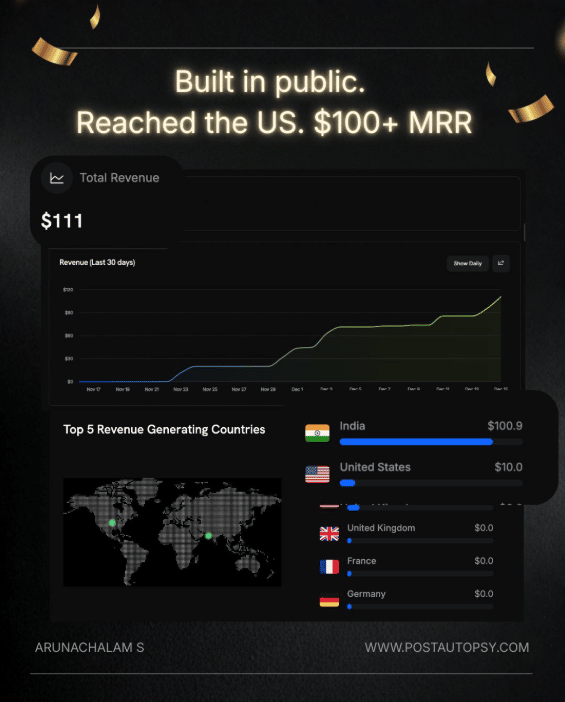
This is my third post on IndieHackers.
And it's the first one I'm writing after crossing a number that actually matters.
Last night at 11:47 PM, my phone buzzed.
Dodo Payments notification.
United States.
And just like that, we crossed $100 MRR.
I stared at the screen. Not because of the amount. But because this stranger, 8,448 miles away, was the one who pushed us over that line.
Let Me Back Up
Last month, Postautopsy was just a frustrated idea in my notes.
No roadmap. No guarantees. Just one problem I couldn't ignore:
Good people were writing consistently on LinkedIn... but growing nowhere.
I'd lived it for 700+ days. The anxiety spiral. The 40-minute rewrites. The "is this good enough?" loop that never ended.
So I built the tool I desperately needed. Something that would read my posts and tell me the truth before I hit publish.
Post #1 on IndieHackers was messy. I dumped everything in one chaotic wall of text.
Post #2 was the real story. The 3 AM rewrites. The 683 days of second-guessing. Why this existed at all.
But this? This is what happened after telling that story.
What Actually Happened Between Post #2 and Today
I didn't run ads.
I didn't do outbound sales.
I didn't have some viral launch moment.
I just kept doing what I'd been doing for 701 days: building in public.
Every rewrite I made to Postautopsy? I posted about it.
Every doubt I had? I shared it.
Every "will anyone even pay for this?" moment? I put it out there.
And slowly, people started finding us.
A few early users signed up. They tried it. Some of them posted about it. Those posts reached other people. Those people signed up.
No fancy funnel. Just: "Here's the problem. Here's what I built. Does this help you?"
And apparently, it did.
Then Last Night
That notification.
United States. Another signup.
But this one was different.
This one pushed us past $100 MRR.
Not because they paid $100. But because they were the customer who tipped us over.
The one who made it real.
What $100 MRR Actually Means
Let me be brutally honest: $100 MRR is not life-changing money.
It won't quit my day job. It won't scale to a unicorn. It barely covers hosting costs.
But here's what it is:
Proof.
Proof that I'm not the only one who needed this.
Proof that building in public works.
Proof that when you solve a real problem for real people, the internet finds you.
No ads. No outbound. No fancy launch.
Just clarity. Just feedback. Just a simple idea that actually helps.
The Real Lesson Here
This isn't about the revenue.
It's about validation.
For 701 days, I've been posting on LinkedIn wondering if anyone actually cared. Wondering if my content mattered. Wondering if I was just shouting into the void.
And every single day, I had to trust that showing up consistently would eventually lead somewhere.
Last night, it did.
Not in some massive viral moment. Not in a Product Hunt #1 badge.
In a quiet Dodo Payments notification from someone 8,448 miles away who looked at Postautopsy and thought: "This is worth paying for."
That's the moment that makes 701 days worth it.
What I'm Learning
You don't need more posts. You need better feedback.
That's what Postautopsy does. It doesn't generate posts for you. It doesn't write in your voice. It doesn't churn out AI slop.
It reads what you wrote and tells you the truth:
Is your hook strong enough to stop the scroll?
Does your story structure actually flow or are you rambling?
Is your ending lazy or does it inspire action?
It's the editor I wished I had at 3 AM when I was rewriting the same post for the seventh time.
And now, people 8,448 miles away are paying for it.
What's Next?
Still early. Still hungry. Still building in public.
We hit $100 MRR. Next milestone? $500. Then $1K. Then who knows.
But right now, I'm just focused on making Postautopsy better for the people who trusted us enough to pay.
Because that's how you build something real.
One customer at a time. One notification at a time. One milestone at a time.
If you're writing consistently on LinkedIn but feel invisible, maybe you don't need more posts.
Maybe you need better feedback.
-
1
This is such a real story. Growth rarely comes from one big moment — it’s showing up every day and listening to real users. The part about one unexpected customer making the difference really hit. Congrats on the milestone.
-
1
thanks mate !
-
-
1
This part really hit for me: “seeing what I’m writing the way my audience sees it.”
I’ve noticed that most of the anxiety isn’t about *writing* — it’s about not knowing whether the effort will land or disappear. You end up over-editing, not because the post is bad, but because you’re guessing how it’ll be received.
What I like about how you framed this is that it’s clearly a tool born out of personal friction, not abstract optimization. Shorter writing time is nice, but removing that feedback blind spot feels like the real value.
Also appreciate the transparency around milestones. Seeing $100 MRR framed as momentum, not success theater, makes the journey feel real instead of performative.
-
1
thanks mate means a lot
-

Here’s a truth bomb no one tells you about LinkedIn!
Your posts are probably mediocre. You scroll, you see the same bland advice, the same recycled platitudes. You want to stand out, but how?
The tool every LinkedIn creator secretly wished for!
We’ve spent countless hours dissecting what makes a LinkedIn post resonate. The emotional hooks, the unexpected stories, the brutal honesty.
After weeks of discussions, iterations, and back-and-forth…
I’m finally excited to launch something we built for creators just like us.
Introducing “Postautopsy” a tool that autopsies your LinkedIn posts before you publish.
-Gives accurate breakdowns
-Points out what’s weak
-Roasts your writing
-And helps you improve instantly
Think of it as your pre-posting truth mirror before the audience becomes your judge.t’s designed to transform your writing from forgettable noise to scroll-stopping insight. No more guessing.
No more hoping. Just clear, actionable feedback that pushes you to write better, faster, sharper.
and why am I doing this ?
i myself am consistent in linked-in for the past 700+ days and what i found is , sometimes writing on linked-in takes a lot of time , just to structure and make it perfect , i wish i had a tool like this so i made this for people
-
1
I’ve noticed this too — I’m personally asking ChatGPT for tools more than Google lately.
Makes me wonder how many smaller products just never get surfaced at all.
-
2
yea i get it mate , gpt writes , but sometimes it doesnt suit well for linkedin
-
-
1
Love how you structured this guide. I'm curious how you got early traction for PostAutopsy — was it mostly through your own LinkedIn audience or did you use other channels like cold outreach or partnerships?
-
1
its all through organic linkedin audience ! build the distribution and then build the product
-
-
1
Love how you structured this guide. I'm curious how you got early traction for PostAutopsy — was it mostly through your own LinkedIn audience or did you use other channels like cold outreach or partnerships?
-
1
700 days of consistency is no joke - that's the kind of muscle memory that actually lets you see patterns others miss. Makes sense you'd build the tool you wished existed.
The "pre-posting truth mirror" framing is sharp. Most writing tools focus on grammar/style, but the real gap is "will anyone actually stop scrolling for this?" That's a much harder question to answer.
Curious how you calibrate the "roast" level - is it purely algorithmic scoring, or did you train it on your own 700 days of what worked vs. what flopped? The personal dataset angle could be a real moat.
-
1
roast level is purely algorithmic scoring !
-
-
1
This is a killer concept, Arunachalam. 'Blandness' is definitely the #1 killer for founders right now.
Quick question: Is your 'roasting' engine specifically tuned to the LinkedIn algorithm (dwell time/formatting signals), or could I use this to audit copy for other platforms like X/Twitter too?
I help technical founders with narrative, so having a 'brutality' tool for all channels would be a game-changer.
-
1
hey jennifer ! , its not just for linked-in , the tool will fix up your hooks , make it scannable , make it perfectly readable format for people , its specialized for linked-in , but you can definitely use it for twitter as well
yes it would definitely help technical founders to be narrative , to make them write better forsure !
-


Comment