
Priowise
Strategic OS for Digital Product Companies
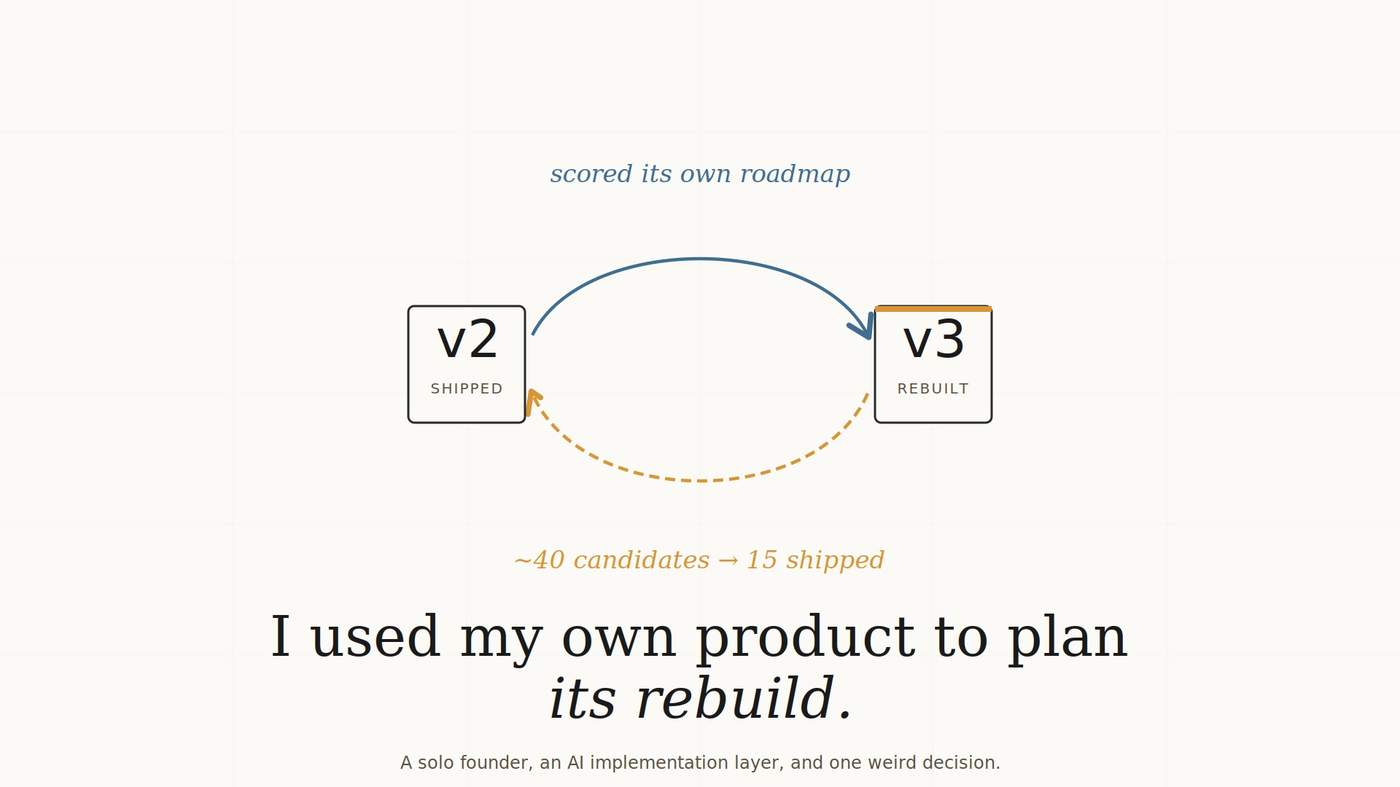
I shipped Priowise v2 on Feb 5th, 2026. Eight weeks later, on Mar 27th, I started rebuilding it from scratch.
The interesting part isn't the rebuild. Plenty of indie hackers have “rebuild” posts. The interesting part is that v2 wasn't broken. It was an MVP, and it worked. Beta users got value from it. The pipeline did what it promised. The decision to rebuild came from a different place: I wanted to use the product itself to decide what v3 should become.
So I did. I fed v2's roadmap candidates, every feature beta users had requested, every fix I'd been sitting on, every "wouldn't it be nice if" I'd been queuing, into Priowise. The product I'd just shipped scored them against the business hypothesis I'd encoded. Some passed. Most didn't. The output became the v3 plan.
This post is about that process. It's also about what it took, technically and operationally, to do it with a team of one.
What beta users actually told me
You can't fake feedback. Six things came up over and over from v2 users:
The interface couldn't show a roadmap shape. They wanted a Gantt view, to see the suggested prioritization as a plan on a calendar, that v2 didn't have one.
Prioritization without explanation felt arbitrary. Beta users wanted to see why a feature scored where it did, not just the score.
Onboarding was buried inside the first assessment. Users had to enter their website, business name, what they did, all inside the analytical flow. It made the assessment too long and onboarding felt nonexistent. v3 splits it out: a dedicated onboarding agent handles the early context, so first assessment stays focused on actual strategic work.
The chatbot felt like a form. It asked a long list of questions in sequence. Users wanted a conversation, not a survey, and ideally fewer questions to begin with.
No room for ideation-stage founders. v2 required users to have an existing roadmap. Many didn't. They wanted Priowise to help them build one from scratch.
Reports were text walls. Users wanted visualization, not just analysis.
Six concrete signals. Two were UX. Two were product surface areas. Two were core workflows. Each one was a candidate for v3. None of them were "v2 is broken", they were "v2 is incomplete". The rebuild wasn't about fixing failures. It was about deciding which of these (and several other candidates) actually deserved v3 development capacity.
How a solo founder ships a rebuild in five weeks
No co-founder. No engineers. The way I shipped v3's launch-critical track in roughly five weeks (March 27 → late April) was by being deliberate about which work was mine, which was the AI's, and which was the boundary between them.
I architected v3 myself. The data model. The user journeys. The pipeline orchestration that determines how the AI does the work for users. The pricing structure. The permissions model. The credit ledger semantics. Every decision point came from me, often through long brainstorming sessions, advisor conversations, and research that used AI tools alongside manual investigation.
Once architectural decisions were locked, I shipped them with Claude Code as my implementation layer. I built a specialized agent squad inside Claude Code organized by layers, dev for implementation, ops for infrastructure, gates for review and deployment, memory for persistent context across sessions. The squad handled most build cycles cleanly.
You may have heard before about some projects that "AI built my SaaS for me" as the indie hacker pitch, that's not what happened here. Architecture is human work. Implementation is collaborative work. Knowing why something broke at 2am is human work. I learned early on that staying in the driver's seat on decisions is the difference between shipping and just typing, the wrong AI suggestion can cost you days when you accept it without understanding why, and the relation with other structures.
The honest version: AI tooling makes the "solo" in "solo founder" radically more capable. It does not replace the founder. A founder who outsources judgment to AI is going to ship the wrong product fast. A founder who keeps judgment and delegates implementation can ship a coherent product as a team of one.
Then I dogfooded the product on itself
By late April, v3's launch-critical track was done. Pipeline rewritten. UX redesigned. Stripe integration hardened. The six beta-user requests above? All six made it into v3.
But before any of them got built, I'd used Priowise to decide they should.
The dogfooding moment was simple. I had ~40 candidate features for v3. Capacity to ship maybe 15 of them before launch. The temptation was to pick whatever I was most excited about, or whatever the loudest beta user wanted, or whatever felt furthest along.
Instead, I ran them through Priowise. I gave the product my v3 business hypothesis (specific outcomes Priowise needed to achieve in launch quarter), the beta feedback as input signals, and capacity constraints as parameters. The output was a scored, prioritized list with each item's link to the business hypothesis made explicit.
Some scoring surprised me. Two features I'd been emotionally committed to score low, not because they were bad, but because at an early-stage startup the impact mechanism wasn't strong enough to justify build cost in the launch quarter. They were my ideas. Priowise told me to wait on them. I waited on them. They moved to later phases.
The product I'd built to help founders avoid building the wrong thing helped me avoid building the wrong thing. Including the things I was personally excited about.
That's the kind of validation you can't fake.
The honest tradeoffs I'm still living with
v3 isn't done. Three things I'm aware of that aren't yet where I want them:
I have hard budget ceilings per stage of the AI pipeline that runs the product, but I don't yet have real-time visibility into per-customer cost in production, building that observability layer next. The output validation catches structural errors in AI-generated content but not semantic ones, which is more of a category problem than a Priowise problem. And I orchestrate the AI pipeline via Inngest's step-based workflows, which is architecturally clean but has a latency floor higher than I want. That's a tradeoff I'm still living with.
I'm shipping these as I go. The point of the rebuild wasn't to make v3 perfect. It was to make v3 honest, every feature in it has a reason, every cut was deliberate, every limitation is known.
Why I'm sharing this now
Priowise launches on Product Hunt on June 3. If you're a fellow indie hacker building with AI, I'd love your support on launch day.
But more than that, if any of the patterns above resonate, drop a comment. The AI-as-implementation-layer workflow is novel enough that I think we're all still figuring out what works. I learned more from beta users telling me v2 was incomplete than I did from any "AI builds products" blog post. The same loop probably applies to you.
What's the most expensive lesson AI tooling has taught your codebase?

After working with several startups as a product strategy advisor, I kept noticing the same pattern.
Founders usually start with a clear vision and strategy.
But as the company grows, things start to drift.
New ideas appear.
Customer requests pile up.
Investors share feedback.
Team members propose features.
The roadmap fills quickly.
But it becomes harder to answer a simple question:
Is what we’re building still moving the strategy forward?
Most prioritization frameworks help rank ideas, but they rarely connect decisions back to strategic objectives.
Over time I realized the real problem wasn’t lack of ideas or execution speed — it was strategy and roadmap slowly drifting apart.
So I started building something to address this.
I’m currently building Priowise, an AI-powered platform that helps founders:
• turn strategic intent into a structured product strategy
• compare their roadmap with that strategy
• identify alignment gaps
• prioritize initiatives based on impact and business objectives
We’ve recently opened the beta after several POC cycles, and I’d genuinely love feedback from founders and product builders here.
Curious how others currently deal with this problem:
How do you keep roadmap decisions aligned with strategy as ideas and feedback accumulate?
You can check the beta here if interested:
Would love to hear your thoughts.
Comment