
SignalsHunt
Find your first paying client. This week.

Let me tell you about a specific kind of panic. You open a spreadsheet. You name it “potential clients.” You stare at row 1, column A. And you have absolutely nothing to type.
Not because you’re bad at your job. I’ve run a web agency (dricomm.com) for years — I know how to build a good site, write decent copy, deliver work people are happy with. That was never the problem. The problem was always this: knowing who to talk to, and knowing what to say that isn’t “hi, I do websites, need one?”
The skill nobody teaches you
Here’s something I think gets missed a lot: “finding clients” and “doing the work” are two completely different skills. You can be excellent at one and genuinely stuck at the other. Most freelance advice assumes if you’re good enough, clients find you. Sometimes that’s true. Mostly, it isn’t — especially early on, especially in crowded fields.
So what do people actually do? They post on Upwork and compete with 40 other bids. They wait for referrals that may or may not come. They tell themselves they’ll “get to marketing” once they have more time — which never comes, because the work itself takes all the time.
I did all of this. For years, across multiple projects (dricomm, and later around.md). And I noticed something: it wasn’t that I lacked opportunities. It’s that finding them took hours I didn’t have, and once I found a business that might need me, I still had to figure out what to actually say to them that wasn’t generic.
Nobody guarantees you a client. But the odds aren’t fixed either.
Here’s the mental shift that changed things for me: waiting for clients and hunting for clients have wildly different odds, even though neither one is guaranteed.
If you wait — you get whatever comes. Could be nothing for months.
If you hunt — and you hunt specifically, picking businesses that visibly need what you do (a restaurant with a site frozen in 2019, a clinic with no online booking, a shop using stock photos instead of their actual products) — you’re not gambling anymore. You’re starting conversations with people who were already halfway to needing you. You just showed up first.
That’s the whole idea behind what I’ve been building.
What SignalsHunt actually does
You paste your own site. An AI reads it and works out who your realistic first client is — not a vague “small businesses,” but something specific. Then it searches real local businesses on Google that match, and — this is the part I care about most — it actually visits each one’s website and looks for something concrete: an old copyright year, no mobile-friendly layout, no online booking, stock photography, missing social links, whatever’s relevant to what you do.
Then it writes you three messages — an opener and two follow-ups — that reference that specific thing, instead of “I help businesses like yours.”
You still send it yourself. You still have the conversation. I didn’t try to automate the human part — I automated the part that was eating my time and killing my momentum before the human part ever got a chance to happen.
Does it work? Honestly — yes, but not magically
I use it myself for dricomm. So far: over 100 emails sent using it, real replies from real people, one paid client, one more in an active conversation right now. Not a hockey-stick story. Just a tool that turned “I should really find some clients” from a dread-inducing task into something I actually do, consistently, because the hard part — the staring-at-a-blank-list part — is gone.
Who this is actually for
If you’re good at your craft and bad at (or just exhausted by) the hunting part — this is for you. Web designers, developers, copywriters, SEO folks, marketers, photographers, consultants. Anyone whose bottleneck isn’t skill, it’s the first move.
Free plan gives you 5 real leads, no card needed, just to see if the whole idea even makes sense for your niche: signalshunt.com
I’ll be honest that this is still early and growing — but the core idea, I’m convinced of: the odds are better when you hunt. I just wanted to make the hunting part take a minute instead of an afternoon.

A 4 days ago I posted here about SignalsHunt and honestly didn't expect much. 200+ comments and 100+ likes later, 55 of you signed up. Thank you — genuinely. This post is what happened next: what I built because of you, what broke, and where things actually stand.
What your comments turned into
I read every comment. A bunch of you asked variations of the same thing: "how do you know WHICH business actually needs help, not just any business?" That question alone reshaped the product. Here's what shipped because of it:
Profession-specific playbooks — pick "photographer" and you now see exactly which niches to search and what to look for, instead of staring at an empty box wondering where to start
Actual problem detection — the tool now checks each lead's site for things that matter to your profession specifically: no mobile viewport for web designers, no booking widget for developers, stock photos for photographers, no social links for social media managers. It's not guessing anymore, it's pointing at something real
Call scripts — a few of you said you prefer calling over emailing for local businesses. So now every lead with a phone number gets a 20-second call script too
Tone control — direct vs. curious-question opener, because not everyone wants to sound the same, and neither do your prospects
None of this was on my roadmap a 4 days ago. It's on the product now because you asked.
Where things stand, numbers included
55 signups, 30 have run at least one search
20 of those came back and ran it 3+ times — that's the number I actually care about, because a tool people use once and forget isn't solving anything
I kept using it myself for my agency (dricomm.com): since my last post I sent 21 more messages and I'm currently mid-conversation with another potential client — nothing signed yet, but a real back-and-forth happening right now
Still no dramatic revenue story. But a tool people keep opening is worth more to me right now than one big number.
Now, the part I almost didn't write
Here's something that happened and made me feel genuinely dumb for a few days: the dashboard started randomly showing raw server code instead of the actual page. Like, literally text like :HL["/_next/static/chunks/... where a working page should be.
I "fixed" it four times. Cleared Cloudflare cache — didn't work. Reconnected the domain — worked for two minutes, then came back. Added cache headers — still came back. Each time I thought it was solved, and each time it wasn't.
Turns out the actual bug was one line, in the wrong place, the whole time: I'd added force-dynamic (a setting that tells the page "always render fresh, never cache me") to files marked 'use client' — and Next.js just silently ignores that setting in client components. Every fix I made was patching symptoms around a config flag that was never actually doing anything.
I'm not sharing this for sympathy — I'm sharing it because "building in public" usually gets shown as clean wins, and the real version is more like this: four wrong turns before the actual cause. If you're building something and something should be working but isn't — check the boring, obvious thing twice before assuming it's something complicated.
What's next
No giveaway this time — just an honest update, and the door's open if you want to try it: signalshunt.com. Free plan gets you 5 real leads, no card needed.
If you tried it last month and it didn't click, genuinely curious why — always happy to hear it, good or bad.
-
2
great, nice one especially for startups looking for credible leads
-
1
Thanks
-
-
1
Hi,
Since you actually run a web agency yourself, I'd love to connect. I'm building an autonomous finance copilot that act as your finance team preventing any cash, recovering the money that you. I'd love to see if this is a pain point you actually face at Dricomm.
I have mailed you at info@dricomm.com, you may check your inbox
-
1
The line that stood out to me was "mid-conversation with another potential client, nothing signed yet." That's the exact stage most prospecting tools quietly stop helping with — they're built for the first message, not the week after, when a reply comes in and then goes quiet again. Curious whether you're thinking about anything on the follow-up/tracking side, or keeping SignalsHunt scoped to the find-and-open part of the funnel on purpose.
-
1
The detail that stands out: 20 of 30 came back 3+ times. That 67% repeat rate is where the real product-market fit signal is, not the 55 signups. You're shipping profession-specific playbooks and actual problem detection instead of generic lead lists - that's the hard part of sales tools, and most people skip it.
Also, shipping that bug debugging story deserves more credit than it gets. Most build-in-public posts hide the 4-failed-attempts part. The "check the boring obvious thing twice" advice probably saved someone days of debugging this week.
-
1
The 20 who came back 3+ times is the right number to obsess over. At SocialPost.ai we ignored raw signups early and tracked who returned in week two, because that cohort told us what to build and later what to charge for. Ask those 20 what they did right before their third session, that is usually your activation moment and your onboarding fix.
-
1
I really like that you changed the product because of what users kept asking instead of sticking to the original roadmap I think thats one of the hardest things as a founder because sometimes the feedback completely changes your assumptions I'm curious was there one feature you were convinced people wanted but ended up removing or deprioritizing after seeing how they actually used the product
-
1
The line that stood out to me was "20 came back and ran it 3+ times — that's the number I actually care about." Great instinct, and honestly a healthy number this early. The one thing worth watching as it grows: repeat use can come from the leads actually landing replies, or from the search just being satisfying to run — both look the same in a usage graph. The strong signal hiding inside your 20 is how many of them sent a message and got a reply back — that's the bit that tells you it's genuinely moving the needle for people.
-
1
One-month updates are often more useful than launch posts because they show what happened after real users touched the product. The bug that humbled you is probably the most interesting part, especially if it exposed an assumption that looked correct during development. Those moments usually improve more than one feature because they change how testing, monitoring, and product decisions are handled. It would be useful to know whether the bug came from scale, user behavior, bad data, or an edge case nobody expected.
-
1
This is the kind of update that makes build-in-public content useful. Feature announcements are easy, but explaining the bug that changed the way the product is built usually reveals much more about the founder and the system. It would be interesting to know whether the bug came from an unusual edge case or from an assumption that seemed completely safe during development. Also, did fixing it change only the code, or did it lead to changes in monitoring, testing, or the product roadmap?
-
1
The "how do you know WHICH one actually needs help" question is the exact same problem I've been solving in a completely different niche (real estate off-market leads). A single distress signal isn't enough, everyone's already working the same "absentee owner" or "tax delinquent" list. The signal only gets useful when you stack 2-3 of them on the same target, since that's what separates someone who might sell from someone who's actually motivated.
Sounds like your profession-specific playbooks are solving the same underlying problem for services businesses. Curious how you're weighting multiple signals together, is it additive scoring or more of a hard filter?
-
1
This is such a smart approach to actually listening to your users. Building exactly what people asked for instead of guessing = 🔥 The profession-specific playbooks idea is genius too. So many tools try to be everything to everyone, but niche focus + solving real problems wins every time. Congrats on shipping!
-
1
Thank you!
-
-
1
Love seeing feedback directly shape the product. Those profession-specific checks sound much more actionable now.
-
1
Thank you!
-
-
1
Love the transparency, especially sharing the numbers instead of only the wins. I'm at a similar stage where I'm learning that user conversations often change the roadmap more than weeks of planning. Looking forward to seeing where SignalsHunt goes.
-
1
Thanks for your honest comment!
-
-
1
I really appreciate the transparency in this update. What stood out to me wasn’t just the new features, but how directly they came from user feedback. That’s often what separates a useful product from one that solves a real problem.
One idea that could make SignalsHunt even stronger is adding a lead priority or buying-intent score. If users can immediately see which prospects are most likely to need their service, they’ll spend less time deciding where to focus and more time having meaningful conversations.
I also like that you’re sharing the debugging process instead of only the wins. Those behind-the-scenes lessons are just as valuable as product updates. Looking forward to seeing how the platform evolves.
-
1
Thanks for your feedback!
-
0
The buying-intent score idea is a good one most lead tools show you volume, not urgency, which just shifts the decision fatigue instead of solving it. Curious what signals you'd use to build that score though is it based on behavior (site visits, opens) or more explicit stuff (company size, role, budget mentions)?
-
1
Great question. I’d probably separate fit from urgency rather than treat them as the same thing. Company size, role and budget signals would help establish whether someone is worth targeting, but the urgency score would lean more heavily on recent behavior and explicit triggers.
So ideally, it wouldn’t be one signal saying “this person is ready to buy,” but a combination of fit + trigger strength + recency. That feels more useful than simply ranking leads by volume. What signals have you found most reliable in practice?
-
-
-
1
This comment was deleted 2 months ago


A month ago I posted here about SignalsHunt - a tool that finds local businesses that actually need your help and writes the first message for you. 7 people signed up, 6 ran their first search. Thank you. Today I want to share what happened when I became my own most demanding user.
The test: does this thing actually land clients?
I run a small web agency (dricomm.com) alongside building this. Finding clients has always been the worst part of the job - not the work itself, the hunting. So I pointed SignalsHunt at my own agency and committed to actually sending what it generated.
The numbers, fully honest:
• 43 emails sent (over ~3 weeks, 5-7 per day, personal Gmail)
• 17 replies - most were “no thanks” or “not right now,” and that’s fine. A reply means the message landed as human, not spam
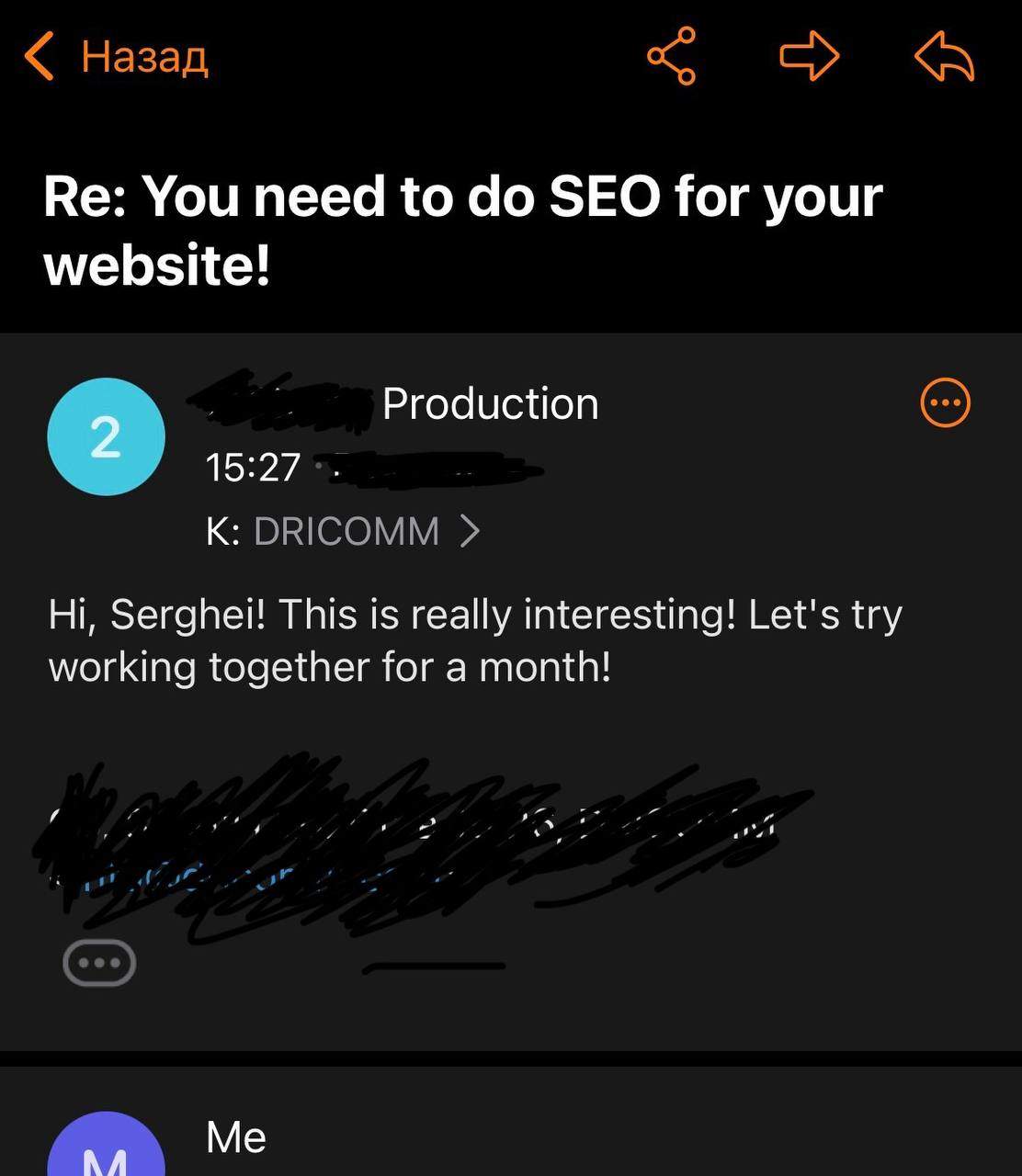
• 1 became a paying client - a $230/month SEO audit for a local business
Is $230 life-changing money? No. Is it proof the loop works - find the right business, reference something real about their site, get a conversation going? Yes. And one audit client is how retainers start.
The philosophy that made me build this
Here’s the thing nobody tells you about finding clients: there are no guarantees either way. You can wait on Upwork and get nothing. You can send cold emails and get nothing.
But the probability is not the same. When you actively hunt - when you pick businesses that visibly need what you sell (outdated site, no booking, invisible on Google) and open with that specific observation - you’re not pitching strangers. You’re starting a conversation they were already half-having with themselves.
I’ll say it plainly: I’d happily spend $1,000/month on prospecting if I knew it reliably surfaced $10,000 worth of clients. The math has always worked. The problem was time - 30-40 minutes of manual research per lead. That’s the part I automated.
Where the product actually is (unofficial launch honesty)
SignalsHunt is still raw. This isn’t a polished Product Hunt launch with confetti - it’s me, building in public, with a tool that already does the core thing: paste your site → get up to 20 real businesses from Google → each analysed (site issues, contact email found) → each with a 3-message outreach sequence written for you.
Free plan gives you 1 run with 5 real leads - no card, no catch. Enough to see if the messages feel sendable for your niche.
4 Pro spots left
From my first post, I gave away 10 free months of Pro. 6 are taken - 4 left. Same deal: sign up through the link in the first comment, and if you’re one of the next 4, you get a full month of Pro (unlimited runs, 20 leads each). All I ask: come back to this thread and tell me honestly what worked and what didn’t.
If you’ve been waiting for clients to find you - maybe try hunting for a week instead. Worst case, you’re exactly where you are now. Best case, someone replies.
Link’s in the first comment. 👇
-
8
Link: https://signalshunt.com/register?promo=ih1
First 4 signups get a full month of Pro automatically.
Happy to answer anything about the numbers above — including the 16 "no"s. -
1
Is this a system to use or is it all from the browser side? It sounds like a very good idea. But there is little mentioned about how it runs. Even ifnit is just a little bit, I feel like it will help someone on the fence.
-
1
Great question — it's a real hosted system, not a browser tool. Here's how it runs under the hood:
When you paste your site, everything happens server-side: an AI reads your homepage and builds your ideal client profile, then it queries Google Places for real matching businesses in your area. For each one, the system actually visits their website, checks for signals (outdated copyright, slow load, missing features), and pulls a contact email where it can find one. Then a second AI writes a personalized 3-message sequence referencing what it found on their specific site.
You just log in, paste your URL, pick a niche — and ~30-60 seconds later you get the leads with messages ready to copy. Nothing runs on your machine, no extension to install, no setup. It's all handled on our servers.
The one thing it deliberately doesn't do: send the emails for you. You copy and send from your own inbox — that keeps you in control and keeps deliverability in your hands (and honestly, keeps everyone on the right side of cold-email rules).
Happy to answer anything more specific — and if you want to just see it, the free plan gives you 5 real leads with no card. Sometimes that answers "how does it run" better than I can. 🙂
-
1
Appreciate the breakdown — that's a solid setup, especially keeping the actual sending in the user's inbox for deliverability. Good luck with the launch.
-
-
-
1
This looks interesting. I like products that help people find signals earlier instead of just guessing what to build or market next. The hard part is usually filtering noise from real intent, so if SignalsHunt can surface patterns that are actually actionable, that is a strong use case. Curious how you are ranking or prioritizing the signals, by volume, recency, source quality, or some kind of relevance score?
-
1
We have about 10 criteria we use to select relevant queries that are highly likely to result in a response to our message!
-
-
1
Wow, there is a lot to learn here
-
1
Thank you!
-
-
1
This hits home. I'm in the "getting the first paying one" phase right now too, and "start a conversation they were already half-having with themselves" is exactly it — a reply just means you sounded like a person, not spam.
Funny thing: I'm applying the same hunting logic one step later in the money flow. Instead of hunting for new clients, I'm building for Shopify B2B stores chasing invoices that are already 30/60/90 days overdue (Termpilot). The signal's already there — the customer bought, the money's just not in yet. Same "don't pitch strangers, reference something real" idea, just pointed at getting paid instead of getting found.
Curious: of your 17 replies, did the specific observation about their site do the heavy lifting, or was it more about timing? Trying to figure out how much of the win is signal quality vs. luck.
-
1
Luck and a signal - and the SignalsHunt assistant is everything!
-
-
1
I like that you shared the numbers instead of just saying "it worked." One thing that stood out was 17 replies from only 43 emails That's a much stronger signal than the single sale. Have you noticed whether personalization had a bigger impact than targeting, or was it the combination of both?
-
1
Thanks for the messages! I've noticed that it's important to communicate the client's pain and problem directly! That increases their chances!
-
2
That's a great point. It seems like people respond when they immediately feel understood rather than when they're pitched a service. Have you found that mentioning a specific issue on their website performs better than talking about the business in general?
-
1
Of course, SignalsHunt doesn't just report the problem; it says something like, "I can't message you—something on your site probably isn't working."
If you tell a client that their website is bad and that you'll make it better—that just doesn't work )))
-
-
-
-
1
The reply rate is encouraging, especially considering the volume. It suggests the targeting is getting people to engage instead of ignoring the email.
I did try the tool, though, and ran into an issue. With a few different search terms I kept getting "No prospects found for this query. Try a broader niche or different city." It wasn't obvious whether my inputs were too narrow or if there just wasn't enough data.
It might help to suggest alternative queries or automatically broaden the search instead of ending at that message. That would make the first experience much smoother for new users.
-
1
Thanks for your feedback! We'll fix it!
-
-
1
great work . a bit of luck and opportunity always favors hardwork
-
1
Thank you!
-
-
1
Congrats on the launch and the results so far wishing you the best with it!
-
1
The official launch hasn't happened yet! But thanks for the comment!
-
-
1
I've been thinking about marketing lately and there are many options. Would you tell me, why cold email?
-
1
That's the easiest thing to do! How else are you going to contact a client for the first time? You can call, but you absolutely must know what to say! Messages are designed to grab their attention and highlight a real error on their website (for example)! It's not going to work if you just call them and say, "I create websites and need clients! Be my client!"
That's my opinion!
-
-
1
Being your own most demanding user is the best QA a sales tool can get, and the $230 retainer matters more than the amount: proof of loop beats size of win. One caution from years of running agency outreach: that 40 percent reply rate lives and dies on your 5-to-7-a-day volume from a personal Gmail, and the moment users scale it to 50 a day the channel becomes deliverability management, not copywriting. Build sending guardrails into the product before your best customers burn their domains.
-
1
The honest funnel math is the most useful part of this: 43 sent, 17 replies, 1 paying. Most people only post the win, and then everyone else wonders why their 40 emails produced nothing but silence. A 40 percent reply rate on cold email is unusual, and I suspect your "reference something visibly broken about their site" opener is doing all the work there.
I'm validating a product for the same audience you're selling to (freelance marketers and small agencies), and I landed on the same principle from the other direction: leading with something concrete beats describing features every time. My landing page's whole pitch is a readable example of the end product rather than a feature list, for exactly the reason your emails open with the 2019 copyright year. Specificity reads as human.
Question about the 16 no's: did any of them tell you WHY? I'm curious whether it was mostly timing, no budget, or already-have-someone. That breakdown would tell you a lot about whether the targeting layer needs tuning or whether the no's are just the base rate of the channel.
-
1
Thanks for the comment! I've gotten responses like, "Not interested, thanks, we'll think about it, we already have a webmaster." I created a feature that shows how likely I am to get a response from a potential client! And it worked!
-
-
0
Great point. I've been researching this exact problem — involuntary churn from failed payments costs most SaaS companies 5-9% of MRR every month. I'm offering free 90-day payment audits if anyone wants to see their actual numbers. DM me.
-
0
Hi there! I built a fully automated system using the Gemini API to boost my own sales.
My stats for 1 week: 30 emails, 10 replies, 3 in progress, 1 sale. The client was a Turkish streamer, and I built a link-sharing platform and YouTube automation for them.
Ultimately, I couldn't scale it because I lacked follow-up sequences and email warming, and API costs started adding up. The system is outdated now and needs a complete overhaul to start finding the best weekly leads again.
-
0
BLOCKCHAIN RECOVERY TECHNIQUES: HOW TO TRACE AND RECOVER STOLEN CRYPTOCURRENCY — VISIT TREK Tech Corp
I never expected to become the victim of a cryptocurrency scam. I was introduced to what appeared to be a legitimate investment opportunity by individuals I had met on X (formerly Twitter). Over time, they gained my confidence and persuaded me to invest 2 BTC by promising substantial returns.
After I transferred the funds, their communication gradually became less frequent until they stopped responding altogether. It was then that I realized I had been scammed. Feeling overwhelmed and uncertain about my next steps, I spent several days searching for possible recovery options.
During my research, I found TREK Tech Corp through a Google search. After reviewing the information about their services, I decided to reach out and explain my situation. Their team responded promptly and professionally, guiding me through each stage of the recovery process.
They carefully examined the details of my case, traced the blockchain transactions, and kept me updated throughout the investigation. Their knowledge, persistence, and clear communication gave me confidence during a very difficult time.
According to my experience, TREK Tech Corp successfully assisted in recovering the full 2 BTC that had been stolen. I sincerely appreciate their professionalism, dedication, and support throughout the process.
If you have been affected by a cryptocurrency scam, seeking qualified professional assistance as early as possible may improve your chances of understanding your options.
For More Information
Email: t r e k t e c h c o r p 1 @ g m a i l . c o m


Real talk — for a long time, finding clients felt like cold-calling people who already had what I was selling.
I'd pitch a business, get excited, do my research... and find out they already had a website, already had someone fixing it, already had it covered. I wasn't bringing value. I was just another person in their inbox.
That happened so many times that I started wondering — what if I could know that BEFORE I reached out? What if there was a way to only talk to the businesses that actually need help right now?
So I built that.
The first version was completely different (and it died fast)
Originally I wasn't building this at all. I spent about 3 weeks building a tool that monitored Reddit and Indie Hackers for people complaining about problems — classic "listen for pain points" approach.
Then I watched a much bigger competitor — 140k users — shut down overnight because Reddit locked their API for commercial use.
I didn't sit on that news. I scrapped the whole thing and rebuilt around a different question: not "who's complaining online," but "who actually needs help right now, and how do I prove it to them in the first message?"
That became SignalsHunt.
What it actually does
You paste your website. The AI reads it, figures out exactly who your ideal client is, then goes and finds real local businesses through Google — but here's the part I'm most proud of: it visits each business's website too, and checks things like outdated copyright years, missing features, slow load times.
Then it writes you a personalized first message (+ two follow-ups) that references something specific and real about that business — not "Hey, I help businesses like yours" generic spam, but stuff like "noticed your site still shows 2019 in the footer, and there's no online booking option..."
You get businesses worth contacting, and a message worth sending. No guessing.
Who this is for
Freelancers and small agencies — web designers, SEO folks, copywriters, marketers — basically anyone whose biggest problem isn't doing the work, it's finding who to pitch.
I want 10 honest opinions before I do anything else
If this resonates — drop a comment with what kind of clients you're trying to land right now (genuinely curious what people are working on). Then DM me your signup email and I'll give you a full month of Pro, free. No card, no catch.
All I want back is your honest take — did it find you real prospects? Did the messages feel worth sending? Tear it apart if you need to.
Link's in the first comment. 👇
-
1
I like the direction you’ve taken here because you’re solving a problem many freelancers run into, spending hours researching businesses only to discover they don’t actually need the service you’re offering.
One feature I’d find especially valuable is an opportunity or priority score that helps rank leads based on how likely they are to benefit from outreach. That would make it easier to focus on the highest-potential prospects first instead of working through a long list.
Another idea would be to pair each issue you detect with a brief explanation of its potential business impact. Knowing what’s wrong is useful, but understanding why it matters makes outreach much more persuasive.
Overall, I think the concept addresses a genuine pain point. I’m interested to see how it evolves as more freelancers put it to work.
-
1
Hey, just wanted to say — your product looks really impressive. It feels useful, clean, and like something that can actually help people solve a real problem.
I’m building Everyday Tiny Tools — a marketplace for small useful web tools, mini apps, calculators, generators, AI tools, productivity helpers, and simple utilities.
The idea is to give independent creators a real place to showcase their tools, get discovered, and maybe even earn from them.
If you’ve built something small and useful, I’d love to invite you to list it here: EverydayTinyTools.com
Tools can be listed as free, or as a simple one-time purchase through the platform.
And if you have any questions, feel free to reach out anytime: nuchem@lightboltlab.com
Really like what you’re building — wishing you a lot of success with it.
-
1
This is a smart pivot. Focusing on “who actually needs help right now” is way more actionable than generic lead gen.
Biggest thing I’d watch is whether the signals translate to real business pain, not just surface-level issues. If the message ties directly to something that could make/save them money, it’ll hit. If it feels like a minor nitpick, it’ll get ignored.
If you can consistently surface high-intent leads, this is genuinely valuable for freelancers.
-
1
https://signalshunt.com/login?promo=ih1
The first 10 users get 30 days of PRO VERSION!


16 Comments
I tried it, I like it - I'll get the PRO version.
Thanks for your feedback!
nice!
Thank you!
So each time I run with the same site, it will give 20 new leads and not repeat the old ones?
Thanks for sharing this post! Indie Hackers is one of the best communities for entrepreneurs to exchange ideas, validate products, and learn from real startup journeys. Discussions like this help founders avoid common mistakes and discover new opportunities. If you're interested in exploring more online platforms, you might also want to check out C444games .vip. Looking forward to more great insights!
Thank you!
"You paste your own site. An AI reads it and works out who your realistic first client is — not a vague “small businesses,” but something specific. Then it searches real local businesses on Google that match, and — this is the part I care about most " = brilliant!!!
Thank you)
This is a really useful idea. Finding the right people to reach out to is often harder than doing the actual work. I like that it helps make outreach more specific instead of sending the same generic message to everyone.
Thank you!
No product can retain customers consistently, unless it’s exceptionally good and represents the customer’s top choice.
I agree! But it's worth a try!
Wow this sounds like a good idea. Now that everyone and their mothers are building saas, services like these will be needed more and more. Thanks for sharing.
Thank you for your review!
Really well-executed positioning shift — going from "who's complaining online" to "who actually needs help right now" is the difference between outreach that gets ignored and outreach that gets read. The detail of actually visiting each business's site and referencing something specific and real (outdated copyright year, missing booking option) instead of generic "I help businesses like yours" copy is exactly the kind of qualification layer most lead-gen tools skip. That's the part that actually earns a reply.
The free-plan-first, low-commitment structure is smart too — letting people see real, sendable messages before asking them to trust the tool with money is the right sequencing.
Great work — following this closely. On a related note, we're tackling a similar "specificity over generic output" problem in a different space with PotenAI (AI-driven career/potential analysis that references a user's actual answers instead of generic labels) — funny how much of building trustworthy AI products comes down to the same core discipline: make the output reference something real, not something plausible-sounding.
You can join the waitlist: https://nopick.site