
Strategic Flow
SaaS emails that actually convert
When I published the original audit, I called out 4 structural patterns and stopped there. Went back through the full dataset properly this week and there are actually 6.
The 2 I missed the first time:
→ Missing visual hierarchy, 71% of the sample. Wall of text, no scannable structure, reader has to work to find the point.
→ Zero or buried social proof, 69%. Either nothing there, or a testimonial buried past the fold where nobody reads that far.
I also caught a labeling error on my end. What I'd called "Caveat Before Consequence" is actually a different pattern entirely, Implied Transformation, same 74% of the sample, wrong name attached to it. Fixed that too.
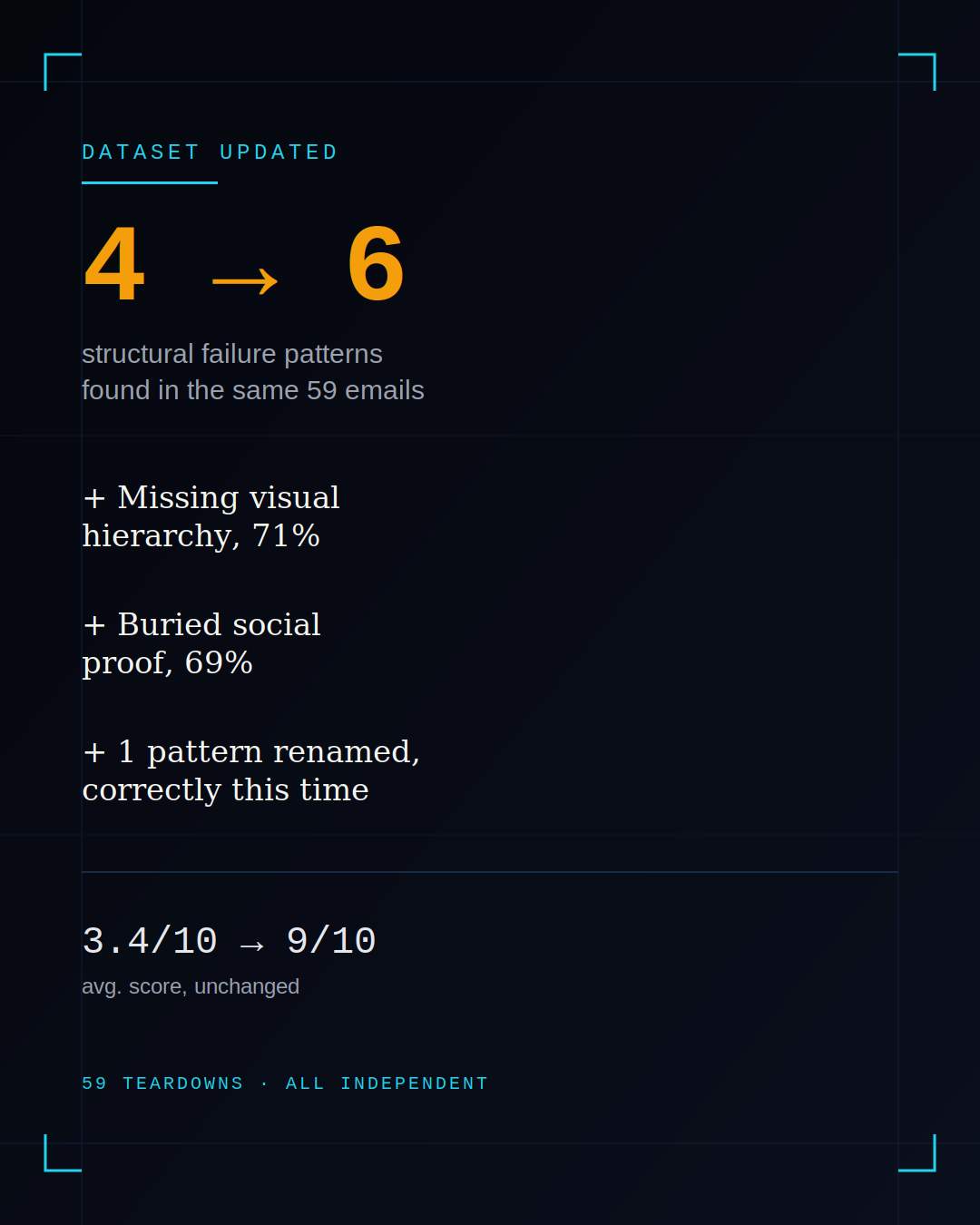
None of this changes the headline number. Average score before a structural rebuild is still 3.4/10, average after is still 9/10. What changed is the resolution, I'm now catching patterns I was folding into other categories before.
Same rule as the original post still applies: none of the 59 companies audited paid for, requested, or reviewed their teardown before I published it. Every one is independent, unpaid, done from the outside.
Full corrected breakdown, all 6 patterns with examples, is live on the same page:
https://strategicflow.tech/state-of-saas-email-architecture-2026-special.html
If you send lifecycle or product emails, the social-proof pattern is worth a 30-second check against your last send. Curious if others are seeing the same gap.

Spent the last few months running a structural audit across 59 published SaaS emails (Semrush, HubSpot, ElevenLabs, Revolut, Perplexity, and 49 others), scoring each one against a 7-point framework.
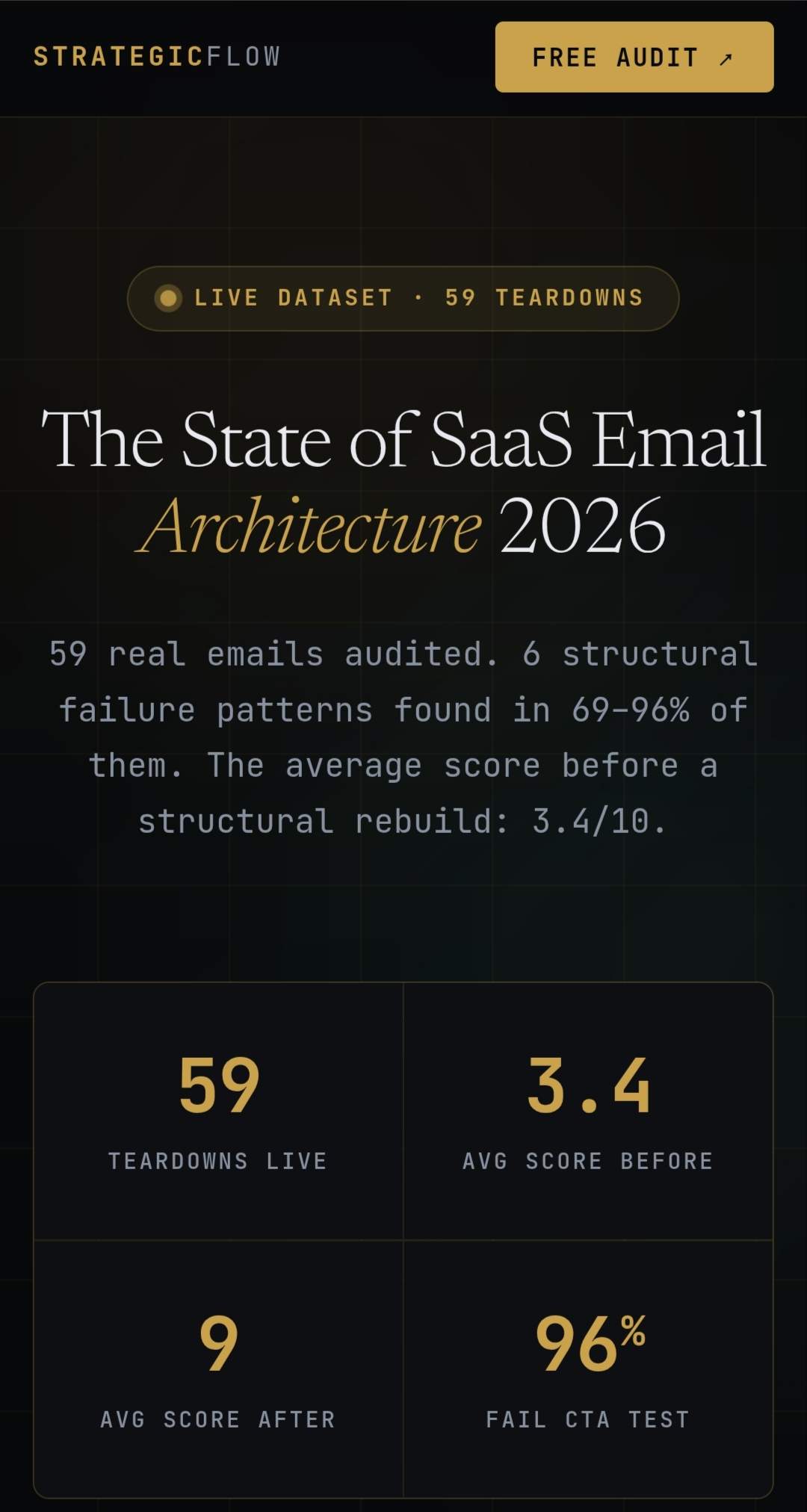
The numbers surprised me more than I expected:
→ 96% used a "guest language" CTA ("Learn more," "See it in action") instead of ownership language
→ 83% led with the feature instead of the consequence for the reader
→ 83% had subject lines that filed the email into a category instead of hooking the open
→ 74% implied a transformation without ever stating it
→ Average score before rebuild: 3.4/10. After: 9/10.
None of the companies audited paid for, requested, or reviewed the teardown before I published it. Every one was independent.
I put the full dataset, the 6 failure patterns, 5 before/after rebuilds, and a scenario calculator (plug in your own list size and open/click rates) on one page:
https://strategicflow.tech/state-of-saas-email-architecture-2026-special.html
If you send any kind of lifecycle or product email, the CTA ownership pattern alone is worth checking against your last send. Curious if others are seeing the same patterns in their own inboxes.
-
1
For anyone wondering how I built this: the audit runs on a 7-point structural framework (CTA ownership, feature vs consequence framing, subject line intent, trust signal placement, urgency integrity, sequence logic, visual hierarchy). Happy to answer questions on methodology or specific patterns if anyone wants to dig into their own emails.
Churn signals sit there. Nobody built the wiring that turns them into action.
Most SaaS teams already have the data.
Activation dropped. A champion stopped logging in. Usage is trending down for three accounts. It's all sitting in a dashboard somewhere.
None of it acts.
A dashboard tells you something changed. It never decides what happens next. That gap is where growth quietly stalls, and it doesn't look like a gap. It looks like a normal Tuesday. Someone opens the churn dashboard, sees three accounts trending down, makes a mental note, gets pulled into a meeting. The note evaporates. Nobody did anything wrong. The system simply never asked anyone to act, so nobody did.
The fix isn't more data or another tool. It's four layers, always in this order.
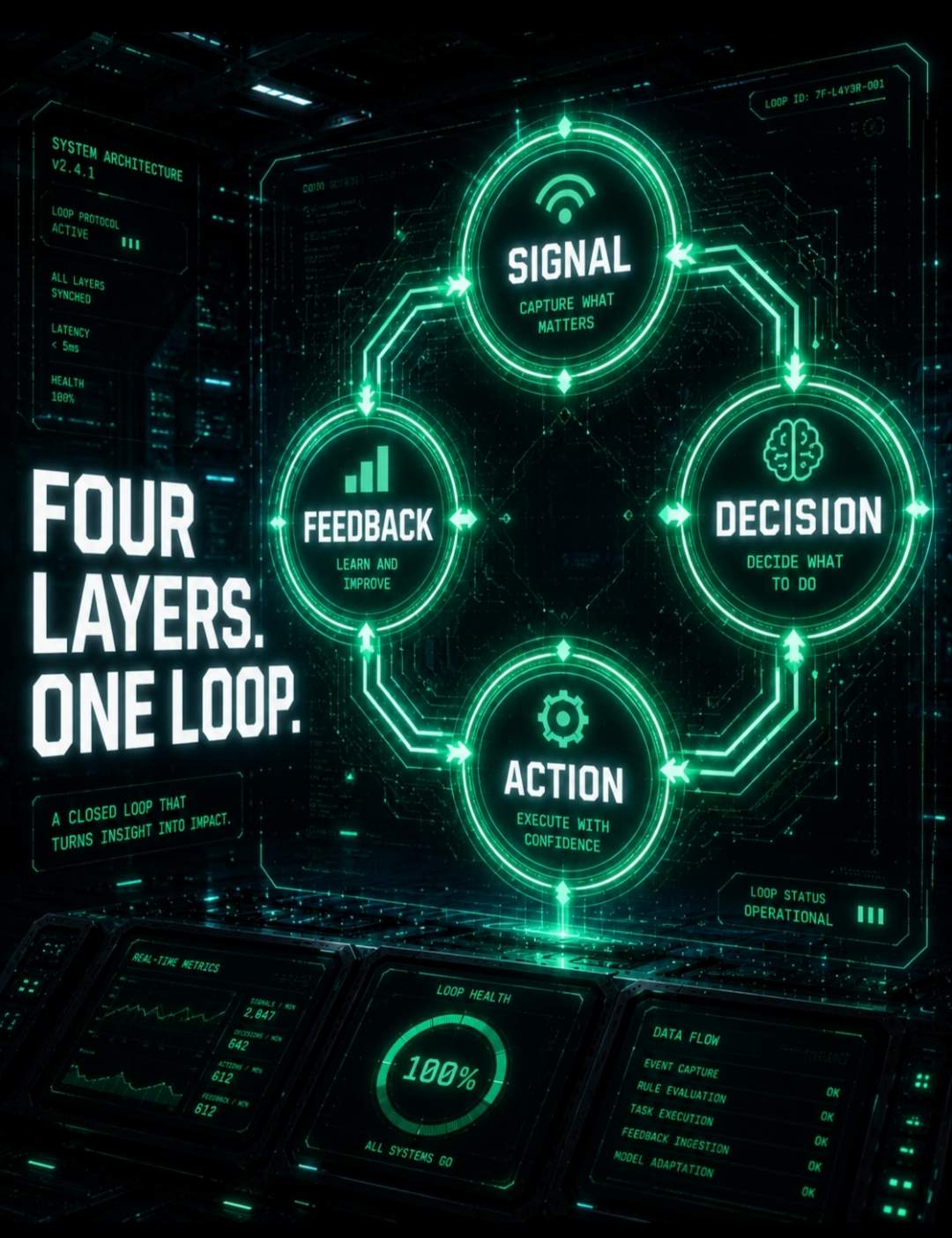
Signal. What changed, the moment it changes. Not a metric on a dashboard, an event: activation dropped for a cohort, a lead went cold, a champion stopped logging in. Fired the instant it happens, not the next time someone opens a report. Target latency under 5 seconds, or you're back to relying on someone noticing.
Decision. The rule that decides if it matters. Not "look at the number and think about it." A codified rule, written once instead of re-made from scratch every time: if a paying account has 0 logins in 7 days and has used the product for 30+ days, flag as at-risk and route to the account owner within 1 hour. This is the layer most teams skip. They go straight from signal to a person's gut feeling, so the decision changes depending on who's on shift.
Action. What happens without you in the room. A message sent, a ticket created, a sequence triggered. The same way, every time, without a person clicking send. Everyone assumes they have this because they own automation tools. Owning the tool and wiring it to a real decision rule are two different things. The line that matters most: safe to automate is sending the alert, drafting the outreach, creating the internal task. Never automate blind is pricing changes, refunds, anything a customer sees with no human check first.
Feedback. Did it work, does the rule learn. Did the action change the outcome? If not, the decision rule was wrong, not the tool. Without this layer you're running the same broken rule forever and calling every fix a one-off. With it, every cycle is a small experiment, and the rule gets sharper each time instead of drifting stale.
Skip one layer and the loop breaks silently. It looks like it's working right up until the day it doesn't, because nothing ever alerted anyone that a step was missing. Most teams stop at two layers, usually Signal and a half-built Action, and wonder why the automation "doesn't feel smart." It isn't supposed to feel smart on its own. Decision is where the intelligence lives, and Feedback is what makes that intelligence compound instead of going stale.
Drop your email, get the full four-layer breakdown, and check which layer is missing in your own stack.
Get the breakdown → https://strategicflow.tech/landing-architecture-layer.html
-
1
The four-layer loop that closes the gap: Signal detects what changed, Decision applies a rule, Action executes without a human in the room, Feedback checks if it worked and adjusts the rule.
Together AI announced an $800M Series C on July 1. Top-tier investors, hundreds of megawatts of compute committed, one of the biggest infrastructure raises in AI this year.
I ran the announcement post through the Decision Friction Model anyway, the same 7-point framework I built from tearing down 59+ SaaS emails. Not because they need the traffic. Because I wanted to know if funding size changes the failure rate. It doesn't.
WHAT I FOUND
Three paragraphs into the post, buried inside a section about frontier research and kernel optimization, sits the one line that actually sells the product: a customer cut its inference costs sixfold after switching. No bold. No headline. No callout. Just one clause sitting in a wall of text.
That's Buried Proof, the same pattern I see in roughly 7 out of 10 SaaS emails I audit. It doesn't care how many zeros are in your funding round.
The post also opens with founder story, four years of company history, before it gets to what actually changed for the reader. Classic Feature-First Bias, just wearing a different outfit. And the CTA closes on a hiring page instead of speaking to the reader who just learned a competitor's client cut costs sixfold and is now wondering if the same thing could work for them.
WHY THIS ACTUALLY MATTERS
I built this framework auditing small SaaS teams' newsletters, assuming the problem was a resource constraint. Bigger companies, better copywriters, bigger budgets, the assumption was that scale fixes structure.
It doesn't. A round like this buys a company maybe 48 hours of elevated attention across the entire AI and SaaS world. Structuring the copy around the founder's story instead of the reader's next question spends that window on the wrong audience, regardless of how much money is in the bank.
The failure patterns I've documented across 59 teardowns (Guest Language CTA, Feature-First Bias, Filing Label Subject, Buried Proof, and others) aren't a small-team problem or a big-team problem. They're a "nobody structurally checked this before publishing" problem, and that happens at every funding stage.
WHAT I'M TAKING FROM THIS
I'm adding funding announcements and major launch posts to the teardown rotation going forward, alongside the SaaS emails. Same framework, same scoring, different stakes. If the pattern holds at $800M, it holds anywhere.
If you've got a launch email, announcement, or newsletter you want checked, run it through the same model I used here, free, takes about two minutes: strategic-flow-audit.replit.app
Curious what it flags. Drop it in the comments, I read every one.
59 teardowns archive: https://strategicflow.tech/teardowns.html
Methodology / 7-point framework: https://strategicflow.tech/email-architecture-audit.html
I've been researching hiring trends for lifecycle and email marketing roles, and found something worth sharing with anyone running a small SaaS team and wondering whether it's time to make that hire.
The numbers
- Median salary for a Lifecycle Marketing Manager in the US: $110,839/year
- Top 10%: up to $181,798/year
- Typical ramp up time before real output: 5 to 8 months
- Marketing automation manager postings grew 10% year over year
That's a serious commitment for a solo founder or small team, and it's a full year of runway before you even know if the hire was the right one.
The job itself is changing
I came across a recent job posting for this exact role that laid out something interesting. The company wasn't looking for a campaign manager. They wanted someone who builds the automated system first and only figures out what needs a human after that. Their words, roughly: if your instinct at higher volume is "what's not automated yet" instead of "who do we hire," you're the right fit.
That's a real shift. The role is moving from "person who writes and sends emails" to "person who architects the system and decides what's worth automating."
Why this matters if you're bootstrapped
If you're a solo founder or small team and your email conversion is weak, hiring isn't usually the answer, mostly because you can't afford the $110K bet and the 5 to 8 month wait even if you wanted to.
What you actually need first is an email architecture audit for B2B SaaS, a diagnosis that answers:ñ
- Where do prospects stall before converting
- Why does the CTA get ignored
- Why does the email get opened but nobody clicks past the first line
None of that needs a full time hire. It needs someone (or some process) to actually look at the architecture, not just the copy.
What I've seen from running audits
I run these audits using the Decision Friction Model, a 7-point diagnostic built from tearing down 59+ real SaaS emails (Semrush, HeyGen, Revolut, Zapier, ElevenLabs, and others). The pattern repeats almost every time. It's rarely a copywriting problem. It's usually one or two structural issues, most often a Guest Language CTA (a button written in the company's language instead of the reader's, found in 96% of audits), a Filing Label Subject line that reads like a folder name instead of a reason to open, or Buried Proof sitting three paragraphs too late, that quietly kill conversion across the entire lifecycle.
Sometimes the right move after that diagnosis really is to hire. But you'll know that for a fact instead of guessing, and you'll know exactly what you're hiring for.
Takeaway
Before your next hiring decision, run the numbers. Before you staff the problem, audit the system underneath it. It's a lot cheaper than finding out five months in that the hire wasn't the fix you needed.
The free audit tool runs this exact diagnostic on your own emails in under 2 minutes: strategic-flow-audit.replit.app. Curious to hear what it flags for you, drop it in the comments.
Five months ago I had a frustration, not a product.
Technically brilliant SaaS teams kept shipping great features and losing them in the inbox. Same pattern every time, different logo. Product update goes out, open rate looks fine, click rate is dead. Nobody on the team can say why.
I'd been embedded in B2B SaaS operations long enough to know the answer wasn't copy. It was structure. The email announced the feature instead of the consequence. The CTA put the reader in the audience instead of in the decision. Nobody was diagnosing this systematically because nobody had named the failure points.
So I built the diagnosis into a system. No dev background. No team. No funding. Replit Agent and Claude API as the build crew, working from my phone for the better part of it.
This is where it stands now.
THE METHOD, NOT THE TOOL
Strategic Flow runs on a 7-point behavioral framework. Subject line construction, lead framing, feature-to-outcome translation, visual hierarchy, before/after contrast, social proof, CTA language. Each point maps to a moment where a reader decides to keep going or leave.
Out of that framework, six failure patterns kept showing up with enough frequency to name and measure:
- Guest Language CTA: 96% of audited emails. The button says "Learn more" instead of naming what the reader is actually doing.
- Feature-First Bias: 83%. The hook announces the product, not the consequence.
- Filing Label Subject: 83%. The subject line archives itself before it gets opened.
- Consequence-After-Caveat: 74%. The benefit shows up after three sentences of context nobody asked for.
- Missing Visual Hierarchy: 71%. Twelve updates, identical visual weight, reader acts on none of them.
- Zero or Buried Social Proof: 69%. The brand vouches for itself. No third party, no number, no name.
Guest Language CTA being the single highest-rate failure surprised me when the data settled. I expected Feature-First Bias to take the top spot, since that's the pattern people talk about more often. It didn't. The CTA is the last decision point in an email, and almost everyone phrases it as an invitation instead of an action. "Explore now" lets the reader stay a visitor. "Fix my reporting" makes them the one doing something.
None of this is style advice. A well-written sentence sitting inside broken architecture still doesn't convert. That distinction is the entire thesis of the business.
59 TEARDOWNS, AVERAGE SCORE 3.4, REBUILT AVERAGE 9
The proof isn't the framework. Anyone can write a 7-point checklist. The proof is what happens when you apply it to 59 real SaaS emails, across companies like Notion, Revolut, Perplexity, Wiz, dbt Labs, Ahrefs, Optimizely, and dozens more.
Average original score across the archive: 3.4 out of 10.
Average score after rebuild: 9 out of 10.
That gap is the actual argument. Not "here's a framework," but "here's 59 documented breaks, here's the rate each pattern shows up at, here's what the rebuild looked like each time." A teardown shows the original email, the score, the exact failure pattern named, and the rebuilt version side by side. The reasoning is checkable. A star rating isn't.
I got useful pushback on this recently, on a comment about the framework-as-hook, archive-as-proof split. The point was sharp: if the pattern library is the real asset, it should be more visible in the sell, not less. "59 SaaS emails diagnosed, here's where they broke" is more convincing than the 7 points alone, because the framework sounds like something anyone could write, and the documented volume proves the reps actually happened. I'm restructuring the content cycle around that now. Every new batch of teardowns becomes its own post instead of sitting quietly in an index.
WHAT ACTUALLY GOT BUILT
Three things exist right now, all running on Replit, all powered by Claude API for the diagnostic and rebuild logic:
The free audit. Paste an email, get a score in 90 seconds, see the named failure patterns and a rewritten version. No call, no signup friction, no payment. This is the front door, and it's deliberately frictionless because the first version of this funnel wasn't. Early outreach sequences pointed cold prospects at a demo page that asked for too much before showing any output. Zero replies for weeks. Moving the CTA to point straight at the free audit instead of a gated form fixed more of the funnel than any amount of better copy would have.
The paid platform. Single audit at $49, no commitment. Growth at $499/mo and High-Impact at $899/mo for teams sending regularly. An Architecture tier, custom-quoted, for full email program audits across an entire lifecycle sequence, not just individual messages.
Activation Intelligence, a separate product for a more specific buyer: Heads of Growth or VP Product at SaaS companies where trial-to-paid conversion sits below 25%. It analyzes the first 7-14 days of onboarding communication as one connected system instead of isolated emails, and outputs an Activation Gap Report, rewritten messages, an in-app audit, and Day 1/3/7 rebuilds. This came out of noticing that single-email audits miss an entire category of bug. Five emails can each pass the structural check individually and still leave a 6-day silence gap right when a trial user is deciding whether the product is worth their time. The individual emails weren't the problem. The gap between them was.
WHAT BUILDING WITHOUT A DEV BACKGROUND ACTUALLY LOOKS LIKE
I want to be precise about this part, because "I built an app with AI" gets thrown around loosely.
I didn't write code. I described what I needed, in plain language, to Replit Agent, and reviewed what came back. The skill that mattered wasn't syntax, it was knowing exactly what the diagnostic logic needed to check for, because I'd already done that diagnosis manually, by hand, on real emails, long before any of this was automated.
AI didn't replace the judgment. It removed the part where I had to become a developer first in order to act on judgment I already had. That's a different claim than "AI built my startup," and it's the more honest one.
The stack, for anyone curious: Replit hosts the audit engine and the platform dashboard. Claude API runs the diagnostic and rebuild reasoning. GitHub Pages hosts the public teardown showcase as static HTML. n8n handles workflow automation where it's needed. No CRM yet. No dev team. Outreach gets tracked manually, which is its own kind of honest constraint at this stage.
WHERE IT ACTUALLY STANDS
No funding. No team. No G2 listing with a wall of five-star reviews, and I'm not going to pretend otherwise. Building real review volume takes real client history, and faking that would undercut the entire premise of a service built on telling people the truth about their own emails.
What exists instead: a public methodology anyone can read before paying anything, 59 teardowns anyone can check the reasoning on, and a free audit that puts the diagnosis in front of a prospect before they spend a dollar. The credibility has to come from the work being checkable, not from a badge.
The site itself had its own structural problems worth admitting. A full audit of the public pages turned up inconsistent numbers across different pages (the teardown count alone had four different figures floating around before I reconciled it to the actual live count of 59), an image that had somehow gotten base64-encoded directly into HTML and was bloating one page to 189KB, and a glossary page, the one page built specifically to get cited by AI search tools, that had wrong figures sitting in its own structured data. Fixed all of it. The irony of building a tool that diagnoses other people's communication failures while having your own wasn't lost on me.
WHAT'S NEXT
Reconciling the content strategy around the archive-as-proof idea instead of leading with the framework. Fresh outreach lists, since the current ones have enough overlap with prior sequences to dilute response rates. And continuing to publish teardowns at the same pace, because the pattern only stays convincing if the count keeps climbing and the rate stays consistent.
If you send product updates, onboarding sequences, or lifecycle emails and your open rate looks fine but nobody clicks, that gap usually isn't a copy problem. Worth checking which of the six patterns is actually doing the damage before assuming the words are the issue.
Free audit: https://strategic-flow-audit.replit.app/demo.html
59 teardowns archive: https://strategicflow.tech/teardowns.html
Methodology / 7-point framework: https://strategicflow.tech/email-architecture-audit.html
Glossary (6 failure patterns, definitions): https://strategicflow.tech/glossary.html
Pricing: https://strategicflow.tech/strategic-flow-pricing.html
Is it worth it (ROI calculator): https://strategicflow.tech/is-strategic-flow-worth-it.html
Main site: https://strategicflow.tech
Built a free tool to prove my email audit framework works. The tool itself became the conversion killer.
Cold sequence: 30%+ opens, real link clicks, zero replies across 500 sends. Spent two days assuming the subject lines or the copy were off.
They weren't. The link went to a form asking for a work email, the full email body, company name, and subscriber count, behind a consent checkbox, before showing anything at all. People were curious enough to click through from a cold email. Then they hit something that looked like a data request from a stranger, not a free tool.
Same failure I diagnose in other people's emails: high curiosity, the moment of friction lands exactly where it shouldn't.
Cut the first form to one field. Show a result before asking for anything else. Testing now.
Curious if anyone else has built a lead magnet that technically worked (good click rates) but still converted at zero, and what the actual blocker turned out to be.
Hey Indie Hackers,
I'm Alex. Romanian founder, currently based in Tenerife. I've been deep in email copywriting and newsletter strategy for SaaS companies for a while now, and I kept running into the same problem.
Teams would send beautifully designed emails. Good subject lines. Nice visuals. And then... nothing. Opens were decent. Clicks were weak. Revenue attribution was zero.
The problem wasn't the design. It was the architecture.
Most SaaS newsletters are built to inform. They lead with product updates, company news, or educational content — and they bury the point. The reader finishes the email with no clear reason to do anything.
So I built Strategic Flow.
What it does:
You paste your newsletter or drop a URL. Strategic Flow analyzes the structure, extracts your brand DNA, and rebuilds the email from the ground up using what I call the Strategic Flow Method:
→ Outcome-first subject line — the reader knows what they get before they open
→ Hook above the fold — the first sentence earns the scroll
→ Ownership CTA — one clear action, framed around the reader's gain
You get back production-ready HTML, A/B subject line variants, audience segmentation suggestions, a cohesion score, and a full before/after showcase. In under 90 seconds.
Where I am right now:
App is live: free Audit tool + paid Pro builder
Tiers: Single ($49 one-time), Lite ($299/mo), Growth ($499/mo), High-Impact ($899/mo)
First users coming in via LinkedIn teardown posts and direct outreach
Building solo, no paid ads, no VC — just the product and the work.
The honest part:
I'm building this remotely, solo, from an island in the Atlantic. No team, no runway pressure, no investors to report to. That freedom is the whole point — but it also means every decision, every line of code, every client conversation is mine alone.
The hardest part isn't the product. It's convincing SaaS marketers that their email problem is structural, not cosmetic. Most think they need better design or a bigger list. The conversion architecture angle is a harder sell — but a stickier one once they get it.
I'm documenting everything here as I go — what works, what doesn't, revenue numbers, real client conversations.
If you run a SaaS newsletter or know someone who does, I'd genuinely love to hear what your biggest email frustration is right now. Not pitching — just trying to understand where the pain is sharpest.
Live showcase: https://strategicflow-tech.github.io/showcase/
Live AUDIT app (one free conversion per email address): https://strategic-flow-audit.replit.app/
-
1
I really like this approach; honestly, I'm not as knowledgable as these guys in the comments but this project is pretty cool!
-
1
Appreciated, Nathanael! More coming as it develops.
-
-
1
This is a really smart approach! Focusing on conversion architecture instead of just design makes a lot of sense—so many newsletters look good but don’t actually drive action. I like the outcome-first and single CTA concept; it feels much more intentional. Excited to see how this evolves!
-
1
Exactly that. Design without architecture is just decoration.
The single CTA constraint forces the question most teams skip: what is this email actually asking the reader to decide?
Once that's clear, everything else either supports the decision or gets cut.
-
-
1
Curious — are you tracking failed payments?
A lot of SaaS lose more from that than churn.
-
1
Not directly, the audit focuses on the structural reasons people don't click, not what happens after.
But the connection is real.
A failed payment recovery email with broken architecture loses twice: once to the payment failure, once to the email that doesn't convert the fix.
-
-
1
This is a sharp take — “design vs architecture” is a real gap most teams don’t notice.
The outcome-first + single CTA framing makes a lot of sense. Most newsletters try to do too much and end up doing nothing.
Curious — in the audits you’ve run so far, what’s the most common structural mistake you keep seeing?
Also, I’m running a small project (Tokyo Lore) where we highlight tools solving problems like this and get them in front of a focused group of builders.
Since you’re tackling a deeper layer than just copy/design, this could be a strong fit — happy to share more if you’re open 👍
-
1
The most common one by far: the hook resets after the subject line.
Subject line earns the open with a consequence or outcome then the first sentence of the body starts with "We're excited to announce..." and the reader's brain switches off. The promise made in the subject dies in the first five words of the body.
Second most common: the CTA asks instead of offers. "Learn more" versus "See how it works for your stack" ... same action, completely different conversion signal.
Happy to hear more about Tokyo Lore.
-
1
That hook drop-off is such a sharp observation — you can almost feel the conversion die in that first line.
And yeah, CTA framing is underrated. Same click, totally different intent signal.
If you productize just those two:
→ subject → first-line continuity
→ CTA = outcome, not actionthat alone could drive real lifts.
Curious — are you showing users the before/after performance difference, or mostly structural feedback right now?
Also, quick context on Tokyo Lore: it’s a small, focused round where we surface tools like yours to a builder audience and look at how they actually perform in the wild (not just theory).
Since you’ve got a clear, testable framework, this could be a strong fit.
Want me to share details? 👍
-
1
Right now mostly structural, the before/after showcase shows the architectural difference visually, but I'm not yet tracking live performance deltas post-rebuild. That's on the roadmap.
The continuity between subject and first line is where I see the biggest drop. Most teams optimize them separately , different person writes the subject, different person writes the body. The seam shows.
Yes, share the details on Tokyo Lore. Happy to take a look.
-
1
hat makes sense — the “seam” between subject and body is exactly where things break.
Once you start tracking performance deltas, that’ll be a huge unlock.
On Tokyo Lore — it’s a small, focused round where we put tools like yours in front of real builders and see how they actually respond (what they notice, what they use, what sticks).
Since your framework is clear and testable, it fits really well.
Here’s the link: tokyolore.com
Happy to answer anything if you’re curious 👍
-
1
Thanks for sharing this — the format is sharp. Not entering Round 01, I don't have a Tokyo-specific idea worth submitting yet. But I'll follow the round.
-
1
Totally fair — makes sense 👍
It’s not really about a “Tokyo-specific idea” though — we’re more looking at tools with clear logic + testable frameworks like yours.
But yeah, following the round is a good start.
Once you start tracking those performance deltas, that alone could turn into a really strong case to run through something like this.
-
-
-
-
-
-
-
1
Most SaaS marketers obsess over design and list size while ignoring the fact that their emails simply don't trigger any real action. It’s frustrating to see great content get buried under a structure that forgets to actually sell the next step. Since the architecture is the main hurdle, how do you handle clients who are stubborn about keeping their traditional "newsletter" look?
-
1
Great question, and it comes up more than you'd think.
The honest answer: I don't fight the look. The architecture lives underneath the design, not instead of it.
You can keep the exact same template, same colors, same layout ... and still move the hook above the fold, rewrite the subject around an outcome, and reframe the CTA as something the reader gains rather than something they're asked to do.
Most clients relax immediately when they realize I'm not touching their brand. What I'm changing is the sequence of information and the framing of action, not the visual identity.
The stubborn ones usually come around after seeing the before/after side by side. The structure looks almost identical. The conversion logic is completely different. That's the point of the showcase: it makes the invisible visible.
-
1
Separating the visual brand from the underlying logic is a brilliant way to bypass client resistance because it proves that efficiency doesn't have to be loud. When people realize they can keep their aesthetic while fixing the "invisible" friction in their sequence they usually stop overthinking the change and start focusing on the results.
It is very similar to how I approach Digital PR and Media Placements on authority sites like MSN or AP News. The "look" of the placement is standard and familiar but the strategy underneath is built specifically to bridge the trust gap and turn a simple mention into long term credibility. In both email and PR the magic happens in that structural layer that the reader feels but doesn't necessarily see.
Making that invisible logic visible through a side by side showcase is definitely the best way to turn a hard sell into a no brainer.
-
1
That parallel is precise. In both cases the reader is making a trust decision before a logic decision.
The structure either earns that trust in the first 3 seconds or it doesn't. And once it does, the rest of the sequence just confirms what they already felt.
The showcase exists exactly for that reason. Seeing the before and after makes the invisible logic undeniable.
-
1
Exactly Alex. That 3-second trust window is non-negotiable. I actually apply this exact conversion logic to my Digital PR strategy. Instead of just chasing links, I focus on placements in top-tier spaces like MSN, Bloomberg, and AP News to build that immediate authority for SaaS brands. If you have a client right now who needs that 'instant credibility' boost through high-authority placements, let's talk. I can show you how we bridge that trust gap without the usual fluff.
-
1
High-authority placements help. Though for SaaS emails, the trust decisio happens before the reader reaches any external signal. It's built or broken in the first line of the email itself.
-
1
Spot on Alex! That first-line trust window is where the battle is won or lost.
But here is the multiplier effect I have seen in the SaaS industry: In today’s world AI LLMs like Gemini and ChatGPT prioritize brands that have consistent mentions across high-authority platforms. When a brand is featured on MSN, AP News, or Bloomberg you are building brand DNA that AI recognizes and recommends as a primary source.
Think of it as hitting multiple goals with one strategy. When a user clicks your high-conversion email and sees as featured in Bloomberg on the landing page the trust decision is already made. In a competitive SaaS space high-authority dofollow backlinks are also the only way to build the rank power needed to compete with giants. The architecture wins the click but the authority wins the long-term retention and AI visibility.
The magic happens when your Strategic Flow meets this trust baseline. Would love to swap notes on how these external signals can make your method even more lethal for growth!
-
1
The LLM visibility angle is real, but it's downstream. A reader decides in the first line before they ever see a Bloomberg logo. No external authority recovers a broken hook.
-
1
That’s a solid way to put it. The hook is the gatekeeper—if the door doesn't open, the interior decor doesn't matter. I really like your focus on 'invisible logic' over aesthetics. Best of luck with the build, Alex, will be keeping an eye on your progress!
-
-
-
-
-
-
-
-
-
0
This comment was deleted 2 months ago
-
1
That's a real tension worth naming.
But "reader readiness" is partly an architecture problem too. A consequence-first hook creates the internal tension that wasn't there yet. A well-timed preview text resolves ambiguity before the open.
The structure doesn't just guide a ready reader. Done right, it builds the readiness. The email that waits for clarity to form externally is leaving conversion to chance.
-
0
This comment was deleted 2 months ago
-
1
Both, but in that order. The audit reads the structure first because structure is where the decision gets either resolved or abandoned.
When a hook leads with company news instead of consequence, the reader's decision stalls at "why should I care" (that's visible in the architecture before you ever need to model intent).
What the audit surfaces is where the email stopped building toward a decision and started reporting instead.
The decision itself becomes readable once you know what the structure was asking the reader to do versus what it was actually giving them.
-
0
This comment was deleted 2 months ago
-
1
That assumption gap is exactly it. Most emails are written for someone who already
knows the product. The structure assumes context the reader doesn't have yet.
The email moves toward the CTA. The reader is still figuring out why it matters.
The fix is almost always earlier than teams expect. Not the CTA. Not the body copy.
The first line that assumed too much.
-
0
This comment was deleted 2 months ago
-
-
-
-
-
-


1 Comment
Small addition since it didn't fit above: happy to take a quick look if anyone wants to check their own last send against these two new patterns specifically.