
SunTec India
AI-Enabled IT and Digital Services Company
Is your B2B sales strategy focused on quantity of contacts, or is it built around the right contacts?
While businesses may have access to vast contact databases, many struggle to identify and prioritize high-value contacts that align with their Ideal Customer Profile (ICP).
The challenge lies in effectively segmenting and creating verified B2B contact lists based on the right attributes—such as firmographics, decision-making authority, and intent signals.
This blog explores the strategic framework for B2B list building in 2026, emphasizing the importance of the human-in-the-loop approach and how leveraging custom list-building services provides the required infrastructure, technical expertise, and scalability for efficient lead generation. Let’s get into the details!
The Volume Trap: Why More Contacts Don’t Lead to More Sales
For years, sales and marketing teams relied on CRM (Customer Relationship Management) and ERP (Enterprise Resource Planning) systems to manage customer databases to store and organize contact information for outreach and lead generation. While these systems offer large volumes of data, their quality is often compromised by outdated or irrelevant data.
Here’s why simply adding more contacts to your list is an ineffective approach for B2B lead generation:
Generic Databases Dilute Relevance: Many businesses build their prospect lists from broad contact databases that prioritize sheer volume over strategic fit. This often results in irrelevant lists that don’t align with the company’s ideal customer profile (ICP), leading to wasted outreach efforts and reduced engagement rates.
Wasted Time on Unqualified Contacts: A significant portion of outreach is spent on contacts who aren’t the decision-makers or lack the need & budget for your service/product. This inefficiency diverts sales teams from high-value opportunities.
Poor Engagement and Response Rates: As outreach becomes more generic, response rates plummet. Campaigns targeting broad, irrelevant databases often yield low engagement, resulting in wasted marketing spend.
Deliverability Issues: As the volume of unverified contact information increases, the likelihood of reaching incorrect or outdated contacts rises. This results in email bounces, misdialed phone numbers, wrong social media profiles, or undelivered direct mail. This affects sender reputation and the effectiveness of future campaigns.
The result? Resources are wasted on contacts unlikely to convert, unqualified contacts undermine lead generation efficiency, and reduce the effectiveness of B2B list building.
Who Are the “Right Contacts” for B2B List Building?
Key Decision-Makers: These individuals have the authority to make or influence purchasing decisions, such as C-suite executives (CEOs, CFOs, or CMOs), as well as VPs and directors of key departments such as IT, procurement, or marketing.
Strategic Fit: The ideal contacts come from companies at a growth stage that face challenges your service or product can address. These challenges might include scaling operations, adapting to market changes, modernizing infrastructure, or improving operational efficiency.
Intent Signals: The right contacts can be identified through first-party signals like website activity (e.g., product page visits, content downloads, demo requests) and email engagement. Third-party signals such as search activity, content consumption (e.g., reviews or comparison articles), and company indicators (e.g., new funding, hiring for relevant roles) reveal increased buyer intent and readiness to engage.
Ideal Customer Profile (ICP) Alignment: The right contact should align with your ICP. This means their business attributes, pain points, and goals should closely match the solutions you offer.
Strategic Framework for B2B List Building in 2026
Step 1 — Define Your Ideal Customer Profile (ICP)
Start by defining the ideal contacts you want to target. Your ICP should include:
Firmographics:
Industry: Focus on sectors that benefit from your solution.
Company Size/Revenue: Align with businesses of the right size and financial capacity.
Location: Geographic relevance, especially for region-specific solutions.
Business Model: B2B, B2C, or hybrid.
Technographics:
Tech Stack: Understand the tools and platforms they already use (e.g., CRM, marketing automation).
Digital Maturity: Assess their level of tech adoption (early-stage or advanced).
Behavioral Insights:
Pain Points: Identify key challenges your solution addresses (e.g., inefficiencies, poor customer engagement).
Use Cases: How your product fits into their existing workflow.
Trigger Events: External signals like funding, leadership changes, or growth that indicate readiness for your solution.
Strategic Fit:
Decision-Makers: Identify key roles involved in the purchasing decision (e.g., C-suite, VPs, department heads).
Budget/Timeline: Understand their spending capacity and purchasing cycle.
Example: For a cloud-based CRM provider, the ICP might be mid-market companies in the eCommerce industry with annual revenues between $10M–$100M that are struggling with customer data management.
Step 2 — Automated Data Collection
Once your ICP is defined, use automation tools to gather data efficiently. The goal is to collect basic contact details and firmographic information that aligns with your ICP.
LinkedIn Sales Navigator: While not a CRM, Sales Navigator integrates with CRM systems (e.g., Salesforce) and allows for advanced searches to find job titles, industries, and geographies that match your criteria.
Data Enrichment Platforms: Tools like ZoomInfo, D&B Hoovers, and Apollo.io can provide accurate and comprehensive contact information like email addresses, phone numbers, and company details.
Example: For a cybersecurity solution, use Sales Navigator to search for CTOs in financial institutions and use Clearbit to gather their email addresses and job titles.
Step 3 — B2B Data Enrichment and Validation
To maintain a high-quality B2B contact list, data enrichment and validation are essential for ensuring your outreach targets accurate and up-to-date contacts. This involves:
Cross-Reference and Email Validation: Verify contact information through multiple sources, including email validation tools, to ensure accuracy and deliverability. This eliminates bounced emails and ensures that the contact details are current.
Remove Duplicates: Cleanse the list by removing redundant entries, ensuring a streamlined, efficient database that avoids wasted outreach efforts.
Enrich Data: Regularly update contact records by adding missing details like updated job titles, company changes, or new contact information. This ensures your lists reflect the most relevant contacts at the right organizations.
Example: If a VP of Marketing moves to a new company, update their contact details, such as email and company, to ensure your outreach remains relevant and targeted.
Step 4 — Human Oversight for Quality Assurance
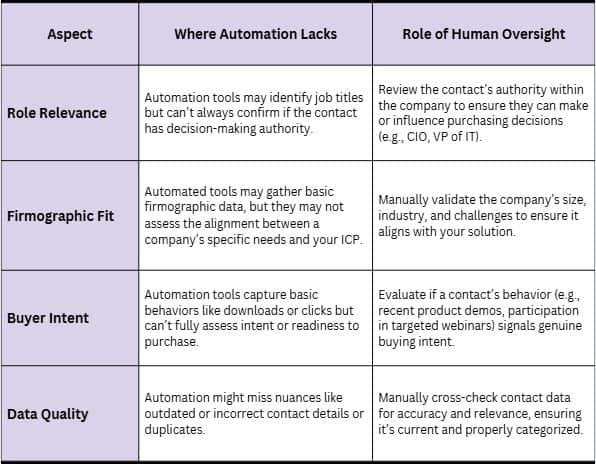
Automation helps you gather large amounts of data, but human review is essential to validate whether the contacts meet your ICP and are relevant for outreach. This involves:
Step 5 — Contact Segmentation for Targeted Outreach
Effective list segmentation breaks down your contact database into actionable groups based on shared characteristics like firmographics (company size, revenue) and demographics (job titles, departments). This enables hyper-targeted campaigns that address specific needs, improving engagement and conversion.
Segmentation Criteria: Group contacts by industry, role, company size, and business challenges.
Tailored Campaigns: Customize messaging to meet the unique needs of each segment.
Example: For a project management software provider, segment by industry (e.g., construction, healthcare, IT) and tailor outreach based on each sector's workflow needs.
Step 6 — Competitor Audience Analysis
Leverage insights from your competitors' audience to identify potential customers already engaging with similar solutions. This allows you to target prospects who are familiar with the value proposition of your product.
Targeting Competitor Engagement: Identify contacts interacting with competitors via social media, webinars, or industry events.
Capture Market Share: Focus on gaps in your competitors' audience that align with your solution.
Example: If your company offers HR software, target companies engaging with competitors on LinkedIn or at HR events.
The Human-in-the-Loop Approach for B2B List Building
Accuracy with Speed: While automation tools can gather large volumes of data quickly, they lack the nuance required for complete accuracy. Manual review ensures the data is not only correct but also free from errors and biases. This process addresses issues like duplicate entries, outdated details, and role relevance that automation tools might overlook, ensuring the list aligns with the target criteria.
Handling Nuance and Context: B2B decisions often depend on complex factors such as long-term partnership value, industry-specific context, and internal team dynamics—factors that AI models struggle to interpret effectively. Human review ensures that these subtleties are considered, aligning the list with broader strategic objectives and company-specific needs.
Continuous Learning and Improvement: Feedback from the manual review process helps identify gaps or inaccuracies, which can then be used to retrain and refine AI models. This creates a continuous learning cycle, enhancing the AI’s ability to better understand market nuances and improve future list-building efforts over time.
Prioritizing High-Value Contacts: Manual review helps identify and prioritize high-value contacts within large datasets by considering additional factors like company culture and strategic alignment—something automation may miss.
Regulatory Compliance: With data privacy regulations like General Data Protection Regulation (GDPR) and California Consumer Privacy Act (CCPA), manual review ensures that data collection, storage, and usage adhere to legal standards, particularly in high-stakes industries like legal and finance.
How to Achieve Efficient B2B Lead Generation with Custom List Building Services
Effective B2B list building in 2026 is no longer about casting a wide net and hoping for leads. It’s about targeting the right buyers—those who have the authority, need, and readiness to make a purchase. However, in-house teams often struggle with the infrastructure and technical expertise needed for scalable, efficient list-building, especially when dealing with large datasets or intricate segmentation.
This is where custom list-building services come in. These services leverage advanced tools, industry expertise, and a human-in-the-loop approach to ensure that your contact lists are not only highly targeted but also actionable, reducing wasted outreach efforts and increasing the likelihood of conversions.
With custom list-building services, you gain access to:
Scalable infrastructure that can handle large volumes of data.
Advanced segmentation based on firmographics, intent signals, and behavioral insights.
Human oversight that ensures the quality and relevance of your contacts, mitigating errors and biases often found in automated systems.
The question isn’t whether you can build a list—it’s whether you can build the right list that fuels consistent growth and maximizes your ROI.
Are you ready to move from volume to precision?

Comment