
TaskJect
Project & task management made simple for small dev teams

As indie builders, we often spend months (or years) shaping our products — coding, polishing features, fixing edge cases, improving UX. But one thing many founders underestimate is distribution. Even a great product can stay invisible if no one knows it exists.
That’s where platforms like Fazier become incredibly valuable.
Here’s why:
1. Visibility beyond your immediate network
Your early audience is usually friends, LinkedIn connections, or a small beta group. Platforms like Fazier put your product in front of people actively looking for new tools — founders, makers, and early adopters.
2. Real feedback from real users
You get feedback from people who don’t know you personally. They are honest, practical, and often catch blind spots your internal testers never notice.
3. Early traction signals
Even a few dozen upvotes or comments become proof of interest. This helps with:
future launches (PH, BetaList, marketplaces)
investor conversations
validating your roadmap
4. Community-driven discovery
Fazier has a “builder-friendly” culture. People there want to support early-stage products. Unlike big marketplaces, you don’t get buried instantly.
5. SEO and discoverability
Each listing gives you a high-quality backlink, which helps your product rank better over time — especially important for new domains.
We just listed TaskJect on Fazier, and the experience reminded me how important these early distribution channels are.
Link: https://fazier.com/launches/taskject
If you're building something — ship it, share it, and let people discover it.
If you're already on Fazier, drop your link in the comments. Let’s support each other 🙌


And How Is the Price Actually Formed?
I keep asking myself this from time to time — especially when I look for a new tool and the price instantly turns me away.
When I started building my own product, I set a goal to define a “minimum acceptable price” for users.
Here’s what I mean by that as a technical specialist:
The Core Components of the Minimum SaaS Cost
Infrastructure
You need to calculate exactly how many hardware resources one user consumes:
servers, storage, databases, backups, monitoring — all of this forms the baseline cost.
Technical Maintenance
You need at least one engineer who will:
handle system errors,
maintain stability,
ensure uptime, updates, and security.
Technically, that’s all you need for a stable SaaS.
So in theory, the final price could be quite low.
But Here’s the Reality: Why “Cheap SaaS” Becomes a Problem
❗ 1. The market distrusts very low prices
If it’s too cheap, people assume it’s a scam or an unstable product.
There’s a psychological trust threshold.
❗ 2. Competition makes everything more expensive
Getting user attention is the biggest hidden cost.
And who wins this competition?
The companies that can spend more and they can spend more because they earn more.
In the end, there’s a paradox:
Technically, SaaS could be cheap — but the market and competition push prices up.
-
2
Customer Success & Support
Here's what kills "cheap SaaS" businesses:
Users expect instant responses (even at $9/month)
Onboarding questions eat hours of time
Feature requests pile up
Churn happens when people don't understand the product
I run a SaaS (Topical Map AI), and honestly? Support and customer success time is my biggest operational cost - way more than infrastructure.
Even with great docs and onboarding, users still need hand-holding. And the cheaper your product, the more support queries per dollar of revenue.
The Real Pricing Formula:
Infrastructure + Engineering + Marketing + Support = Minimum viable price
Then you add:
Perceived value (what problem are you solving? If you save someone 10 hours/week, $50/month feels cheap)
Market positioning (premium pricing = premium perception)
Profit margin (you need room to grow, hire, and weather downturns)
-
1
thanks for sharing your experience. I think it can be profitable for me
-
2
TaskJect explains SaaS prices are high due to development costs, server infrastructure, ongoing support, and value-driven pricing — helping users understand the economics behind subscription software.
-
1
Thanks! Nice to hear it
-
-
2
Insightful read — TaskJect explains why SaaS pricing is high, citing development costs, infrastructure, support, and value-based pricing strategies.
-
2
Makes sense—SaaS pricing reflects ongoing development, maintenance, infrastructure, and support costs, not just the software itself.
-
1
That is why we are already reviewing the pricing policy of our tariffs
-
-
2
This breakdown makes a lot of sense. I think many people underestimate how much goes into sustaining a SaaS product beyond just “hosting.”
Infrastructure, continuous development, support, and the cost of keeping a product stable at scale all add up , and most of that isn’t visible to the end user.
What I’ve also noticed is that users often compare SaaS pricing to one-time purchases, even though the ongoing maintenance for SaaS is very different. A single bug fix or feature update can take days or weeks of effort.
For me, the real challenge as a builder is finding that balance between making the price accessible and still being able to support the product long-term.
Curious....do you think most SaaS tools underprice themselves early on, or overprice to recover costs faster?
-
1
I think, mainly we can talk about overprice. Any SaaS want to growth up, so they need money)
-
-
2
Love this concept thinking-first AI’ is exactly the kind of tool builders need to level up without shortcuts
I help startups and founders use Reddit to attract early users, validate ideas, and spark meaningful engagement all without spam. Your AI has huge potential to drive real discussions and learning moments
If you’re open, I’d be happy to share a few strategies to bring the right early adopters and feedback fast. DM me anytime would love to exchange ideas and see how it can grow
-
2
SaaS churn is real. IMO AI has already started a race to the bottom in many areas. Much of what the golden age of SaaS was comprised of is now commoditized.
-
1
Interesting how almost all SaaS products use the Goldilocks Effect to their advantage - 3 pricing tiers, the lower one must be too cheap to be any good (our brain says), the higher one is 'over the top'. I was recently with someone trying to purchase a new washing machine and, after being completely confused by the distinction between 3 different machines, guess which one they first chose? The middle one! Recently released my own app and thought about a similar strategy for pricing with that, but in the end decided 2 levels was simpler.
-
1
Yeap, but what do you think about more levels, for example 5?
From one side its about flexible, but ...
-


As an indie founder building a SaaS for small tech teams, I’ve learned one powerful truth:
You can go fast alone, but only so far. With the right partners—you go far and fast.
That’s why TaskJect, our lightweight project and task management platform, is now proudly part of the Microsoft Azure partnership program.
🔍 Why this matters:
✅ Credibility – Being backed by a giant like Microsoft validates your product in the eyes of users and investors.
💸 Cost Optimization – Azure supports our infrastructure needs—freeing up budget to invest in features and growth.
⚙️ Scalability – We can build with confidence knowing our platform can scale globally on Azure-native services.
🤝 Collaboration & Opportunities – Access to a partner network, co-marketing, and future funding paths.
📊 For an indie product like ours, this type of partnership is not just a “nice to have” — it’s a difference-maker.
-
2
This is the kind of milestone that can truly change the momentum for an indie product.
Congratulations, Partnerships like this often become turning points for early-stage products, not just because of the technical benefits but the credibility boost you mentioned.
What stood out to me is how partnerships create a kind of “shared confidence.” When a major platform like Azure backs you, users feel safer adopting your tool, and investors see it as a validation signal.
I also appreciate how you highlighted cost optimization. Many indie founders focus only on revenue, but forget that reducing infrastructure cost can be just as impactful for growth.
-
1
I completely agree with you!
Cost optimization is always worth thinking about, even if you are a big business.
Case in point: one airline removed a few olives from their business class salad and it started saving them several million dollars a year.
-
-
2
Love seeing this partnerships like Azure can really accelerate growth and credibility for indie SaaS
I help indie founders and small SaaS teams use Reddit to attract early users, validate features, and create meaningful engagement all without spam or wasted ad spend. A partnership like yours could be amplified even further by connecting with the right communities and showcasing your story strategically
If you’re open, I’d be happy to share a few approaches that have helped similar indie SaaS founders turn partnerships into traction and early users
DM me anytime would love to exchange ideas -
1
Congrats, Serhii 👏 That’s a huge move. Strategic partnerships like this can massively amplify awareness , I’ve helped a few SaaS founders build organic traction post-collaboration, and it’s amazing how quickly momentum compounds. TaskJect’s timing looks perfect. 💪
-
1
Thanks you! How exactly have you helped SaaS founders?
-
1
Appreciate that, Serhii 🙏
I’ve worked with SaaS founders to position their products on Reddit and other organic channels in ways that drive real traction , early users, feedback loops, and brand visibility , without heavy ad spend.
It’s mostly about finding the right communities, crafting authentic narratives, and building conversations that naturally attract users to your product.
If you’re open to it, I’d be happy to share a quick example of how one founder went from launch to 400+ signups in weeks through organic Reddit visibility , could be useful for TaskJect’s next growth phase. 🚀
-
1
Sounds great. Write to me at serhii.bezpalyi@taskject.com
-
1
Thanks for confirming! I’ve just sent you an email with a quick case study showing how I helped a SaaS founder gain 400+ organic signups through Reddit.
Excited to hear your thoughts and explore how we can apply a similar strategy for TaskJect’s next growth phase
-
2
I tried sending you a message via email, but it seems the address you provided isn’t valid. Could you please confirm the correct email so I can resend it?-
1
Find me in LinkedIn: https://www.linkedin.com/in/serhii-bezpalyi/
-
-
-
-
-
-
-
1
The Azure partnership is a smart move, especially at this stage. Beyond the technical benefits, having Microsoft's name attached opens doors that would take years to open otherwise. For TaskJect specifically, that credibility piece matters a lot when you're asking dev teams to trust you with their workflow. Congrats on securing this.
-
1
Thanks you! It's really important move for TaskJect!
-


Hey Indie Hackers 👋
We’ve just released GitHub integration for TaskJect — our lightweight project & task management tool for small dev teams.
Here’s how it works:
Connect your GitHub repo to a project
From a task, create a branch & Issue automatically
When you open a pull request → the task moves to On review
If PR is closed without merge → the task goes back to In progress
When the branch is merged → the task is automatically marked as Done
The idea is simple: tasks follow your dev workflow automatically, so you don’t have to update statuses by hand.
We built this because we were tired of bloated PM tools that don’t sync with dev workflows.
👉 If you want to try it out, check taskject.com
👉 DM me for early access codes — would love your feedback!
-
2
Really like this approach. Keeping task management aligned with GitHub activity saves a ton of manual updates. Excited to see how this evolves.
-
2
Hi [serhii],
First off all, congrats on building TaskJect — the GitHub integration is a brilliant idea for dev teams 👏.
I recently ran a quick audit of your website and noticed a few things:
Aesthetic Score is currently 2
Website traffic is close to 0
Existing backlinks are mostly no-follow and from low DA sources
This means search engines aren’t giving TaskJect the authority it deserves yet — which may hold back organic growth and visibility.
👉 The good news: this can be fixed with a focused off-page SEO strategy.
Here’s what I recommend for TaskJect:Guest posts on niche-relevant, high-DA tech sites
Quality do-follow backlinks to improve domain authority
These steps can steadily raise your authority, rankings, and organic traffic, helping TaskJect reach more developers without relying only on launch posts or ads.
Would you like me to prepare a mini backlink plan (free) for TaskJect, showing exactly where you can gain high-quality links?
Looking forward to your reply,
[ASIFA IQBAL]
[SEO specialist]-
1
Thanks for reply. Sure, let's do it
-
1
Hi [Serhii],
Here is the 3-Month Backlink Growth Strategy (For SaaS Websites)
Since SaaS websites are highly competitive and most authority sites allow only link insertions, this strategy focuses on building high-quality, contextual backlinks that deliver long-term growth.
🎯 Goals of the Strategy
Increase Domain Authority (DA) gradually & naturally
Drive relevant referral traffic from niche articles
Improve keyword rankings & visibility in search engines
Build a diversified backlink profile with safe, white-hat methods
📅 Month-by-Month Plan
Month 1 – Foundation Building
8–10 link insertions in niche-relevant blogs/articles (DA 30–50)
Focus on branded and naked URL anchors (to keep it natural)
Ensure placements are contextual within existing content
Expected outcome: Faster indexing, first trust signals from Google
Month 2 – Authority Growth
8–12 link insertions, targeting DA 40–60 websites
Add 1–2 premium placements on DA 60+ authority sites
Start mixing in keyword-rich anchor texts (partial match)
Expected outcome: Noticeable improvement in authority & early keyword ranking growth
Month 3 – Diversification & Scale
10–12 link insertions with a healthy DA mix (30–70+)
Diversify anchor texts: branded + generic + keyword variations
Target content pieces that already rank on Google for SaaS/tech terms
Expected outcome: Stronger SERP presence, consistent organic traffic increase
🔗 Why Link Insertion Works Best for SaaS
Instant authority transfer – backlinks from aged, indexed articles carry stronger SEO value
Relevant audience – placements on niche-specific articles send targeted traffic
Cost-effective & scalable – faster than guest posting while maintaining quality
Long-term impact – high-authority contextual links continue passing value for years
📊 Reporting & Tracking
Monthly backlink report (with URLs, DA, anchor text)
Traffic & ranking progress updates
Strategy adjustments based on results
✅ With 8–12 quality link insertions per month, your SaaS website can steadily grow in authority, rankings, and organic traffic within 3–6 months.
I’ve put together a short backlink growth plan tailored for SaaS sites like yours and sites related to your niche SaaS. plz find the PDFs in your email.
shared the backlink plan and SaaS SaaS-related sites PDF in your email
[ASIFA IQBAL]
[SEO specialist]
-


One thing our early users kept asking for: “How do I know when something changes without checking the board all the time?”
So we built a simple notification center.
Now you’ll instantly see when:
a task gets assigned to you
your task moves to Done
It’s lightweight, distraction-free, and keeps the whole workflow in sync.
For us, this was about balancing simplicity (no clutter, no spam) with visibility. Small teams don’t need 10 different pings — they just need to stay aligned.
👉 If you’re building for small dev teams too — how do you approach notifications without overloading users?
-
2
This is clean work. As someone building civic infrastructure in Nigeria, I’ve learned that simplicity isn’t just a design choice,it’s survival. Notifications done right keep teams aligned without drowning them in noise. Respect for keeping it lean and purposeful. That’s how you build trust.
—Karo, Founder of White Waters Sentinel
-
1
Thanks a lot, Karo 🙌
I really resonate with your words — simplicity as survival. Exactly the balance we’re aiming for: helping teams stay aligned without turning notifications into background noise.Your perspective from civic infrastructure makes it even more meaningful. Lean and purposeful feels like the only sustainable path, no matter the industry.
Respect for your work as well — building trust is the hardest, but also the most important part. 🚀
-
-
2
this is smart, small teams really need just the essentials
-
2
Super clean approach 👏
I like how you kept it lightweight and focused on visibility instead of spamming users.
Curious — did you test different notification frequencies or formats before settling on this one?
-
1
We conducted testing exclusively on our own experience. We noticed that most of the time is lost at the "Review" stage of the task. The manager may have a bunch of his own tasks, so he may not see the task that has received the On review status.
-
-
2
Can I customize which notifications I want to receive?
-
1
at this moment no. We fixed base notification now, but in the future, we plan to increase the number of notification types, and then we will introduce a customization option.
-


We’re excited to announce two new features in TaskJect! 🎉
✅ Personal To-Do Lists
Plan your day, set priorities, and track your progress with a dedicated personal task list.
📝 User Notes
Keep important thoughts, ideas, and reminders right inside TaskJect — always at hand when you need them.
These updates make TaskJect not only a tool for team collaboration but also your personal productivity hub.
-
1
TaskJect explains SaaS prices are high due to development costs, infrastructure, support, and value-based pricing — giving insight into why subscriptions often seem expensive.


When we started building TaskJect, we went with microservices. It felt like the “right” move — modern, scalable, modular.
But… the reality hit hard:
– Too much overhead for a small team
– Local dev setup was a nightmare
– Most bugs weren’t in business logic — they were in communication between services
– Shipping a feature meant syncing across multiple repos/services
So we re-evaluated and did something counterintuitive…
🚀 We moved everything into a clean monolith — built with ASP.NET Core + Razor Pages.
The result?
✅ Faster development
✅ Simpler deployments
✅ Easier testing
✅ More focus on features, less on orchestration
The takeaway: complex architecture ≠ maturity. Sometimes simplicity is the smartest form of scaling.
💡 When microservices actually make sense:
✔️ You have a large dev team working in parallel
✔️ You’re dealing with high-variance workloads
✔️ You need to scale across domains/languages
✔️ You can afford strong DevOps and observability tooling
But for small teams or early-stage products — monoliths are often the better tool.
Have you ever simplified your stack and felt the relief? Would love to hear your experience.
-
2
Here is my longish thread about microservices.
https://x.com/_zenman/status/1225649080069525509
These are the exact reasons why I think they are unnecessary for most small to medium size products.
– Most bugs weren’t in business logic — they were in communication between services
– Shipping a feature meant syncing across multiple repos/services
They probably make sense when you're building a large platform.-
2
Absolutely agree with you! Those two points resonate a lot with our experience: most of our headaches were around service-to-service communication, not actual logic.
Also checked out your post on X — really enjoyed it!
-
-
2
I think people often misunderstand "best practice". There isn't one right way to do anything. I've noticed a ton of college grads come in thinking that there is, or expecting to learn, the "one true" way to solve a specific problem. I found myself constantly teaching them that you can never do anything "that correct way" because of constraints and requirements.
We found ourselves building a system to replace our archaic solution that was built about 8 years before. An engineer, funnily enough not knowing I was the one that built that archaic system all by myself, asked me innocently, "Why did they build it wrong? Why didn't they just make it like we're making it now?" I'm not offended. I told them that the system had been in place for 8 years so you could argue that it had actually been overengineered when we expect our software at our growth rate to have a shelf life of about 18 months. That that archaic piece of software in all it's glory was designed to do less than 100 millionth the volume that we had by then and it had also gotten us to where we are, even though it was now the most hated software at the company. Many of the new technologies we were replacing it with didn't exist when it was originally built and we probably couldn't have built it the new way anyway because our team didn't have the expertise and was about 1/50 the size. Even if we were successful in building it then, it would have been too expensive and had too much overhead... we wouldn't exist anymore.
This was going from monolith to microservices. The right answer is not the same for everyone. And it changes over time.
-
1
I couldn’t agree more: context is everything. What might seem like a "bad decision" in hindsight was often the best (or only) decision at the time — given the team, tools, and constraints.
We also try to avoid the “one right way” mindset at TaskJect. Our own shift from microservices to a monolith wasn’t about saying one is better — it was about aligning with our current team size, velocity, and what our product needed right now.
Loved the story about your old system — it’s a great reminder that even "archaic" solutions might have done a great job under very different conditions.
Thanks for sharing — I think many builders need to hear this perspective.
-


Hey Indie Hackers,
After trying Jira, Trello, Notion, ClickUp… we realized none of them really fit how we wanted to work:
Clear, fast, and without distractions.
So we built TaskJect for our team — and now it’s live for others to try.
🛠️ What’s inside:
— Minimal UI (one-screen task view)
— Table + Kanban
— Priorities, deadlines, complexity
— Lightweight manual time tracking (no timers!)
— Notes from the Team Lead
— Project-level access control
— Telegram notifications for status changes
We’ll keep improving it based on feedback — that’s what got us this far.
💬 I’d love your thoughts:
What do you need from a task manager right now?
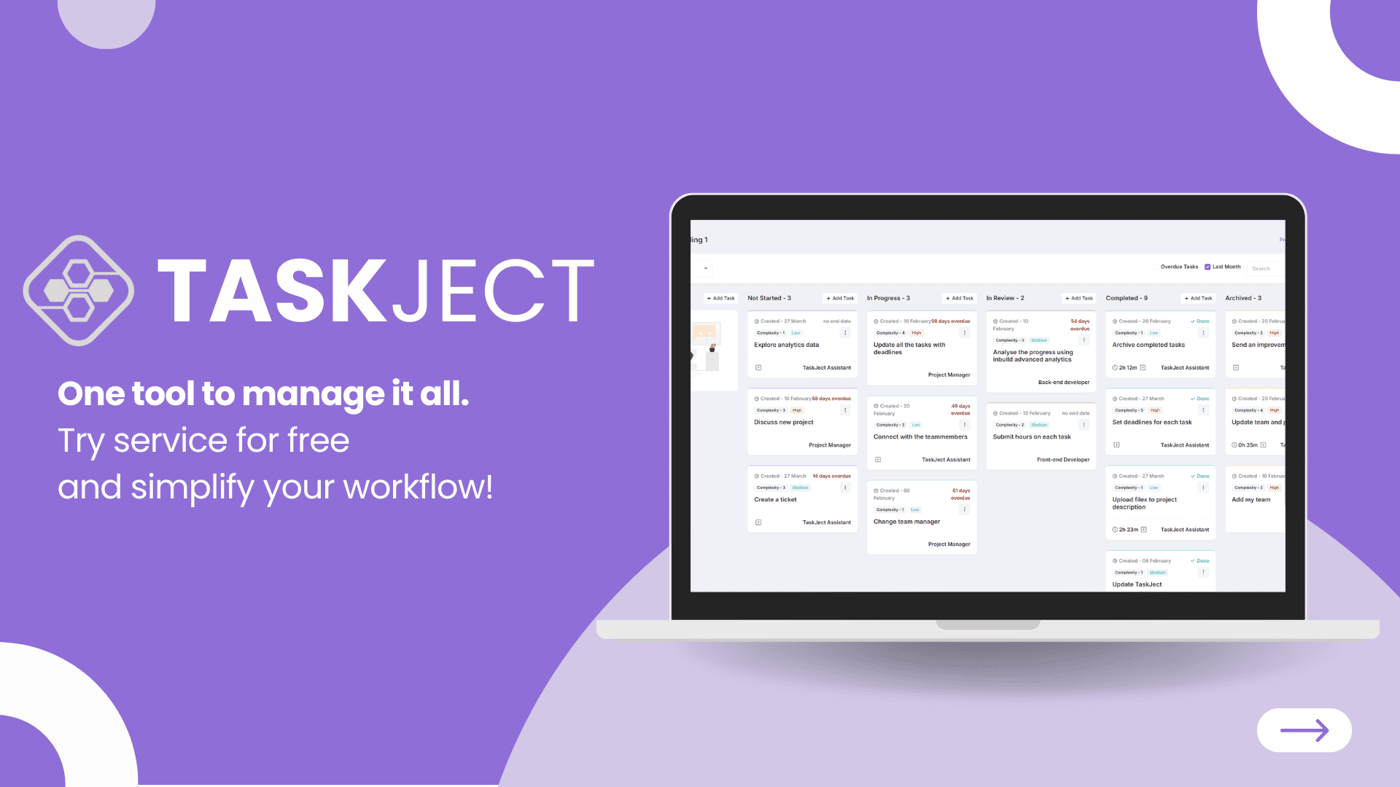
👉 You can check it out here: taskject.com
-
2
Excited to see where TaskJect goes...
-
1
Thank you! It really means a lot. We’re building it step by step and can’t wait to see where it takes us.
-
-
2
thoughtful and effortful. congrats!
-
1
Thank you so much! Really appreciate the kind words — it's been a lot of effort, but we're excited to finally share it with the world.
-
-
2
Congrats! I hope your product finds its audience!
-
1
Thanks!
-
-
1
Awesone


We didn’t build TaskJect because we dreamed of launching a startup.
We built it because we were tired of tools that didn’t match how we worked.
🧩 Jira felt too heavy.
🧩 Trello too basic.
🧩 Notion too unstructured.
And everything else had either too many features or too much noise.
So instead of fighting with tools, we created one.
TaskJect was born from internal team needs —
just 6 of us working after hours, building a tool we’d actually want to use every day.
No funding.
No launch parties.
Just real usage, honest feedback, and steady progress.
It’s been intense, but we’re getting small wins:
people stick around, use the features we struggled to design, and say “This is exactly what we needed.”
-
2
As PM at Teamcamp, I bootstrapped our SaaS PM tool from the same Jira/Trello frustrations – started internally with a small team, iterated on feedback, and hit sustainable growth without funding. Building for real needs creates that 'exactly what we needed' magic. What's your go-to tactic for turning early user feedback into feature priorities?
-
1
That's awesome to hear — Teamcamp looks really solid! Totally agree: building from real needs keeps everything grounded.
Right now, our tactic is super direct: we log every piece of feedback (even small passing comments), then look for patterns across multiple users or teams.
If a feature request pops up 3–4 times in a week — it moves to the top of the roadmap.
We also weigh effort vs impact heavily, especially since we’re a small team.What worked best for you when it came to filtering noise vs real needs?
-
-
2
Really like what you’re doing. We’ve felt the same frustration with most tools on the market — too rigid or too noisy.
But to be honest, I’m not sure a task manager can scale meaningfully without funding.
Curious how you plan to grow and compete in such a saturated space?


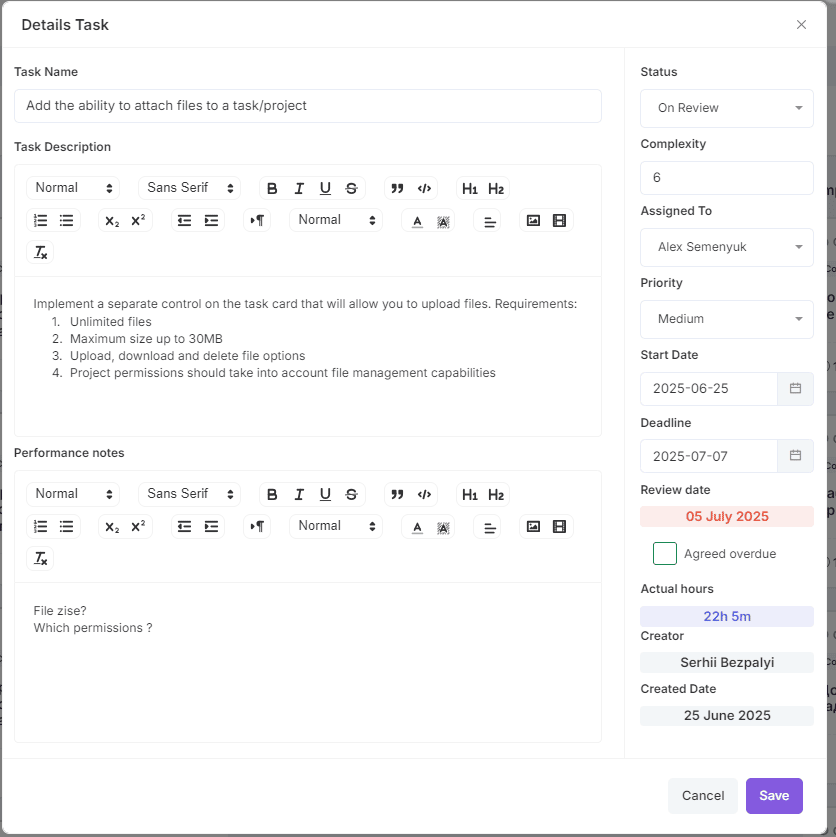
When designing TaskJect, one of our main goals was simple:
Make the task view as informative as possible — without any noise.
Everything you need fits into one clean screen:
Task title and description
Assigned user, deadline, complexity
Priority and status
Notes from the Team Lead
Time tracking & progress
Created date and task owner
💡 This helps teams:
Understand the task instantly — no extra clicks
Keep clarity even a week later
Work more efficiently — when each task carries context, not just text
(The screenshot shows a real task from our dev roadmap: adding file attachments)
We’re improving TaskJect every day — and curious to hear from you:
👉 What’s a must-have in your task view?
Got an idea to make it even more convenient? Drop it in the comments!
-
2
Love how everything critical sits in a single panel. really good. I don't know if I missed it but is there a possibility to add subtasks ? It's a must-have for me so I don't know if you thought about it.
-
2
Thanks a lot! Glad you like the focused layout 🔥
At the moment, we don’t support subtasks. But if our users identify it as a must-have — it’s definitely something we’ll prioritize and implement. We always listen closely to real needs rather than building just in case.
-
-
2
Love the clarity of your onboarding flow — especially the table view!
Instead of going the traditional board/column route, we’ve been experimenting with a tag-first approach to avoid the clutter that boards can create over time.
Curious — did you explore any alternatives to columns during your design process, or was the board view always the direction?
-
1
Thanks for the thoughtful question!
We actually follow a linear task flow, so our board uses a fixed set of columns to reflect that structure. That said, clutter is something we’re careful about — by default, we apply a filter to show only tasks from the past month, so older tasks don’t get in your way.
We’ve also recently introduced a table view, which focuses by default on tasks that are either not started or in progress, again to avoid visual overload.
On top of that, we’re heavily user-focused. In our Pro and Expert plans, users can suggest features or improvements directly — we aim to solve real problems that our users face, instead of adding features just for the sake of it.
Always happy to hear new approaches, though — your tag-first idea sounds really interesting!
-
-
2
For me, quick access to related tasks or dependencies is a must. It helps a lot when you're working on something that’s part of a bigger flow.
-
1
Absolutely! That’s exactly why we show your active tasks (up to 10) right in your profile — with quick access to their projects. Makes it much easier to stay in the flow
-
-
2
> "Interesting product! Good luck with your launch."
-
1
Thanks! If you're curious to try it out, feel free to give it a spin — would love to hear your thoughts!
-


2 Comments
Great work here projects with a clear story and real user value like this usually perform extremely well on Reddit. If you ever want help positioning this for maximum organic reach and community engagement, I can guide you on exactly how to launch it across the right subreddits. Just reach out anytime.
I don't know why, but both platforms published the content. While traffic hasn't increased, we've gained backlinks. Having data is a good thing.