Top 5 AI Model Training Services to Consider in 2026
AI is becoming easier to integrate, but building an AI system that performs reliably is becoming more complex.
At Triple Minds, we’ve seen businesses move beyond simply connecting an application to an LLM API. They now want AI systems that understand their industry, work with proprietary data, follow specific business rules, reduce hallucinations, and deliver consistent results at scale.
That is where AI model training services become important.
However, we also believe there is a common misunderstanding around AI model training. Not every business needs to build a model from scratch. Depending on the product, fine-tuning an existing model, implementing RAG, or even starting with a pre-built AI application can be a much more practical approach.
With that in mind, we’ve put together five companies we would consider when evaluating AI model training and AI development requirements in 2026:
Triple Minds
Burj Code
Prebuilt Apps
Sell My Code
Make An App Like
This isn't intended to be an absolute ranking. These companies have different strengths, and some are more focused on AI application development and ready-made solutions than traditional model training.
Our goal is to help businesses understand those differences before choosing an AI partner.
What Do AI Model Training Services Actually Involve?
AI model training is much more than feeding information into a machine-learning model.
A professional AI model training project can start with data collection and preparation before moving into model selection, training, fine-tuning, testing, evaluation, deployment, and ongoing optimization.
Depending on the project, an AI training provider may work with:
Large language models
NLP models
Computer vision models
Image-generation models
Recommendation systems
Predictive models
Multimodal AI
AI agents
The data itself can also come in different forms, including text, images, documents, audio, video, structured business data, and customer interactions.
For us, one of the most important parts of the process is determining what actually needs to be trained.
A company building an internal knowledge assistant may not need a custom LLM. A RAG architecture connected to its private knowledge base may be enough.
A business developing a specialized image-generation product, however, may benefit from fine-tuning an image model.
The right approach depends on the problem we're trying to solve.
1. Triple Minds
At Triple Minds, we approach AI model training as part of a broader AI product-development process.
Our experience is that businesses rarely need a trained model sitting independently. They usually need that model to power something useful, such as an AI chatbot, AI agent, AI companion, recommendation system, image-generation platform, or another AI-powered application.
That's why our AI model training services cover multiple parts of the AI lifecycle.
We work with areas such as LLM fine-tuning, custom datasets, RAG systems, AI agents, multimodal AI, image models, embeddings, vector databases, model evaluation, and AI API development.
Our process generally starts with understanding the use case and the data available. From there, we determine whether the project requires custom training, fine-tuning, RAG, or another approach.
Data preparation is particularly important. A model trained on poorly structured or irrelevant data isn't automatically going to produce better results simply because more data has been added.
We therefore look at data quality, relevance, consistency, and the specific behavior we want the model to learn.
Once the model has been trained or fine-tuned, we can evaluate it against real-world requirements and integrate it into the larger product.
For example, an AI companion platform may require far more than an LLM. It could involve personality systems, long-term memory, image generation, voice interaction, moderation, subscriptions, APIs, and scalable backend infrastructure.
That's where we believe an end-to-end approach becomes valuable.
Our take: Triple Minds is a strong option for businesses that need AI model training combined with AI product development, integration, and deployment.
2. Burj Code
Burj Code is another provider we'd consider when the project has a strong machine-learning engineering component.
Its AI model training services cover custom machine-learning models, LLM fine-tuning, NLP, computer vision, time-series applications, recommendation systems, anomaly detection, and model optimization.
The company also highlights technologies and frameworks such as PyTorch, TensorFlow, Hugging Face, JAX, MLflow, Ray, and DeepSpeed.
That technical infrastructure matters because model training can become increasingly demanding as datasets and models grow.
A serious ML project may involve data pipelines, GPU infrastructure, distributed training, experimentation, evaluation, model management, deployment, and monitoring.
Burj Code also highlights techniques including LoRA, QLoRA, and RLHF for LLM-related work.
From our perspective, this makes the company particularly interesting for organizations looking beyond basic AI API integration.
Businesses working on computer vision, NLP, predictive systems, recommendation engines, or specialized machine-learning applications may need this kind of deeper engineering capability.
Our take: We'd consider Burj Code when the requirement is heavily focused on custom ML, LLM fine-tuning, computer vision, NLP, or production-oriented machine-learning engineering.
3. Prebuilt Apps
Prebuilt Apps takes a different approach, and we think it's important to make that distinction clear.
Rather than being positioned primarily as a traditional AI model-training consultancy, Prebuilt Apps focuses more on ready-made and white-label applications.
That can actually be useful for businesses that don't need to develop every component from scratch.
Imagine a startup wants to launch an AI-powered application. The founders may initially think they need a completely custom AI system, but their real requirements could include a mobile app, web platform, user accounts, AI chat, payments, administration, and integrations.
Building all those components independently can take significant time.
A pre-built application can provide an existing foundation that businesses can customize around their brand and business model.
This approach can be particularly relevant to consumer-facing AI products, including AI companion platforms and other application categories where the surrounding product architecture is just as important as the underlying AI.
The biggest advantage here is speed.
Instead of spending months building basic application infrastructure, a company can potentially begin with an existing foundation and concentrate its resources on customization, positioning, user experience, and growth.
Our take: We would consider Prebuilt Apps when the priority is launching an AI application quickly, rather than developing a proprietary foundation model from scratch.
4. Sell My Code
Sell My Code follows a similar build-versus-buy philosophy, with a focus on ready-to-deploy software and source-code products.
Its marketplace includes AI-related applications such as chatbots, AI companions, AI content tools, AI agents, and other AI-powered software.
For startups and entrepreneurs, this approach can solve a very practical problem.
Building an AI product from zero requires much more than integrating an LLM.
There may be a need for:
Frontend development
Backend infrastructure
Authentication
Payments
AI integrations
Databases
Admin dashboards
User management
Deployment
Analytics
A ready-made codebase can provide many of these components from the beginning.
The company also provides customization options for businesses that need something beyond the existing product.
We see this as particularly relevant for businesses that are testing an AI product idea or want to enter a market without investing immediately in an entirely new application architecture.
It's also important to understand what Sell My Code isn't.
If your objective is to develop a proprietary foundation model or undertake advanced custom model research, this isn't the same category as a dedicated AI model-training provider.
But if your requirement is to launch a functional AI application quickly, the model can be very different.
Our take: Sell My Code is worth considering for businesses that prioritize ready-made AI software, customization, and speed to market.
5. Make An App Like
Make An App Like is another company we'd consider for businesses that are primarily looking to build and launch AI applications.
Its offerings include AI companion applications and other AI-powered platforms with capabilities such as chat, voice interaction, image generation, personas, subscriptions, and other consumer-facing features.
This type of solution can be particularly useful for startups entering competitive AI categories.
Consider an AI companion application.
The LLM is only one part of the product.
The application may also require personality management, memory, image generation, voice, user accounts, subscriptions, moderation, analytics, and administrative controls.
Building all of that from the ground up can require considerable development effort.
A ready-made architecture can allow the business to focus more heavily on differentiation.
That differentiation might come from the target audience, product experience, AI personalities, monetization strategy, content, or distribution rather than from developing a foundation model.
This is an important consideration because many AI startups don't actually need to build their own model.
They need to build a better product around existing AI models.
Our take: We'd consider Make An App Like when the requirement is primarily AI application development, white-label solutions, or consumer-facing AI platforms.
Comparing the Top 5 AI Model Training and Development Providers
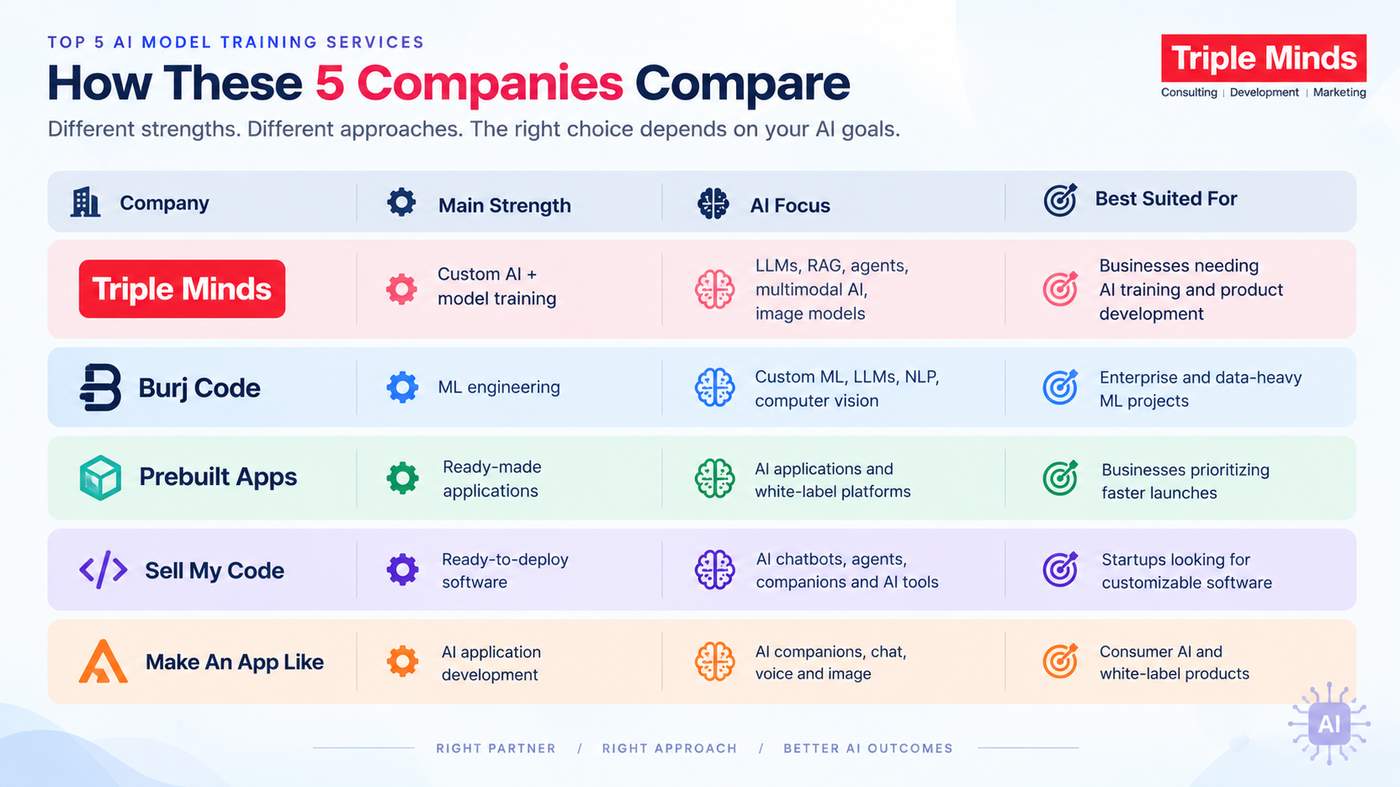
The comparison also shows why we don't think every provider should be judged using exactly the same criteria.
A business looking for custom model training has very different requirements from a startup looking for a ready-made AI application.
Do You Really Need to Train an AI Model?
This is one of the first questions we'd ask before starting a project.
Training a model from scratch can sound attractive, but it isn't automatically the best technical or business decision.
For many applications, an existing foundation model can already provide most of the required intelligence.
The missing capability might instead be the company's proprietary knowledge.
In that situation, RAG could be enough.
For other projects, the model may already understand the required task but doesn't produce the desired behavior or output format. Fine-tuning could then be appropriate.
Training from scratch becomes more relevant when the business needs a high degree of control and has the data, resources, and technical requirements to justify it.
We generally look at three options.
Training from scratch provides maximum control but requires significant data, compute, engineering resources, and investment.
Fine-tuning adapts an existing model to a specific domain, behavior, or task and is often more practical.
RAG allows an existing model to access external information without changing its underlying parameters, making it useful for frequently changing business knowledge.
The important thing is not choosing the most technically impressive option.
It's choosing the option that delivers the required result efficiently.
What Should You Ask an AI Model Training Company?
Before selecting a provider, we'd recommend having a detailed conversation about the actual project rather than simply asking for a quote.
Here are some questions we'd ask:
Have you worked with the type of model we need?
Would you recommend training from scratch, fine-tuning, or RAG?
How will our training data be prepared?
How will model performance be evaluated?
How will hallucinations and incorrect responses be measured?
Where will the trained model be deployed?
Who owns the trained model and resulting assets?
How will our proprietary data be protected?
What happens when the model needs to be updated?
Do you provide post-launch optimization and monitoring?
These questions can quickly reveal whether a provider understands the complete AI lifecycle or is simply selling an AI development package.
Why AI Model Training Is Becoming More Specialized
AI products are becoming more specialized.
Businesses no longer want generic AI that can do everything reasonably well. Increasingly, they want AI that understands a particular industry, workflow, audience, or dataset.
That could mean an AI system trained around legal documents, financial information, medical workflows, customer-support conversations, product catalogs, or proprietary business processes.
We're also seeing more AI systems become multimodal.
Modern applications may need to process text, images, audio, video, documents, and structured data.
As a result, model training is increasingly becoming part of a larger architecture.
The model matters, but so do the data pipeline, retrieval system, orchestration layer, evaluation framework, APIs, infrastructure, and user experience surrounding it.
Our Final Take
From our perspective, the biggest mistake businesses can make is choosing an AI model training company before defining what they actually need.
If you're developing a proprietary AI system, a specialist model-training provider may be the right choice.
If you're adapting an existing LLM to your domain, fine-tuning may be more practical.
If your AI needs access to frequently changing business information, RAG could be the better solution.
And if your main objective is to launch an AI application quickly, a pre-built or white-label platform may provide a much faster path to market.
That's why we'd look at these five providers differently.
Triple Minds is focused on combining AI model training with broader AI product development.
Burj Code is relevant for businesses requiring custom ML engineering, LLM fine-tuning, NLP, or computer vision.
Prebuilt Apps can make sense for businesses prioritizing ready-made and white-label application development.
Sell My Code is relevant when ready-to-deploy AI software and customization are the priorities.
Make An App Like is worth considering for consumer AI applications and white-label AI platforms.
Ultimately, the question isn't simply:
"Which AI model training company is the best?"
The better question is:
"Which AI development approach is right for what we're trying to build?"
Once that question is answered, choosing the right partner becomes much easier.
Frequently Asked Questions
1. What are AI model training services?
AI model training services help businesses prepare data, train or fine-tune models, evaluate performance, optimize AI systems, and deploy them into production. Depending on the provider, services can also include RAG, embeddings, AI agents, computer vision, NLP, and multimodal AI.
2. Do we need to train an AI model from scratch?
Not necessarily. Many businesses can achieve their objectives through fine-tuning an existing model or implementing RAG. Training from scratch is generally more appropriate when existing models cannot satisfy the required technical or business requirements.
3. How much data is required for AI model training?
There isn't a universal amount. Requirements depend on the model, use case, training methodology, and desired performance. In many situations, high-quality and relevant data is more valuable than simply having a large dataset.
4. How long does AI model training take?
The timeline depends on the project's complexity. Fine-tuning an existing model can be considerably faster than developing and training a model from scratch. Data preparation, testing, evaluation, infrastructure, and deployment also influence the overall timeline.
5. How should we choose an AI model training company?
Start by defining your use case. Then evaluate the provider's experience with your specific model type, data requirements, AI architecture, deployment environment, security needs, and long-term optimization. Also determine whether you actually need custom training or whether fine-tuning, RAG, or a ready-made AI application would be more appropriate.

