
AI Agents
Best AI Products
If you are planning to build a roadside assistance application, start with the business model, define the users, map the operational workflow, prioritize the services, select the necessary integrations, and then determine the technology investment.

The global focus on sustainability and carbon reduction is creating new opportunities for businesses to participate in carbon markets. A Carbon Credit Trading Platform enables organizations, investors, and project developers to buy, sell, track, and manage carbon credits through a digital ecosystem. Adding a mobile app to the platform can make carbon trading more accessible by allowing users to monitor transactions, manage portfolios, and receive real-time market updates from anywhere.
However, building a reliable carbon credit trading platform requires more than a standard marketplace app. It involves secure transactions, transparent credit tracking, verification mechanisms, regulatory considerations, and a scalable technology infrastructure. Here is a step-by-step guide to developing a carbon credit trading platform with a mobile app.
1. Define the Business Model
The first step is to determine how your carbon trading platform will operate. You need to identify your target users, including businesses looking to offset emissions, carbon project developers, brokers, investors, and sustainability-focused organizations.
You should also decide whether the platform will support direct trading, marketplace-based transactions, auctions, or a combination of different models. Your business model will influence the platform's features, revenue strategy, compliance requirements, and technology architecture.
A well-defined business model also helps your development team determine the appropriate mobile and web experiences for different user groups.
2. Identify Essential Platform Features
A successful carbon credit marketplace needs features that support transparency, usability, and secure transactions. Common features include:
User registration and identity verification
Carbon credit listings and project profiles
Search and filtering
Credit pricing and market information
Buying and selling functionality
Digital wallet and payment integration
Transaction history
Carbon credit portfolio management
Notifications and alerts
Administrative dashboards
Reporting and analytics
The mobile application should provide a simplified experience for users who want to monitor their carbon credit portfolios, review available projects, execute transactions, and receive important notifications.
3. Add Carbon Credit Verification and Tracking
Trust is one of the most important factors in carbon markets. Users need confidence that credits represent legitimate projects and that ownership and transactions can be accurately tracked.
Your platform should therefore maintain detailed records for each credit, including project information, issuance data, verification details, ownership, and transaction history. Depending on the market and business model, the platform may also need to integrate with relevant registries, verification providers, or other external systems.
A transparent tracking mechanism can help reduce duplicate claims and improve confidence among buyers and sellers.
4. Consider Blockchain Technology
Blockchain can be considered when building a carbon credit trading platform that requires an immutable transaction history and transparent ownership records. Carbon credits can potentially be represented as digital assets, allowing transactions to be recorded on a distributed ledger.
Smart contracts can also automate certain processes, such as transferring ownership after a successful transaction or executing predefined marketplace rules.
However, blockchain should be used based on actual business and regulatory requirements rather than simply because it is a popular technology. The platform architecture should be designed around the specific carbon market in which the business intends to operate.
5. Build a User-Friendly Mobile App
The mobile app is an important component of a modern carbon trading ecosystem. Working with an experienced provider of mobile app development services can help businesses create applications for both Android and iOS users.
The app can provide features such as real-time portfolio updates, carbon credit discovery, price alerts, transaction notifications, project information, account management, and secure payments.
For better usability, the interface should clearly present complex carbon market information through intuitive dashboards, charts, filters, and summaries. Security should also be prioritized through measures such as multi-factor authentication, encryption, secure APIs, and appropriate access controls.
6. Integrate Payments and Digital Wallets
A trading platform needs secure mechanisms for processing payments and managing transactions. Depending on the target market, the platform may support bank transfers, cards, digital wallets, or other approved payment methods.
If blockchain-based assets are involved, crypto wallet integration may also be considered where legally and commercially appropriate.
All financial functionality should be designed with applicable payment, financial, data protection, and regulatory requirements in mind.
7. Develop the Admin Dashboard
The admin panel gives platform operators control over the marketplace. Administrators should be able to manage users, carbon projects, listings, transactions, verification workflows, disputes, payments, and reports.
Advanced analytics can help administrators monitor trading activity, transaction volumes, user engagement, and platform performance. Automated alerts can also help identify unusual activity that may require review.
8. Focus on Security and Compliance
Carbon trading platforms can handle sensitive business, financial, and environmental data, making security essential. Development teams should implement secure authentication, encryption, API protection, access controls, audit logs, and regular security testing.
Compliance requirements can vary depending on the countries, carbon markets, financial services, and types of transactions supported by the platform. Therefore, businesses should work with appropriate legal and compliance professionals before launching the product.
9. Test and Launch the Platform
Before launch, conduct comprehensive testing across the web platform, mobile applications, APIs, payment systems, and trading workflows. Functional, performance, security, usability, and compatibility testing can help identify issues before users access the marketplace.
A phased launch can also be useful. Businesses can begin with an MVP containing essential trading and portfolio features, collect user feedback, and gradually introduce advanced functionality.
Conclusion
Building a carbon credit trading platform with a mobile app requires a combination of marketplace functionality, secure technology, transparent credit tracking, user-friendly mobile experiences, and regulatory awareness. From project verification and trading workflows to payments, analytics, and portfolio management, every component should be designed around the needs of the target carbon market.
Partnering with an experienced provider offering Carbon Credit Trading Platform Development services can help businesses transform their sustainability-focused concept into a scalable digital marketplace. By combining robust platform architecture with reliable mobile app development services, businesses can create convenient and transparent solutions for participating in the evolving carbon economy.
A U.S. LLC provides founders with a real U.S. entity for Stripe, payment processors, and customers without needing a visa or a Social Security Number. Yet three issues often trip up every non-U.S. founder: obtaining an EIN without an SSN, filing Form 5472 each year even when revenue is zero, and planning for state fees that have increased in 2026. None of these issues are difficult once you are aware of them.
If you are building a SaaS product or selling products from outside the U.S., a Delaware or Wyoming LLC is usually the fastest route to obtain a U.S. bank account, a Stripe or Mercury account, and a business entity that does not require physical presence. The formation of the LLC is truly simple. It is the paperwork that appears six months later that often surprises people.
Here is what truly matters once the LLC exists, not just how to file the formation documents.
You Do Not Need an SSN, Yet the EIN Process Appears Different
Every U.S. LLC requires an EIN (Employer Identification Number) to open a bank account, to use payment processors, and to file taxes. If you possess a Social Security Number or an ITIN, the IRS online tool issues an EIN in fifteen minutes.
Foreign founders without either cannot use that online tool. Instead, you file Form SS-4 by fax or by mail. Write "Foreign" in the SSN field.
The IRS official estimate for fax applications is four business days, but founders on Indie Hackers and elsewhere have reported that it can take several weeks longer in 2026 because IRS staffing is reduced. Mail applications normally take four to six weeks. There is also a phone option for applicants at 267-941-1099, and some founders find this faster than waiting for a fax response.
None of this requires a lawyer. It does require patience. It is wise to start the EIN application the same week you form the LLC rather than waiting until you urgently need a bank account.
The Form You Have Never Heard Of: Form 5472
This is the form that surprises people. If you are the foreign owner of a U.S. single-member LLC, the IRS treats your LLC as a disregarded entity for income tax but as a reporting corporation for information purposes. That means you must file Form 5472 attached to a pro forma Form 1120 each year, even if the LLC made no money and has never had a customer.
The trigger is not revenue. It is any transaction between you and the LLC, and a single capital contribution to open the business counts. Fund your LLC with $500 to open a bank account and do nothing that year, and you still have a reportable transaction.
The deadline is April 15 for calendar-year filers, with an automatic six-month extension available if you file Form 7004 on time. If you miss the filing entirely, the penalty starts at $25,000 per form, per year. There is no cap if it continues. This is not a fee schedule with a small-business exception. A dormant LLC with zero revenue owes the $25,000 penalty if the form is not filed.
This is the most common gap we see in EIN application work with foreign-owned LLCs. Founders get the EIN, open the bank account, and never realize that the 5472 obligation exists separately from any income tax return, because a disregarded entity normally does not file one at all.
The FinCEN Reporting Rule Has Changed, and It Is Good News
During most of 2024 and 2025, foreign founders were told they would need to report ownership information to FinCEN under the Corporate Transparency Act. That requirement has since been rolled back for domestic entities.
As of a rule that took effect on August 14, 2026, U.S.-formed companies, including LLCs owned entirely by foreign persons, are exempt from BOI reporting to FinCEN.
The exemption only applies to entities formed in the U.S. If you are a company registering to do business in a U.S. state (a "foreign reporting company" in FinCEN's terminology, meaning foreign to the U.S., not foreign to you), that separate reporting requirement still applies.
But if you are an indie hacker forming a fresh Delaware or Wyoming LLC to run your product through, you are not on the hook for this filing anymore. It is wise to confirm this directly on FinCEN's site before you act on it, because the rule has changed direction more than once since 2024.
Registered Agents and State Fees Are Not One-Time Costs
Every LLC needs a registered agent, a person or company with an address in the formation state who can receive legal and state mail on the LLC's behalf. This is a requirement, not a one-time formation step, and most founders pay an annual fee for it.
State fees also are not static. Delaware raised its annual LLC tax from $300 to $400 under House Bill 400, signed in May 2026 and applied retroactively to the start of that tax year. The tax is paid a year in arrears. It is due by June 1, so an LLC active in 2026 will see the new $400 figure when that payment comes due in 2027. If you miss the deadline, Delaware adds a $200 penalty plus 1.5% monthly interest.
Wyoming, by comparison, has no state income tax and a lower minimum annual report fee, which explains why it is popular with founders who do not need Delaware's court system or investor familiarity. Neither state charges you anything for being foreign-owned. The fee schedule is the same regardless of where you live.
Common Mistakes Foreign Founders Make
Treating the EIN as the finish line. Getting the EIN feels like the hard part is over. It is actually the starting point for Form 5472, state fees, and (if you sell taxable products) sales tax registration once you cross a state's economic nexus threshold, commonly around $100,000 in sales.
Mixing personal and business funds. Running Stripe payouts into a personal account or paying yourself informally instead of through a documented distribution weakens the liability protection the LLC is supposed to provide and creates a mess when Form 5472 asks you to report contributions and distributions.
Assuming "no revenue" means "no filing." As covered above, this is backwards for Form 5472. Zero income does not equal zero obligation.
Ignoring registered agent renewal notices. A lapsed registered agent can put an LLC out of good standing, which then complicates everything from bank account maintenance to future contracts.
A Practical Checklist
Form the LLC in a state that fits your situation (Delaware for investor familiarity, Wyoming for lower ongoing costs)
Apply for an EIN via Form SS-4 by fax or phone the same week the LLC is approved
Open a business bank account using the EIN, and keep every personal expense out of it
Mark April 15 for Form 5472 and Form 7004 if you need the extension
Confirm your state's annual fee and due date, and budget for it changing year to year
Check FinCEN's BOI page directly rather than relying on outdated advice from 2024 or 2025
The Practical Takeaway
None of these requirements are hard individually. The problem is that they are scattered across the IRS, FinCEN, and whichever state you formed in, and nobody sends you a combined checklist. Treat the EIN, Form 5472, and your state's annual fee as three recurring obligations rather than one formation task, and the actual maintenance burden of a U.S. LLC drops to a few hours a year.
If you are past the formation stage and specifically stuck on the 5472 filing, annual compliance tracking for foreign-owned entities is the part worth automating or delegating because it is the one with the highest penalty for getting wrong.

Plumbing plays a critical role in keeping commercial properties safe, functional, and comfortable. Restaurants, offices, retail stores, warehouses, medical facilities, apartment buildings, and industrial properties all depend on reliable plumbing systems every day. A small leak, blocked drain, damaged pipe, or water heater problem can quickly interrupt normal operations and create expensive damage if nobody addresses it promptly.
Commercial plumbing also differs from residential plumbing because business properties often have larger systems, higher water demand, more fixtures, and stricter operational requirements. Property managers and business owners need professionals who understand these demands and can handle routine maintenance as well as unexpected problems. Working with a reliable Commercial Plumber Sacramento can help businesses maintain their plumbing infrastructure and reduce the risk of disruptive failures.
Why Commercial Plumbing Requires Specialized Attention
Commercial plumbing systems often serve many people simultaneously. An office building may have multiple restrooms, kitchens, water heaters, and supply lines operating throughout the day. A restaurant may place even greater pressure on its drainage and water systems because of constant food preparation, cleaning, and customer use.
These systems require careful inspection and maintenance. A problem that seems minor in one area can affect other parts of the building if it remains unresolved. For example, a slow drain may indicate developing buildup inside the plumbing line, while unusual water pressure can point toward a larger supply issue.
Commercial plumbing professionals understand how these systems work together and can identify problems before they become major interruptions.
Common Plumbing Problems in Commercial Properties
Businesses can experience many different plumbing issues depending on their industry and building design. Some problems occur more frequently than others.
Leaking faucets and pipes may waste water and gradually damage surrounding materials. Clogged drains can create unpleasant odors and prevent sinks or fixtures from operating normally. Low water pressure can affect multiple areas of a property and make daily operations difficult.
Commercial properties may also experience sewer line problems, water heater failures, backflow concerns, and damaged fixtures. Regular maintenance can help identify these issues before they result in costly emergency repairs.
Commercial Drain Cleaning
Drain problems are particularly common in busy commercial environments. Restaurants, for example, send significant amounts of water, food residue, grease, and other materials through their drainage systems.
Over time, buildup can restrict water flow and eventually cause a complete blockage. A slow drain should not always be treated as a minor inconvenience because it can signal a developing problem deeper within the system.
Professional drain cleaning can remove buildup and restore proper flow. Regular service can also help businesses reduce the likelihood of sudden blockages during busy operating hours.
Sewer Line Services
A commercial property's sewer system carries wastewater away from the building. If the sewer line becomes damaged or blocked, the consequences can be serious.
Warning signs may include recurring drain backups, unpleasant odors, slow drainage across multiple fixtures, or unusual changes in water flow.
Professional plumbers can inspect the system and determine whether the problem involves a blockage, damaged pipe, tree root intrusion, or another issue. Early attention can sometimes prevent a localized problem from becoming a larger plumbing emergency.
Water Heater Maintenance and Repair
Hot water is essential for many commercial businesses. Restaurants need hot water for cleaning and sanitation, while hotels, healthcare facilities, and apartment buildings may depend on large water heating systems throughout the day.
A failing water heater can affect business operations quickly. Common warning signs include inconsistent water temperature, unusual noises, visible leaks, or insufficient hot water.
Routine inspections can help identify developing issues and keep the system operating efficiently. When replacement becomes necessary, a plumbing professional can help determine the appropriate system based on the building's water demand.
Preventing Plumbing Emergencies
Emergency plumbing problems rarely happen at a convenient time. A burst pipe during business hours can interrupt operations, while a major leak overnight can cause extensive property damage.
Preventive maintenance provides one way to reduce these risks. Businesses can schedule inspections and address small problems before they become serious.
A maintenance plan may include checking pipes, valves, fixtures, water heaters, drains, and other important components. The exact schedule should depend on the property's age, usage, plumbing design, and business type.
Plumbing for Restaurants
Restaurants place unique demands on plumbing systems. Sinks, dishwashing equipment, bathrooms, grease management systems, and kitchen appliances may all operate throughout the day.
Grease and food particles can create serious drainage problems when businesses do not manage them properly. Regular cleaning and appropriate disposal practices can reduce buildup.
Restaurants should also address leaking fixtures quickly. A small leak can waste significant amounts of water over time and may contribute to moisture damage.
Plumbing for Office Buildings
Office buildings typically have a large number of employees using restrooms, break rooms, kitchens, and other plumbing fixtures.
High usage can gradually affect fixtures and drainage systems. Restroom problems can also create an unpleasant experience for employees and visitors.
Regular inspections can help property managers identify leaking faucets, running toilets, clogged drains, low water pressure, and other common concerns before they affect the entire building.
Plumbing in Retail Properties
Retail businesses need functional plumbing to maintain daily operations. Customers and employees depend on accessible restrooms, sinks, and other fixtures.
A plumbing issue can become especially problematic in a busy retail environment because it may affect customer experience and employee productivity.
Businesses should have clear procedures for reporting plumbing problems and contacting professionals when immediate repairs are necessary.
Importance of Water Efficiency
Water consumption can contribute significantly to operating costs, especially in large commercial properties. Leaking fixtures and inefficient plumbing equipment can increase water bills without providing any business benefit.
Businesses can improve efficiency by repairing leaks, replacing outdated fixtures, and monitoring unusual changes in water usage.
Water-efficient fixtures can also reduce consumption while maintaining the functionality employees and customers expect. A plumbing professional can help identify opportunities to improve efficiency without compromising performance.
Backflow Prevention
Backflow can create serious concerns because contaminated water may enter a clean water supply under certain conditions.
Commercial properties may have specific equipment and plumbing configurations that make backflow prevention particularly important. Businesses should ensure that required prevention devices receive appropriate inspection and maintenance.
Professional plumbers can help property owners understand their systems and address backflow-related requirements.
Detecting Hidden Plumbing Leaks
Not every plumbing leak is immediately visible. Some leaks occur behind walls, beneath floors, or underground.
Hidden leaks may cause unexplained increases in water bills, damp areas, unusual odors, damaged materials, or changes in water pressure.
Early detection can reduce the amount of damage caused by a leak. Businesses should investigate unexplained water consumption or visible signs of moisture rather than assuming they will disappear on their own.
The Value of Regular Plumbing Inspections
Routine inspections allow professionals to examine plumbing components before serious failures occur.
During an inspection, a plumber may look for corrosion, leaks, damaged connections, drainage problems, worn fixtures, water pressure issues, and other potential concerns.
The goal is to identify problems while they remain manageable. Preventive service can often be less disruptive than emergency repairs because businesses can schedule maintenance around their operating hours.
Choosing a Commercial Plumbing Professional
Businesses should consider several factors when selecting a plumbing provider.
Experience with commercial properties is important because commercial systems can differ considerably from residential plumbing. Availability also matters, particularly for businesses that operate outside traditional working hours.
Companies should also consider communication, service scope, professionalism, and the ability to provide both maintenance and repair services.
A reliable plumbing partner should understand that minimizing downtime is an important part of commercial service.
Planning for Plumbing Emergencies
Even with good maintenance, emergencies can still happen. Businesses should have a response plan before a serious plumbing problem occurs.
Employees should know where major water shutoff valves are located and whom to contact when a leak or plumbing failure occurs. Property managers should also maintain records of previous repairs and important plumbing equipment.
Having this information available can help reduce confusion during an emergency and allow professionals to respond more efficiently.
Long-Term Plumbing Maintenance
Commercial plumbing should be treated as an ongoing property management responsibility rather than a system that only needs attention when something breaks.
A long-term maintenance strategy can include scheduled inspections, drain cleaning, fixture checks, water heater service, leak monitoring, and timely replacement of aging components.
Keeping maintenance records can also help property managers identify recurring issues and plan future upgrades.
Conclusion
Reliable plumbing is essential for businesses across Sacramento. Commercial properties depend on functioning water supply, drainage, sewer, restroom, and water heating systems to maintain everyday operations. When these systems fail, the resulting disruption can affect employees, customers, property, and revenue.
Regular maintenance, timely repairs, and professional inspections can help businesses reduce these risks. From drain cleaning and sewer services to water heater maintenance and leak detection, a comprehensive approach can keep commercial plumbing systems working efficiently.
By choosing experienced professionals and addressing small issues before they become major problems, Sacramento businesses can protect their properties, control operating costs, and maintain a more dependable environment for everyone who uses the building.
AI is becoming easier to integrate, but building an AI system that performs reliably is becoming more complex.
At Triple Minds, we’ve seen businesses move beyond simply connecting an application to an LLM API. They now want AI systems that understand their industry, work with proprietary data, follow specific business rules, reduce hallucinations, and deliver consistent results at scale.
That is where AI model training services become important.
However, we also believe there is a common misunderstanding around AI model training. Not every business needs to build a model from scratch. Depending on the product, fine-tuning an existing model, implementing RAG, or even starting with a pre-built AI application can be a much more practical approach.
With that in mind, we’ve put together five companies we would consider when evaluating AI model training and AI development requirements in 2026:
Triple Minds
Burj Code
Prebuilt Apps
Sell My Code
Make An App Like
This isn't intended to be an absolute ranking. These companies have different strengths, and some are more focused on AI application development and ready-made solutions than traditional model training.
Our goal is to help businesses understand those differences before choosing an AI partner.
What Do AI Model Training Services Actually Involve?
AI model training is much more than feeding information into a machine-learning model.
A professional AI model training project can start with data collection and preparation before moving into model selection, training, fine-tuning, testing, evaluation, deployment, and ongoing optimization.
Depending on the project, an AI training provider may work with:
Large language models
NLP models
Computer vision models
Image-generation models
Recommendation systems
Predictive models
Multimodal AI
AI agents
The data itself can also come in different forms, including text, images, documents, audio, video, structured business data, and customer interactions.
For us, one of the most important parts of the process is determining what actually needs to be trained.
A company building an internal knowledge assistant may not need a custom LLM. A RAG architecture connected to its private knowledge base may be enough.
A business developing a specialized image-generation product, however, may benefit from fine-tuning an image model.
The right approach depends on the problem we're trying to solve.
1. Triple Minds
At Triple Minds, we approach AI model training as part of a broader AI product-development process.
Our experience is that businesses rarely need a trained model sitting independently. They usually need that model to power something useful, such as an AI chatbot, AI agent, AI companion, recommendation system, image-generation platform, or another AI-powered application.
That's why our AI model training services cover multiple parts of the AI lifecycle.
We work with areas such as LLM fine-tuning, custom datasets, RAG systems, AI agents, multimodal AI, image models, embeddings, vector databases, model evaluation, and AI API development.
Our process generally starts with understanding the use case and the data available. From there, we determine whether the project requires custom training, fine-tuning, RAG, or another approach.
Data preparation is particularly important. A model trained on poorly structured or irrelevant data isn't automatically going to produce better results simply because more data has been added.
We therefore look at data quality, relevance, consistency, and the specific behavior we want the model to learn.
Once the model has been trained or fine-tuned, we can evaluate it against real-world requirements and integrate it into the larger product.
For example, an AI companion platform may require far more than an LLM. It could involve personality systems, long-term memory, image generation, voice interaction, moderation, subscriptions, APIs, and scalable backend infrastructure.
That's where we believe an end-to-end approach becomes valuable.
Our take: Triple Minds is a strong option for businesses that need AI model training combined with AI product development, integration, and deployment.
2. Burj Code
Burj Code is another provider we'd consider when the project has a strong machine-learning engineering component.
Its AI model training services cover custom machine-learning models, LLM fine-tuning, NLP, computer vision, time-series applications, recommendation systems, anomaly detection, and model optimization.
The company also highlights technologies and frameworks such as PyTorch, TensorFlow, Hugging Face, JAX, MLflow, Ray, and DeepSpeed.
That technical infrastructure matters because model training can become increasingly demanding as datasets and models grow.
A serious ML project may involve data pipelines, GPU infrastructure, distributed training, experimentation, evaluation, model management, deployment, and monitoring.
Burj Code also highlights techniques including LoRA, QLoRA, and RLHF for LLM-related work.
From our perspective, this makes the company particularly interesting for organizations looking beyond basic AI API integration.
Businesses working on computer vision, NLP, predictive systems, recommendation engines, or specialized machine-learning applications may need this kind of deeper engineering capability.
Our take: We'd consider Burj Code when the requirement is heavily focused on custom ML, LLM fine-tuning, computer vision, NLP, or production-oriented machine-learning engineering.
3. Prebuilt Apps
Prebuilt Apps takes a different approach, and we think it's important to make that distinction clear.
Rather than being positioned primarily as a traditional AI model-training consultancy, Prebuilt Apps focuses more on ready-made and white-label applications.
That can actually be useful for businesses that don't need to develop every component from scratch.
Imagine a startup wants to launch an AI-powered application. The founders may initially think they need a completely custom AI system, but their real requirements could include a mobile app, web platform, user accounts, AI chat, payments, administration, and integrations.
Building all those components independently can take significant time.
A pre-built application can provide an existing foundation that businesses can customize around their brand and business model.
This approach can be particularly relevant to consumer-facing AI products, including AI companion platforms and other application categories where the surrounding product architecture is just as important as the underlying AI.
The biggest advantage here is speed.
Instead of spending months building basic application infrastructure, a company can potentially begin with an existing foundation and concentrate its resources on customization, positioning, user experience, and growth.
Our take: We would consider Prebuilt Apps when the priority is launching an AI application quickly, rather than developing a proprietary foundation model from scratch.
4. Sell My Code
Sell My Code follows a similar build-versus-buy philosophy, with a focus on ready-to-deploy software and source-code products.
Its marketplace includes AI-related applications such as chatbots, AI companions, AI content tools, AI agents, and other AI-powered software.
For startups and entrepreneurs, this approach can solve a very practical problem.
Building an AI product from zero requires much more than integrating an LLM.
There may be a need for:
Frontend development
Backend infrastructure
Authentication
Payments
AI integrations
Databases
Admin dashboards
User management
Deployment
Analytics
A ready-made codebase can provide many of these components from the beginning.
The company also provides customization options for businesses that need something beyond the existing product.
We see this as particularly relevant for businesses that are testing an AI product idea or want to enter a market without investing immediately in an entirely new application architecture.
It's also important to understand what Sell My Code isn't.
If your objective is to develop a proprietary foundation model or undertake advanced custom model research, this isn't the same category as a dedicated AI model-training provider.
But if your requirement is to launch a functional AI application quickly, the model can be very different.
Our take: Sell My Code is worth considering for businesses that prioritize ready-made AI software, customization, and speed to market.
5. Make An App Like
Make An App Like is another company we'd consider for businesses that are primarily looking to build and launch AI applications.
Its offerings include AI companion applications and other AI-powered platforms with capabilities such as chat, voice interaction, image generation, personas, subscriptions, and other consumer-facing features.
This type of solution can be particularly useful for startups entering competitive AI categories.
Consider an AI companion application.
The LLM is only one part of the product.
The application may also require personality management, memory, image generation, voice, user accounts, subscriptions, moderation, analytics, and administrative controls.
Building all of that from the ground up can require considerable development effort.
A ready-made architecture can allow the business to focus more heavily on differentiation.
That differentiation might come from the target audience, product experience, AI personalities, monetization strategy, content, or distribution rather than from developing a foundation model.
This is an important consideration because many AI startups don't actually need to build their own model.
They need to build a better product around existing AI models.
Our take: We'd consider Make An App Like when the requirement is primarily AI application development, white-label solutions, or consumer-facing AI platforms.
Comparing the Top 5 AI Model Training and Development Providers
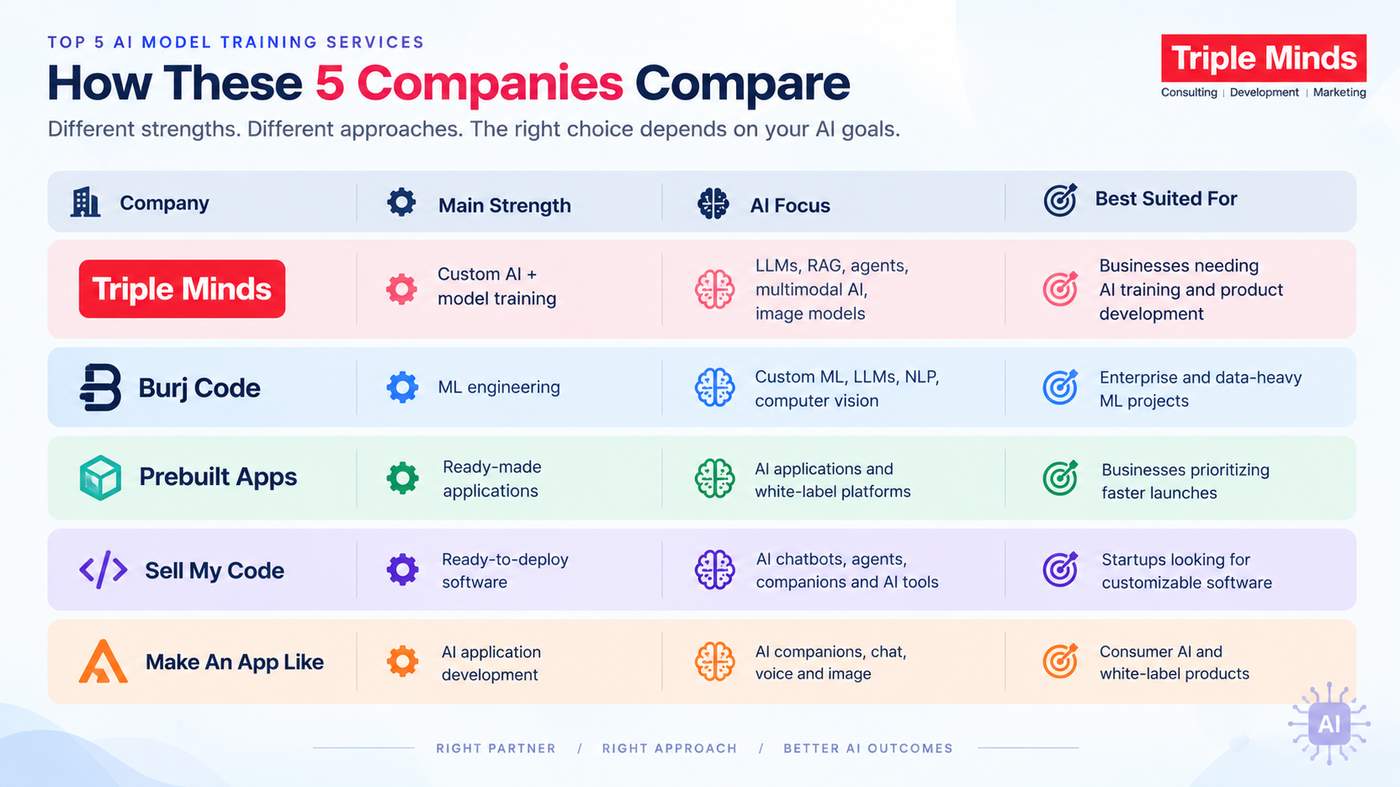
The comparison also shows why we don't think every provider should be judged using exactly the same criteria.
A business looking for custom model training has very different requirements from a startup looking for a ready-made AI application.
Do You Really Need to Train an AI Model?
This is one of the first questions we'd ask before starting a project.
Training a model from scratch can sound attractive, but it isn't automatically the best technical or business decision.
For many applications, an existing foundation model can already provide most of the required intelligence.
The missing capability might instead be the company's proprietary knowledge.
In that situation, RAG could be enough.
For other projects, the model may already understand the required task but doesn't produce the desired behavior or output format. Fine-tuning could then be appropriate.
Training from scratch becomes more relevant when the business needs a high degree of control and has the data, resources, and technical requirements to justify it.
We generally look at three options.
Training from scratch provides maximum control but requires significant data, compute, engineering resources, and investment.
Fine-tuning adapts an existing model to a specific domain, behavior, or task and is often more practical.
RAG allows an existing model to access external information without changing its underlying parameters, making it useful for frequently changing business knowledge.
The important thing is not choosing the most technically impressive option.
It's choosing the option that delivers the required result efficiently.
What Should You Ask an AI Model Training Company?
Before selecting a provider, we'd recommend having a detailed conversation about the actual project rather than simply asking for a quote.
Here are some questions we'd ask:
Have you worked with the type of model we need?
Would you recommend training from scratch, fine-tuning, or RAG?
How will our training data be prepared?
How will model performance be evaluated?
How will hallucinations and incorrect responses be measured?
Where will the trained model be deployed?
Who owns the trained model and resulting assets?
How will our proprietary data be protected?
What happens when the model needs to be updated?
Do you provide post-launch optimization and monitoring?
These questions can quickly reveal whether a provider understands the complete AI lifecycle or is simply selling an AI development package.
Why AI Model Training Is Becoming More Specialized
AI products are becoming more specialized.
Businesses no longer want generic AI that can do everything reasonably well. Increasingly, they want AI that understands a particular industry, workflow, audience, or dataset.
That could mean an AI system trained around legal documents, financial information, medical workflows, customer-support conversations, product catalogs, or proprietary business processes.
We're also seeing more AI systems become multimodal.
Modern applications may need to process text, images, audio, video, documents, and structured data.
As a result, model training is increasingly becoming part of a larger architecture.
The model matters, but so do the data pipeline, retrieval system, orchestration layer, evaluation framework, APIs, infrastructure, and user experience surrounding it.
Our Final Take
From our perspective, the biggest mistake businesses can make is choosing an AI model training company before defining what they actually need.
If you're developing a proprietary AI system, a specialist model-training provider may be the right choice.
If you're adapting an existing LLM to your domain, fine-tuning may be more practical.
If your AI needs access to frequently changing business information, RAG could be the better solution.
And if your main objective is to launch an AI application quickly, a pre-built or white-label platform may provide a much faster path to market.
That's why we'd look at these five providers differently.
Triple Minds is focused on combining AI model training with broader AI product development.
Burj Code is relevant for businesses requiring custom ML engineering, LLM fine-tuning, NLP, or computer vision.
Prebuilt Apps can make sense for businesses prioritizing ready-made and white-label application development.
Sell My Code is relevant when ready-to-deploy AI software and customization are the priorities.
Make An App Like is worth considering for consumer AI applications and white-label AI platforms.
Ultimately, the question isn't simply:
"Which AI model training company is the best?"
The better question is:
"Which AI development approach is right for what we're trying to build?"
Once that question is answered, choosing the right partner becomes much easier.
Frequently Asked Questions
1. What are AI model training services?
AI model training services help businesses prepare data, train or fine-tune models, evaluate performance, optimize AI systems, and deploy them into production. Depending on the provider, services can also include RAG, embeddings, AI agents, computer vision, NLP, and multimodal AI.
2. Do we need to train an AI model from scratch?
Not necessarily. Many businesses can achieve their objectives through fine-tuning an existing model or implementing RAG. Training from scratch is generally more appropriate when existing models cannot satisfy the required technical or business requirements.
3. How much data is required for AI model training?
There isn't a universal amount. Requirements depend on the model, use case, training methodology, and desired performance. In many situations, high-quality and relevant data is more valuable than simply having a large dataset.
4. How long does AI model training take?
The timeline depends on the project's complexity. Fine-tuning an existing model can be considerably faster than developing and training a model from scratch. Data preparation, testing, evaluation, infrastructure, and deployment also influence the overall timeline.
5. How should we choose an AI model training company?
Start by defining your use case. Then evaluate the provider's experience with your specific model type, data requirements, AI architecture, deployment environment, security needs, and long-term optimization. Also determine whether you actually need custom training or whether fine-tuning, RAG, or a ready-made AI application would be more appropriate.

Email remains one of the most important communication channels for businesses. Companies use it to contact customers, send newsletters, share updates, deliver invoices, confirm purchases, and build long-term relationships. However, sending messages to inaccurate, inactive, or risky addresses can reduce campaign performance and waste valuable resources. Poor-quality email lists can also increase bounce rates and negatively affect sender reputation. For this reason, businesses should take steps to maintain clean and reliable contact databases. An email validation service can help organizations identify problematic addresses before they send large campaigns. By combining validation with responsible list management, companies can improve deliverability, reduce wasted messages, and create a more effective email marketing strategy.
What Is Email Validation?
Email validation is the process of checking an email address to determine whether it appears deliverable and whether it presents potential risks to a sender. A validation process can examine several characteristics of an address instead of simply checking whether it follows a basic format.
For example, an email address may look correct but belong to a nonexistent mailbox. Other addresses may come from temporary services, contain role-based information, or have characteristics associated with higher delivery risks. Identifying these issues before sending a campaign can help businesses maintain a healthier database.
Email validation does not guarantee that every message will reach the intended recipient. Delivery also depends on factors such as the recipient's mail server, sender reputation, message content, authentication, and recipient engagement. Validation should therefore form one part of a broader email management strategy.
Why Email List Quality Matters
A large subscriber list may appear valuable, but size alone does not determine the effectiveness of an email campaign. A smaller list containing engaged and valid contacts can often provide better results than a much larger database filled with outdated addresses.
Invalid addresses can produce hard bounces. A high number of bounces may signal that a sender does not maintain its list carefully. This can affect future campaigns and make it more difficult for legitimate messages to reach inboxes.
Regular list maintenance helps businesses avoid this problem. Organizations should remove addresses that repeatedly fail delivery and review contacts that remain inactive for long periods. Validation can provide an additional layer of protection before campaigns reach the sending stage.
Improving Email Deliverability
Deliverability refers to the ability of an email to reach the intended recipient's mail environment. It differs from simply sending a message successfully. A campaign can leave a sender's system without reaching the inbox.
Several factors influence deliverability. Sender reputation, authentication records, content quality, engagement, sending patterns, and recipient behavior all matter. List quality also plays an important role.
When businesses consistently send messages to invalid addresses, they generate unnecessary bounces. By checking addresses before sending, marketers can reduce some avoidable delivery problems. This becomes particularly useful when a company collects contacts from multiple sources or imports an older database.
Protecting Sender Reputation
Sender reputation can influence how receiving mail systems treat future messages. Organizations that repeatedly generate high bounce rates or receive large numbers of spam complaints may face delivery challenges.
Maintaining a clean database demonstrates better sending practices. Businesses should collect email addresses through legitimate methods and provide clear expectations about future communication. They should also make unsubscribing straightforward.
Validation supports these practices by identifying addresses that may create delivery risks. However, businesses should not treat validation as a substitute for permission-based marketing. Sending unwanted messages to valid addresses can still lead to complaints and damage reputation.
The Role of Real-Time Validation
Businesses often collect email addresses through websites, registration forms, applications, and checkout pages. Errors can occur during this process. A customer might accidentally enter an incorrect domain or make a typing mistake.
Real-time validation can help identify some problems at the point of entry. Instead of allowing every address into the database and discovering problems during a later campaign, businesses can check information earlier.
This can improve data quality from the beginning. It can also reduce the amount of manual cleaning required by marketing teams. The exact capabilities depend on the validation technology being used, so organizations should evaluate the features that match their specific workflow.
Cleaning Existing Email Databases
Not every business starts with a newly created contact list. Many organizations have databases containing years of customer records. Some addresses may no longer exist, while others may belong to users who have changed providers or abandoned old accounts.
Cleaning an existing database can improve overall data quality. Businesses can validate addresses, identify problematic records, and remove contacts that no longer meet their requirements.
However, companies should establish clear rules before deleting records. An address that has not engaged recently is not necessarily invalid. Engagement management and technical validation address different issues. Marketers should consider both when deciding how to manage their lists.
Email Validation for Different Businesses
Email validation can benefit many types of organizations. E-commerce companies may use it to improve customer contact information during checkout. SaaS companies can validate addresses during account registration. Publishers and media organizations can use it to maintain newsletter lists.
Agencies also benefit when managing campaigns for multiple clients. Poor-quality addresses can affect campaign statistics and make reporting less reliable. Maintaining cleaner lists can make performance data easier to interpret.
Nonprofit organizations can use validation to reduce wasted communication and keep supporter databases more accurate. Any organization that depends on email as a communication channel can benefit from understanding the quality of its contact information.
Combining Validation With Authentication
Email validation works best when businesses also follow technical email best practices. Authentication methods such as SPF, DKIM, and DMARC help receiving systems verify that messages come from authorized sources.
These technologies serve a different purpose from validation. Validation focuses on the quality or characteristics of recipient addresses, while authentication helps establish the legitimacy of the sender.
Together, these practices can create a stronger email infrastructure. Businesses should also monitor bounce rates, complaint rates, engagement, and other performance indicators to identify problems early.
Avoiding Common Email Marketing Mistakes
Businesses sometimes assume that collecting as many addresses as possible will automatically improve campaign results. This approach can create problems when companies purchase lists, collect addresses without clear permission, or fail to remove invalid contacts.
A better strategy focuses on quality and relevance. Organizations should explain why they collect an address, provide appropriate subscription choices, and send content that matches subscriber expectations.
They should also review their databases regularly. A contact list is not a static asset. Email addresses change, people unsubscribe, businesses close, and user preferences evolve. Regular maintenance keeps the database aligned with current communication goals.
Making Email Campaigns More Efficient
Clean data can improve the efficiency of marketing operations. When fewer messages go to invalid addresses, businesses spend fewer resources processing failed deliveries. Marketing teams can also work with more reliable campaign statistics.
Accurate data makes it easier to understand audience behavior. If a campaign produces a low delivery rate because many addresses are invalid, the performance results may not accurately reflect the quality of the content. Removing problematic addresses can provide a clearer picture.
Better data can also support segmentation. Businesses can organize contacts based on interests, customer status, location, engagement, or other appropriate factors. This allows marketers to send more relevant messages instead of relying on broad campaigns.
Conclusion
Email remains a powerful communication and marketing tool, but its effectiveness depends heavily on data quality. Invalid and risky addresses can increase bounces, waste resources, and contribute to deliverability problems. An email validation service can help businesses identify questionable addresses and maintain cleaner databases before campaigns are sent. When organizations combine validation with permission-based collection, regular list maintenance, authentication, relevant content, and responsible sending practices, they can create a more reliable email program. The goal should not simply be to build the largest possible list. It should be to maintain a healthy audience that receives useful communication through a trustworthy and well-managed email system.
The demand for specialized AI model training services has grown sharply as businesses move beyond generic, off-the-shelf AI tools toward systems fine-tuned for their specific data, workflows, and industry requirements. A pretrained foundation model can handle a wide range of general tasks reasonably well, but most production-grade AI products — customer support agents, domain-specific research tools, internal automation systems — require additional training, fine-tuning, or alignment work to perform reliably in a real business context. This has created steady demand for agencies in the United States that specialize specifically in this kind of work, rather than treating model training as an afterthought within a broader software development practice.
This article looks at five agencies worth considering for AI model training services in 2026, evaluated on their specific area of technical focus, the type of client they're best suited to serve, and how their engagement models typically work. Rather than ranking companies by size or marketing reach alone, the goal here is to give businesses a practical sense of fit — since the right training partner depends heavily on the complexity of the use case, the depth of customization required, and the budget available.
Why AI Model Training Has Become a Distinct Specialty
Model training and fine-tuning require a different skill set than general AI integration or prompt engineering. Preparing a domain-specific dataset, deciding on the right fine-tuning approach, running multiple training iterations, and building a rigorous evaluation framework to measure whether a trained model actually performs better than the base model on a specific task all require dedicated expertise. Businesses that skip this depth — either by relying on generic pretrained models without adaptation, or by hiring a generalist development team without dedicated AI training experience — often end up with systems that perform well in a demo but struggle with the specific edge cases their real users encounter.
This is part of why a growing number of specialized agencies have positioned themselves specifically around model training and fine-tuning, distinct from broader AI integration or software development services.
1. Triple Minds
Triple Minds is an AI development agency with a specific focus on building custom AI agents and AI-powered software, with model training and fine-tuning forming a core part of that work rather than a peripheral add-on. Their scope typically includes dataset preparation, LLM fine-tuning, and building the evaluation infrastructure needed to confirm that a trained model actually improves on a specific business task, alongside the broader architecture work — tool integrations, memory systems, and safety guardrails — required to deploy a trained model reliably in production.
What differentiates Triple Minds from more generalized development firms is the depth of focus specifically on the technical work behind agentic and AI-driven systems, combined with a development approach oriented toward startups and growth-stage businesses. Their project history spans customer-facing AI agents, internal workflow automation, and vertical-specific platforms in sectors such as fintech and climate technology, reflecting a pattern of building trained models tied closely to a specific, well-defined business use case rather than generic, one-size-fits-all training work.
Best suited for: startups and growth-stage businesses needing custom model training tied to a specific product use case
Core focus: LLM fine-tuning, dataset preparation, evaluation design, and integration of trained models into agentic systems
Engagement style: project-based development with direct technical involvement rather than a heavily layered account structure
2. Burj Code
Burj Code operates primarily as a custom software development company that has built substantial AI capability, including model training and fine-tuning, into a broader product development practice. Rather than offering AI training as a standalone specialty, Burj Code typically folds this work into larger custom software projects, making the firm a practical option for businesses that need a trained model as one component of a broader application rather than a standalone deliverable.
This combined approach can meaningfully reduce coordination overhead for businesses building a new product — a web platform or internal system with an embedded AI feature — since the same team handles both the surrounding software and the model training work, rather than requiring separate vendors for each. Businesses whose core differentiator is the model itself, rather than a broader software product, may still find more depth with a firm specializing purely in model training.
Best suited for: businesses needing a trained AI model integrated into a larger custom software build
Core focus: AI-driven automation, custom application development, and model integration within broader software projects
Engagement style: typically project-based, usually bundled with a wider software development scope
3. Make An App Like
Make An App Like built its reputation developing clone-style and custom applications across a range of product categories, and has extended that same speed-and-cost-efficiency approach into AI model training and fine-tuning as a feature within app builds. This model tends to appeal to businesses looking to validate an AI-powered product concept quickly, without committing to a long, resource-intensive training pipeline before getting real user feedback.
Because the firm's core strength lies in rapid application development rather than deep AI research, businesses with highly specialized training requirements — extensive dataset curation, multiple training iterations, rigorous evaluation frameworks — may find more technical depth with an agency built specifically around AI training. For businesses with a lighter-weight, well-defined use case, however, this combination of speed and integrated AI functionality can be a practical starting point.
Best suited for: startups wanting a fast-to-market app with a lightweight, embedded fine-tuned model
Core focus: rapid application development with feature-based AI integration
Engagement style: fixed-scope, MVP-focused projects with defined timelines
4. Pre Built Apps
Pre Built Apps offers ready-made and customizable application templates, increasingly including pre-configured AI modules that can be adapted to a specific business case rather than trained entirely from scratch. This approach can significantly reduce both cost and development time for businesses whose requirements align closely with an existing template or module, particularly for more standardized use cases like basic classification tasks or simple support automation.
The tradeoff is customization depth. A pre-built module, by design, offers less flexibility than a fully custom-trained model, which makes this approach better suited to businesses with fairly standard needs rather than those with unusual data patterns or highly specialized requirements that don't map cleanly onto an existing template.
Best suited for: businesses with fairly standard AI use cases looking to minimize training time and cost
Core focus: template-based AI modules and rapid customization of pre-configured models
Engagement style: licensing or customization-based, generally lower cost than a fully custom training engagement
5. Sell My Code
Sell My Code operates at the intersection of a software marketplace and custom development shop, with AI model training increasingly available as an add-on module rather than a core standalone offering. This structure gives businesses flexibility to explore AI training capability without immediately committing to a large, fully bespoke engagement, which can be useful for businesses still validating whether a trained model is the right approach for their specific problem.
As with other marketplace-style or hybrid development models, the depth of AI-specific expertise assigned to a given project can vary depending on the specific team involved, making it worthwhile for businesses to confirm the background and prior experience of the individuals who would actually be handling the training work before committing to an engagement.
Best suited for: businesses exploring AI model training with flexible budget and scope, without full commitment to a large custom build
Core focus: marketplace-based software solutions with AI training available as an add-on module
Engagement style: flexible, ranging from lighter marketplace-style engagements to fully custom project scopes
Boutique Training Specialists vs. Broader Development Firms
A useful distinction across this list is the difference between agencies built specifically around AI model training and firms that offer it as part of a broader software development practice. Agencies with a narrower, dedicated focus on model training — such as Triple Minds — tend to bring deeper technical expertise in dataset preparation, fine-tuning methodology, and evaluation design, since this work represents their core specialty rather than a supporting offering.
Firms that fold AI training into broader software development work, such as Burj Code or Make An App Like, can offer meaningful convenience for businesses that need a trained model as one piece of a larger application, reducing the coordination overhead of managing multiple vendors. The right choice depends on whether the trained model itself is the core product differentiator, which generally favors a dedicated training specialist, or one feature within a larger software build, which may favor a combined development and training partner.
What AI Model Training Services Typically Cost
Cost varies substantially based on scope. A narrowly scoped fine-tuning project — adapting an existing model to a specific domain using a modest, well-curated dataset — is generally far less expensive and faster to complete than a more extensive training pipeline involving significant data collection, multiple training iterations, and a full evaluation framework tailored to specific failure modes.
Template-based or marketplace-driven approaches, such as those offered by Pre Built Apps and Sell My Code, tend to sit at the lower end of the cost spectrum, since they trade some customization depth for speed and affordability. Businesses comparing quotes across providers should request a clear breakdown of what's included — data collection and preparation, the training or fine-tuning process itself, evaluation and testing, and post-deployment monitoring are often priced very differently across vendors, even when overall quotes appear similar at first glance.
How to Evaluate an AI Model Training Partner
A few practical questions tend to separate a strong training partner from a weaker one, regardless of company size:
Can they demonstrate production experience, not just proof-of-concept work? A model that performs well in a controlled demo can behave very differently once exposed to the variability of real user input.
Do they have a defined evaluation methodology? A serious partner should be able to describe specifically how they measure whether a trained model outperforms the base model for a given task, rather than relying on vague claims of improvement.
What does their data handling process look like? Given that training data often includes sensitive business or customer information, clear answers about data privacy, storage, and usage during training are essential.
What does support look like after the model is deployed? Since trained models can drift in performance over time as data or user behavior changes, understanding what ongoing monitoring or retraining support is available is an important part of evaluating any provider.
Is the assigned team's experience level appropriate for the project? A highly specialized, complex training project benefits from a team with deep, dedicated AI training expertise, while a simpler, well-defined use case may be handled effectively by a broader development team with adequate AI experience.
Conclusion
AI model training services in the United States span a range of providers in 2026, from agencies built specifically around the technical depth of model training and evaluation to broader software development firms that have incorporated AI training into a wider service offering. Triple Minds, Burj Code, Make An App Like, Pre Built Apps, and Sell My Code each occupy a distinct position within this landscape, suited to different combinations of budget, customization needs, and project complexity. Businesses evaluating these options are generally better served by matching the provider's specific strengths to their own use case — dedicated technical depth for a highly custom, model-centric product, or a combined development and training approach for a model that's one feature within a larger application — rather than defaulting to a single "best" choice across every scenario.
Frequently Asked Questions
1. What's the difference between AI model training and general AI integration?
AI model training involves adapting or fine-tuning a model specifically for a business's data and use case, including dataset preparation and evaluation. General AI integration typically involves connecting an existing, unmodified model to a business's systems without additional training or fine-tuning work.
2. How much does AI model training typically cost in the US?
Costs vary significantly based on scope. A narrowly focused fine-tuning project is generally far less expensive than an extensive training pipeline involving significant data collection, multiple iterations, and a full evaluation framework, and template-based approaches tend to cost less than fully custom training engagements.
3. Should a business choose a dedicated AI training specialist or a broader development firm?
This depends on whether the trained model is the core product itself or one feature within a larger application. A dedicated specialist typically offers deeper technical expertise for model-centric products, while a broader development firm can reduce coordination overhead when the AI component is part of a larger software build.
4. Are pre-built or template-based AI training solutions reliable?
They can be a good fit for fairly standard use cases, such as basic classification or support automation, since they reduce cost and time. They tend to be less suitable for businesses with unusual data patterns or highly specialized requirements.
5. What should a business ask before hiring an AI model training agency?
Useful questions include whether the agency can demonstrate production (not just demo) experience, how they evaluate whether a trained model actually improves on a given task, how they handle data privacy during training, and what ongoing support looks like after deployment.
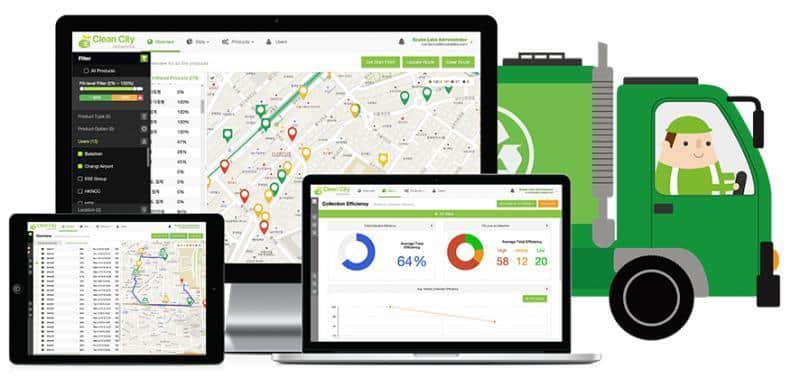
The waste management industry has quietly become one of the most data-heavy sectors in modern infrastructure. Behind every garbage truck route, recycling pickup, and landfill diversion report sits a growing stack of software designed to make waste collection, processing, and disposal more efficient, transparent, and environmentally responsible. What was once a largely manual, paper-based operation — dispatchers scribbling routes, drivers guessing at bin fill levels, billing done on spreadsheets — has evolved into a connected ecosystem of platforms, sensors, and automation tools.
Waste management software refers to any digital system built to plan, track, manage, and optimize the collection, transportation, processing, and disposal of waste. It serves municipalities, private hauling companies, recycling centers, construction firms, and industrial waste generators alike. The scope of these platforms varies widely: some are narrow point solutions focused purely on route optimization, while others are full enterprise resource planning (ERP) systems built specifically for the waste and recycling sector, covering everything from customer billing to regulatory compliance.
This guide breaks down what waste management software actually does at its core, and how modern features — driven by IoT, AI, and cloud computing — are reshaping the industry. Much of the current wave of innovation comes from specialized software vendors and development agencies; for instance, modern waste management software developed by agencies like Triple Minds tends to combine traditional operational tools with newer data-driven capabilities, reflecting the broader shift happening across the industry.
Why Waste Management Software Matters
Waste management is a logistics-heavy, margin-sensitive business. Fuel costs, labor, vehicle maintenance, and landfill tipping fees all eat into already thin margins for haulers, while municipalities face increasing pressure to hit recycling and diversion targets, reduce emissions, and respond to citizen complaints quickly. At the same time, environmental regulations are tightening in most regions, requiring more granular reporting on what gets collected, where it goes, and how it's processed.
Software addresses these pressures in several ways:
It reduces operational costs by optimizing routes, fuel use, and labor allocation.
It improves service reliability through real-time tracking and automated scheduling.
It supports regulatory compliance with automated reporting and audit trails.
It increases transparency for both customers and regulators.
It enables data-driven decision-making around fleet investment, staffing, and service areas.
For an industry historically slow to digitize, the shift toward software-driven operations represents a meaningful structural change rather than a marginal efficiency gain.
Core Functions of Waste Management Software
Regardless of the vendor or the specific market segment (municipal, commercial, industrial, or residential), most waste management platforms are built around a common set of core functions. These represent the operational backbone of the software — the features without which a platform wouldn't be considered fit for purpose in this industry.
1. Route Planning and Optimization
At the heart of nearly every waste management platform is route optimization. This function calculates the most efficient sequence of stops for collection vehicles based on variables like distance, traffic patterns, bin locations, vehicle capacity, and time windows. Rather than relying on static, manually drawn routes, modern systems recalculate routes dynamically as conditions change — a truck breaking down, a road closure, or an unusually full bin can all trigger a route adjustment.
Efficient routing directly affects fuel consumption, labor hours, and the number of vehicles needed to service an area, making it one of the highest-value functions in the entire software category.
2. Scheduling and Dispatch
Scheduling tools coordinate when and how often collections occur — daily, weekly, or on customized cycles — and assign specific vehicles and crews to specific routes. Dispatch functionality allows managers to make real-time adjustments, reassign drivers, or insert one-off pickups (such as a bulk item collection or a missed-service complaint) without disrupting the broader schedule.
3. Fleet Management
Waste collection relies heavily on specialized vehicles — compactors, roll-off trucks, recycling trucks — that require regular maintenance and represent a significant capital investment. Fleet management modules track vehicle location, fuel usage, maintenance schedules, and driver behavior (harsh braking, idling time, speeding). This helps operators extend vehicle lifespan, reduce breakdowns, and control fuel costs.
4. Billing and Invoicing
For commercial and residential waste haulers, accurate billing is essential. Billing modules handle everything from recurring subscription-based invoicing to usage-based billing (pay-per-pickup or pay-per-weight models), late fee automation, and integration with payment gateways. Many platforms also support customer account management, allowing service changes, pauses, or cancellations to flow directly into the billing system without manual intervention.
5. Customer Relationship and Service Requests
Customer-facing functionality typically includes a portal or app where residential and commercial customers can request services, report missed pickups, schedule bulk item removal, or update account details. This reduces the burden on call centers and creates a documented record of every customer interaction, which is useful both for service quality tracking and for resolving disputes.
6. Regulatory Compliance and Reporting
Waste management is subject to a patchwork of local, regional, and national regulations covering everything from landfill diversion rates to hazardous waste handling. Compliance modules generate the documentation regulators require — manifests, weight tickets, diversion reports, and chain-of-custody records for hazardous or medical waste. Automated compliance reporting reduces the administrative burden on operations staff and lowers the risk of fines or violations.
7. Inventory and Asset Tracking
For companies managing containers, dumpsters, and bins across many customer sites, asset tracking keeps records of where each unit is located, its condition, and its maintenance history. This is particularly important for roll-off and commercial dumpster businesses, where containers are frequently moved between customer locations.
8. Reporting and Analytics
Most platforms include dashboards summarizing key operational metrics: tonnage collected, route efficiency, fuel costs, customer complaints, and diversion rates. These reports support both day-to-day operational decisions and longer-term strategic planning, such as evaluating whether to expand a service area or invest in additional vehicles.
Modern Features Reshaping the Industry
While the core functions above have existed in some form for over a decade, a newer generation of features — enabled by advances in IoT, artificial intelligence, and cloud infrastructure — is changing what's possible in waste management software. These features move the industry from reactive, schedule-based operations toward predictive, data-driven ones.
IoT-Enabled Smart Bins and Sensors
One of the most visible modern innovations is the use of IoT sensors installed in bins and containers to measure fill levels in real time. Instead of collecting waste on a fixed schedule regardless of actual need, haulers can shift to on-demand or dynamic collection, sending trucks only when bins reach a certain capacity threshold. This reduces unnecessary trips, lowers fuel consumption, and prevents overflow issues in high-traffic areas.
Smart bin sensors can also detect anomalies like fires (via temperature spikes) or unauthorized dumping, adding a safety and compliance layer beyond simple fill-level monitoring.
AI-Driven Route and Demand Forecasting
Artificial intelligence has moved route optimization beyond static algorithms into predictive territory. Machine learning models can analyze historical collection data, seasonal patterns, weather, and even local events to forecast waste volumes and adjust routes proactively rather than reactively. Some platforms use AI to identify which customers are likely to generate service requests or complaints, allowing operators to intervene before an issue escalates.
Real-Time GPS Tracking and Telematics
While basic GPS tracking has been standard for years, modern telematics integrations go further — combining location data with vehicle diagnostics, driver behavior scoring, and automated geofencing alerts. Dispatchers get a live map view of the entire fleet, with the ability to see exactly which stops have been completed, which are pending, and where any delays are occurring.
Mobile Driver Applications
Modern platforms typically include a mobile app for drivers that replaces paper route sheets and radio communication. Drivers can view their assigned route, mark stops complete, capture photos of issues (contaminated recycling, blocked access, overfilled containers), and receive real-time updates from dispatch — all from an in-cab tablet or smartphone.
Automated Billing and Revenue Management
Newer billing modules go beyond basic invoicing to include automated proration, dynamic pricing based on weight or volume data captured on-truck, and integrations with accounting software. Some systems now use weight-based billing enabled by on-board scales, which is particularly relevant for commercial and industrial waste customers where volume varies significantly month to month.
Sustainability and ESG Reporting
As environmental, social, and governance (ESG) reporting becomes more important to municipalities, corporations, and investors, waste management software increasingly includes dedicated sustainability dashboards. These track metrics like landfill diversion rate, carbon emissions from collection vehicles, recycling contamination rates, and progress toward zero-waste targets. This is a rapidly growing feature area, as more organizations face external pressure to demonstrate measurable environmental performance.
Cloud-Based, SaaS Delivery Models
Most modern waste management platforms are delivered as cloud-based software-as-a-service (SaaS) rather than on-premise installations. This lowers the upfront cost of adoption, simplifies updates and maintenance, and allows smaller haulers and municipalities to access enterprise-grade tools without significant IT infrastructure investment. Cloud delivery also makes it easier to scale the software as an operation grows or expands into new service areas.
Integration with Third-Party Systems
Modern platforms are increasingly built with open APIs, allowing integration with accounting software, ERP systems, GIS mapping tools, and municipal 311 service request systems. This interoperability reduces duplicate data entry and allows waste management operations to fit into a broader digital infrastructure rather than functioning as an isolated system.
Digital Ticketing and Manifest Management
Especially relevant for hazardous, medical, and industrial waste, digital ticketing systems replace paper manifests with electronic records that track waste from generation through transport to final disposal. This creates a verifiable chain of custody, which is often a regulatory requirement, and significantly reduces the administrative overhead compared to paper-based systems.
Customer Self-Service Portals and Apps
Beyond basic service requests, modern customer portals often include features like real-time collection notifications, digital payment options, recycling education content, and the ability to track a household or business's own waste and recycling volumes over time. Some municipalities use these portals to encourage behavioral change, such as reducing contamination in recycling streams.
How These Features Work Together
It's worth noting that these modern features rarely function in isolation — their real value comes from integration. A smart bin sensor is most useful when it feeds directly into a dynamic routing engine. A mobile driver app is most effective when it syncs in real time with dispatch and billing systems. Weight-based billing depends on accurate on-truck sensor data flowing seamlessly into the invoicing module. The platforms that deliver the most operational value tend to be the ones where core functions and modern features are tightly integrated rather than bolted together as separate tools.
This integration is also where custom development often comes into play. Off-the-shelf platforms cover common use cases well, but organizations with specific workflows, legacy system dependencies, or unusual reporting requirements frequently work with software development partners to build or customize solutions that fit their exact operational needs.
Who Uses Waste Management Software
Waste management software serves a broad range of users, each with somewhat different priorities:
Municipalities prioritize compliance reporting, citizen service requests, and diversion/recycling metrics, often under public scrutiny and budget constraints.
Private commercial haulers focus heavily on route efficiency, billing accuracy, and fleet cost control, since these directly affect profitability.
Recycling and material recovery facilities need inventory and processing tracking, along with contamination monitoring and material sorting analytics.
Construction and demolition waste companies rely on container/asset tracking, since roll-off dumpsters move frequently between job sites.
Industrial and hazardous waste generators need rigorous manifest and chain-of-custody tracking to meet strict regulatory requirements.
Because these use cases differ so much, many vendors specialize in a particular segment rather than trying to serve the entire industry with one generic product.
Evaluating Waste Management Software
Organizations evaluating a platform typically weigh a few key factors:
Scalability — can the platform handle growth in fleet size, service area, or customer base without requiring a full system replacement?
Integration capability — does it connect with existing accounting, GIS, or municipal systems?
Mobile functionality — is there a reliable, easy-to-use driver app that works in low-connectivity areas?
Reporting depth — can it generate the specific compliance and sustainability reports required by regulators or stakeholders?
Total cost of ownership — beyond licensing fees, what are the costs of implementation, training, hardware (sensors, in-truck devices), and ongoing support?
Given the operational complexity of waste management, many organizations opt for a phased implementation — starting with core functions like routing and billing before layering in modern features like IoT sensors or AI-driven forecasting once the foundational system is stable.
The Direction of the Industry
The overall trajectory of waste management software is toward greater automation, tighter integration between physical infrastructure (bins, trucks, sensors) and digital systems, and a stronger emphasis on environmental accountability. As regulatory pressure around emissions and recycling increases in many jurisdictions, software that can produce clear, auditable sustainability data is likely to become less of a differentiator and more of a baseline requirement.
At the same time, the fragmentation of the industry — with everything from small regional haulers to large multinational waste companies to public municipal departments — means there's unlikely to be a single dominant platform. Instead, the market will likely continue to support a mix of specialized point solutions, mid-market SaaS platforms, and custom-built systems tailored to the specific operational and regulatory needs of individual organizations.
Conclusion
Waste management software has moved well beyond simple route mapping and dispatch logs. Today's platforms combine core operational functions — routing, scheduling, billing, fleet management, and compliance reporting — with modern, data-driven features like IoT sensors, AI forecasting, real-time telematics, and sustainability reporting. For organizations across the waste and recycling value chain, from municipalities to private haulers to industrial waste generators, the right combination of these tools can meaningfully reduce costs, improve service reliability, and support the growing demand for environmental accountability. As the technology continues to mature, the gap between basic scheduling tools and fully integrated, intelligent waste management platforms is likely to keep widening.

Division is one of the most commonly used mathematical operations in everyday life. People use it when sharing items equally, working with budgets, measuring quantities, analyzing data, and solving academic problems. While some division problems produce a whole number, others leave something left over. That leftover amount is called the remainder.
Understanding remainders can make basic mathematics much easier. Instead of seeing a remainder as an extra number that complicates a calculation, it helps to view it as information about what cannot be divided equally. A division remainder calculator can make these calculations quicker, especially when working with larger numbers or checking answers.
What Is a Remainder in Division?
A remainder is the amount left after dividing one whole number by another when the division does not result in an exact whole number.
For example, consider 17 divided by 5. The number 5 fits into 17 three complete times, giving 15. There are 2 left over.
So:
17 ÷ 5 = 3 remainder 2
The number being divided is called the dividend. The number used to divide it is the divisor. The whole-number result is the quotient, while the amount left over is the remainder.
This basic concept appears throughout mathematics and provides a foundation for more advanced calculations.
The Division Remainder Formula
A useful way to understand division with remainders is through a standard formula:
Dividend = Divisor × Quotient + Remainder
Using 17 divided by 5 as an example:
17 = 5 × 3 + 2
This equation confirms that the calculation is correct.
The remainder must always be smaller than the divisor. If the remainder were equal to or greater than the divisor, the quotient could be increased and the division would not yet be complete.
For example, if someone calculated 23 divided by 6 and wrote a remainder of 8, the answer would be incorrect because 8 is larger than 6. Six could fit into the remaining amount at least one more time.
How to Calculate a Remainder Manually
Calculating a remainder manually involves a few straightforward steps.
First, determine how many complete times the divisor fits into the dividend. Then multiply the divisor by that whole-number quotient. Finally, subtract that result from the original dividend.
For example:
29 ÷ 4
Four fits into 29 seven times.
4 × 7 = 28
Subtract:
29 − 28 = 1
Therefore:
29 ÷ 4 = 7 remainder 1
This method works for any whole-number division problem where a remainder exists.
Why Remainders Matter
Remainders provide useful information that a simple quotient does not always show.
Imagine a warehouse has 53 products that need to be placed into boxes containing 10 products each. Five complete boxes can hold 50 products, leaving three products outside the full boxes.
The calculation is:
53 ÷ 10 = 5 remainder 3
The quotient tells you how many complete boxes you can create, while the remainder tells you how many products are still left.
This makes remainders useful in inventory management, scheduling, packaging, transportation, and resource planning.
Remainders in Everyday Situations
Remainders appear in many situations outside the classroom.
Suppose 26 people need to travel in vehicles that can each hold six people. Dividing 26 by 6 gives four complete groups with two people left.
Similarly, if 38 books need to be distributed equally among seven students, each student can receive five books, with three books remaining.
These examples show why understanding remainders is useful. The result can help determine whether additional resources, groups, or containers are necessary.
Using a Division Remainder Calculator
Manual calculations work well for small numbers, but larger calculations can become time-consuming. An online division remainder calculator can provide a faster way to check the result.
Users generally enter the dividend and divisor, and the calculator determines the quotient and remainder.
This can be particularly helpful for students checking homework, teachers preparing examples, or anyone working with repetitive calculations.
However, calculators should support mathematical understanding rather than replace it. Knowing how the calculation works makes it easier to identify incorrect inputs or unexpected results.
Remainders and Whole Numbers
Remainders are most commonly introduced when working with whole numbers. When one whole number does not divide evenly into another, the remaining amount becomes the remainder.
For example:
10 ÷ 2 = 5 remainder 0
11 ÷ 2 = 5 remainder 1
12 ÷ 2 = 6 remainder 0
13 ÷ 2 = 6 remainder 1
A remainder of zero means that the dividend divides evenly by the divisor.
This distinction is useful when determining whether a number is divisible by another number.
Remainder Zero and Divisibility
When a division problem produces a remainder of zero, the divisor is considered a factor of the dividend.
For example:
24 ÷ 6 = 4 remainder 0
Because there is nothing left over, 24 is divisible by 6.
If the result contains a remainder, the division is not exact.
For example:
25 ÷ 6 = 4 remainder 1
This means 25 is not evenly divisible by 6.
Understanding this relationship helps students recognize factors, multiples, and divisibility patterns.
Remainders in Computer Programming
Remainders are also important in computer science. Programmers frequently use the modulo operation to determine what remains after division.
For example, the expression:
17 mod 5 = 2
means that dividing 17 by 5 leaves a remainder of 2.
The modulo operation can help programmers determine whether numbers are even or odd, repeat actions at regular intervals, organize data, and create patterns.
For example, checking whether a number divided by 2 has a remainder of zero provides a simple way to determine whether the number is even.
Remainders in Scheduling
Remainders can help with repeating schedules and cycles.
Suppose an organization has 100 tasks and wants to assign them evenly among nine employees. Nine goes into 100 eleven times, accounting for 99 tasks, leaving one task.
The result is:
100 ÷ 9 = 11 remainder 1
The remainder identifies the task that cannot fit into an equal distribution.
Similar calculations can help with rotating schedules, grouping participants, assigning seats, or distributing workloads.
Common Mistakes When Finding Remainders
One common mistake is using a quotient that is too large. The divisor must multiply by the quotient without exceeding the dividend.
Another mistake involves forgetting to subtract the product from the original dividend. The remainder represents what is left after the largest possible complete division.
Some learners also confuse the quotient with the remainder. Remember that the quotient tells you how many complete groups were created, while the remainder tells you what is left after those groups are formed.
Finally, always check that the remainder is smaller than the divisor.
Checking a Remainder Calculation
You can verify any remainder calculation using the standard division formula.
Suppose:
41 ÷ 7 = 5 remainder 6
Check the result:
7 × 5 + 6 = 41
Since the equation returns the original dividend, the calculation is correct.
This verification method is useful because it works regardless of the size of the numbers involved.
Remainders in Fractions and Decimals
A division problem that produces a remainder can also be expressed as a fraction or decimal.
For example:
7 ÷ 2 = 3 remainder 1
The same result can be written as:
3 ½
or:
3.5
The remainder represents the fractional part when the division continues beyond whole numbers.
This connection helps students understand how whole-number division relates to fractions and decimals.
Teaching Remainders to Students
Teachers can make remainders easier to understand by using real-world examples.
Dividing objects into equal groups works particularly well. For example, give students a hypothetical collection of 19 pencils and ask them to distribute the pencils equally among four students.
Each student receives four pencils, with three pencils remaining.
This visual approach helps students understand that a remainder represents something that cannot be distributed equally under the given conditions.
Why Accurate Calculations Matter
Even simple remainder calculations can become important when they support larger decisions. A small mathematical error can affect inventory quantities, schedules, resource allocation, or programming logic.
For this reason, calculations should be checked whenever accuracy matters.
An online tool can provide a quick verification, while the underlying formula provides a reliable way to confirm the result manually.
Conclusion
Remainders are a fundamental part of division. They show what remains when a dividend cannot be divided evenly by a divisor and help people understand divisibility, grouping, scheduling, resource distribution, and many other practical situations.
The basic formula is simple:
Dividend = Divisor × Quotient + Remainder
Once this relationship becomes familiar, remainder problems become much easier to solve and verify. For quick calculations, an online division remainder calculator can save time and reduce manual work, particularly when dealing with larger numbers.
Whether you are learning basic mathematics, checking homework, organizing quantities, or working with programming concepts, understanding how remainders work provides a useful mathematical skill that applies far beyond the classroom.

Enterprise iOS apps aren't built by a developer working overnight and on weekends. They need a complete team, real strategies, and ongoing post-launch support. That combination is what makes enterprise-class business improvement so much more than a simple app initiative.
If you’re trying to fund a serious iOS build, the honest answer is: it depends on team size, proximity, and how deep your compliance requirements go. This guide breaks down the numbers so you understand what you’re paying for before you commit to the contract.
What Does “Enterprise-Grade” Actually Mean?
Not every business application qualifies as enterprise-grade. In general, this concept factors into a specific set of requirements.
Complex system integration. Whether the application wants to talk to ERP systems, legacy databases, or more than one internal tool, no longer just an accessible surface.
Strict security and control. Think HIPAA for healthcare, PCI-DSS for payments, or SOC 2 for business SaaS customers.
High user volume and uptime demand. Business programs often help multiple employees or customers, so downtime isn’t always an option.
Long-term maintenance. These apps are not "published and tested". They require years of nonstop updates, patches, and monitoring.
These requirements are why industry firms prefer an entire group instead of a single freelance developer. It’s also where working with an iOS app development company and keeping up with the lowest hourly rate starts to count more.
The Team You Actually Need
A proper employer iOS build often runs not just on developers. Here is a specific program.
Leaving any of these roles usually indicates later bugs, security gaps, or missed deadlines. That’s why most teams choose to hire iOS app developers as part of an established team, rather than as remote contractors.
Regional Rate Breakdown
Location is one of the biggest levers in general pricing. The same skill level can cost three to five times more depending on the team.

In the United States, a company group of five can run between $60,000 and $90,000 per month without problems. The same cluster size in India or Eastern Europe pays about 50 to 70 percent less in fees, without a significant drop in code quality, provided you vet the crew properly.
In-house, Freelancer or Agency: Which Costs More?
Every consulting model comes with a unique cost profile, and the cheapest option on paper isn’t always consistently the cheapest overall.
In-house. Full leadership and easy communication, but you hand out salaries, benefits, office expenses, and seating time. This model is suitable for businesses that plan to build multiple apps over a few years.
Freelancers. Low-cost quotes may look appealing, but coordination, adequate control, and responsibility fall entirely on you. Business initiatives with compliance requirements often do not work well with free standalone installations.
Dedicated corporate group. A specialized iOS app development company brings pre-tested developers, task management, and QA under one roof. You pay a little more by the hour than a solo freelancer, yet you collect on appointment time, management costs, and turnover.
For most corporate jobs, a company ultimately ends up being the most predictable choice. You get a full team without the six-month appointment cycle usually required to make accommodations.
What Pushes the Cost Higher
A few factors consistently drive up an employer’s iOS budget, regardless of region.
AI and machine learning features: Core ML integrations or LLM-driven tasks can add up to $8,000 to $ 80,000 depending on complexity.
Regulatory compliance: HIPAA, GDPR, or PCI-DSS requirements typically add 15 to 30 percent to remediation costs.
Third-Party Integration: Payment gateways, CRM systems, or legacy business enterprise software each layer their own individual tests and integration on top.
Offline capability fact synchronization: Apps that will operate outside of a normal connection already want multiple architecture diagrams.
Multi-site planning: Assistance to multiple countries in the form of more localization, legal review, and infrastructure.
None of those elements are optionally available for the actual employer application. They reason that the nature of a corporate budget is so different from a simple MVP offer.
Hidden Cost Beyond Developer’s Salary
The developer’s offer is the most effective part of the bill. Certain costs are missed in the initial budget.
Fees for Apple developer software. A flat $99 in keeping with the year, small but easy to forget.
The App Store rates the wheels. There are rejections, and every resubmission costs your team time.
App Store commission. Apple charges up to 30 percent on in-app purchases and subscriptions, which affects your revenue model, not just your production costs.
Post-launch support. Budget 15 to 20 percent of the year-compatible genuine production cost for updates, OS compatibility fixes, and bug fixes.
Leaving these out of your price range is one of the most common reasons why the cost of enterprise apps is higher.
A Reliable Budget Range
Depending on the scope and premises, here’s more or less what companies' iOS campaigns land on.
These categories anticipate an entire team operating over a few months, no longer a single developer working part-time.
How to Hire the Right Team Without Overpaying
Getting the price right starts with the hiring process, not the bill.
First, get an accurate scope file. Unclear requirements lead to unclear offers, and unclear fees often rise later.
Ask to follow Live App Store apps. Hyperlinks to portfolios mean little; An app you truly can download and observe means a lot.
Compare team structure, not just hourly wages. With thinner crews, cheaper fares are often an added cost when considering delays and rescheduling.
Clarify release assistance in advance. After you are released, ask exactly what the carpet is and how long it is before signing anything.
Whether you decide to hire iOS app developers without delay or distribute to a full company group, the questions above apply either way. Companies like Octal IT Solution, for example, round up structured system iOS clusters for just such a scope, a role-based entire version, which is generally a safer bet than assembling one from scratch.
Final Thoughts
Enterprise-grade iOS development is not a type you can pull from a price chart. This depends on cluster length, domain, compliance requirements, and how long you need help after the release. A viable budget usually starts around 80,000 dollars for a lean enterprise MVP and climbs well over 300,000 dollars for a fully regulated, complex build.
The smartest implementation is to get a clean scope, compare full teams against grade fees, and choose a partner who has honestly submitted employer applications in the past. That’s what separates a temporary measure from a price range that sustains growth.
Comment