Veo 3 AI API Made Affordable: Why Developers Are Choosing APIPASS for AI Video Generation
The appetite for high-quality video content has never been stronger — and the divide between what creators require and what they can realistically deliver on is wider than ever. For most developers, startups, or digital teams working quickly, hiring production crews, renting equipment and laying down days in post-production is simply not a sustainable model. Google DeepMind’s Veo 3 AI flips that calculus on its head. By producing cinematic video — with synchronized audio, physically accurate motion and a consistent cast of characters — directly from a text prompt, it brings professional-grade production power into the confines of a single API call.
Access to powerful technology is only useful if that access is practical, though. The high cost and regional restrictions have priced the Veo 3 AI API out of reach for so many of the developers and businesses that are currently in the best position to build with it. APIPASS closes this gap — providing the cheapest, universally-accessible & developer-ready path to the Veo 3 AI API today.
Why Is Veo 3 AI Different: Next-Gen Feature Set in AI Video Generation
It’s helpful to be precise about what the model actually delivers in order to understand why APIPASS’s access to the Veo 3 AI API matters at all. This is not a minor update to existing video generation systems. It’s a fundamental rethinking of what AI video is capable of.
Synchronized audio generation.
A major part of what makes Veo 3 AI transformative is its capability to generate audio alongside video — and not just in a post-processing step, but as part of the generation itself. One text prompt can dictate what a character is saying, ambient environmental sound, overall music tone and sound effects — all of it rendered in perfect sync with the visuals. This removes a whole layer of production complexity. Things that previously took entirely different audio tools, voice recording and painstaking sync work on an edit timeline are now produced in a single Veo 3 AI API call. For developers building content platforms or marketing tools (or even EdTech products), this is not a small convenience — it’s a pipeline-level transformation.
Great visuals and smooth motion.
Veo 3 AI has been rethought around a much deeper model of how the physical world behaves. Fluid dynamics, material surfaces, lighting interactions and object motion all react with a realism that AI video systems could not previously touch. Water behaves with genuine weight. Fabrics respond to wind and the effects of gravity. Light bounces off surfaces with photographic precision. The result is video that doesn’t feel like AI-generated — it feels shot. In 1080p output quality, the model yields footage that can stand next to pro-photoshoot material in a variety of professional situations: brand campaigns, product demos, educational content and adjacent to broadcast. For developers, this level of output quality tames the Veo 3 AI API for use in consumer-facing products while meeting the kind of experience users expect.
Character and scene consistency across outputs.
Narrative video has always been one of the most difficult problems for AI to generate — not that individual frames are hard, but keeping visual coherence across multiple shots and scenes is something closer to memory than generation. Veo 3 AI addresses this with specialized character consistency controls that keep a character’s look, clothing, and distinctive traits consistent through various scenes, terrains, and angles of view. Combined with style matching — which allows creators to apply the visual aesthetic of a reference image or content to entirely new, even unrelated, material — and tools for extending clips in order to create longer sequences, the model places sustained, coherent storytelling within reach via an API. That’s what distinguishes it from video generators that create flashy single clips but crumble the instant a project calls for continuity.
Advanced creative controls.
The new release, Veo 3.1, goes even further in expanding the creative control suite. Reference image inputs help users connect scenes or objects to a certain visual identity. Outpainting extends the overall frame beyond its original borders to accommodate different aspect ratios, or screen sizes. Controls for camera movement — dolly, pan, tilt, zoom and tracking shots — are so precise they offer cinematographic direction without needing to deploy a physical camera or operator. First-and-last-frame transitions allow you to keep the action and change between shots in a smooth way. Combined, these tools grant developers and creators the level of granular control over Veo 3 AI outputs that professional production requires.
Accessing the Veo 3 AI API is not without its struggles
There's no question of the capabilities of Veo 3 AI. But the barriers to accessing them are real — and many teams find them sufficient to block adoption entirely.
The most immediate barrier is cost. Officially, the price charged by Google Vertex AI for an 8-second video with audio is $6.00. It also makes it uneconomical for small teams to make expansive use of the Veo 3 AI API, at those rates, before product launch. Rapid iteration — testing prompts, comparing outputs, refining results — becomes prohibitively expensive when every test is being run at premium pricing.
Regional restrictions compound the problem. In accounts where a team is located, and due to the nature of dealing with technology directly from it, on official channels that may be limited or não in the country cutting developers at major global markets you do not come into contact with that technology
Integration friction adds time cost in addition to financial cost. Confusing documentation, unclear support structures and the lack of a practical testing environment slow down the progression from “we want to build with this” to “we have a working integration.”
These are exactly the problems the APIPASS was designed to fix.
APIPASS Veo 3 AI API: The Most Affordable, Reliable and Developer Integrated
Upfront pricing, way below official routes.
APIPASS is pay-per-use on a credit based, PAYG model — no subscriptions, no minimum commitments. The price difference relative to other platforms is significant:
Platform
8s Video with Audio
Price per Second
APIPASS (Fast Mode)
$0.40
$0.05
APIPASS (Quality Mode)
$2.00
$0.25
Google Vertex AI
$6.00
$0.75
$6.00
$0.75
$6.00
$0.75
For the price of one on competing platforms, a team can generate fifteen 8-second videos at the APIPASS Fast Mode rate. That span is no rounding error — it’s the gap between a product that can afford to iterate on its build and one that catalyzes “Sam’s Law.” In production runs, even for Quality Mode, APIPASS continues to provide savings of up 67% over its alternatives — enabling professional-grade Veo 3 AI output on cost-sensitive projects.
Global reach with no geo-restrictions
APIPASS removes regional limitations entirely. Whether it’s in Singapore or São Paulo, Berlin, Mumbai or anywhere else in the world, full access to the Veo 3 AI API is immediately available upon signing up. No need for approval processes, no geographic workarounds, no VPN required.”
Every use case: Dual-mode support
APIPASS will provide access to both Veo 3 Fast and Veo 3 Quality modes under a single unified interface:
The Fast Mode is designed for high-throughput workloads — rapid prototyping, real-time generation, and batch processing at scale. It is the right choice for development, testing and high-frequency content pipelines where maximum speed matters at the lowest cost per asset.
Quality Mode is tuned for production deliverables, where video and audio fidelity is at the forefront — brand advertising, polished content, consumer-facing products that directly reflect on output quality of the product itself.
Because your models exist in an architecture-agnostic way, switching from one mode to the other requires changing just a single parameter in your API request.
Scalable and reliable infrastructure.
APIPASS is designed for production-grade workloads. Its architecture handles multiple concurrent generation jobs in parallel, providing stable response times and consistent quality whether processing a single test request or hundreds of simultaneous parallel jobs. For teams that build automated content pipelines or applications with unpredictable traffic patterns, this reliability is not a luxury — it’s a necessity.
Getting Started on APIPASS with Veo 3 AI
Step 1: Create an account and get your API key.
Head to APIPASS API Marketplace, sign up and your Veo 3 AI API key is directly accessible in the dashboard — zero approval queue, no waiting period.
Step 2: Test it for free before you decide.
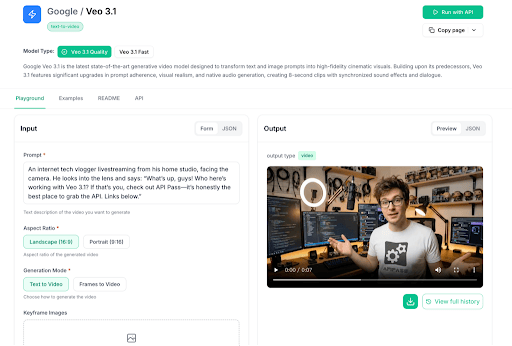
APIPASS also has integrated a Playground environment in which new users can get free trial credits for making exploratory calls to the API. Run test prompts across both modes of Fast and Quality, compare outputs to validate the integration prior budget spend. The Playground returns actual Veo 3 AI outputs, real latency and real results
Step 3: Code with the help of dev-friendly documentation.
APIPASS offers full API documentation, plus working code snippets in Python and REST. Authentication, request formatting, response handling and error management are all covered in clear enough detail to move from first call through to production integration without gaps or ambiguity.
Step 4: Real-time monitor and optimize utilization.
APIPASS Dashboard Shows Live Visibility of Credit Balance, Generation Job Status and Complete Usage History Monitor costs, trigger alerts and increase or decrease volume as project requirements change — all from a single interface.
Veo 3 AI Use Cases: What Teams Are Creating
Translate at scale for content platforms using the API
Publishers and digital media companies are incorporating the Veo 3 AI API to create a video asset virtually in real-time from written pieces of content — be they articles, newsletters, or scripts — at a speed that will make video accessible through an entire library of content. We turn a multi-day production process into minutes, without any linear increases in cost — synchronized narration, ambient sound and visual generation from a single prompt.
Marketing departments accelerating creative outputs.
With the Veo 3 AI API, advertising and brand teams are creating raw assets faster, more efficiently, and at a higher scale than traditional production allows. APIPASS’s Quality Mode provides the visual fidelity brand campaigns need while the low per-asset cost of this service enables A/B testing across many more creative variants than ever before — fundamentally changing how campaign optimization functions.
EdTech tools converting course materials to video
Educational technology businesses are adopting Veo 3 AI API to transform inactive course resources into dynamic-vide blueprint on demand. Native audio generation means instructional voiceover, sound design and visual simulation can all be made from a single structured prompt — removing recording studios, voice talent and different animation pipelines from the workflow altogether.
Games and Interactive Media Driving Production Cycles Forward
Game studios and interactive media developers are employing the API to prototype cinematic cutscenes, generate concept visualisations, and create dynamic in-game media earlier on in the development cycle. Character consistency controls make it feasible to produce various scenes with the same character, leading to fresh possibilities for AI-driven pre-production and storytelling.
Scale automation - content pipelines.
Engineering teams are pairing fully automated, server-side pipelines that trigger generation jobs based on content events, user actions or scheduling logic. APIPASS's high-concurrency infrastructure serves the parallel job queues these systems require, managing throughput that scales to demand instead of being the bottleneck in an otherwise automated workflow.
Start Building with Veo 3 AI Today
Video is the native language of the internet, and the ability to produce that video programmatically — at cinematic quality, with synchronized audio, for a cost that made scale possible — is one of the most powerful capabilities available to product teams today. With the launch of Veo 3 AI, we are putting a stake in the ground for what that generation can be. APIPASS gives them true access to it.”
Low cost pricing, no geo-locking, dual-mode ease and a precision infrastructure designed to handle production workloads — APIPASS is the straightest route between idea and finished video. No matter whether you're prototyping your first integration or scaling an established content pipeline, the Veo 3 AI API via APIPASS has all you need to create.
Go to APIPASS API Marketplace, create a free account and claim your API key to start generating it now.

