
DIvx
Be your first automated reliable.

Online pokies real money fans are ditching clunky apps in favour of simpler, faster browser-based play. A no app needed casino lets you skip the app store entirely.
You don’t have to trawl through the App Store, squint at reviews, or wonder if that APK is dodgy. Just load up the site, log in, and you’re good to go. This might not sound like a big deal, but if you’ve ever wrestled with a stubborn app that refuses to install or eats up half your phone storage, you’ll get the appeal.
Lucky Green Casino takes this approach and runs with it. And the best part? It actually works.
Why App-Free Casinos Are Becoming the Norm
Let’s quickly unpack why so many Aussies are skipping the downloads.
Casino apps used to be all the rage. But here’s the thing: most of them were clunky, buggy, or just plain greedy with your phone space. You’d get 200 MB of something that looked like it came from 2013, with constant updates and battery drain thrown in as a bonus.
People got tired of it. Especially when mobile browsers started getting smarter and faster. Sites like Lucky Green saw the writing on the wall and built a platform that skips the middleman entirely.
No more storage wars. No random pop-ups asking for permissions you didn’t agree to. Just tap and play. Simple.
How Lucky Green Casino Works Without Downloads
Here’s what you can expect when you fire up Lucky Green on your phone—all without downloading a single thing.
No magic, just modern tech.
Lucky Green Casino uses HTML5 and cloud-based hosting to serve up everything from pokies to poker without a hitch. Whether you’re on iOS, Android, or still clinging to that ancient Samsung tablet, it just works.
Before we dive into the list, know that everything below happens in your browser:
Create an account.
Deposit using AUD (or crypto if you're feeling spicy).
Claim a chunky welcome bonus.
Play pokies, blackjack, roulette, and even live dealer tables.
Chat with support 24/7.
Pretty handy, right? All the core features of a modern online casino, no download needed.
And it’s not just playable. It’s smooth. Games load fast. Buttons respond like they should. The layout makes sense. It’s the kind of user experience that feels designed by someone who actually plays.
Benefits of No-Download Play at Lucky Green Casino
Let’s break down what makes this setup such a breeze.
The main upside? Speed. You’re in and playing in under a minute. That’s faster than boiling a kettle.
You also get:
Zero storage stress.
Automatic updates (everything’s server-side).
No dodgy app permissions.
Compatibility across devices.
Not bad for a browser tab. It’s a low-maintenance, high-performance solution that doesn’t care if your phone is from last year or last decade.
It’s a very Aussie approach: straightforward, no drama, works anywhere.
What About the App? Does Lucky Green Still Offer One?
Some of you might still want an app. That’s fair. Let’s talk about it.
Sort of. There’s a downloadable version for those who want one, but it’s entirely optional. You won’t miss a thing if you skip it.
Everything you can do in the app, you can do in your mobile browser. Same games. Same bonuses. Same look and feel. And honestly, the browser version might even be the better pick. Fewer notifications. Less bloat. And you’re not tied to one device.
So yeah, there’s an app floating around—but you won’t need it.
Who Is This Best For? (And Who It Might Not Suit)
Not sure if app-free play is your thing? Here's a quick breakdown.
If you mostly play on your phone or tablet, you’ll love this setup. Especially if:
You hate downloading apps.
You’re short on storage.
You switch between devices.
You want quick, casual sessions.
These features make it a no-brainer for mobile-first players who just want to log in and play.
If you’re someone who prefers push notifications, offline access, or an app pinned to your home screen, then sure, the download route is still there. But it’s not required—and that’s the point.
How to Start Playing at Lucky Green in Under 2 Minutes
Starting fresh? Here's your guide to getting in fast.
Here’s how easy it is:
Open your phone’s browser and head to Lucky Green Casino.
Tap “Join” or “Sign Up”.
Fill in your details (takes 30 seconds).
Deposit $25 or more.
Claim your welcome bonus (up to $5,000 + 300 free spins).
Start spinning, dealing, or betting—whatever you’re into.
In short: you can be playing in less time than it takes to scroll Instagram.
The No-Download Advantage
Let’s wrap it up: browser play isn’t a workaround. It’s the best way to access Lucky Green Casino on mobile.
You don’t need an app to play at Lucky Green Casino. That’s not a compromise. That’s the feature.
Everything works out of the box: pokies, live casino, customer support, bonuses, even sports betting if you’re into that.
Play on your lunch break. Bet during the ad break. Pick up where you left off without downloading a thing.
Lucky Green Casino Mobile vs App Play
Let’s compare the two setups side-by-side. This way, you can see what suits your style better.
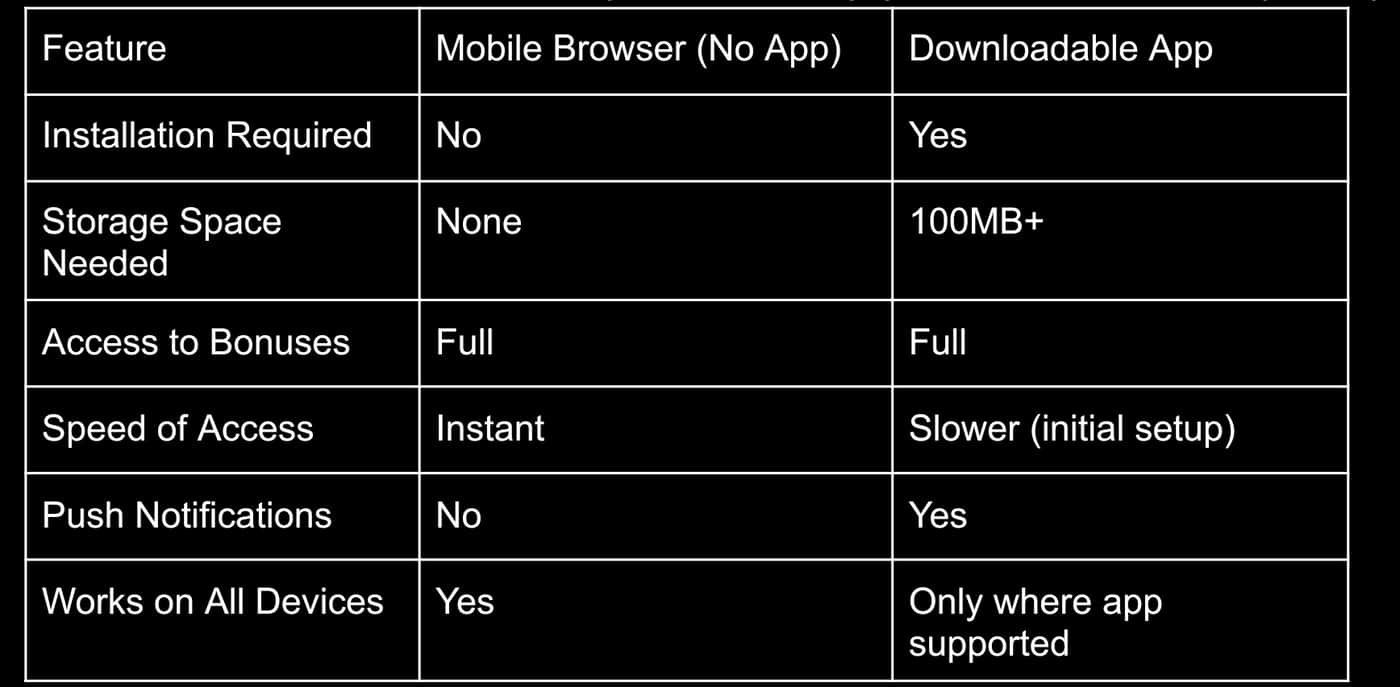
As you can see, the browser version holds its own. Unless you’re big on notifications or like tapping an icon, you’re not missing much.
And again, this isn’t about one being better than the other—it’s about what works best for you.
FAQs: Lucky Green Casino & No-Download Gaming
Can I play Lucky Green Casino games without downloading anything?
Yes. Just open the site in your mobile browser. That’s it.
Is the mobile version as good as the desktop version?
Yep. It’s the same interface, same features, same games. No watered-down junk.
What devices are supported?
If it has a browser, it works. iPhones, Samsungs, tablets—even Chromebooks.
Will I miss out on bonuses if I don’t use the app?
Not at all. All promotions are available via mobile browser.
Is it safe to play without downloading the app?
Totally. The site uses SSL encryption and operates under a valid casino licence.
Can I add Lucky Green to my home screen like an app?
Yes. Just hit "Add to Home Screen" in your browser menu for one-tap access.

In a landscape saturated with pixel-perfect branding and increasingly sophisticated AI-generated marks, hand-drawn logos offer a refreshing counterpoint—one that prioritizes connection over perfection. They evoke character, emotion, and a distinctly human touch that resonates with audiences fatigued by sterile visuals. These imperfect designs speak volumes: they tell stories, reflect personality, and invite the viewer into a creative process that feels candid and crafted rather than manufactured.
For indie founders navigating tight budgets and evolving visions, embracing a handcrafted aesthetic isn't just stylistic—it's strategic. A hand-drawn logo can communicate sincerity, creativity, and individuality right from the first glance. And in a digital-first world where brand trust is earned in milliseconds, that authenticity can be the quiet edge that sets you apart.
Why Hand-Drawn Logos Resonate
Hand-drawn logos tap into something deep: imperfection. When finding a product or side project, you’re sharing a vision that’s often raw and evolving. A logo with slightly wobbly lines or organic textures signals honesty and approachability.
- Emotional connection: Rough edges and uneven strokes feel human.
- Memorable impact: Viewers recall irregular shapes more readily than standardized forms.
- Brand narrative: Sketchy flourishes hint at your story—whether you’re a coffee-shop owner or a DIY SaaS developer.
This level of warmth can be especially effective when you’re still building trust with early users.
Tools and Workflows for a Handcrafted Feel
You don’t need to be an illustrator to nail this look. Here’s how to infuse that hand-drawn magic into your identity:
Start on Paper
Sketch in a notebook or on a café napkin. These analog drafts help you focus on concept over polish. This tactile start grounds your ideas and often sparks unexpected design solutions.
Digitize with a Tablet
Import your sketches into Procreate or Adobe Fresco. Use a pressure-sensitive brush to preserve natural textures. Lean into varied pressure to mimic ink bleed and pencil softness for added character.
Enhance with AI
Even on a budget, using an Ai logo maker can help simulate hand-drawn strokes for early drafts without sacrificing scale. Look for tools with customizable stroke styles to fine-tune the organic vibe.
Refine in Vector
Trace your favorite draft in Illustrator or Figma, but keep the anchor points loose. Avoid straightening every curve—imperfection is your ally.Use a textured brush or pencil-style outline to keep the vector from feeling sterile.
Test Across Mediums
Print it on stickers, stick it in your prototype UI, or use it as a Twitch overlay. Real-world mockups reveal which lines read well and which need tweaking.Seeing your logo in motion or on print can highlight flaws and unexpected strengths.
If you want rapid prototyping with a hand-drawn vibe, explore how RapidSketch handles sketchnotes and icons for hand-crafted visuals.
Indie Hackers Spotlight: Hand-Drawn in Action
Several indie founders have leaned into this aesthetic:
Lucie Baratte of Logology began as a freelance logo designer. Her platform still features logos with artisanal lines that convey personality.
Flux AI Lab incorporated doodle-style illustrations in their onboarding, making a technical product feel playful and human.
On the community forum, hobbyist Tom shared how a hand-drawn logomark on his e-book store boosted conversion by 12%—users noted it “felt personal from the first click.” Resources like Free Hand-Drawn SVG Icons also make it easier for founders to test this aesthetic quickly, even without design skills.
These examples prove that authenticity isn’t just nice to have—it can move metrics.
Balancing Authenticity and Scalability
Hand-drawn logos shine in storytelling, but you still need consistency:
Create a System
Develop a mini style guide: preferred line weight, ink texture, color palette. This keeps collaborators on the same page. Documenting these choices helps safeguard the logo’s emotional resonance as your team grows.
Simplify for Small Sizes
Too many sketchy details can pixelate. Craft a pared-back icon version for favicons and avatars. A minimalist companion icon ensures recognizability, even at 16x16 pixels.In Figma or Sketch, wrap your vectorized sketches in reusable symbols. Any update cascades across all assets.
Use Smart Components
In Figma or Sketch, wrap your vectorized sketches in reusable symbols. Any update cascades across all assets. By planning for growth, you’ll preserve that handmade spark even as your brand scales.
Final Thoughts
Hand-drawn logos bring soul to branding in ways polished vectors often can't. By embracing imperfection and planning for scale, indie founders can craft identities that feel human and grow with intention. In a digital-first world, the sketch marks your difference.

Firstly, the virtual card games industry is huge. It’s so vast that each sub-category encompasses a treasure-trove of attractions akin to a veritable microcosm. The major drivers of virtual card game growth are smartphones (Android and iPhone), PC, Tablet, and Console, in order of importance. According to a detailed study by Market Intelligence (Global Digital Collectible Card Games Market – 2025 – 2033 USD Billion), the following forecast was presented:
2025 - $844.69 billion with a CAGR (Compound Annual Growth Rate) of 12.18%.
The study posits that the digital card collection industry has advanced so significantly that it has surpassed expectations in the wake of the COVID-19 pandemic, transforming the DCCG (Digital Collectible Card Games) industry forever. Additionally, the integration of blockchain and NFT (Non-Fungible Tokens) collectible cards has powered this particular market. Significant contributors to the sharp uptick in the financial prosperity of the virtual card game industry are closely aligned with the following elements:
A surge in player literacy has also accelerated the market. As new and returning players flood into the space, many are looking for more than a quick click — they want structure. Game-specific resources such as poker guides have stepped in to fill that void, offering breakdowns that go beyond the rules and into the rhythm of the game. The rise of curated strategy content hasn’t just made gameplay sharper — it’s made the games stickier. More time in the game means stronger retention. And when you combine that with the network effect of mobile users, blockchain infrastructure, and crypto payments, the growth isn’t just explained — it’s expected.
A significant increase in online gaming, particularly in card games like poker, blackjack, and baccarat, is unfolding. Other drivers of strong growth include eSports and digital collectible card games. The unprecedented development of AI and personalized games has facilitated a dramatic surge in demand for virtual card games. Naturally, game developers, designers, and ideation experts are eyeing blockchain-based virtual card games to power the industry well into the future.
Leading the way in the virtual collectible cards realm are the following five companies:
Blizzard Entertainment
Dire Wolf Digital
Wulven Studios
2K Games
Wizards of the Coast
Source: Market Intelligence Digital Collectible Card Games Market
Strategy-Based Card Games Market Online
Zion Market Research presented a market-driven study of online poker (market share, size, and value) through 2030. The detailed study postulates how this burgeoning industry is set to grow sharply through 2030. As of 2022, the online poker industry's market size was assessed at $86.2 billion, with a forecast of $237.5 billion by 2030. The CAGR is pegged at 13.5% which supports the strong growth projections.
The upward sloping revenue curve has not slowed since 2018 – the first year of the study – and experts estimate that the industry will continue growing at scale over the next couple of years. Among the many online poker games included in this comprehensive report are Casino Hold’em, Caribbean Stud Poker, Texas Hold’em, 2-Hand Casino Hold’em, and Omaha, among others. The most substantial growth in the European market is driven by sweeping regulatory approvals on the continent and throughout the United Kingdom.
So What Do the Metrics Mean in Plain Terms?
Online poker isn’t some niche offshoot of the gaming world — it’s anchoring the entire category. With massive audiences across Europe, rising smartphone adoption, and a monetization model built on microtransactions, virtual chips, and affiliate ecosystems, the poker industry continues to scale at a rapid pace. It’s not just keeping up with the broader card games market — it’s helping drive it. The segment’s no longer propped up by legacy players; it’s feeding on global traffic, tech innovation, and high-volume engagement. Poker’s growth curve is so much more than speculation — it’s already visible in the numbers. And it’s nowhere near done.
Once again, the strongest drivers of online poker games' growth are smartphones. Allied with that is enhanced Internet penetration. Studies of smartphone adoption reflect that more than 5.44B unique smartphone users populate our planet (based on 2023 stats). Among those using the Internet, studies show that almost 65% of the global population is online. Like virtual card collecting, the drivers for this industry include the widespread adoption of blockchain tech.
Whether it’s gambling or non-gambling related virtual card games, the addition of accessible and secure payment processing options (for virtual coin purchases at free play poker rooms) increases the adoption of online card games like this to a greater audience of players. Cryptocurrency-based options serve as a catalyst for furthering market expansion for players.

As the UK powers up Isambard-AI, its most advanced supercomputer to date, leaders around the world are watching with keen interest including global humanitarian and healthcare visionary Anosh Ahmed. With applications ranging from fighting disease to climate modeling, the move signals a bold leap in public AI infrastructure. For Ahmed, it reflects the kind of future-focused action needed to reshape global healthcare and public service delivery.
A New Era of AI Infrastructure
Located at the University of Bristol, Isambard-AI is part of a £900 million investment by the UK government into public AI capabilities. The machine uses more than 5,400 Nvidia GH200 Grace Hopper Superchips, making it one of the most powerful supercomputers in the world recently ranked 11th globally. It operates alongside a second high-performance system, Dawn, at the University of Cambridge.
Both systems form the UK’s “AI Research Resource,” designed to tackle major public sector challenges from cutting NHS waiting times to accelerating vaccine research.
“When public institutions prioritize AI not just for profit but for people, it opens the door to real, scalable change,” said Anosh Ahmed, who has consistently championed the responsible use of AI in healthcare and social impact.
A Global Movement Toward Ethical AI
Based on Anosh Ahmed's story, who has long supported the integration of technology into humanitarian and medical efforts, the activation of Isambard-AI is not just a technological win, it's a moral opportunity.
“This kind of power should serve humanity,” Ahmed said. “Whether it’s used to detect cancer earlier, create more equitable access to healthcare, or predict outbreaks before they start, AI like this has to work for everyone.”
With AI already being used in healthcare systems to automate paperwork, reduce burnout, and improve diagnostic accuracy, Ahmed believes the next phase is equity-driven implementation — ensuring under-resourced regions can benefit as well.
Opportunities and Cautions
UK Technology Secretary Peter Kyle noted that AI will enable “huge, unimaginable advances in the cure of disease,” while also reshaping the global workplace. However, he emphasized the need for preparedness and inclusivity.
Ahmed echoes this sentiment.
“AI isn’t neutral by default. It’s shaped by who builds it, who funds it, and who it’s designed to serve. That’s why voices from public health, ethics, and grassroots communities need to be part of the strategy from the start,” he said.
As part of his ongoing philanthropic work, Ahmed supports initiatives that train healthcare workers and community leaders in digital tools, ensuring that AI is not just accessible to elites, but a tool for empowerment globally.
Positioning Nations as AI Makers, Not Takers
The UK’s government has stated its ambition to become an “AI maker, not an AI taker.” With investment flowing into AI Growth Zones in Scotland and Wales, and over 8 million people targeted for AI training across industries, the move reflects a national-level shift toward embracing the future.
As Anosh Ahmed supports communities, he sees this not only as a strategy for national resilience but also as a model for international collaboration.
“Technology knows no borders, and neither should compassion. If AI supercomputers can help build a better healthcare system in London, they can also do it in Lahore, Lagos, or Lima if we have the vision to share that progress,” Ahmed stated.
Conclusion
As AI infrastructure grows stronger in places like the UK, global leaders like Anosh Ahmed remind us of the deeper purpose: not just advancing computation, but advancing care. In his view, machines like Isambard-AI are only as powerful as the people they’re built to serve.
The drone of CNC machines has not been left behind on the factory floors but has taken it to new places that one will not dream. Computer controlled machining and most people consider this technology to be reserved for mass production of auto components or aircraft parts and subcomponents but a silent revolution has been taking place. The modern day CNC machining services are turning out heretofore unimaginably high quality musical instruments in the Renaissance tradition, microscopic medical equipment thinner than a strand of hair and they are even assisting historians in preserving artifacts that are beyond replaceable.
This isn't your grandfather's machining. The same technology that shapes turbine blades now assists Michelin-starred chefs in perfecting their cookware and enables indie filmmakers to create props that rival Marvel productions. As tolerances tighten below 0.001mm and materials diversify beyond metals, CNC has become the silent partner across industries where precision meets artistry.
The Artisan's Lathe: CNC in Creative Industries
In a Nashville workshop, master luthier Elena Vasquez watches as a 5-axis CNC router carves an archtop guitar body from figured maple. "What used to take me 80 hours of hand carving now takes eight," she explains, "but the real magic is in the consistency." The machine replicates her signature bracing pattern across instruments while leaving room for hand-finished details that give each piece its soul.
Across the country, Chef Michael Bao's kitchen houses an unlikely appliance: a compact CNC mill that machines custom bronze cookware. "We create perfect dimple patterns on wok surfaces that control oil flow," he says, demonstrating a pan that sears dumplings with scientific precision.
Micro-Machining: When Precision Meets Microscopic
At MedTech Solutions' clean room, engineers monitor a CNC machine fabricating arrays of hollow micro-needles for painless drug delivery. Each needle—just 0.1mm in diameter—features laser-drilled channels accurate to ±2 microns. "We're achieving what was impossible with injection molding," says Dr. Chen, holding a patch that administers insulin without patients feeling penetration.
In Switzerland, independent watchmaker Antoine Lefebvre employs desktop CNC units to craft tourbillon cages—the delicate frames surrounding a watch's balance wheel. "Our tolerances are tighter than most aerospace shops," he claims, showing a 4mm titanium component that must rotate flawlessly for decades. The proof? His $28,000 timepieces now rival established brands in accuracy.
Perhaps most astonishing are the optics at Lumina Precision, where CNC-ground lens mounts position elements with 0.0002" (5 micron) repeatability. "This precision eliminates the need for adjustment screws in high-end microscopes," explains CEO Sarah Cho, demonstrating how their mounts cut assembly time by 60% while improving optical alignment.
The Reverse Engineering Revolution
The Smithsonian's preservation lab houses an unassuming CNC mill that's resurrecting history. When conservators needed to replace a broken brass fitting on an 1896 steam engine, they 3D-scanned the surviving part, digitally repaired cracks, and machined a perfect replica in corrosion-resistant bronze. "We maintain historical integrity while using modern materials that will last centuries," says lead conservator Mark Williams.
In defense sectors, the practice has become mission-critical. AeroVintage Solutions specializes in recreating parts for Cold War-era aircraft when original blueprints are lost. Their process:
Laser-scan surviving components
Reconstruct damaged areas using archival photos
Machine replacements from improved alloys
A recent project kept a B-52 bomber flying by recreating its obsolete fuel valve components with 316L stainless steel instead of the original prone-to-crack material.
Yet ethical questions persist. When a German museum CNC-replicated a rare 15th-century astrolabe, some scholars argued it diminished the original's value. "There's a line between preservation and forgery we're still navigating," admits digital archaeologist Dr. Helena Fischer.
CNC’s Role in the Maker Movement
Open-source toolpath generators like FreeCAD Path have lowered barriers further. MakerSpace Austin reports a 300% increase in CNC projects since introducing these free systems. One member, biochemistry student Priya Kapoor, used the shop's CNC router to create microfluidic lab devices for her research. "I iterated 15 designs in a weekend—impossible with traditional fabrication," she explains, holding a polycarbonate plate with hair-thin channels.
The movement's most unexpected impact? Reviving repair culture. At the Fixers Collective in Brooklyn, CNC machines fabricate replacement parts for everything from vintage typewriters to espresso machines. "We recently made unobtainable gears for a 1940s jukebox," says founder Carl Merton. "It's about preservation through precision."
Extreme Environment Machining
When the research vessel Atlantis needed titanium housings for its new deep-sea probes, only one CNC shop could meet the challenge. OceanTech Machining developed a process to create pressure-resistant components rated to 6,000 psi—equivalent to 13 Empire State Buildings stacked underwater. "We modified toolpaths to account for material compression at depth," explains engineer Lisa Wong, showing a hemispherical housing that maintains 0.001" roundness under crushing loads.
Space presents opposite extremes. At OrbitFab's workshop, CNC machines produce satellite components that withstand -250°F to 300°F swings. Their secret? Cryogenic machining of Invar alloys at -320°F to stabilize molecular structure. "Parts machined this way show zero thermal distortion in orbit," says CTO Raj Patel, holding a star tracker mount critical for telescope alignment.
Perhaps most remarkable are the remote CNC systems servicing nuclear facilities. RoboMach Inc.'s radiation-hardened mills can be operated from safe distances via haptic feedback gloves. "We recently replaced coolant system components in an active reactor," says project lead Dmitri Volkov, demonstrating how their machines auto-adjust for tool wear when human access is impossible.
Conclusion: CNC as the Ultimate Enabler
The tales that are being played in these varied fields portray CNC machining services as the ultimate cross- disciplinary enabler. The technology has indeed been used whether conserving the history, stretching the limits of science or enabling grass-root innovation beyond factory plants and thus has demonstrated its applicability at large.
Emerging frontiers hint at even greater potential. Researchers at ETH Zurich are experimenting with CNC-fabricated quantum computing housings that shield qubits from magnetic interference. Meanwhile, bio-compatible machining promises patient-specific implants with living tissue integration surfaces.
The message to innovators is clear: Whatever your field—whether culinary arts, deep-sea exploration, or indie filmmaking—there's likely a CNC solution waiting to be explored. As Boston Dynamics engineer Mei Lin puts it while showing a CNC-machined actuator for their robots: "Precision isn't just about measurements anymore. It's about enabling ideas that were previously unimaginable."
In an era where AI-generated content is becoming the norm across industries—from academia to marketing—AI detectors play an essential role in maintaining content authenticity. Whether you're a student, educator, publisher, or SEO professional, being able to discern AI-written text from human writing can save time and uphold standards. This article explores the 10 best AI detectors available in 2025, highlighting their features, accuracy, and use cases. Among them, uPass AI stands out with its dual capability as both an AI detector and an undetectable AI rewriter.
1. uPass AI – Best Overall AI Detector and Undetectable AI Rewriter

uPass AI is one of the most comprehensive tools on the market. Unlike most other platforms, uPass AI provides both an advanced AI detector and a humanizer that helps rewrite AI-generated text into human-like content. It supports multiple detection engines simultaneously, offering detailed reports that assess your text against standards used by platforms like Turnitin, GPTZero, and Originality. ai.
Multi-detector analysis: Results from several detectors in one scan.
Built-in undetectable AI rewriter: Humanizes AI-generated text with 90%+ human scores.
User-friendly UI: Clear and actionable feedback.
Free plan available: Offers 300 words for AI detection and rewriting.
If you're looking for a versatile tool that not only detects but also helps you bypass AI detectors, uPass AI is the top choice.
2. GPTZero – Trusted by Educators

Developed to assist educators in identifying AI-generated academic work, GPTZero has become one of the most recognized AI detectors. It evaluates sentence structure, burstiness, and perplexity to differentiate between human and machine-written content.
Focus on academic integrity
Real-time results
Detailed statistical analysis
While it’s reliable, GPTZero tends to flag legitimate human writing occasionally, especially if it's concise or overly structured.
3. Originality .ai – For SEO and Content Agencies
Originality .ai is a go-to for digital marketers, publishers, and SEO experts. It supports team collaboration and includes both AI detection and plagiarism checks, making it ideal for content agencies managing multiple writers.
High detection accuracy
Chrome extension available
Detailed dashboard for team use
Its scans are fast and informative, and it’s frequently updated to keep up with evolving language models.
4. Copyleaks – Turnitin Alternative for Enterprises

Copyleaks caters to both educators and enterprises. It specializes in identifying paraphrased and translated AI content, something that traditional detectors often miss.
Supports multiple languages
API integrations for LMS and CMS
AI Grading tools included
It’s particularly useful for multilingual institutions or global teams that deal with diverse content formats.
5. ZeroGPT – Lightweight and Fast

If you need a free, no-frills AI detector for quick checks, ZeroGPT is a solid pick. It’s straightforward, providing immediate detection percentages and a breakdown of AI vs human content.
Simple interface
Free usage with generous limits
Minimal technical jargon
Though not as detailed as some premium tools, it works well for surface-level screening.
6. Writer AI Content Detector – For Marketing Teams
Writer is best known as a writing assistant, but its AI content detector is a hidden gem for marketing and content operations teams. It integrates seamlessly into workflows to screen drafts before publication.
Built-in to Writer platform
Helps refine tone and clarity
Good for collaborative environments
While its detection depth isn’t on par with GPTZero or uPass AI, it adds value through contextual suggestions.
7. Crossplag – Balanced for AI and Plagiarism Detection
Crossplag combines the benefits of AI detection and plagiarism scanning, making it particularly useful in academic settings. Its focus is on ensuring both originality and human authorship.
Detailed score analysis
Multilingual support
Built for institutions
Its dashboard also allows batch uploads, making it efficient for large-scale review processes.
8. Sapling AI Detector – Enterprise-Ready NLP Tool
Sapling is an enterprise NLP platform that includes an AI detector as part of its larger suite. It’s used by customer support teams, HR departments, and enterprise content creators to ensure human-like communication.
Enterprise-grade NLP tools
Focused on business communication
Helps maintain brand tone
It’s less suitable for casual or educational users but great for professional environments.
9. Winston AI – Built for Educators and Institutions
Winston AI is tailored to meet the demands of teachers and academic institutions. Its primary aim is to flag AI-generated essays and academic submissions.
Supports various document formats
Offline scanning available
Clear and easy-to-read reports
It's particularly good at identifying texts generated by ChatGPT, Claude, and similar tools.
10. Kazan SEO AI Detector – SEO-Centric Tool
Kazan SEO provides a lightweight AI detection solution designed for SEOs and content strategists. It analyzes content from an algorithmic perspective to determine if it might be flagged by Google or other platforms.
SEO-specific analysis
Integration with SEO scoring tools
Focus on algorithm safety
Its detection model is practical for web content audits but less suited for academic checks.
Final Thoughts
Choosing the right AI detector depends on your specific needs. Whether you’re a student submitting academic work, a marketer checking SEO blogs, or an editor verifying submissions, there's a suitable tool for you. uPass AI remains the standout option for users who not only need to detect AI-generated content but also need to bypass AI detection using its undetectable AI rewriter.
As AI-generated content continues to blur the lines of authorship, tools like these will become indispensable. Use them wisely to ensure transparency, originality, and compliance in all your written communications.
Taking notes in class is hard. Your hand gets tired after just 10 minutes of writing. You miss out on hearing the teacher's important points because you're busy writing. Sometimes you can't read your messy handwriting when you study later! Many students feel stressed during class because they can't take notes.

In such a situation, students can take the help of voice to note apps, which are a fast and easy way to take notes. These smart apps listen to your voice and write everything down for you. You can focus on studying while the app does all the writing.
According to recent statistics from a research study by the University of Chicago, more than 60% of students in the United States have started using voice-to-text apps to take notes. Thousands of students are already using this easy method to get better grades and feel less stressed in class
What Is Voice to Text and How Does It Work?
Voice-to-text is like having a friend who writes down Everything you say. You talk into your phone or computer. The app listens. Then it writes your words on the screen.
Here is how it works:
You talk into your phone
The phone listens to you
The app turns your voice into words
The words show up on your screen
These apps are brilliant. They know many words. They can understand different ways people talk. The best apps get 95 out of 100 words right!
5 Easy Tips for Taking Smart Class Notes with Voice-to-Text
Now that you understand why voice-to-text is beneficial for students, let's learn how to utilise it effectively. These five simple tips will help you take the best notes possible. Follow these steps, and you will become more proficient at taking notes every day.
Many students see significant improvements in just one week! Teachers are also using voice to notes apps in their classrooms to help students learn better - you can read more about how educators use voice to text tools to make learning easier for everyone.
1. Sit in a Quiet Spot
Find a seat away from loud things. Avoid sitting near the air conditioner, noisy children, or the door. The quieter it is, the better your app will hear you.
2. Don't Try to Say Everything
You don't need to say every Word the teacher says. Just say the important things. Use words like "Important:" or "Remember:" to mark the big ideas.
3. Add Your Ideas
While you listen, add your thoughts. Use phrases like "I think" or "Question:" to encourage deeper reflection on what you learn.
4. Check Your Notes After Class
Right after class, read your notes for 5 minutes. Fix any wrong words. Add anything you forgot. This helps you remember better.
5. Make Your Notes Look Good
Make sections in your notes. Use phrases like "New topic:" or "Homework:" to introduce new sections. You can also say "new line" to make space.
How to Pick the Best Voice to Text for Student App
Not all apps are the same. Here is what to look for:
Gets words right: Pick apps that get at least 90 words right out of 100. Test a few to see which one likes your voice best.
Works without internet: Some apps require Wi-Fi to function. Choose one that works even when Wi-Fi is poor.
Easy to use: The app should be simple. You should be able to make new lines and sections while you talk.
You can save notes: Ensure you can save your notes and share them with others.
Doesn't use up battery: Choose apps that don't drain your phone's battery quickly during long periods of use.
Good apps to try include Voicetonotes.ai (free, accurate, noise handling), Microsoft Dictate (works with Word), and Dragon (excellent but requires a subscription).
Why Writing Notes by Hand Is Hard
Most students still write notes by hand with pen and paper. This old way has significant problems:
Writing is slow: You can only write 15 words in one minute. But teachers talk much faster. You miss a lot of what they say.
Your hand hurts: Writing for extended periods can cause your hand to become tired and sore. When your hand hurts, you can't think about what the teacher is saying.
Messy writing: When you write fast, your writing looks bad. Later, you can't read what you wrote. 6 out of 10 students have this problem.
You miss essential things: While you write one thing, the teacher says something else important. You can't do both at the same time.
Papers get lost: Paper notes can get lost or torn. You can't find things in them fast when you study.
Good Things About Voice to Text for Students
Voice-to-text addresses many issues with traditional note-taking. Here are the best parts:
Much faster: You can say 150 words in one minute. That is 10 times faster than writing!
You can watch the teacher: You don't look down at the paper. You can see what the teacher is doing and showing.
Clean notes: The app makes neat notes that are easy to read. No more bad handwriting!
Easy to share: You can send your notes to friends or yourself very fast.
Find things fast: You can search for any word in your notes in just one second.
No tired hands: Your hands stay relaxed. No more sore fingers!
Helps all students: Children who struggle with writing or reading find this tool much easier to use.
Conclusion
Voice-to-text for Students apps make taking notes much easier. Instead of writing slowly and getting tired hands, you can focus on what your teacher is saying. The app writes neat notes for you.
The secret is picking the right app, practising with it, and making good habits like checking your notes after class. Remember, this tool helps you learn more effectively, but you still need to listen and think critically.
Start by using voice-to-text in just one class. When you become proficient, try it in more classes. With practice, taking notes will be much easier, and your grades might get better too!
If you have trouble writing fast, can't read your writing, or want studying to be easier, voice-to-text might be perfect for you.
FAQ
Q: Will I bother other students when I talk to my app?
A: You can whisper, and the app will still hear you. You can also use headphones with a microphone to be even quieter. Practice at home to find the right volume.
Q: What if the app doesn't know hard words from my class?
A: You can teach the app new words by typing them. You can also spell out hard words by saying each letter.
Q: Do voice-to-text apps cost a lot of money?
A: Many good apps are free! Voicetonotes.ai, Windows Speech Recognition, and basic Otter.ai are free. Apps that charge money typically offer additional features and benefits.
Q: Can I use voice-to-text when reading books?
A: Yes! You can read essential parts aloud, and the app will create text notes for you. This is great for kids who learn better by hearing things.
Most growing businesses hit a wall, and it usually starts with software. That Excel sheet you relied on? It’s too clunky now. That off-the-shelf CRM? It barely works. If your team is spending more time fixing things rather than working, it is time to consider alternatives.
That’s where custom software for businesses enters the picture. Not as a luxury, but as a practical solution built around your way of working.
When Generic Tools No Longer Fit
Let’s face it - pre-made software tools can only take you so far. They’re made to serve as many companies as possible, which means they rarely do exactly what you need.
Eventually, you start to see the cracks:
Features you never use, but still pay for
Gaps in what the software can handle
Teams jumping between apps just to finish one task
Missed updates, missed leads, missed opportunities
You don’t need more software. You need better software.
Why Custom Is More Practical Than You Think
Contrary to what many assume, custom software for businesses isn’t reserved for Fortune 500 companies. It’s often small to mid-sized teams that benefit the most.
Here’s why:
It fits how you already work - no need to retrain everyone
It scales - new users, new features, new markets? No problem
It speaks your language - your industry, your metrics, your customers
It’s secure - no backdoors, no bloat, just what you need
Think of it like a well-tailored suit. The investment pays off every time you use it.
What a CRM Developer Really Brings to the Table
Let’s talk about one piece that matters more than most: your CRM.
Relationships with customers can make or kill a business. However, your CRM becomes an issue rather than a solution if it is unreliable, out-of-date, or unconnected to the rest of your resources.
This is where a CRM developer steps in.
A great CRM developer does more than write code. They:
Understand how your sales and support teams actually work
Build tools that save clicks, not add them
Connect your CRM to your website, email, and payment systems
Make it easy to track leads, follow up, and report results
The right CRM doesn’t just store contacts. It gives your team a clear path from hello to closed deal - and keeps the customer experience smooth the whole way through.
Real Example: A Business That Finally Clicked
Take a logistics firm in New York. They were managing leads in spreadsheets, client emails in a separate app, and order updates through manual calls.
It was messy, and it was slowing them down.
After working with a custom dev team, they rolled out a CRM that:
Tracked leads from inquiry to invoice
Sent real-time shipment updates to clients
Allowed their sales team to close deals on the road
Within a few months, missed follow-ups dropped. Customer reviews went up. And most importantly, employees stopped dreading the software.
A Look Inside the Development Process
Building custom software for businesses doesn’t happen overnight, but it’s not rocket science either. Projects typically have a straightforward structure:
Discovery – Determine the objective, what is functioning, and what is not.
Planning – Define the workflows and key features
Build – Clean code, clear logic, and regular updates
Test & Train – Catch bugs, polish the UI, and get your team onboard
Launch – Smooth rollout, strong support, and follow-up improvements
Each step is grounded in your real operations - nothing is done in a vacuum.
What to Watch Out For
Not every custom software project goes well, and that usually comes down to choosing the wrong partner. Look out for these red flags:
Teams that don’t ask detailed questions
Developers who promise the moon in week one
Lack of updates, vague deadlines, or missed scope
No post-launch support
A strong CRM developer will be clear, curious, and focused on outcomes, not just lines of code. They’ll steer your project like it’s their own business on the line.
Why iWeb‑Soft Gets It Right
iWeb-Soft offers hands-on experience gathered over 16 years by serving industries like logistics, real estate, healthcare, education and many others.
What makes them stand out?
Projects delivered on time, with full transparency
A collaborative process from discovery to launch
Industry-specific expertise - especially in complex CRM builds
Post-launch support that actually supports
Their team of developers, designers, and technical leads don’t just build what you ask for. They build what works better.
What You Gain with Software That Truly Fits
Custom-built software does more than “run the business” - it clears the path. When your tools are designed around how your team actually works, things start to click. Fewer delays. Fewer errors. Fewer “why isn’t this working?” moments.
Sales move faster. Communication improves. Reports are easier to read and more useful. No time lost switching between tools that barely talk to each other.
Some worry that custom systems are expensive, but over time, cookie-cutter software usually costs more. You’re stuck with extra features no one uses and gaps that require manual workarounds.
With custom software for businesses, every function earns its place. You get tools that work hard from day one and grow with you over time.
This is not about fancy tech. It is about building calm, focused systems that help people do their jobs better. That’s where real value lives.
Start Small. Grow Big.
You don’t have to go all in on day one. Many businesses start with a single pain point - a confusing CRM, a disconnected support workflow, a messy dashboard - and expand over time.
The point is to start. Build one tool that truly fits. Then add more as your needs grow.
When you invest in software that actually reflects your business, you stop working around your tech and start letting it work for you.
Final Take
In the real world, your business runs only as smoothly as the systems behind it. Choosing custom software for businesses isn’t about chasing trends - it’s about having tools that do the job and make life easier.
And with a skilled CRM developer guiding the way, you don’t just fix what’s broken. You build something better, smarter, and ready to scale.
The future doesn’t run on spreadsheets. It runs on systems built for you.
-
1
I’ve seen a lot of teams hit that wall where spreadsheets and one-size-fits-all tools start slowing everything down. What helped me was stepping back and mapping the actual workflow, then comparing it with options like the guide at redeagle.tech, which explains the tradeoffs in plain English. It made it easier to figure out what should be built, what could stay off-the-shelf, and what risks were worth taking.

Sometimes poverty does not look like people imagine it. It is not always someone homeless or begging on a street corner. Often it looks like families juggling multiple jobs, barely making ends meet, living paycheck to paycheck. Poverty traps are like invisible chains that quietly tighten over time. You are working hard, but you are not getting ahead. Each unexpected bill feels like a disaster. And even when you try to fix things, the solutions are not always what they seem.
Take debt settlement, for example. For someone drowning in credit card debt, it can sound like a lifeline. Settle your debt for less than you owe. Sounds great, right? But sometimes these programs come with hidden fees, damaged credit scores, and broken promises. Instead of climbing out, some people find themselves slipping deeper into the hole. That is why it is so important to fully understand your options and be cautious of anything that sounds too good to be true.
Breaking Free at the Individual Level
Escaping poverty traps takes a combination of personal action and broader support. At the personal level, education is often one of the strongest tools. It does not always mean a four-year college degree. Vocational training, trade certifications, or community college programs can open doors to better-paying jobs. Learning new skills helps you compete in the job market and create more stable income streams.
Financial literacy is another critical piece. Many people never learn how to manage money effectively. Simple habits like budgeting, saving, and understanding credit can make a huge difference over time. Knowing how to avoid predatory loans, high-interest credit cards, or risky financial products like misleading debt settlement offers can help you keep more of your hard-earned money.
Accessing available resources also plays a big role. Community organizations often offer programs for job training, childcare assistance, food support, and housing help. Government programs can provide healthcare coverage, education grants, or financial aid. Sometimes people avoid these services because of pride or fear of judgment. But these resources exist to provide a safety net and create a pathway forward.
When the System Needs to Step Up
Even with the best individual efforts, systemic barriers can make escaping poverty nearly impossible. That is why we cannot talk about poverty traps without addressing the bigger picture. Access to affordable healthcare is a prime example. One unexpected illness can wipe out years of hard work and savings. Without solid healthcare systems, families can be forced to choose between paying for medical care or paying the rent.
Social inclusion matters too. Discrimination based on race, gender, or background can limit opportunities. If employers, banks, or landlords treat people unfairly, it keeps them trapped even when they are trying to move forward. Promoting equal opportunity and inclusion is not just about fairness. It is about creating a society where everyone has a real chance to succeed.
Strong governance is another key factor. Governments play a huge role in setting policies that either help or hurt people trying to escape poverty. Fair labor laws, affordable housing programs, accessible education, and consumer protections all contribute to a stronger safety net. Without effective governance, even the most determined individuals can be crushed by the weight of rising costs and limited options.
The Myth of Personal Failure
One of the cruelest aspects of poverty traps is the myth that being poor is always a personal failure. That if people just worked harder or made better choices, they would not be struggling. While personal responsibility matters, this belief ignores the many systemic forces at play.
Imagine someone working full-time at a minimum wage job, trying to raise kids, pay rent, afford groceries, and cover medical expenses. Even with perfect budgeting, there is simply not enough money to cover basic needs. Blaming individuals for systemic problems creates shame and discourages people from seeking help. Recognizing the larger context helps shift the focus from blame to real solutions.
Building a Path Out Together
Avoiding poverty traps is not just about pulling yourself up by your bootstraps. It is about creating bridges that make it possible to climb out. Those bridges include accessible education, financial literacy programs, community resources, and policies that support working families.
When communities come together to offer support, it creates momentum. When governments invest in strong social programs, it creates stability. When individuals take steps to build skills and knowledge, they create hope. It is not one thing or the other. It is all of it working together.
Small Changes, Big Impact
Sometimes the steps toward breaking a poverty trap do not feel very dramatic. They might start with something small, like attending a financial literacy workshop, applying for a job training program, or finally reaching out for childcare assistance. Each small step chips away at the larger problem.
Even learning how to ask the right questions can make a difference. Before signing up for debt settlement or any financial service, ask: What are the fees? How will this affect my credit? What are the risks? Knowledge is power. The more you understand, the better choices you can make.
A Future Within Reach
Breaking out of poverty traps may feel overwhelming, but it is possible. It takes personal courage, access to resources, and a system that supports rather than punishes those trying to improve their situation. While no single solution fits everyone, combining education, financial literacy, community support, and fair policies creates real opportunities for lasting change.
The chains of poverty may be invisible, but they are not unbreakable. With the right tools, support, and determination, a better future is within reach.
In the age of digital transformation, having a reliable tool to scan, store, and share documents on the go is essential. CamScanner MOD APK is one such powerful application that has revolutionized mobile document scanning for millions around the globe. Whether you're a student, professional, or just someone looking to digitize paperwork, CamScanner offers an all-in-one solution directly from your smartphone.
What Is CamScanner?
CamScanner is a mobile scanning app developed by INTSIG Information Co., Ltd. It allows users to scan physical documents using their phone's camera and convert them into high-quality PDFs or JPEG images. The app uses smart cropping and image enhancement technology to make scanned documents clear and readable.
Key Features
Smart Document Scanning
Automatically detects edges and crops images.
Enhances text and graphics to improve readability.
Supports multi-page document scanning.
OCR (Optical Character Recognition)
Extracts text from images for editing or searching.
Supports multiple languages.
Cloud Integration
Syncs documents to cloud storage services like Google Drive, Dropbox, Box, and OneDrive.
Backup and restore features ensure your files are never lost.
Collaboration Tools
Share scanned documents via email or social media.
Invite others to view and comment on documents.
Security Features
Set passcodes for confidential files.
Add watermarks to scanned documents for branding or protection.
Why Use the APK Version?
The APK (Android Package Kit) version of CamScanner allows users to install the app on Android devices without using the Google Play Store. This can be useful for:
Users in regions where the app is not available in the Play Store.
Installing older versions of the app for compatibility or preference.
Accessing premium/unlocked features in modded APKs (Note: Use with caution due to potential security risks and legal concerns).
Pros and Cons
Pros:
High-quality scans with minimal effort.
Lightweight and easy to use.
Excellent OCR and cloud sync support.
Cons:
Free version includes ads and watermark on scans.
Some advanced features require a premium subscription.
Privacy concerns due to past controversies (e.g., malware detection in a previous version, now resolved).
How to Download and Install CamScanner APK
Warning: Always download APKs from trusted sources to avoid malware or compromised versions.
Steps:
Search for “CamScanner APK latest version” from a trusted APK site like APKMirror or APKPure.
Enable “Install from Unknown Sources” in your device settings.
Download and open the APK file.
Follow the on-screen prompts to complete the installation.
Is CamScanner Safe?
CamScanner has faced scrutiny in the past. In 2019, a version of the app was found to contain malicious adware and was briefly removed from the Play Store. The developers have since resolved the issue and improved security. The current versions available from official sources are generally considered safe. However, caution is advised when downloading unofficial or modded APKs.
Alternatives to CamScanner
If you're exploring other options, here are some popular alternatives:
Adobe Scan – Trusted and free, with Adobe’s robust document tools.
Microsoft Lens – Seamlessly integrates with Office and OneDrive.
Genius Scan – Known for simplicity and privacy.
Final Thoughts
CamScanner APK remains one of the most powerful and versatile mobile scanning tools available today. With its impressive feature set and consistent performance, it’s a go-to app for digitizing documents on the fly.
If you want to download CamScanner MOD APK visit https://camscannerapk.org/
-
1
CapCut is perfect for quick edits or detailed projects! I enjoy experimenting with the filters and effects to make my clips unique. It’s such a creative tool!
-
1
I love using CapCut for all my videos! The transitions are smooth, the stickers are cute, and the app is so user-friendly. It really helps my content stand out!
-
1
CapCut makes video editing super fun and easy! The templates save so much time, and the effects always make my videos pop. I can’t imagine editing without it anymore!

2 Comments
My approach is simple: if a casino pays out well and doesn't create any problems, then it's worth playing. Everything else is secondary. I've tried a ton of sites over the past year, so I have something to compare it to. I found this casino through a random comment on a forum. Someone wrote that they had no problems with withdrawals, so I decided to check it out https://wageon-h.click/73516/8357?l=3990&utm_source=wl The first thing I noticed was that everything worked quickly. Registration was straightforward, and the deposit went through immediately. I played a few slots, then switched to new games and liked that there were a lot of them, not just a standard selection. The bonuses are also decent, with no weird restrictions. I usually don't like them, but I used them here a couple of times and was satisfied. Withdrawals are a separate issue. I checked several times, and everything comes consistently. For me, that's the most important factor. In the end, I kept this casino as my main one. Sometimes I try others, but I always come back here.
cool!