
SaasOffers
Unlock $500,000+ in SaaS Credits for Your Startup
More buyers, not just in software, ask ChatGPT or Perplexity before they ever type a company name into Google. If your product or service isn't in that answer, you don't just miss a click, you miss a decision you'll never even know you lost, because nobody tells you "I asked AI and you weren't mentioned."
I tested this directly instead of assuming it. Checked 30 real companies (SaaS tools, but also services like background checks, hosting, payroll) for a live Reddit thread in their exact category, someone asking "what should I use for X." Found one in nearly every case. In the large majority, the company itself had never replied, while competitors got named freely by other users in the same thread. That's not just a lost Reddit reader. It's exactly the kind of source material ChatGPT and Perplexity increasingly pull from when they answer the same question for the next person.
Run real buyer questions against live models and see plainly whether you're mentioned, where you rank against competitors, and how that shifts over time. Pair that with watching Reddit for new mentions of your brand as they happen, automatically, not something you have to remember to check. That's the AEOrank side most people expect.
But tracking alone just tells you you're losing. It doesn't fix anything. The part that actually moves the number is finding the specific live threads where your category is being discussed right now, verifying they're genuinely still open (not already answered, not removed by mods), and getting a real reply into that exact conversation while it's still live, since that's the material the next AI answer gets built from.
If you want to see what this actually finds for your own Business, go check it out yourself at aeorank.tech.
Curious how other companies here are actually measuring this today: tracking AI mentions at all, or mostly flying blind on it?

I've been reorganizing a few projects recently, and Notion was one of the tools I wanted to standardize on.
The only thing holding me back was the Business plan. For a solo founder it's manageable, but once you start inviting teammates, contractors, or collaborators, subscriptions add up pretty quickly.
While attending an event this week, I discovered something I honestly hadn't heard many people mention: eligible startups can get 3 months of Notion Business + AI for free.
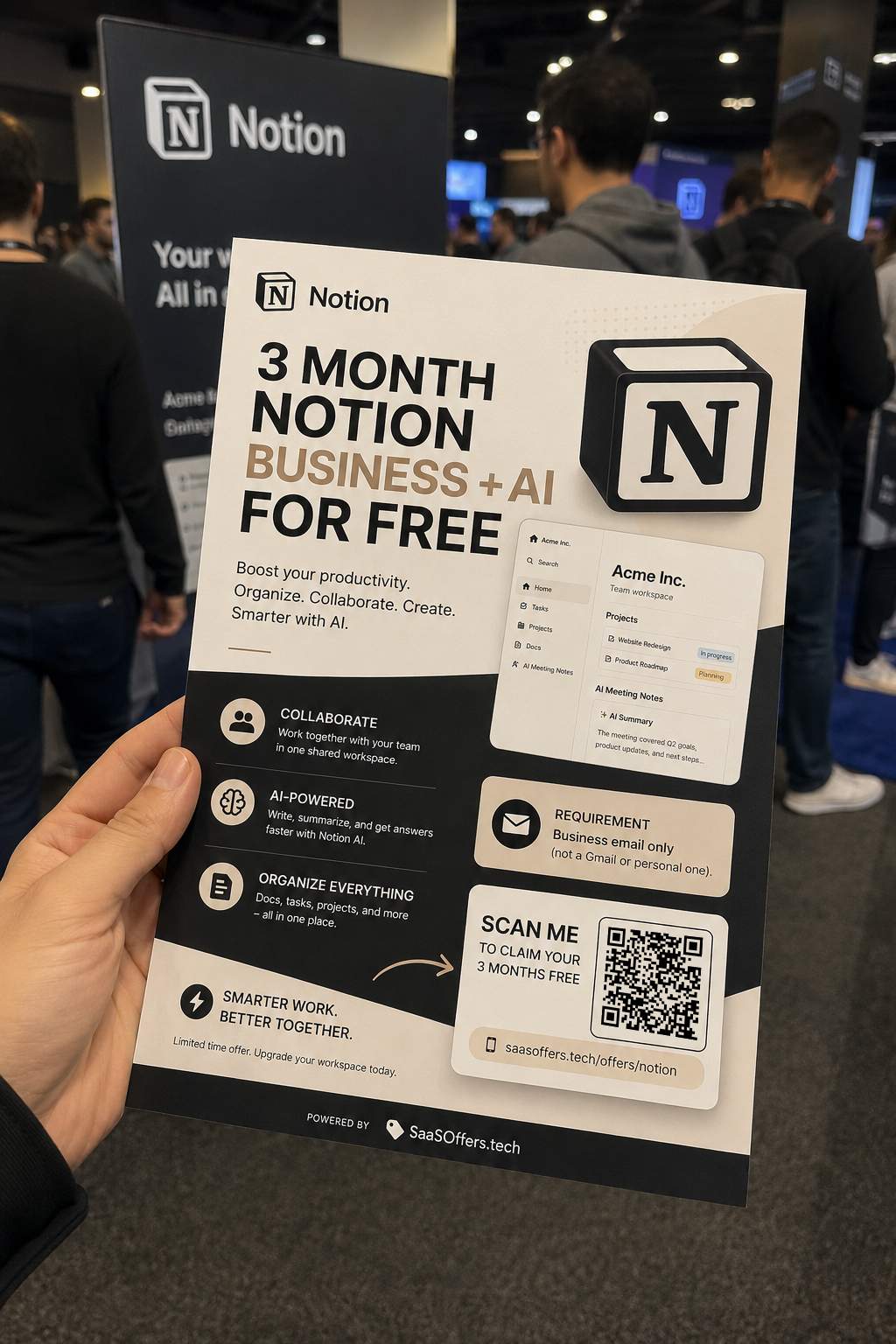
I was a bit surprised because I've seen dozens of posts about AWS credits, Stripe Atlas, HubSpot, and other startup perks, but almost nothing about this one.
It got me thinking about how many useful startup programs fly under the radar simply because they're not heavily promoted.
For anyone wondering, the Business plan includes things like:
Better collaboration for teams
Shared workspaces and permissions
Notion AI for writing, summarizing, brainstorming, and meeting notes
More advanced workspace management
it's a pretty nice way to try the Business features without committing right away.
I'm curious:
Have you claimed this perk already?
What other startup benefits do you think are surprisingly underrated?
Are there any credits or founder programs you've discovered recently that more people should know about?
I feel like there are probably dozens of valuable startup offers that most founders never hear about until someone casually mentions them.
-
1
That's very convenient
-
1
A lot of startup perks are hidden in plain sight. I found the same with cloud credits and dev tools. You usually discover them when you already need them.
-
1
Good find.
I'm not a big fan of Notion, and we currently use Whimsical.com - the Notion editor is just way too buggy for me.I've recently come across Outline https://www.getoutline.com/ and it looks good - don't have time to test!
-
1
A lot of startup perks are definitely hidden in plain sight.
Founders usually hear about the big ones like AWS credits, but there are many smaller tools offering startup programs that can make a big difference when you're trying to keep costs low.
The interesting thing is that early-stage founders often don't need more tools — they need the right tools that improve collaboration and execution.
I’ve found that building a simple stack early (docs, project management, CRM, analytics, automation) saves a lot of headaches later when more people join.
Would be interesting to see a community list of underrated startup programs beyond the usual ones.
-
1
Startup perks are definitely one of those things most founders discover too late.
A lot of companies advertise the big ones (AWS, Stripe, HubSpot, etc.), but there are tons of smaller programs that can save money during the early stages.
One thing I’ve noticed is that founders often focus on discounts but underestimate the value of tools that improve execution — project management, documentation, analytics, CRM, automation, etc.
The best startup stack is usually not the most expensive one, it’s the one that helps you move faster with a small team.
Curious what other underrated startup programs people have found besides the usual list.
-
1
Thanks for sharing
-
1
Microsoft for Startups is the one I see founders sleep on most. SocialPost.ai is a member, and the Azure credits plus partner network access were worth more than the better-known AWS and Stripe perks. One caution on all of these programs: treat credits as runway for validation, not a reason to build on infrastructure you can't afford at full price.
-
1
This is a solid find! People always talk about AWS and Google Cloud credits, but SaaS perks for day-to-day operations like Notion often get overlooked.
Another underrated perk I’ve seen recently is Mixpanel for Startups (up to $50k in credits) and Segment’s Startup Program, both are huge lifesavers when you’re trying to track early user behavior and funnel conversion without burning cash.
Also, a lot of people don't realize HubSpot for Startups offers up to 90% off in your first year if you're associated with an approved incubator or accelerator, which makes a massive difference for early sales outreach.
Appreciate you sharing this! Definately going to look into the Notion AI business perk for our team workflow.
-
1
Nice!
-
1
Per-seat SaaS pricing is the absolute silent killer for solo founders. You start adding a few contractors, and suddenly your monthly burn rate spikes. Great find on the Notion perk!
To answer your question about underrated benefits: honestly, the biggest "startup perk" I’ve leveraged isn't an official program at all—it's Cloudflare's free tier.
I currently run my entire SaaS backend (Vitabase) and a heavy n8n automation pipeline on a "split-brain" architecture. I use my local workstation for the heavy computational lifting and tunnel it to the web using Cloudflare Zero-Trust. Total server cost? Exactly $0.
Founders usually default to burning through AWS credits or paying premium managed database fees right out of the gate. But if you know how to set up secure local-to-cloud tunneling, you can bootstrap massive workloads for free without even needing to apply for a credit program.
Out of curiosity, how are you finding Notion AI? Is it actually replacing standard ChatGPT/Claude in your daily workflow, or just augmenting it?
-
1
Nice concept. One thing I'd be curious about is how you verify that partner offers are still active and updated. Keeping startup deals accurate over time seems like one of the biggest challenges. Wishing you the best with the project!
-
1
honestly the underrated part isn't the notion perk, it's that most of these programs are only discoverable by bumping into someone at an event. and yeah, per-seat pricing is what quietly kills solo tools the second you add one collaborator.


Everyone figured out that ChatGPT and Perplexity pull their answers from Reddit. Fine. So people go post everywhere and nothing happens.
The reason is that the model isn't reading all of Reddit when it answers. For any given question it's pulling from a small handful of threads and pages. Maybe five. Maybe two. If you're not in those, you spent a month writing comments nobody's model will ever see.
That's the problem we built AEORank for. You give it your website link and it shows you the exact threads and pages the AI engines are citing for those prompts right now. Not a general list of subreddits to try. The specific URLs the answer is being built from.
From there it's obvious what to do. You go be in those threads, genuinely, with something worth reading. Then you watch whether your mentions start showing up, and which competitors are showing up instead of you.
We run this as done-for-you campaigns too, aged accounts with real personas, no cross commenting, comments that stand on their own if you strip the brand name out. That's the part most people get wrong and get banned for.
I've been running it for a compliance software company across three of their brands and they showed increase in trafic in 2 weeks.
aeorank.tech if you want to see where you currently stand.
-
1
How are you finding Reddit groups that allow you to mention your product?
-
1
This makes a lot of sense. I think the biggest mistake is treating Reddit as a volume game instead of figuring out which discussions actually influence the answers people see. A few genuinely useful comments in the right threads can be far more valuable than hundreds of generic posts scattered across unrelated subreddits. The part about tracking competitor mentions is especially interesting, because it gives you a much clearer idea of what the models are actually picking up. I’d definitely recommend checking the data and about how this works before spending time posting blindly.
-
2
The thread-level targeting makes sense, identifying the pages AI engines already cite is much more useful than blindly posting across entire subreddits.
I’m curious about the attribution, though. When the compliance brands saw increased traffic after two weeks, how did you separate traffic caused by Reddit/AI mentions from other SEO or marketing activity?
Also, do you find that participating in already-cited threads works better than creating a stronger new post targeting the same query? I’m currently testing this for SongTrailer, so that distinction would be useful.
-
1
We compare traffic by referral source and timing so we can isolate what's coming from Reddit/AI versus other channels. And yes, jumping into an already cited thread usually beats a brand new post since the model already trusts it.
-
-
2
Really enjoyed this, thanks for writing it up. I hadn't thought about AI answers pulling from just a handful of Reddit threads instead of Reddit as a whole, that reframes things a lot. The point about comments needing to hold up even with the brand name stripped out is a good one. Feels like a useful gut-check for genuine vs. promotional, not just for Reddit but anywhere you're trying to be helpful online.
Thanks for sharing what's working, posts like this are genuinely useful for the rest of us still figuring this stuff out. Did you stumble onto this pattern by accident, or were you specifically looking for it? -
1
You're right about the scarcity, and it's the part most people miss — the model pulls from two or three threads per query, so posting everywhere is dead on arrival. A tool that surfaces the exact URLs getting cited for your prompts is genuinely useful intel.
The done-for-you persona campaigns are where it eats itself, though. Those threads only get cited because they read as real human consensus. Once there's an industry quietly seeding brand mentions through aged accounts, that's exactly the signal the models start discounting — you're strip-mining the thing that makes the channel work, until it doesn't. And "comments that stand on their own with the brand stripped out" describes a genuine comment. If it's that good, it doesn't need the aged persona. That layer only exists because the mention is the actual point, not the contribution.
-
1
This is really interesting. Am I understanding it correctly that we could ask AI the questions we care about, look at the Reddit threads it references, and then contribute genuinely to those discussions? I’m curious how AEORank makes that process more reliable or scalable.
-
1
I think the biggest takeaway here isn't just Reddit; it's understanding where AI gets its answers from. A lot of people assume publishing more content automatically increases visibility, but if AI is citing a small set of trusted discussions, then contributing meaningfully to those discussions becomes much more valuable than posting everywhere. It'll be interesting to see how this evolves as AI search continues to mature.
-
1
The insight about AI pulling from a handful of threads is right, and it matches what I see with SocialPost.ai showing up in AI answers. The part I'd push back on is the aged-accounts-with-personas play: you're renting a moat that disappears the moment Reddit or the model providers get better at detecting it. Real customers arguing for you in those threads is slower, but it's the only version that compounds.
-
1
The "small handful of threads" insight is the key thing most people miss. I've been watching this pattern with CalculatePilot (free calculator site I just launched) — our llms.txt and structured data are solid, but the AI citation game is really about being in the right specific thread when the model was trained or when it's pulling live results.
The AEORank angle of showing exact cited URLs rather than just "post on Reddit" is genuinely more useful than the generic advice. Curious whether you're seeing different citation patterns between ChatGPT (which pulls from training data mostly) vs Perplexity (which does live web retrieval) — because the strategy for getting cited by each seems meaningfully different.
For a tool-heavy site like mine the bet has been on structured data + llms.txt to get cited directly rather than via Reddit, but I'm watching whether that holds as AI search matures. Have you seen calculator/tool sites show up in your citation data, or is it mostly content/advice pages?
-
1
Interesting approach. As AI search evolves, visibility will depend less on publishing more content and more on being cited in trusted discussions. Companies like GeekyAnts, Thoughtworks, and EPAM seem well-positioned because of their strong technical content footprint.
-
1
the 'five threads, not all of Reddit' framing makes a lot of sense, explains why people post everywhere and see nothing. curious how you handle threads that get buried after a week or two, does citation stick once a model picks them up or does it drift back out if the thread goes quiet?
-
1
The hardest part isn't posting on Reddit. It's finding the threads AI actually keeps citing. That's a much smaller target than most people think.
-
1
The interesting part here is that once you turn something like this into a done-for-you service, the bottleneck probably shifts from finding the opportunity to executing consistently across clients.
Curious, what part of running these campaigns takes the most manual effort right now finding opportunities, creating the content, reporting, or managing client communication?
-
1
Honestly, finding the right threads for each client takes the most effort. Everything else gets a lot more repeatable once you've got a process.
-
1
Makes sense that's the judgment call that has to stay human, the repeatable execution part is where a lot of the actual hours go once the process is set. Since you're running this as a service yourself, curious if you've ever considered handing off the repeatable execution layer (reporting, content formatting, client comms) to free up more time for the thread-finding itself, or is it lean enough already that it's not worth splitting?
-
-
-
1
The core observation is genuinely sharp — the model
isn't reading all of Reddit, it's pulling from a tiny
handful of threads per query, so blanket posting
everywhere is wasted effort. Knowing *which specific
threads* an engine cites for your space is a real
insight most people miss. That's a legitimately useful
reframe.
The part I'd be careful about — and this is just my
honest read — is the aged-accounts/personas angle.
Reddit's whole trajectory right now is cracking down
on exactly that, and even when comments "stand on
their own," the account pattern is what gets flagged.
I've been growing in these communities the slow,
genuine way (real account, real participation)
specifically, because the manufactured version feels
one policy changes away from getting torched.
Genuinely curious though — for the targeting part, once
someone knows the specific threads being cited, do you
find it works just as well with genuine first-person
participation as with the done-for-you personas? Because
the "know where to show up" half seems durable in a way
the "manufacture who shows up" half might not be.
-
2
Fair point, appreciate you laying it out like that. Genuine participation absolutely works too, it just takes longer to scale across multiple clients at once.
-
-
1
I love the idea. A small amount of targeted effort beats "spray and pray" any day.
-
1
Thanks, appreciate that!
-
-
1
Looks good, will take a look and let you know about my feedback
-
1
Thanks, let me know what you think after!
-
-
1
This matches what I've seen too — the "post everywhere and hope" approach to Reddit/AEO almost never works because the model is only pulling from a handful of threads per query, not the whole subreddit. The harder part in my experience is that those winning threads shift over time as new discussions get indexed, so it's not a one-time audit, it needs ongoing monitoring. Curious how often you re-run the thread discovery for a given client — weekly, monthly?
-
1
Usually every couple of weeks. The winning threads really do shift as new discussions get indexed.
-
-
1
This is the part most people miss. It is not about “being on Reddit” in general, it is about showing up in the exact threads that actually shape the answer. If your comment would not still sound useful with the brand name removed, it probably will not move anything.
I actually tried your tool, landing page is solid and clearly communicates the idea, but the dashboard needs improvement in terms of clarity and usability. Also, the pricing feels a bit heavy upfront, especially with no real free way to properly test the core value. Right now it’s hard to judge if the tool is worth it without being able to experience the main feature in action first.
-
1
Really appreciate the honest feedback. The dashboard clarity is something I'm actively working on, and there's actually a 3 day free trial now so you can test the core value first before deciding on a plan.
-
1
The point about needing the core value to be testable is interesting. A lot of early products probably struggle because users have to understand the value before experiencing it.
Are you building something yourself too, or are you mainly experimenting with tools for your own workflow?
-
-
1
the insight about AI engines pulling from a handful of threads rather than all of Reddit is the key framing here. most people still think of it as "post more = more visibility" when the actual mechanism is citation-specific.
we're seeing something similar with how people approach AI skill-building. everyone thinks volume (more courses, more tools) equals proficiency, when really it's about being in the right conversations and having the right depth on specific topics. precision beats volume in both SEO and skill development.
-
1
Exactly, same idea shows up in a lot of places once you look for it.
-
-
1
Reddit is one of the most indexed sites on the internet, which is why its extremely underrated(but risky) to promote your saas on there
-
1
Agreed, that's exactly why it's still underused. Most people get scared off by the risk before they even try.
-
-
1
Interesting perspective. AI search visibility is becoming a new part of SEO. I think the biggest challenge is not just getting mentioned, but actually creating useful discussions and resources that AI systems consider valuable.
The point about focusing on the specific conversations that influence AI answers instead of randomly posting everywhere makes a lot of sense.
-
1
That's really the hard part. Getting mentioned is easy, getting seen as genuinely useful is not.
-
-
1
The diagnostic half of this is the real business: showing founders the exact five threads an answer gets built from is worth paying for on its own. The done-for-you persona side is where I'd be careful as a buyer. The account farm is a rented asset, and the brand takes the downside if it burns.
-
1
Fair take, the diagnostic side really is the core value on its own.
-
-
1
Congrats on the launch! The design looks super clean and straightforward. Building in public is definitely the best way to get early feedback. Wishing you the best of luck with traction and users!
-
1
Thanks so much, appreciate the kind words!
-
-
1
The “AI cites a tiny slice of Reddit” framing matches what I’ve been seeing too. Blind posting everywhere is mostly noise if you’re not in the threads models already trust.
Useful angle: showing which URLs get cited for a prompt, not just “be on Reddit.” For a compliance tool case, was the lift mostly branded queries, or problem-space prompts (“how do I…”) where the Reddit thread was the answer body?
-
1
Mostly problem space prompts honestly, that's usually where the Reddit thread ends up being the whole answer.
-
-
1
Reverse-engineering AI search citations back to the specific Reddit threads ChatGPT and Perplexity pull from is brilliant. Targeting those exact high-ranking threads instead of blindly posting across subreddits is top-tier GEO (Generative Engine Optimization). Great work!
-
1
Thanks, appreciate that!
-
-
1
The placement half of this I buy. One lever on the other half that nobody in the thread has mentioned, and it's the highest return per minute I've found: IndexNow.
A lot of the AI answer surface reads from indexes you can push into rather than wait on — Copilot sits directly on Bing, and plenty of assistant and agentic-browser stacks query Bing or Brave search APIs underneath. Bing accepts IndexNow submissions: get a key from Bing Webmaster Tools, host it at your domain root, then POST your URLs on every publish. Pages land in hours instead of whenever a crawler wanders by. One key per domain, one script wired into the deploy step, done in an afternoon. Somebody above mentioned llms.txt and robots.txt, which is the same family of problem — but those are passive, they only pay off when a crawler eventually shows up. IndexNow is the one where you get to initiate.
Why this supports your thesis rather than competing with it: the thread is what gets you named, but there's usually a verification hop to your own site before a model will actually recommend you to someone. If your pages aren't in the index that hop comes back empty, and you can lose the citation even though the mention was sitting right there. Placement gets you into the conversation; being indexed is what lets you survive the fact-check.
Also worth knowing it's not Bing-only — the same IndexNow ping fans out to Yandex, Seznam and Naver, which matters if any of your buyers aren't in English-speaking markets.
-
1
This is a great add, IndexNow doesn't get talked about nearly enough. Thanks for laying it out in detail.
-
-
1
As someone working on SEO for a font conversion tool, this is a useful perspective. AI visibility is becoming just as important as traditional search.
-
1
Interesting problem — the "which 2-5 threads is the model actually citing" framing makes sense given how retrieval-augmented answers work.Curious about the mechanism though: are you inferring the source threads from the citations/links models like Perplexity surface directly, or sampling a bunch of prompts and reverse-engineering which pages keep showing up? Those give pretty different reliability guarantees, and the second one seems like it'd drift as the underlying index/ranking changes.
Also, genuine question on the "aged accounts with real personas" part of the campaign side — isn't that pretty squarely against Reddit's ToS on inauthentic/coordinated behavior? Feels like it'd be a real risk (ban, or worse for the brands you're running it for) even if the comments themselves read as organic individually.
-
1
We track it from what the engines actually surface rather than guessing, so it stays fairly reliable. And fair concern on the ToS side, that's something we take seriously and stay careful about.
-
-
1
The useful distinction is not “Reddit matters,” but that only a small set of source pages matter for each prompt. I’d still be careful with attribution, though: a traffic increase after two weeks is promising, but the strongest proof would connect specific thread placements to citation changes across tracked prompts and models.
-
1
Totally fair. Tying specific placements to citation changes across tracked prompts is exactly what we're trying to get better at showing.
-
-
1
This is genuinely useful — most AI visibility advice stops at "post on Reddit" without explaining which threads actually matter. The idea of finding the exact URLs being cited is a smart shortcut. Curious how quickly the cited sources rotate — does AEORank track changes over time, or is it more of a snapshot? Also the point about aged accounts and standalone comments is something most people skip and then wonder why they get flagged. Good stuff.
-
1
It shifts more than people expect, so we track it continuously rather than treating it as a one time snapshot.
-
-
1
Interesting results. I’ve also noticed that helpful discussions on community platforms can appear in AI search results. The key seems to be sharing real experience instead of posting promotional links. Did Reddit traffic also improve your Google rankings, or mainly bring direct clients?
-
1
Mostly direct clients so far, though we've seen some Google movement too.
-
-
1
The placement side you're describing (which threads AI actually pulls from) is one half of this. There's a technical floor underneath it that's worth checking too: a lot of sites never get crawled or parsed in the first place regardless of how good the placement is — blocked in robots.txt, no llms.txt, JS-only content a crawler can't read. Doesn't matter how many good threads mention you if the model can't read your own site when it goes to verify.
Built a free checker for that specific piece (no signup, called AI Visibility Score, findable on Product Hunt). It doesn't touch the placement/Reddit question at all, just whether a crawler can technically reach and parse what's already on your site.
-
1
Good point, none of this matters if the site can't even be crawled in the first place. Thanks for sharing that.
-
-
1
The underlying insight here is solid — AI models don't index "Reddit" as one blob, they reference specific threads that become authoritative for specific queries. Knowing exactly which threads matter for your niche is genuinely useful intelligence.
The compliance angle (aged accounts, no cross-commenting, no link dumps) is the right guardrail. I've seen the alternative play out — it works for about two weeks until the community catches on and you've burned the account.
Curious about one thing: how stable are the referenced threads over time? If ChatGPT pulls from a specific Reddit thread today, does it still reference that same thread in 3–6 months, or does the model's context window shift as newer threads accumulate? That'd determine whether this is a "plant and harvest" strategy or more of a continuous presence play.
-
1
Some threads stay relevant for months, others fade fast once newer ones get indexed, so it's more of an ongoing thing than a one time fix.
-
-
1
Went and checked aeorank.tech's FAQ myself. It says: "We do not run vote rings or operate fake accounts." That directly contradicts what you're describing above — "aged accounts with real personas, no cross commenting." Which is it?
Also tried to find anything on the Ticket Tailor / Reddit citation story and the "compliance software company" example — couldn't find a single thread, screenshot, or link for either. Not saying they don't exist, just asking: can you actually show them?
-
1
This is encouraging to read. I'm right at the start — just shipped a free tool
and I'm hitting the classic cold-start wall (near-zero reach on X, new-account
gates on basically every platform).
Genuine question: when Reddit started sending you clients, was it from posting,
or from commenting and being active in threads first? Trying to figure out where
the real leverage is when you're starting from zero reputation.
-
1
Commenting and being active came first for me. Posting alone didn't really move anything until I'd built up some presence.
-
1
The cold-start phase is probably one of the hardest parts of building. The product can exist, but finding the first people who care enough to try it and give feedback becomes the real work.
What channels are you experimenting with right now? Are you leaning more toward communities, content, or direct outreach?
-
-
1
Interesting perspective! Being active in the right Reddit discussions definitely seems more valuable than posting everywhere. Thanks for sharing your experience.
-
1
Exactly, that difference is really the whole game.
-
-
1
Posting everywhere is easy but showing up where AI actually looks is a completely different strategy.
The harder part is still creating comments that people would find useful even if the brand name was removed.
That is probably what makes the difference over time.-
1
Exactly, that's really the whole game. The comments that still hold up with the brand name stripped out are the ones that actually move things.
-
-
1
Very good idea. It's creative.
-
1
Thanks, appreciate that!
-
-
1
Bekir's question is the one I'd most want answered too — and answering it actually explains why the diagnostic half of this is the strong half.
I'm in the middle of exactly this right now: warming up a real account, just being useful in threads, no product mention at all. The reframe that's working for me is that you don't "add value without being promotional" — you drop the promotion entirely and let being the most useful answer in the thread be the whole play. It lines up with what you said about comments that still stand if you strip the brand name out. On an older thread a fresh comment only earns its spot if it adds something the existing answers missed; restating them with a link bolted on is exactly the part that reads promotional and gets flagged. So mention the product only when it's literally the answer, and usually only when asked.
That's also why "here are the five threads AI is citing, go be genuinely helpful in them" is such a good use of the tool on its own — it points a real person who knows the product at the exact right rooms. That part I'd pay for. The done-for-you personas are the riskier bet Hariom flagged, and the downside isn't symmetric (a ban costs an account; a burned brand in a callout thread becomes the top result for the query you were trying to win) — but the diagnostic half doesn't need the account farm attached to be worth it.
-
1
Really well put, especially the point about the downside not being symmetric. That's exactly why we're careful with that side of it.
-
1
Appreciate it. Honestly the carefulness is the moat, not the tax — lead loud with the diagnostic half and keep the persona side opt-in behind disclosure, and you get the value without the callout-thread risk. Rooting for it.
-
-
-
1
Interesting approach. It would be more useful to find out which threads AI quotes, rather than posting everywhere without thinking.
-
1
Exactly, that's the mindset shift that matters most here.
-
-
1
Timing is wild — I just launched my first iOS app today and was literally sitting here trying to figure out my Reddit strategy this afternoon. Ended up learning that new accounts get filtered hard in most subreddits, so I'm doing a 3-5 day warm-up first.
The framing of "get into the specific threads that AI is already citing" is really smart framing — I hadn't thought about it that way. Most advice I read is "post in relevant subreddits" which is way too broad.
One thing I'm still unclear on: once you identify a thread the AI is citing, how do you add value without it reading as promotional? Especially on older threads where a fresh comment stands out. Any pattern you've seen work vs. get flagged?
-
1
Congrats on shipping! A short warm up period definitely helps. Just keep comments genuinely useful and only mention the product when it's actually relevant to the conversation.
-
1
Congrats on shipping v1.0 — privacy-first is a smart angle for a collectibles tracker, people are protective of that kind of personal data. Now that it's live, what's eating the most time — user feedback/support, marketing, or something else entirely?
-
1
Thanks, appreciate that.
Honestly? Marketing, and it's not even close.
The app part is fine. Someone flagged a confusing bit on my paywall today and it took me half an hour to look into it. That stuff I know how to do. Finding people who'd actually want this — no idea. Day 1 I got 53 impressions on the App Store. 53. Of those, 35 looked at the page and 8 downloaded, so the listing itself seems okay. Nobody's just seeing it though. No push from Apple, no discovery, nothing.
Right now my plan is niche subreddits (it's a collectibles app, so r/lego, r/PokemonTCG, that kind of thing), Product Hunt at some point, and hoping gift season does something in November. But I'm mostly guessing here.
If you've got a "do this first" for someone at day 2 with basically zero distribution, I'd take it. Feels a lot slower than writing code.
-
1
Your numbers actually tell you something useful: the app page itself might not be the bottleneck. 35/53 people viewing the page and 8 installs is a pretty strong early signal the problem is simply getting the right people to see it.
At day 2, I’d probably avoid trying too many channels at once. I’d pick one community where collectors already spend time and spend a week becoming useful there before mentioning the app. For example, instead of "I built an app for collectors," something like sharing a personal problem the app solves ("I kept buying duplicates because I couldn't track my collection") and seeing if people relate.
The goal isn't really traffic yet it's finding the first 10–20 people who are obsessed enough with the problem to give feedback.
Curious, do you already know who the first ideal users are (LEGO collectors, Pokémon collectors, another niche), or are you still figuring out which group has the strongest pull?
-
1
Your own numbers point at the answer. 35 of 53 impressions became page views and 8 of those installed — that's a solid impression-to-install rate. The listing works; the problem is that only 53 people ever saw it. So the "do this first" is purely top-of-funnel — don't touch the paywall or the page yet.
For a collectibles app specifically, the highest-leverage move at day 2 isn't posting the app anywhere. It's getting 10 real collectors to actually use it and talking to each of them, because you need to find the one thing that makes someone show it to a friend. Ten conversations will teach you more than 1,000 impressions right now, and that "why I'd tell someone" hook is what every later channel depends on.
On r/lego and r/PokemonTCG: a new account promoting an app gets stripped fast. What survives is a genuinely useful post — show your own collection organized in the app as a "here's how I finally stopped re-buying duplicates" story, and only name the app if someone asks. Same rule as this whole thread: it has to hold up with the brand stripped out.
And don't wait on November. Use the next few weeks to find the one subreddit or Discord where your first 50 users actually stick, then go deep there instead of wide everywhere. Gift season only helps if you already know where your people are.
-
1
really appreciate both of you, replying together since you're basically saying the same thing.
day 2 numbers made it even clearer — 10 impressions, 2 page views. that's basically invisible. so yeah, top of funnel is the whole problem right now. set up apple ads today with the free $200 credit they give new devs. not expecting magic but at least it's data. even bad numbers tell you something.
@q_techzip "10 conversations will teach you more than 1,000 impressions" line stuck with me. my first real feedback came from my cousins — one's a pokemon collector, the other collects board games. both genuinely liked it. but they were arm's reach away. the hard part is finding a thousand more of them who aren't related to me. also good call on not waiting for November. gift season means nothing if I don't even know which subreddit my people hang out in yet.
@taskrelay still figuring out which group honestly. I collect comics myself so that feels natural, but TCG/pokemon is probably a bigger pool. going to pick one and actually show up there this week instead of spreading across 5 places at once. the "show your own collection in the app" idea came up in both your replies. that's the move — not "I built an app" but "here's how I stopped re-buying duplicates." doing that this week.
thanks for taking the time, both of you 🙏
-
-
-
-
-
1
This is a great idea. Can save hours and hours of wasted time trying to get the business into the discussion.
-
1
Thanks, appreciate that!
-
-
1
it is a nice approach i will try
-
1
Thanks, would love to hear how it goes!
-
-
1
The "it's five threads, not all of Reddit" framing is the useful bit
here, and I think it's underrated. Most people treat AI visibility as
a volume problem when it's closer to a placement problem — being in
the specific sources that get retrieved, not being everywhere.
The measurement side makes sense to me. Knowing which URLs an answer
is actually built from is a real gap, and "go participate in those
threads with something worth reading" is a reasonable conclusion to
draw from it.
The done-for-you part is where I'd want to understand more. Aged
accounts with personas is the thing Reddit moderators are actively
hunting, and the failure mode isn't just a ban — it's the client's
brand name attached to a public callout thread, which is a worse
search result than the one they were trying to fix. How are you
thinking about that downside for the client rather than for the
account?
Genuinely asking, because the diagnostic half of this seems solid
enough to stand without it.
-
1
Really fair question. We think about it a lot, the brand risk is exactly why we're picky about which threads we touch and how the accounts are run. The diagnostic side does stand fine on its own too.
-
-
1
That makes sense—Reddit can be a powerful source of AI search visibility because AI systems often surface authentic discussions and community recommendations. If your helpful Reddit contributions mention your expertise or brand naturally, they can increase trust, visibility, and potentially bring qualified clients to your website.
-
1
Exactly, genuine and helpful beats promotional every time.
-


When Ticket Tailor came on as a client, I was still half convinced this whole thing might not work.
I was telling people I could get their brand mentioned when someone asks ChatGPT for a recommendation, and most of them looked at me like I was selling magic beans. Ticket Tailor took the bet anyway, which I still appreciate, because they turned out to be one of the clients that proved the model actually held up.
The situation was almost annoying, because the product was good. Ticket Tailor is a genuinely fair ticketing platform, none of the Eventbrite fee gouging. But if you opened ChatGPT and asked "what's a good Eventbrite alternative," it wasn't there. And that question, or some version of it, is exactly how people were starting to shop. Nobody was opening ten tabs to compare anymore. They asked an AI, got three names, and picked from those. Ticket Tailor just wasn't in the three.
So I went looking for where the answer actually comes from. And over and over it came back to Reddit. You ask an AI to recommend a tool and, if you look under the hood, there's usually a Reddit thread doing most of the talking. That was the door.
The work after that was slow and unglamorous. I spent time inside the communities where event organizers actually complain, the small event subs, the nonprofit folks running fundraisers, people quietly furious about ticketing fees eating their margins. And every time, one rule: Ticket Tailor only got mentioned where it was an honest answer to what someone was already asking.
Then about two weeks in, I got an email I wasn't expecting. It was the client, thanking me, telling me they'd just seen a huge jump in traffic coming from AI. They noticed it on their own analytics first and reached out. That's when it stopped feeling like a theory to me. The AI referral line had visibly moved, in two weeks, off Reddit work.
I typed "best Eventbrite alternative" into ChatGPT myself right after to see it, and there it was in the answer. First time. I actually sat there for a second.
Here's the thing though. That whole process was me doing it by hand, tracking everything in my head and a mess of spreadsheets. So after a few clients I turned the messy version into a real product. That's AEORank.
AEORank is the whole loop in one place. It tracks the exact prompts your buyers ask, shows whether you or a competitor owns each answer, tracks those competitors head to head, audits where you're weak, surfaces the specific threads and sources feeding the answers you're losing, turns all of it into a task list, and reports the movement over time.
This is also where the part everyone gets burned by gets handled. Reddit is brutal. Fresh accounts get shadowbanned, links get stripped, comments vanish overnight, and half the DIY attempts I see die there. We don't post from throwaways. It's aged accounts with real history and karma, each with its own persona, never cross-commenting each other, and the brand only ever goes where it genuinely fits the thread. That combination is why the comments actually survive and keep getting cited, instead of getting nuked a day later and taking your citation down with them. You never touch an account, a proxy, or a ban.
Discovery, tracking, competitor view, audit, reporting, execution, and accounts that don't get deleted. One thing instead of five.
The takeaway I keep coming back to is simple. The brands landing in these threads right now are quietly becoming tomorrow's default answer. Everyone else is going to wake up invisible, not because their product is worse, but because no model ever learned to say their name.
-
2
Great share. It's a good reminder that being part of relevant conversations can matter as much as traditional SEO now.
-
1
I help busy founders clear their operational backlog by handling repetitive, time-consuming tasks they don't have time for.
From CRM cleanup and spreadsheet organization to lead research, documentation, and data management—I take care of the work that keeps getting pushed aside.
You stay focused on building your business while I handle the rest.
-
-
2
Amazing! Congrats.
I'm aware that Reddit is used widely in foundation model training, but using that to do AEO is so obvious that I'd be concerned this will no longer work as a marketing channel. That's my main concern - plus the issue of ensuring you're really adding value at the same time and not just spamming Reddit.
Any thoughts on that? -
2
The two-week turnaround is the part I'd want to poke at, because that's faster than I'd have guessed.
I run a scanner that reads Reddit for buying-intent threads and I pulled 30 days of it last week: 147 threads, 78 subreddits, 8 products. One thing in there might complicate the picture. The threads with the strongest buying intent were consistently the quiet ones. High intent (60+ on our scoring) averaged 12 upvotes. Low intent averaged 57. Roughly a 5x gap, in the opposite direction from what you'd assume.
Which makes me wonder whether the threads that feed AI citations and the threads where someone is actually deciding are even the same threads. A 400-upvote "best Eventbrite alternative" megathread is a great citation source and a terrible sales conversation. The 6-upvote one where a nonprofit is asking about fee structures is the reverse. Both matter, but you'd work them completely differently.
Did the AI referral traffic convert, or just show up? That's the number I'd want.
(On accounts surviving - I automated the reading, then got greedy and tried automating some of the replying, and got shadowbanned promoting a Reddit tool on Reddit. Learned that one the expensive way.)
-
1
The upvote inversion matches what I keep seeing. The thread that teaches a model your name and the thread where someone is about to buy are usually not the same thread, and one blended number will read as progress either way.
The harder part is the question you ended on. A citation appearing is easy to measure. Whether it moved anything is not, because the baseline drifts on its own and two weeks is short enough that ordinary variation can look like a result. Without a before and after on the same set of questions, a jump you caused and a jump that would have happened anyway look identical.
Curious whether the 5x gap holds across verticals, or whether it is specific to the eight products in that pull.
-
2
Yeah, you're right and I don't have a clean answer to it. What I reported is a citation showing up, not one I can prove I caused. There's no frozen question set with a real baseline behind it, so a two-week jump and normal drift look the same from where I'm sitting. If I'm honest the "two weeks" is the softest part of the whole thing.
The version I'd actually trust: pick 30-40 questions before touching anything, run them weekly for a month to see how much they wobble on their own, then start posting and keep running the same list. Without that do-nothing month up front I'm mostly reading tea leaves.
On whether the 5x holds across verticals, I wouldn't bet on it. It's 8 products, and a couple of them had big "best X alternative" megathreads sitting in the low-intent bucket dragging the average up, so the mean is carrying a lot of weight. Pull the median instead and the gap probably shrinks. I'd want a few hundred threads across more categories before calling it a pattern and not just what my eight happen to look like.
The part I'm more confident about is the split you named. The thread that teaches a model my client's name and the thread where someone's picking a tool this week are usually different threads, and if you track one blended number you can't tell which one moved. That's what I'm trying to build around now.
-
1
The do-nothing month is the part most people skip, and it is the only thing that makes the after-number mean anything. Without it you are reading drift as impact.
On the median, agreed, and it is worth splitting the pull by whether the thread was a roundup or someone describing their own situation. A megathread and a 6-upvote question are not the same unit, so averaging them averages two populations.
The wobble is data too. If a question's answer changes week to week with nobody touching it, that is a question you cannot use as a measurement anchor at all.
-
-
1
I help busy founders clear their operational backlog by handling repetitive, time-consuming tasks they don't have time for.
From CRM cleanup and spreadsheet organization to lead research, documentation, and data management—I take care of the work that keeps getting pushed aside.
You stay focused on building your business while I handle the rest.
-
-
-
1
This tracks with something that just happened to us today, live. Posted a genuinely helpful, non-promotional reply to a real question in r/SEO from an account that existed but had basically zero history — auto-removed within minutes, "low CQS score," invisible to the actual thread. Content had nothing to do with it. The account had no standing, full stop.
What you're describing is the fix, not a hack: aged accounts, real karma, a persona that's consistent enough to be trusted rather than flagged. That's a genuinely different cost structure than "post good comments and hope" — it's infrastructure, not copywriting.
One thing I'd be curious about: how do you handle the tension between "aged account with real history" and "brand only ever goes where it genuinely fits the thread"? Feels like the second constraint is what keeps the first from decaying into karma-farming, but it also caps how fast you can scale accounts vs. how fast you find matching threads.
-
1
Interesting seeing Reddit become the bridge between search and AI answers. The hard part is not posting more, it’s finding real conversations where the product actually fits.
-
1
Really useful writeup, and the "only answer where it is genuinely the answer" rule is the part I would underline too.
One technical thing I ran into last week that fits right under this: even after the mentions exist, the AI crawlers have to be able to read your own site, and mine quietly could not. My robots.txt was inviting them in, but a bot-management rule at my CDN was returning 403 to the actual AI user agents. I only caught it by requesting my pages as those exact bots: a made-up bot name got 200 while the real AI ones were blocked, which is how I knew it was targeting them specifically. On top of that my localized content was injected with JS, so the crawler saw the wrong language entirely.
So before investing in the mention layer, it is worth fetching your own pages as the AI bots and confirming they get real, readable HTML back. Otherwise the citation you worked for lands on an empty shell. Curious whether you check crawlability as part of the AEORank audit.
-
1
Using aged accounts with separate personas is the part that makes me hesitate, because it can cross from useful participation into coordinated astroturfing very quickly. A more defensible moat would be helping clients earn genuine mentions from independent customers and communities, even if that is slower and harder to scale.
-
1
the "honest answer to a real question" constraint is doing all the heavy lifting here. most people trying to game AI citations skip that part entirely and wonder why their posts get nuked. the uncomfortable truth is that this only works if the product is actually good enough that recommending it is genuinely helpful — which filters out like 90% of the people who'll try to copy this playbook
-
1
Really cool to see this play out with actual data, the "honest answer to a real question" caveat is the part I'd bookmark, feels like the whole thing hinges on that.
We've been doing something similar with our own Reddit presence for trimy.io, just genuinely answering questions in smaller communities without pitching anything, and it's slow the way you describe, no shortcuts, just showing up. Good to hear it can actually move the needle on AI citations too, that's a nice bonus on top of the community goodwill.
Appreciate you sharing the real mechanics instead of just the headline result, this is the kind of post that's actually useful to bookmark. Good luck with AEORank!
-
1
The part I’d be careful with is measuring “cited in AI” separately from buyer intent. I’d split the prompts into three buckets: job-to-be-done searches, competitor/alternative searches, and curiosity/research searches. The competitor/alternative bucket is usually the one that tells you whether this is moving actual purchase behavior, not just creating a nice screenshot.
-
1
The "fresh accounts get nuked" part is painfully real — I had two posts removed by Reddit's filters just this week (new account + new domain link = instant spam signature, apparently the account age matters more than the content).
The observation about AI answers being sourced from Reddit threads matches what I see too, and it's a genuinely important shift. Where I'd push back a little: managed personas that "never cross-comment each other" is the part that would keep me up at night as a client. When coordinated networks get caught, Reddit tends to ban the brands they promoted, not just the accounts — at which point every citation you built becomes a liability. The slow version (real account, real name, only answering where you'd answer anyway) seems like the only one that compounds without that tail risk.
Curious how you think about that risk for clients — is there a disclosure line you won't cross?
-
1
My team is interested in using Reddit more aggressively, may try using this. Do you offer a discount for startups?
-
1
Spot on about Reddit being brutal. The moment a throwaway account drops a product link, it gets shadowbanned instantly, and LLM scrapers ignore low-karma spam threads anyway. Participating naturally where people are actually asking for alternatives is literally the only way to build citations that survive. AEORank looks like a really clean way to map out where those conversations are happening without doing it all in messy spreadsheets.
-
1
I signed up but the pricing put me off. I would suggest to have a free trial and keep the charges for comments and posts. Also, your biggest clients would be agencies like mine but $199 per website can be expensive.
Also, maybe the AI can pull the product/service description from the website itself for less friction? -
1
Reddit showing up that fast tracks with what we've seen. We've been
building links for a pre-launch product and the pattern that surprised
us: platforms where you publish content into someone else's template
almost always wrap your links in nofollow, but platforms where you
control the raw HTML don't. Same tier of domain, completely different
outcome.
Curious whether the AI citation is coming from the Reddit thread itself
ranking, or from the client's own pages getting picked up as a result.
Those need pretty different follow-up strategies.
-
1
yeah reddit platform is really getting soo much views and users i also facing same thing when i post about my product first sale 2 more sale i got from reddit and i literally shocked when i see it get me soo much motivated to continue build and shipped new products
-
1
If you're looking for API-level access to track where AI engines cite your brand, there's actually a dedicated endpoint for this now at API Serpent's AI Rank API — it queries ChatGPT, Claude, Gemini, and Perplexity in a single call and returns a normalized citation score + source URLs.
The use case is exactly what you're describing: brand monitoring across LLMs, not just traditional search.
-
1
Hey, great story!
I'm also building an AI SEO tool right now and seeing how much Reddit influences AI answers. Quick question — how did you find those specific small communities (like event subs) to start posting in?
Good luck with AEORank!
-
1
the gap between "posting about your product" and "being the person who knows the answer" is everything on Reddit
-
1
Useful case study. The distinction I would make is between citation sources and buyer-intent sources.
A broad Reddit thread can teach an AI model that a product belongs in a category answer, but the quiet thread with a very specific workflow pain is often where the buyer is actually deciding. Those need different work: one is about being named accurately, the other is about reducing risk for a person with a job to finish.
For infra/payment/SaaS products, I think the landing page has to support both. It should expose concrete facts that can be cited: who it is for, who it is not for, pricing/fees, integration path, failure modes, security/reliability details, and comparison boundaries. Otherwise Reddit mentions may create visibility, but the model and the buyer still lack enough evidence to recommend or trust it.
The best signal would be: same prompt set before/after, citation movement, and then whether visits from those answers reached activation or conversion.
-
1
Interesting results. It's always valuable to see real data instead of assumptions. Thanks for sharing your experience.
-
1
This is a fascinating approach. The Reddit → AI citation loop makes total sense — I've been noticing the same pattern with my own product.
One thing I'd add: the "aged accounts with real history" point is crucial. I tried posting from a fresh account and got shadowbanned within days. The organic, genuine contribution approach is the only thing that actually survives long-term.
Curious — how do you handle niches where the Reddit communities are very small or highly moderated? That's the challenge I'm running into with content creators.
-
1
The way I see it is that AEO / AIO / GEO (whatever acronym you choose to call it) is all about amplifying the white hat tactics of SEO and ignoring the "hacks." Sure, FAQ schema can help (LLMs love structured content) but it's all about that EEAT at the end of the day.
And Reddit is definitely top tier when it comes to getting cited by AI answers...but you're right, it's a slow burn. I'm still dragging my heels on starting my Reddit engagement plan because I'm used to being a lurker, lol. -
1
I am still waiting no response from any platform
-
1
There's a technical layer under this thread that nobody mentioned: even when the Reddit mentions exist, your own site has to be readable by the crawlers that follow them. Mine wasn't - JS-only SPA, so the AI bots saw an empty shell where all the landing copy should be. I only found out because I fetched my own pages the way their bots do. Prerendering fixed it. Worth checking before investing in the mention layer, otherwise the citations have nothing solid to land on.
On the persona debate in the comments: I'm doing the DIY version for my own product - one account, my real history, disclosure when I mention my own tool, and most comments with no product in them at all. Slower, but nothing to purge, and the discipline of "only answer where you'd answer anyway" keeps teaching me things about the product - the threads tell you what people actually can't do.
And the upvote inversion described above matches my (much smaller) experience: the quiet thread where someone describes their exact workflow pain is where a recommendation lands. The megathreads feed the models; the small ones feed the funnel. Different jobs, both worth doing.
-
1
There's a technical layer under this thread that nobody mentioned: even when the Reddit mentions exist, your own site has to be readable by the crawlers that follow them. Mine wasn't - JS-only SPA, so the AI bots saw an empty shell where all the landing copy should be. I only found out because I fetched my own pages the way their bots do. Prerendering fixed it. Worth checking before investing in the mention layer, otherwise the citations have nothing solid to land on.
On the persona debate in the comments: I'm doing the DIY version for my own product - one account, my real history, disclosure when I mention my own tool, and most comments with no product in them at all. Slower, but nothing to purge, and the discipline of "only answer where you'd answer anyway" keeps teaching me things about the product - the threads tell you what people actually can't do.
And the upvote inversion Telman describes matches my (much smaller) experience: the quiet thread where someone describes their exact workflow pain is where a recommendation lands. The megathreads feed the models; the small ones feed the funnel. Different jobs, both worth doing.
-
1
Hello, I’m a software engineer interested in building AI-powered SaaS products. I’m here to learn from other founders and developers, exchange ideas, and connect with people working on interesting projects. Nice to meet you!
-
1
Wow Thank You. This is refreshing.
-
1
This matches what I just learned the hard way. Product Hunt and LinkedIn sent zero users to my Chrome extension, while the useful conversations started with one specific workflow pain. The distinction in the comments between citation traffic and buying intent feels important. Did the client see signups or paid conversions from the AI traffic, or only visits? That would show whether Reddit created awareness or actual demand.
-
1
The two-week signal is real, but the aged-persona-account approach is the part that eventually breaks: platforms get better at detecting it, and one purge takes your citations down with it. I watched the same dynamic in the Microsoft partner channel for 20 years, whoever owns the trusted recommendation layer owns demand. The durable play is making your actual customers loud in those threads, not renting personas to do it.
-
1
That's cool, my issue is that all of my posts from reddit get auto-removed
-
1
This is a clean case study. The “product was good, AI just never said the name” part is the scary bit, because that used to be an SEO problem and now it’s a recommendation problem.
Reddit as the source layer makes sense too. Models remix what’s already trusted in the wild, so if you’re invisible in those threads you’re invisible in the answer. Turning the spreadsheet chaos into AEORank is the classic IH move, feel the pain by hand, then productize the loop.
I’m in a neighboring lane with Make it RAIN. Less “does ChatGPT recommend you,” more “once a builder has something shipped, how do they get buyers, pricing, and a 30-day path without drowning in tabs.” Built it after doing that mess myself: https://ReliableAINetwork.com
Testing whether links still get stripped on my account, so if this URL vanishes I’ll know I’m still gated. Either way, strong writeup. Two weeks to a visible AI referral jump is a hell of a proof point.
-
1
Today's Reddit DNS issue is another reminder of how quickly a small infrastructure problem can disrupt millions of users.
For engineering teams, it's not just about knowing that something is down—it's about understanding what changed, when it changed, why it changed, and how it affects the rest of your digital presence.
That's exactly why I'm building Stacck.
Stacck is a website intelligence platform designed to bring website auditing, change monitoring, and uptime intelligence into one unified workspace. Instead of piecing together information from multiple tools, teams can understand the health of their websites from a single platform.
I'm looking for 5–10 design partners who manage websites at scale and want to help shape the product.
I'm especially interested in working with:
- SaaS companies
- Digital agencies
- Web development teams
- DevOps and platform engineering teams
- IT departments
- E-commerce businesses
- Organizations managing multiple websites
As a design partner, you'll get direct access to the roadmap, influence product decisions, receive priority support, and help build a platform around real operational challenges—not assumptions.
If your team has ever dealt with outages, unexpected website changes, monitoring blind spots, or tool fragmentation, I'd love to hear how you solve those problems today.
If you're interested, leave a comment or send me a DM.
Website: https://stacck.vercel.app
#Reddit #DNS #WebsiteMonitoring #DevOps #SRE #PlatformEngineering #Infrastructure #Observability #SiteReliability #SaaS #Startup #BuildInPublic #DesignPartner #WebDevelopment #TechStartup #Stacck
-
1
Reddit's DNS outage shows how fragile website operations can be.
I'm building Stacck to unify website auditing, monitoring, and uptime into one platform.
Looking for 5–10 design partners to shape it.
https://stacck.vercel.app
#BuildInPublic #SaaS #DevOps #Stacck
-
1
Cool


When I started SaaSOffers, I had a simple idea.
There are thousands of software tools for startups, and almost every company advertises discounts or promotions. The problem is that founders often spend hours searching for them, comparing offers, or realizing they missed a better deal after they've already signed up.
I wanted to build a platform that brings those opportunities together and, whenever possible, works directly with SaaS companies to create something more valuable than a standard affiliate offer.
Over the past few months, I've been speaking with founders from different industries, and one topic kept coming up:
Hiring globally is becoming easier but it's still expensive.
Whether you're hiring your first contractor, building a remote engineering team, or expanding into new markets, the operational costs can add up quickly. Payroll, compliance, contracts, and international employment are things that many founders don't think about until they need them.
That's what led me to reach out to the team at Deel.
After several conversations, we were able to launch a collaboration through SaaSOffers that gives eligible startups access to up to $1,500 in Deel credits, which can be applied toward eligible Deel paid plans.
For me, this wasn't just about adding another offer to the website.
It was about proving that a startup-focused platform can work directly with SaaS companies to negotiate benefits that genuinely help founders reduce costs.
One thing I learned throughout this process is that many software companies are surprisingly open to partnering with startup communities. These collaborations don't happen overnight, but if you can demonstrate value and bring the right audience, they're often willing to build something that benefits everyone involved.
This experience also made me think differently about startup ecosystems.
Sometimes, saving money is just as valuable as raising money.
If a founder can reduce operating expenses by a few thousand dollars during the first year, that's budget they can invest elsewhere whether it's product development, marketing, or hiring another team member.
This is exactly the kind of value I want SaaSOffers to provide: practical opportunities that help founders stretch their budgets a little further.
I'm curious to hear from other founders here:
Are you currently hiring internationally?
Which platform are you using for payroll or Employer of Record services?
What's been the biggest challenge you've faced when building a remote team?
If you could negotiate one exclusive startup perk with any SaaS company, which company would it be?
I'd love to hear your experiences and learn what tools have worked well for your businesses.
P.S. If you're interested in the Deel collaboration or want to know whether your startup is eligible for the credits, feel free to ask in the comments. I'm happy to share more details.
-
1
The direct-partnership point below is right, but the thing that decides whether Deel renews this isn't the negotiation, it's attribution. If the credits run through a plain 'mention SaaSOffers' or a shared code, Deel can't cleanly see how many paying customers you actually sent, and partnerships quietly die at renewal when the partner can't measure ROI. Before you pitch the next SaaS company, I'd pin down exactly how each side counts a conversion: unique codes, a tracked signup link, or a shared dashboard. The pitch that lands isn't 'we have an audience', it's 'here's the revenue we drove you last quarter, want more?'. How are you tracking the Deel conversions right now?
-
1
is it realy easy to build a sass product i always want to become a developer and generate money like this.
-
1
The "saving money equals raising money" framing is something I wish I had heard earlier. Spent months chasing investors when cutting costs would have bought the same runway without giving up equity.Also interesting that you approached Deel directly rather than just plugging into their affiliate program. How many people said no before someone actually engaged with the partnership conversation?
-
1
Direct partnerships are much more valuable than a page full of affiliate links. If founders know the offers are negotiated, there's a better reason to come back.
-
1
"saving money is just as valuable as raising money" is a good line, and honestly underrated by most early founders.
the part i didn't expect: SaaS companies being that open to partnering with small communities. i always assumed you needed size first, good to know the value/audience angle works earlier than that.
nice to see a deal post that's actually a story and not just a coupon drop.
-
1
Love this. The strongest part for me is that SaaSOffers turns a boring but painful founder problem into distribution: everyone needs tools, everyone hates overpaying, and good deals create a natural reason to come back.
Also curious: when partnering with Deel, was the main leverage your existing startup audience, the quality of the deal page, or the founder-to-founder angle?
-
1
Really like the concept. Startup software costs add up quickly, especially for bootstrapped founders, so having verified deals in one place is genuinely useful. One suggestion would be to add more filtering options (by startup stage, category, or funding status) so founders can find the most relevant offers faster. Wishing you continued growth—looking forward to seeing how the platform evolves!
-
1
For founders who want to benefit from this offer you can use this link : https://saasoffers.tech/offers/deel
-
1
the "small but specific audience beats big generic one" point is real. I'm not even doing partnerships yet but already noticing the same thing with directories, some list barely sends traffic but the users are your exact people, versus stuff with way more reach but nobody who actually cares. easier to negotiate anything, funding or partnerships, when you can say "these are the 200 people who all have this exact problem" instead of "we have a big audience"
-
1
Exactly, and "these are the 200 people who all have this exact problem" is a stronger pitch than any reach number. Directories taught me the same thing: the ones that barely send traffic often convert best because everyone who clicks actually cares. Qualified beats big every time, whether you're negotiating funding or a partnership.
-
-
1
One thing I've noticed is that partnerships like this usually come from having a specific audience, not just a large one. A small community of the right founders is often more valuable to SaaS companies than a much bigger but generic audience.
-
1
Exactly right. A tight community of the right founders beats a huge generic list every time. Deel didn't care about raw reach, they cared that the audience was actual startup founders who hire globally. Specific and qualified wins over big and vague, every single time.
-
-
1
Congrats on getting the Deel partnership over the line, that's not a small thing to negotiate as a smaller platform. To your question about the biggest challenge building a remote team: from what I see on the hiring side, sourcing is rarely where teams get stuck. It's everything that happens after someone says yes, contracts, compliance, getting them actually paid on time in their local currency. Founders spend so much energy on finding the right person that the "how do we legally employ them" part becomes an afterthought until it's urgent. That's honestly what makes this Deel angle interesting to me, it's solving the part of hiring that doesn't get talked about until it's already a fire. Would be curious whether the founders you talked to brought up onboarding speed as a pain point too, or if cost was really the main driver for most of them.
-
1
Thanks! And you nailed it, sourcing was rarely the pain point. Most founders I talked to could find the person, they just froze on the "how do we legally employ them" part, exactly like you said. Cost mattered, but it was usually second to the fear of getting compliance wrong in a country they've never operated in.
Onboarding speed came up too, but more as a symptom, the anxiety was less "this is slow" and more "am I about to do something illegal." That's why the Deel angle clicked, it takes the whole scary part off the table.
If global hiring is on your radar, the credits are live: get.deel.com/1500
-
1
That's such a sharp distinction, "am I doing something illegal" is a very different fear than "this is slow." Makes total sense the partnership landed the way it did, you're removing fear, not just friction.
-
-
-
1
This is a solid write-up. I really liked your point that saving money can be just as valuable as raising it especially for early-stage startups where every dollar extends the runway.
One thing I'm curious about: when you first approached Deel, did you lead with data about your audience, or was it more about building the relationship over time?
I'm building a startup myself, so I'm always interested in how founders land their first meaningful partnerships with larger companies.
-
1
Thanks! Bit of both, but data opened the door. I led with the audience numbers, Reddit traction and founder count, because that's what gets a reply. The relationship built from there over a few rounds of conversation. My take: lead with proof the audience is real and engaged, then let trust develop once they see you're serious.
-
1
That's a great way to think about it. Appreciate you sharing the process. One follow up: what kind of proof mattered most in those early conversations? Was it monthly active users, newsletter subscribers, website traffic, or simply having an engaged niche audience? I'm trying to understand what larger companies value most when deciding whether to partner with an early stage startup.
-
-
-
1
this is actually pretty smart. i feel like everyone obsesses over raising money but barely talks about how much you can save by negotiating better software deals. how did you get deel to actually agree to the partnership
-
1
Thanks! Honestly it came down to showing them the audience was real. I didn't pitch, I just shared the Reddit traction and founder numbers and let that do the talking. Once a partner sees you can bring people who'll actually use the product, the conversation gets easy.
If global hiring is on your radar, the Deel credits are live: get.deel.com/1500
-
-
1
Your line about software companies being surprisingly open to partnerships matches 20 years I spent in the Microsoft channel: vendors will trade real money for a qualified audience because credits are cheaper than their blended CAC. That is also your negotiating lever with the next partner, show them conversion data from the Deel deal, not signup counts. The partner list compounds once you can prove one deal converted.
-
1
This is gold, thank you. Conversion data over signup counts is exactly right, "this deal converted X paying customers" is undeniable in a way signup numbers never are. Building that tracking into every partnership now so I walk into the next one with proof, not promises.
-
-
1
Nice work. I like that you talked to the company first instead of only using affiliate links. One idea that could make this even more useful is adding a short guide with every deal. Explain who should use it, who should skip it, and the real cost after the credits end. A few founder stories would help too. That makes it easier for people to decide if the offer fits their stage instead of signing up just because there is a discount.
-
1
Really solid idea, and it's going on the roadmap. The "who should skip it" part especially, that's the kind of honesty that builds trust and it's rare in a deals platform. Founder stories are the harder lift but probably the most convincing, so I'll start collecting those. Appreciate you taking the time to think it through.
-
-
1
The point about saving money being as valuable as raising money is underrated. Most early stage founders are so focused on the funding conversation they ignore the fact that cutting $1,500 in costs has the same effect on the runway as raising $1,500. The Deel partnership model is interesting too. Direct partnerships with SaaS companies rather than standard affiliate deals is a much better value prop for your audience. Curious how long the initial outreach to Deel took before they were willing to have a real conversation about it.
-
1
Agreed, cutting $1,500 and raising $1,500 do the same thing to your runway, but only one costs you equity.
Outreach to a real conversation took about 4 weeks
If global hiring is on your radar, the Deel credits from that partnership are live: get.deel.com/1500
-
-
1
I agree with this statement: "Sometimes, saving money is just as valuable as raising money." SaasOffers seems like a great tool, and I think I’ll likely use it. I see that you used Reddit, and since the AI is advising me to use it too, thanks for confirming what the AI told me.
-
1
That's exactly why I lean on Reddit and community posts over paid ads. Show up in real conversations and the answer engines start surfacing you naturally.
-
-
1
Nameless_Eternal here that was something good


Quick context for anyone new here. I launched the platform in December 2024 with zero budget and one channel: Reddit. The first few months were completely free, no premium, no monetization, just building the email list and the deal catalog.
Where it stands now:
10,000+ email signups, all organic from Reddit
859K+ organic Reddit views
500+ verified deals live
Premium tier launched at $79/year
$3K MRR this month
The thing I was wrong about: I thought premium would convert because of the deals themselves. It didn't. What converted was the layer around the deals. Verified status, the compare tool, alternatives pages, the accelerator application tracker. People paid for the platform, not the discounts.
Lesson for anyone doing freemium: your paid tier shouldn't be more of the same. It should solve a different problem for the same audience.
Which brings me to today. I'm launching on Product Hunt because the platform is finally in a place where I'm proud of it. The MRR proved people will pay for the layer. PH is the next test: can I get in front of people who've never heard of it on Reddit.
If you want to check it out the link : https://www.producthunt.com/products/saasoffers
And if you've launched on PH before I'd love to hear what surprised you on the day itself
-
1
That freemium insight is one of the clearest I've seen. Paying for the layer around the product, not the product itself. Saving that one. Congrats on the $3K, hope the PH launch went well.
-
1
That lesson about people paying for the layer around the deals instead of the deals themselves is probably the most valuable part of this whole post. A lot of products start as “access to information,” but the real value ends up being organization, trust, filtering, or helping people make decisions faster. Also getting 10k+ signups from Reddit organically is genuinely impressive. Curious to see how Product Hunt compares since the audiences behave so differently.
-
1
Congratulations on everything you've achieved. Nowadays, with AI and so many new tools being launched, it's increasingly difficult to gain recognition and clients, or not...
-
1
The line about 'a different problem for the same audience' is the single most important sentence in this post. Most freemium tiers just gate quantity (more storage, more API calls, more seats). The paid tiers that actually convert solve a new job-to-be-done that only becomes visible after the customer has used the free product for a while. At SocialPost.ai our paid tier is not 'more posts'. It is approval workflows, brand voice memory, and team review. None of which the free user needs until they have a real workflow. On Product Hunt: the day itself matters less than your launch list, your top three comments, and your follow-up the week after. Most launches die because the founder treats day one as a finish line. Good luck today.
-
1
What I found most impactful was the line 'It should solve a different problem for the same audience.'
When I was building my app it seemed like I was solving a problem for a different audience, and it made me question if certain implementations were actually worth the time or if they were just 'distractions'. I implemented a RSVP Reader, and it seemed a little off for me at first because it was just something I liked. However, I implemented it next to a 'Notes' section. I've received reviews from testers that applaud it's unique approach, but I'd like to see how the market feels. Those words gave me a change in perspective.
May your venture impact you and many more people! -
1
congratulations on the launch, $3k MRR is inspiring and more inspiring is your grit in working through the process of acquiring customers. Wishing you the best
-
1
Congrats on the launch. The layer around the deals being the real sell is a great insight. People will pay for trust and tools, not just a discount code.
-
1
Congrats on the $3K MRR and the PH launch! It's really inspiring to see people succeed with SaaS. I hope to build my own profitable platform in the future too.
-
1
My congratulations! Well done!
-
1
Really interesting breakdown — especially the shift from “selling deals” to selling the layer around the deals.
The verified + comparison + workflow tools sound like what actually creates willingness to pay, not the discounts themselves.
Also impressive that Reddit alone carried both distribution and validation at this scale.
Curious how you’re thinking about Product Hunt — are you expecting it more as a traffic spike, or as a new acquisition channel long-term?
-
1
Congrats!!!
-
1
Congrats on the $3K MRR, clearing that milestone via the "utility layer" rather than just the deals is a huge validation of your product strategy. Product Hunt is a different beast, so watch out for the "tourist" signups vs. your high-intent Reddit crowd; keep your focus on the paid conversion data over the upvote count. Ready to see you climb the leaderboard!
-
1
The conversion insight here is underrated — "people paid for the platform, not the discounts" is exactly what good cohort analysis surfaces. If you segment premium converters vs. free users who never converted, the compare tool and alternatives pages show up disproportionately in the converter cohort. The deals were the acquisition hook; the platform layer was the retention and conversion engine.
Freemium products that stall on conversion usually have this backwards: they add more of the same for paid users instead of solving a different anxiety. For a deal platform the core anxiety is trust and verification, not deal volume — which is exactly what you figured out.
Congrats on $3K MRR. If you're building dashboards to track conversion funnels by cohort as you scale, this free SQL guide has query patterns useful for exactly this kind of funnel analysis: https://growthwithshehroz.gumroad.com/l/psmqnx
-
1
Hit the same realization at a different product. Started positioning my translation extension by listing features (three style modes, eight platforms) and watched users describe it back to me as a workflow tool, not a feature set. The shift wasn't adding a premium layer, it was renaming what the free tier even was. Verification and the compare tool are the same pattern at the buyer-experience level - solving the meta-problem of trust, not adding rows.
-
1
The 'paid tier solves a different problem' framing is the sharpest part of this, and most freemium founders never get there. On PH launches I've watched across portfolio companies, the first 90 minutes matter more than people expect. Comment volume on the page itself (not just upvotes) is what pulls hunters up the rankings, so reply fast to every comment, even one-liners. And have a clean before/after sentence ready when someone asks 'what does this actually do', because most launches die when the maker repeats the tagline instead of telling a story. Good luck today.
-
1
The “people paid for the platform, not the discounts” lesson is the strongest part here. It’s easy to assume the offer inventory is the product, but the real value is removing uncertainty: verified deals, comparison, tracking, and knowing what to apply for next. That’s a good reminder for freemium generally — paid should often reduce decision friction, not just unlock more rows in the database.
-
1
Really interesting approach. The distribution problem is something most indie hackers underestimate early on. Curious how you measured which channels were actually driving signups vs just traffic.
-
1
Lemzouri — congrats on the PH launch. Quick observation from the outside: 10,000 signups converting at roughly 0.38% to paid means 9,962 people saw enough value to give their email but not enough to pay $79. That gap between free signup and paid is almost always a positioning or trust problem on the upgrade page — not a product problem. That's exactly what I audit. Happy to find it if you're interested.
-
1
I'm curious, did you have a specific system for staying 'organic' on Reddit without getting flagged as spam, or was it mostly just manual engagement?
-
1
This is a great launch post. Thanks for pulling back the curtain on what actually drove premium conversions. This part really stood out: "What converted was the layer around the deals." I think a lot of founders default to the obvious paid feature set and miss what you caught—people pay to reduce complexity (compare tools, trackers, verification) not just get cheaper stuff.One thing I'd love to understand deeper: once you realized the "layer" was the real driver, how did that change your roadmap prioritization in the following weeks? Did you kill any planned features, or just accelerate the ones that reinforced the platform value?
Also, I'm Bexra—helping entrepreneurs find, build & grow. Best of luck with the rest of the PH day.
-
1
Huge congrats on $3K MRR and the PH launch, Ilyas. The insight about premium solving a different problem (platform tools, not just deals) is gold. Freemium fails when both tiers do the same thing.
One thing that stood out: you built a community and validated demand before monetizing. That's exactly the lesson most founders learn too late. I wasted 6 months building blind — which is why I built TrendyRevenue, an AI tool that validates market demand, competitor gaps, and revenue potential in 10 seconds.
As you scale SaaSOffers (new features, partnerships, maybe a second product), running ideas through the free tier (1 analysis, no card) could save you from building what nobody wants.
Good luck on PH today. Will keep an eye on the launch. 🚀
-
1
Ilyas, massive congrats on the $3K MRR and the PH launch! The insight about people paying for the platform layer (not just the deals) is brilliant—definitely a lesson I’m keeping in mind.
I’m a Lead Generation & Email Outreach Specialist, and I’d love to help you scale SaaSOffers beyond Reddit. I’m currently opening up a few slots to build out my case studies, and I’d like to offer you 4-5 days of free lead generation and outreach execution.
My goal: Identify high-intent leads and run a personalized email campaign to drive conversions. If you see value in the leads/subscriptions generated during these 5 days, I’d be happy to discuss a performance-based commission model moving forward.
No strings attached—just want to prove the impact of direct outreach for your platform. Would you be open to a quick chat or DM?"
-
1
Leverage organic communitiesReddit-driven organic growth can drive serious scale and revenue without ads.
-
1
I’m preparing my first PH launch and didn’t realize how much work the launch itself is compared to building the product 😅
Any tips for launch day?-
1
Wow that’s amazing, congrats on great work.
-
-
1
The freemium lesson is one of the most counterintuitive things in SaaS and you articulated it better than I've seen it said. "Paid should solve a different problem for the same audience" — that's going in my notes.
I'm building 6 tools for trades, field service, seasonal hiring, and rental operators and I've been wrestling with the same question from a different angle: when you serve people who are skeptical of software by default, the conversion isn't about features at all. It's about proving you actually understand their problem before asking for money.
Congrats on the $3K MRR. The Reddit → email list → premium path is one of the cleanest bootstrapped funnels I've seen documented. Rooting for a strong PH day.
-
1
Thanks for sharing this good post, plz admin. Visit my domain (bhoomii rtc. com), find the mistake, and inform me via email at bhoomiirtc@gmail. info
-
-
1
Wow congrats. That is actually a cool product. Where is the algorithm pulling results from? How do you make sure they work? What was your trick to go viral on reddit? Good luck!
-
1
That is actually a really smart realization. People rarely pay for raw information anymore, they pay for organization, trust, and tools that save them time. Growing to $3K MRR organically from Reddit is impressive too. Best of luck with the Product Hunt launch.
-
1
This is actually something ight be helpful to my Saas. Thanks.
-
1
Congrats! How did you gain so much traction on Reddit?
-
1
Good luck! Curious how you were able to get that much traction on Reddit? And at what point did you decide you were ready for PH? Besides being at a place where you're "proud of it" did you wait until you had a certain number of users?
-
1
Congrats! That's really cool.
-
1
Congrats on $3K MRR — and that insight about people paying for "the layer" not the deals is genuinely valuable for anyone building freemium products.
That discovery only happened because you were tracking the right data. A lot of early-stage founders I work with as a BI consultant hit a milestone like this and then realize their analytics can't tell them WHY it happened — only that it did. The compare tool and verified status converting better than raw deals access? That's a segmentation/cohort analysis story waiting to be told as you scale.
Worth making sure your data infrastructure can answer "which feature drove this user to upgrade?" before you're at $30K MRR and guessing.
Good luck on PH today! If you ever need to stress-test your data layer as usage scales up, I put together some free SQL diagnostic scripts for exactly that → https://growthwithshehroz.gumroad.com/l/psmqnx
-
1
Really impressive execution, especially going Reddit-first and turning it into a compounding acquisition channel. The insight about distribution + trust + workflow being more valuable than the raw deals is spot on.
-
1
Congrats — and honestly the “people paid for the platform, not the discounts” insight is incredibly accurate. A lot of founders underestimate how much trust, structure, and workflow matter compared to the raw feature itself.
Also impressive that you reached 10k+ signups almost entirely through Reddit. That’s probably harder today than most people realize.
We’re launching our own AI platform on Product Hunt tomorrow :D, so this post was actually super helpful. Curious — what was the biggest thing you changed or optimized specifically for the PH launch compared to your Reddit growth approach?
-
1
This is such an important realization and honestly one of the hardest things to understand early on.
A lot of founders think monetization comes from giving users “more.” But in reality, people usually end up paying for clarity, structure, trust, and reduced decision fatigue around the thing they already wanted.
The part about the layer around the deals becoming the actual value really stood out to me.
Also respect for being transparent about what didn’t convert initially. Posts like this are far more valuable than overly polished “growth” threads.
-
1
Congrats on the progress with SaaSOffers!
As someone who runs a tech review site, "lifetimedealtech" focused on lifetime deals and SaaS audits, I can really appreciate the value you're building here.
The UI looks clean, and the offer curation is spot on. I’d love to keep an eye on your updates. Maybe we can even cross-promote or feature some of your top offers in my upcoming 2026 guides.
Keep up the great work!
-
1
The "paid tier should solve a different problem" framing is sharp but I think its more nuanced than that. What youre describing with the compare tool and tracker is really about reducing friction around the same core problem. Thats not a different problem, its a deeper solution to the same one. Your actual lesson seems closer to free gets them in the door, paid removes the work theyd do manually around whats already free. Curious whether the accelerator tracker was planned from the start or something users asked for.
-
1
$3K MRR from Reddit alone before touching PH is crazy! Congrats. The verification layer insight is great too, made me look at my pricing. Paid tiers that solve a different problem for the same audience compound in a way that "more of the same" never does. Congratulations on the launch today
-
1
The layer insight is the part most freemium founders miss. Same pattern I saw bootstrapping SocialPost.ai. Users never paid for more posts, they paid to stop thinking about posting. Reduce decisions, not add volume.
One thing on PH day itself: the morning crew gets you the early upvote spike, but the real evaluators show up between 1 and 4pm PT when the leaderboard stabilizes. If you have 2 or 3 customer replies queued for hour 6 and hour 10 of the launch, conversion off the listing tends to double versus letting the thread go quiet after the morning push.
Good luck today.
-
1
good
-
1
Reddit-only to $3K MRR is rare. Most indie projects either get banned from the sub or they’ve flipped to paid before any trust is built. The email list first changes the whole conversion math.
-
1
Really solid milestone congrats on $3K MRR and especially on getting there fully organic from Reddit. That’s not easy to sustain consistently.
The insight about “people pay for the layer, not the deals” is the most interesting part here. It’s a good reminder that in freemium models, the value isn’t the data itself but the workflow, trust, and utility built around it.
Curious how you structured the “verified status” and compare/alternatives features — was that based on user feedback early on or something you planned from the start?
Also interesting to see Reddit as the primary acquisition channel before PH. That sequencing feels like it gave you a strong validation base before going broader.
Good luck on the Product Hunt launch
-
1
Thanks, appreciate it. The verified status and compare pages were both reactions to user behaviour, not something I planned. Early on I kept getting DMs asking if a deal was still active because half the SaaS deal sites out there list stuff that expired 8 months ago, so verification became the obvious wedge. Compare and alternatives came later when I saw people landing on a single deal page from Reddit and bouncing because they wanted to weigh it against 2 or 3 other tools before committing. Once I added that layer, time on site and email signups jumped. On the Reddit before PH sequencing, that was less strategic and more pragmatic, Reddit was free and I knew the playbook so I just leaned into what worked. The upside you mentioned is real though, by the time PH happens you already have signups, reviews, and actual usage data to point to instead of launching cold.
I will apreciate a comment from you in our launch : https://www.producthunt.com/products/saasoffers
-
-
1
"Lesson for anyone doing freemium: your paid tier shouldn't be more of the same. It should solve a different problem for the same audience." - this is pure gold. Thank you for sharing your product and this piece of your journey.
-
1
Thanks man, glad it resonated. That one cost me a few months of bad pricing experiments to actually learn, the temptation to just gate more of the same is strong because it feels easier, but it never converts.
I will apreciate a comment from you in our launch : https://www.producthunt.com/products/saasoffers
-
-
1
the part about people paying for the layer around the deals is actually really useful. feels like a good reminder that “more content” isn’t always the premium feature, sometimes it’s just reducing the mess around the content.
-
1
Yeah that's the part that took me longest to see. Adding more deals barely moved conversion, what moved it was making the existing set easier to navigate and trust. Less content, more structure.
I will apreciate a comment from you in our launch : https://www.producthunt.com/products/saasoffers
-
-
1
Built to simplify SaaS growth and marketing workflows, SaaSOffers just crossed $3K MRR. Today marks another milestone with its Product Hunt launch after an exciting and fast-moving week for the platform.
-
1
Thanks for the write up. It's been a fast week
Would really appreciate a comment from you on the launch: https://www.producthunt.com/products/saasoffers
-
-
1
Often getting more of the same is what most the businesses get wrong when launching a premium version of their service it might work for them in the early stage but in the long run a competitor doing the more version of you for free can easily replace you solving multiple aligned problems with the premium tier is the way to go if you want to actually help solve the user problem. EOD the product that leads to most conversion in revenue is actually the one that solves the user's problem in best way possible for the user.
-
2
100%. Volume gated premium is the easiest version to copy, anyone with funding can undercut you overnight. Solving adjacent problems for the same user is what actually compounds.
Would really appreciate a comment from you on the launch: https://www.producthunt.com/products/saasoffers
-
-
1
The freemium lesson you shared is one of the most underrated insights in SaaS — people don't pay for more of the same, they pay for a different solution to the same problem. The fact that you figured that out through iteration rather than theory means you actually understand your users.
One thing worth watching on launch day specifically: Product Hunt traffic converts differently than Reddit traffic. PH visitors are tool-curious but commitment-shy — they upvote and leave. The leak is usually between the PH listing and the first meaningful action on your site.
What's your primary CTA for someone landing from Product Hunt today?
-
1
Yeah the PH vs Reddit difference is real, totally different intent. CTA today is email signup to unlock the full verified list, premium upsell comes later in the nurture flow once they've actually used the product.
Would really appreciate a comment from you on the launch: https://www.producthunt.com/products/saasoffers
-
1
Smart approach — nurture first, upsell later makes sense for a freemium model. The risk is that the email sequence has to do a lot of heavy lifting to move someone from "free user" to "$79/year." Happy to look at that conversion gap too. Commenting on the PH launch now
-
1
Yeah, the PH vs Reddit difference is real, totally different intent. CTA today is email signup to unlock the full verified list, premium upsell comes later in the nurture flow once they've actually used the product. Thanks for visit this domain: suds Windows .com /
-
-
-
1
Huge milestone. $3K MRR from organic Reddit traffic is proof that distribution matters as much as the product.
Great lesson too: people paid for the workflow around the deals, not just the deals themselves.
Good luck on Product Hunt.
-
1
Thanks Reena, really appreciate it. Distribution being half the equation is something I learned the hard way, spent too long polishing before shipping.
Would really appreciate a comment from you on the launch: https://www.producthunt.com/products/saasoffers
-
-
1
I'm inspired
-
0
This comment was deleted 3 days ago
-
0
This comment was deleted 3 days ago


Posting this because every time someone DMs me asking what I'm running under the hood, the answer is a lot less impressive than people assume. No team, no engineers, no fundraise. Just a stack of tools picked carefully and a lot of weekends.
For context: SaaSOffers.tech is a startup perks platform with 500+ verified deals worth over $500K in savings. 2,000+ founders signed up. Built and run by me. Reddit drove most of the early traffic (859K views and counting), and a $79/year premium tier handles the revenue side.
Here's everything in the stack, in the order I'd set it up if I started over today.
Frontend and hosting
Next.js + Vercel. Boring choice, fastest to ship, good SEO out of the box. Vercel has a free tier that gets you surprisingly far before you ever pay.
Supabase for database, auth, and file storage. One service handles three jobs that used to need three. The free tier covered me for the first several months.
Payments and finance
Stripe for checkout and subscriptions. Nothing exotic, just a hosted checkout link wired to a webhook. Setup took an afternoon.
Productivity and ops
Notion is where the whole business actually lives. Deal database (every offer with status, partner contact, expiration date), content calendar, partner outreach tracker, weekly metrics, and a brain dump page I update daily. If Notion went down for a week I'd be unable to function. Listed it on SaaSOffers with 6 months of Notion Business +AI for free.
Marketing and growth
Ahrefs Webmaster Tools for SEO. Backlink monitoring, site audits, keyword tracking, all of it free forever if you verify your site. This is the single most underused free tool in startup land.
Amplitude for product analytics. Funnel tracking, retention, conversion from free to premium. The startup program gives you a year free of the Growth plan, which is more than enough to figure out which features actually move the needle.
Pipedrive for partner pipeline (which deals I'm chasing, what stage, last contact). 1 month free on the platform.
AI
Anthropic API for the AEO Audit feature on the site.
What I don't use
No paid email marketing tool yet (just plain Resend for transactional). No CRM beyond Pipedrive. No design subscription.
Total monthly cost
Under $40/month for the first year because almost everything sat on free tiers or startup programs. The premium tools came later when the math made sense, not on day one.
The real lesson
Most solo founders pick tools too early and pick the wrong tools. If I were starting today, I'd set up the free versions of everything above before writing a single line of code, and I wouldn't pay for anything until I had paying customers myself.
I keep all of these (and 490+ others) on saasoffers.tech if you want a shortcut to the same offers. Free to browse, no credit card. That's also where you'd find the Notion offer if you want to set yours up cleanly from day one.
Happy to answer specific questions in the comments.
-
3
This is refreshingly honest. Most people expect some crazy, over-engineered stack behind anything doing revenue, but this is exactly how a lot of solid solo products are actually built.
What stood out to me is how you delayed paying for tools until revenue justified it. That’s the part most founders ignore—they treat tools like progress, when they’re really just expenses until proven otherwise.
Also +1 on your point about Reddit. People underestimate how powerful it is when the positioning is right. It’s not just traffic, it’s qualified intent traffic if you hit the right threads.
From my side (I run in the inbox / cold outreach space), I see a very similar pattern. The founders who win aren’t the ones with the most tools—they’re the ones with the cleanest, simplest pipelines. For example, instead of stacking 5 tools, you can run a lean outreach system + smart segmentation and get better results.
That’s actually something I’ve been focusing on with inatboxapp —keeping inbox workflows minimal but high-converting, especially for founders doing outbound themselves without a team.
Curious about one thing though:
Did you start with SEO in mind from day one, or did Reddit traction push you to double down on it later? -
1
The interesting thing about solo founder tech stacks is that the ops stack matters just as much as the product stack - and nobody ever talks about it.
Going from 0 to 5K solo means you're the sales team, support team, finance team, and product team simultaneously. The tool that lets you see all of those in one place (without context switching into 4 different dashboards) is the one that doesn't exist yet for most solopreneurs.
I've been building a Solopreneur OS in Notion as a complement to the typical tech stack posts: CRM for leads and clients, Revenue Dashboard for income tracking, Projects for delivery, Client Portal for collaboration, Decisions Log, and Weekly Review - all linked. The idea is that your ops stack should tell you the same things your product stack tells you: what's working, what's at risk, what needs to happen next.
Curious what's in your ops stack vs. product stack. Most 5K solo stories list the SaaS tools but skip the operational layer - how are you tracking clients, pipeline, and revenue all in one place?
-
1
I'm also using vercel's free tier. You're absolutely right - it goes a LONG way. Ahref is fantastic (and also very useful at the free level).
-
1
Solid post. The "set up free tiers before you write a line of code" line is underrated advice.
Quick question, is SaaSOffers your only project right now, or do you have a few other ideas spinning in parallel on free plans? I'm asking because once I had 3+ side-projects in the ideation phase, keeping track of which Vercel/Supabase/Stripe account was tied to which idea (and which one was quietly about to hit a free-tier quota or a forgotten trial expiration) became a mess that even Notion couldn't really solve for me.
That's actually why I ended up building StackMemo a dashboard that centralizes every project + every service across them, tracks monthly cost / status (idea / active / paused / abandoned) / renewal dates, and pulls live KPIs (stars, MRR, signups, visitors) straight from GitHub / Stripe / Plausible into one view. Free tier covers exactly the "I have 4 ideas on free plans" phase.
Genuinely curious, is that a pain you've felt while running SaaSOffers alongside other experiments, or has Notion + discipline been enough for you so far?
-
1
This is a masterclass in pragmatism! As a solo founder building Triply and Laura at 50 on a Chromebook, I love your breakdown.
However, I’ve had to take a slightly different approach regarding the 'free' tiers. Since I’m learning to code as I go and working a physical full-time job, my time is my most expensive resource. I simply don't have the hours to debug 'free tier' limitations or deal with servers that 'go to sleep' and slow down the experience for my 81 users.
I decided to pay for Render and Vercel specifically to ensure the system stays awake and responsive. Along with Claude as my primary coding partner, these are the only 'employees' I pay for right now. For me, the cost is worth the speed and the sanity!
Quick question: Since you used Reddit for growth—did you focus more on deep storytelling in niche subreddits or just sharing the value of the perks? I’m trying to find that balance for my launch!
-
1
Curious about the Anthropic API line - is the AEO audit feature a core part of the product or more of a bolt-on? Because that's the one cost that doesn't stay flat as you scale and I'm wondering how you're mamaging the pre-call cost at 2000+users.
-
1
Love how lean this stack is. I'm running a similar solo operation with TrendyRevenue (AI validation for founders) – and I made the exact opposite mistake at first: picked too many paid tools before revenue. Burned cash, learned nothing.
Your point about 'free tiers until paying customers' is gold. I'm on Supabase free tier, Vercel free tier, and built my own MVP validation flow instead of paying for analytics. The only thing I spent on was API credits for the AI analysis – and even that's pay-as-you-go.
Reddit driving most of your early traffic – any specific subreddits or post formats that overperformed? I'm trying to crack Reddit for my own launch and could use the signal. Notion as the business brain – same here. If Notion goes down, I'm paralysed for a day.
Thanks for sharing the real numbers. $35K solo is motivating -
1
This is exactly the kind of transparency that makes IH useful. What's the one thing you'd do differently if you started over?
-
1
You are on right track, I'm also building something and didn't have revenue yet just released but the point it we get enough emails from resend, and as long as we get sales it is the only thing that matters.
-
1
Hey everyone,
I’ve spent the last few months building custom AI applications, and I’ve noticed a major pattern: most businesses are struggling because they try to use generic ChatGPT wrappers for complex data tasks.
I recently finished a project where I integrated a custom Python/LangChain engine with a client’s existing stack (Zapier + Slack) to handle their lead qualifying. Instead of a human spending 10 hours a week sorting CSVs, the AI now handles the logic, cost analysis, and data mapping automatically.
The Tech Stack I used:
Language: Python
Models: GPT-4o / Claude 3.5 (depending on the logic complexity)
Automation: Custom Webhooks & API Gateways
UI: Streamlit for a custom client dashboard
I’m looking to connect with other devs working in the automation space, or business owners who are hitting a "wall" with basic tools.
If you’re curious about the architecture or need a hand scaling your own AI workflows, I just put together a structured service to help businesses bridge this gap:
Check out my AI Automation Workflows & Projects here
Would love to hear what stacks you guys are using for production-grade AI right now!
-
1
Running nearly the same stack for my marketplace — Next.js + Vercel + Supabase — and the "one service handles three jobs" point about Supabase is spot on. The free tier handles auth, database, AND storage, which removes entire categories of early-stage decisions.
The Reddit-as-distribution angle is underrated. Most founders skip it or treat it as a one-off; the fact that 859K views came from there shows consistency wins over channels. Thanks for sharing the actual numbers — most stack posts keep it abstract.
-
1
that is very insightful. i am starting as a founder looking to launch AI productivity improvement tools and will take some learning from you. Thanks
-
1
sound like good
-
1
Love seeing the stack details. Running Go + PocketBase + SQLite per tenant on Hetzner myself, whole thing costs ~€50/mo. No k8s, just docker compose and SSH. Curious how your infra costs scaled as you grew — did you hit any surprise jumps?
-
1
Ilyas, 35Ksolowith35Ksolowith40/month costs is inspiring.
I just launched my own product (TrendyRevenue – AI idea validation) and your stack post made me realize I'm overcomplicating things. I was looking at paid CRMs and email tools. Now I'm sticking with free tiers until I have paying customers. One question: Your Reddit drove 859K views – any specific subreddit or post format that worked unusually well? Asking as someone trying to crack Reddit for my launch.Solid stack. Followed
-
1
This is gold. As another solo founder building in public (TrendyRevenue – AI idea validation), the 'pick tools too early and pick the wrong tools' line hit hard.
I made the mistake of paying for a CRM before I had my first paying customer. Lesson learned. Your stack is refreshingly lean. One thing I'm curious about: You mentioned Reddit drove most early traffic (859K views – insane). Did you have a specific strategy there, or was it mostly 'Show HN' style posts and genuine comments? I'm currently trying to crack Reddit for my own product and would love to learn what worked for you.
-
1
Really useful breakdown, thanks for sharing. I'm doing the same thing right now — keeping costs near zero until the math makes sense. No paying customers yet, but this is exactly the kind of validation that keeps you going.
-
1
The Supabase point hit hard! I am running the same setup right now: data base + auth + storage in one place!
Just finished building my first micro-SaaS and about to launch... My stack ended very similar - Next.js, Vercel, Supabase, Stripe, Resend, Sentry, PostHog , all on free tiers.
This post is must to know for your first product!!
Bookmarking the Ahrefs tip specifically.
-
1
This is incredibly inspiring and practical. As a Backend Developer focusing on Clean Code and efficiency, I love your 'real lesson' about not paying for tools until you have paying customers. It’s easy to get caught up in the perfect tech stack and forget that the goal is to solve a problem. Thanks for the detailed breakdown of your costs and the free tier tips!.
-
1
Really appreciate the transparency on costs. The "don't pay until you have paying customers" principle is something I wish I'd internalized earlier, I burned way too much time evaluating premium tools before I even had users.
Curious about one thing: you mentioned Reddit drove most of the early traffic (859K views is insane for a solo project). Was that organic posts in specific subreddits, or did you have a repeatable strategy? That's the part most stack breakdowns skip the distribution side.
-
1
great info. super honest. I'm stealing some of this!
-
1
That's really interesting what you're describing. I think I'll have to follow the same path, since I'm developing and implementing an app/website and I'm not quite sure what to do or where to start... Any other good advice?
-
1
Now this is a great idea! i just signed up
-
1
I had forgotten about ahrefs. Just fired it up! Thanks!
-
1
This is really inspiring — exactly the kind of honest breakdown I needed to read right now.
I'm building KickNoir, a SaaS/ecommerce hybrid for sneaker culture. Still pre-revenue and trying to figure out the same distribution puzzle you cracked.
A few questions: For something at the intersection of SaaS and ecommerce, would you still push Reddit first? And when it comes to listing on platforms like Product Hunt or getting into directories early — did you find that worth it before you had traction, or does it only pay off once you have some social proof?
Also — do you have KickNoir-relevant deals on SaaSOffers? Would love to cut costs on the stack while I'm still pre-revenue.
-
1
Great article. Will be applying it for sure.
-
1
Fantastic article, thank you for sharing you thoughts. How did you distribute it? This is where I am struggling. Built benchmark product but feels like it's impossible to showcase it to people.
-
1
How many subreddits did you post in? If more than one, did you post them all at once? I'm considering doing the same thing but don't want to be marked as spam, even though my reddit account is old with 40k+ karma
-
1
Congrats. What was your Reddit/SEO Strategies?
-
1
This is one of the most honest stack breakdowns I've seen on here. No fluff, no affiliate links, just what actually worked.
The Reddit traffic point is the one I keep coming back to. 859K views is not luck.. that's either exceptional timing, exceptional framing, or both. Most founders treat Reddit like a billboard and get banned. You clearly did something different.
A few things I'd genuinely love to understand better:
What did your first Reddit post look like that made it work? Was it purely value or did you tease the product at all?
And on the $79/year price point.. how did you land on that number? Did you test lower, or did you start there and it just converted?
Building something in the accountability and behavior change space myself. The distribution question is the one keeping me up at night right now. Your Reddit experience feels like the most transferable lesson in this whole post.
Filippo, building xoobz
-
1
the Anthropic API call-out is the biggest piece here.
AEO is where SEO was ten years ago. most founders are still optimizing for google while their buyers are already asking claude and perplexity instead. you built tooling for where attention is going, not where it's been.
the reddit angle is worth a standalone post too. 859k views before a single paid ad isn't luck. that's a sequencing decision most founders never make. they polish the stack before they know if anyone wants what they're building.
what is the AEO audit actually checking for? curious how you thought about the signal set.
-
1
The 'don't pay for anything until you have paying customers' line at the end contradicts most startup advice and is also the most honest thing in the post. Most tool stack posts are written retrospectively to justify decisions that felt risky at the time. This one reads like someone who actually ran the math first. The Ahrefs Webmaster Tools being free forever is criminally undermentioned I've seen founders spend hundreds on SEO tools that do less. The Notion as actual business operating system rather than just notes is the detail that separates people who use Notion from people who work inside it. Curious whether the Reddit 859K views came from one post that caught fire or consistent presence over time because those are completely different distribution strategies that look identical in the final number.
-
1
Thanks for the great breakdown.
How did you get in front of customers? Simply SEO? Or other social engagement? -
1
SaaSOffers is solving a real pain point for founders by helping them reduce software costs through curated credits, discounts, and startup perks, which is especially valuable in the early growth stage when cash flow matters most.
-
1
The Reddit part got me. I haven't been able to make any progress at all with Reddit. Maybe I'd try again.
-
1
859K Reddit views solo is wild. the 'just tools and weekends' framing resonates - i've been building my PM dashboard the same way. was Reddit discovery mostly organic or did you seed specific subreddits?
-
1
The Reddit angle is what got me. 859K views is wild. What was the split between organic (people finding your posts) and active posting from you? And which subs actually converted vs just gave volume?
I just posted my first r/sideprojects thing yesterday. 24 signups, 0 paying, so way behind your trajectory but trying to learn what to expect. 6 comments and score of 2 in 24h. Was your early Reddit traction this slow or did it always feel like something was happening?
-
1
How do your comments not get removed on Reddit? 😩 Mine always gets removed.
-
1
What subs were they getting removed from? In my (very small) experience, sub choice matters more than copy. r/sideprojects let mine through yesterday with a self-promo-adjacent post (24 signups, 0 paying, link to my site). r/iOSProgramming or r/SaaS would've nuked the same post on sight.
Other things that seemed to help: no product name in title, body reads as a story with numbers, single link, used the "Feedback Request" flair. Happy to share the post if useful for comparison.
Also, I'm trying to get a karma positive and be active in reddit life. The first pain point but very important, the most, maybe, it's to be helpful I think.
-
-
-
1
From your experience what was the best way to get first customers ?
-
1
In your experience, is it better to build a very polished UI first to gain trust, or should I just ship a 'bare-bones' functional tool and see if people actually use it before making it look pretty?"
-
1
This feels honest. Not dressed up.
The boring stack is the takeaway. Nothing fancy, just stuff that lets you keep moving.
Also that line about not paying until customers show up. Most people do the opposite and get stuck setting things up forever.
Curious though. From all that Reddit traffic, what actually made people sign up?
Feels like there’s something subtle there that most people would miss
-
1
HI, i'm Connell, a Bug Bounty Hunter. I run PentraSec, a Web Application Security boutique, similar to platforms like HackerOne and Bugcroud but more personalised, meaning more focus on in-scope applications to test.
I'd be happy to partner with you to test your applications before attackers do; leaving you to focus on the development while i cover your unintentionally open paths and footprints attackers could crawl into, and making sure you stay trusted and guaranteed by your clients.
-
1
The exact stack I used to take SaaSOffers from 0 to $35K solo
-
1
This comment was deleted a month ago


A few weeks ago I shipped saasoffers.tech/aeo-audit a free tool that scores how "quotable" your site is for AI search. Schema markup, semantic HTML, FAQ density, the works.
People liked it. I liked it. My own site scored well.
ChatGPT still didn't cite me.
I started running my brand through the audit every week. Score went up. Citations didn't. Same story for the customers using it. The audit was telling everyone they were quotable, and AI was telling everyone there was nothing to quote them from.
So I dug into where ChatGPT, Claude, and Gemini actually pull from when they answer "what's the best X for Y?" — and the answer is depressingly consistent: Reddit. Specifically, threads where real humans are arguing about products, sharing receipts, recommending alternatives.
If you're not in those threads, no amount of schema markup gets you cited. The optimization layer can be perfect. If the source data doesn't mention you, AI can't either.
So I built AEOrank.
Drop in your URL → ~20 seconds later you see:
The subreddits your category is actually living in
Real threads from the last 30 days where you're missing
Sample formats showing how AI could surface you once those gaps are closed
Free to run a report. The paid plans ($1k trial, $2k/mo growth) are where my agency actually publishes the Reddit content
Try it on your own brand: aeorank.tech
Genuinely curious — does the report tell you something useful about your category, or does it feel obvious? What's missing that would make you actually pay the engagement service?
-
2
Hey I like it. Consider not requiring an email to run the scan and then collecting it afterward. Might get more users if you do.
-
1
Definitely agree.
-
1
Fair point. The email gate is there because people were closing the tab during the 20-second scan and I wanted to deliver results either way. But you're probably right that it costs top-of-funnel volume. Going to test scan-first, email-to-unlock-full-report and see what happens. Thanks for the nudge.
-
1
You might consider a different loading strategy if that's the case. For example give them content while they have a loading indicator or something. Something to keep them engaged and let them know when it will finish.
-
-
-
2
This is a brutally honest pivot post. You built the thing, ran the experiment, watched the data not match your theory, and actually asked why. Respect.
The "score went up, citations didn't" insight is key. It means the optimization layer and the citation layer are decoupled. Schema markup can be perfect. If you're not in the threads where humans argue, AI can't cite you.
We see the same pattern with our API gateway (ChinaLLM). Developers search "OpenAI alternative" on Reddit, find comparison threads, then ask ChatGPT to summarize. If we're not in those threads, we don't show up even though our product fits the query.
One question on the $2k/mo service: how do you handle authenticity? SaaS subreddits are good at sniffing out planted content. A downvoted thread probably hurts more than silence. Is the work genuine participation or more like seeding mentions?
-
1
Honest answer: it's genuine participation, not seeding. If we tried to seed at scale we'd get caught within a month and the client's brand would take the hit, not ours. The economics don't work.
The process is roughly: the audit surfaces threads where someone is asking a real question the client can credibly answer, we draft a reply with the client's actual context and voice, and we never lead with the product. We lead with the answer and mention the product only when it's the obvious fit. About a third of the threads the audit surfaces we don't reply to at all because the angle would feel forced.
You're right that a downvoted thread hurts worse than silence. That's why the paid side is mostly thread selection and content strategy, not posting volume. 4 to 8 replies per month per client, not 40. Quality of fit beats quantity every time.
-
-
1
Super useful tool!
-
1
This hits a truth most people don’t want to admit — the technical optimization layer (schema, markup, HTML structure) solves visibility, but not mentions.
The distinction you made between “being quotable” and “being present in the source data” is the part that actually matters for AI search.
I ran the report and the subreddit-mapping alone is surprisingly useful. Seeing where the conversations actually live vs where I assumed they were is eye-opening.
Curious: do you think long-term AI ranking will behave more like SEO (optimize → get indexed) or more like community presence (earn mentions → get citations)?
-
1
This is such an important point. Everyone is optimizing for “being picked” by AI, but not enough focus is on actually being mentioned in the first place. Distribution is the real layer here. We’ve been seeing similar patterns while helping founders structure product visibility systems at FoundersBar.
-
1
Congrats on your launch! Your product looks interesting. If you ever need a SaaS explainer or promo video to showcase your product, I’d love to help. please contact me +923136201106
-
1
Ran tryreleaselog.com through it. The keyword opportunity data was genuinely useful 37k monthly searches across changelog and release management terms I hadn’t fully mapped. The subreddit suggestions were way off though r/NoMansSkyTheGame and r/skyrimmods kept coming up because ‘release log’ is gaming terminology for patch notes, not just a SaaS product name. The tool struggled to separate brand name from generic term which is probably a common edge case for products with descriptive names. The r/ExperiencedDevs result was the one legitimate hit. The core insight still lands though. I have zero Reddit presence in r/SaaS and r/indiehackers where my actual category lives, and that’s exactly why AI won’t cite me yet. The audit didn’t surface the right communities but it confirmed the problem is real.
-
1
Glad the keyword data landed. The "your category lives in r/SaaS and r/indiehackers but you're absent there" insight is the whole point, and you got there even with noisy subreddit output. Will ping when the fix is live.
-
1
Appreciate it and yes the noisy subreddit output actually made the core insight clearer not murkier. When the tool surfaces r/NoMansSkyTheGame for a SaaS product it's obvious something is off, which means you have to actually think about where your category lives rather than just trusting the output. That's probably more useful than a clean list that gives false confidence. Will be watching for the fix the brand name versus generic term disambiguation is a real edge case that probably affects more products than people realize.
-
-
-
1
This is a brutally honest pivot post. You built the thing, ran the experiment, watched the data not match your theory, and actually asked why. Respect.
The "score went up, citations didn't" insight is key. It means the optimization layer and the citation layer are decoupled. Schema markup can be perfect. If you're not in the threads where humans argue, AI can't cite you.
We see the same pattern with our API gateway (ChinaLLM). Developers search "OpenAI alternative" on Reddit, find comparison threads, then ask ChatGPT to summarize. If we're not in those threads, we don't show up even though our product fits the query.
One question on the $2k/mo service: how do you handle authenticity? SaaS subreddits are good at sniffing out planted content. A downvoted thread probably hurts more than silence. Is the work genuine participation or more like seeding mentions?
-
1
Nice information, Like it
-
1
Thanks!
-
-
1
Strong insight. We’re seeing the same in our scans: schema can improve structure, but citations move only when brands start appearing in real discussion ecosystems. Have you noticed which subreddit signal (mentions vs upvotes vs recency) correlates most with later AI citations?
-
1
Recency matters more than I expected. A 30-day-old thread with 5 mentions outperforms a 2-year-old thread with 50, retrieval leans fresh.
Engagement depth beats upvotes. 8 upvotes with 40 substantive replies gets cited more than 200 upvotes with 4 replies. Models seem to weight "real conversation" over "popular."
Mentions inside replies beat mentions in the original post. Recommendations read as signal, self-mentions read as pitch.
-
-
1
Honestly this is the most honest pivot post I've seen in a while. You built the thing, watched it not work, and actually asked why instead of just adding more features to it. Respect.
The Reddit insight tracks. I've noticed the same thing - when I ask ChatGPT about tools in my space, it's basically just summarizing a 2-year-old r/entrepreneur thread.
My only hesitation with the paid side: how do you avoid the content feeling planted? Subreddits in the SaaS/tools space are pretty good at sniffing that out, and a downvoted thread probably hurts more than silence. Is the $2k/mo work more like genuine participation or more like seeding?
Would run the report either way. Already curious what subreddits it spits out for my category.
-
1
Genuine participation, not seeding. The economics don't work otherwise, planted content gets sniffed out fast and the client's brand takes the reputation hit, not ours.
The short version: audit finds threads where the client can credibly answer a real question, we draft with their actual context, they post from their own account, we never lead with the product. About a third of the threads the audit surfaces we skip because the angle would feel forced. Volume is 4 to 8 replies a month per client, not 40. Quality of fit beats quantity.
-
-
1
Love that you didn’t just stop at the observation, but built AEOrank to solve the actual root problem: mapping exactly which subreddits and recent threads your niche lives in, and highlighting the gaps where your brand is completely missing. Running a free report feels immediately actionable, not just theoretical vanity metrics.
The shift from generic AEO audits to Reddit signal tracking is exactly the next wave of AI search growth. Most builders are still only focused on traditional SEO, so this fills a huge underserved gap. Curious to dig deeper into the thread gap analysis, and I think the paid agency service makes total sense—most founders don’t have the time to consistently engage niche Reddit communities the right way without spamming. Great build, great problem solved!
-
1
Appreciate this. The "fewer audits, more thread visibility" framing is exactly how I'd pitch it now if I were rewriting the post. Most builders treat AI search as an SEO problem when it's really a presence problem, different muscle, different tools.
If you run the report on your own brand and the thread gap analysis surfaces something useful (or something obviously wrong), would love to hear about it.
-
-
1
awesome tool. Thanks mate
-
1
An AEO audit can highlight issues, but it doesn’t fix them on its own—it’s just the first step. The real improvement comes from implementing changes like optimizing content, improving structure, and aligning with user intent.
Just like audits need action to deliver results, staying informed about opportunities like can help you take practical steps toward growth and better outcomes.
-
1
Agreed, the audit is diagnosis not treatment. The whole point of the post is that I had to build the second tool to do the actual fixing.
-
-
1
Living this right now. I launched a Chrome extension 3 days ago and the first thing I did was start commenting in relevant Reddit threads - not pitching, just answering questions where my experience as a builder was useful.
The "score went up, citations didn't" pattern is real. I have vs-pages, schema markup, blog posts - all the on-page stuff. But the only thing that actually drives profile clicks is genuine Reddit activity.
Interesting to see someone productizing the gap between "optimized" and "mentioned." Ran a report on my site - curious to see if the subreddit recommendations match where I've been manually finding traction.
-
1
This is exactly the use case I built it for. Manual Reddit work is the right move early, you learn the communities and build account history. The audit is most useful as a sanity check plus surfacing 2 or 3 subreddits you missed.
Real test when you run it: how many surfaced subreddits were already on your list, and how many are new but actually relevant? If it's mostly overlap, the tool just confirms what you know. If it surfaces new ones that pass your sniff test, that's the value.
-
-
1
Interesting shift from “optimize your site” to “optimize your presence where opinions are formed.” Feels like off-page SEO just evolved into community-driven signals.
-
1
That's the cleanest framing I've heard. Off-page SEO just shifted surfaces, backlinks from authority sites became mentions in places where opinions are formed. Same logic, different terrain. The tools haven't caught up to the shift yet, which is the whole opening.
-
-
1
I gave it a try and SEO part was great and it looks rather useful. The recommended subreddits on the other hand were accidentally hilarious. I thought it was great! I might even use some of them in my advertising in some twisted way in the future. FYI my web application is for website monitoring/e2e testing and the recommended subreddits were:
r/Monitors - which 4k monitor to buy?
r/Parents - monitor your child
r/FelineDiabetes - monitor glucose
r/PPC - monitor Google ad campaigns
r/ITCareerQuestions - employee monitoring
r/ClaudeAI - token monitoring
r/ sharepoint - monitor shared folders
r/microsaas - people who build things visit it (maybe a match)I understand it locked onto the "monitoring" only, which makes me wonder if I should be more specific on my website itself too. It's such a wide category otherwise. So, overall, I think it's fairly useful, but not sure if useful for the main use-case proposed in my case without being able to modify the main keyword/concept. AIs when asked tend to answer correctly what my website is about, so maybe it's just generalizing a little bit too far.
-
1
Shipping a fix this week. Two things changing: the extractor will preserve multi-word phrases as a unit when they form a recognized category, and you'll be able to override the extracted concept before the search runs. So you'd type "uptime monitoring and end-to-end testing for web apps" and confirm the concept as "website monitoring" before it pulls subreddits. Going to use your case as the test case if that's ok, will DM when it's live.
Your instinct on being more specific on the site itself is also right, but for a different reason. The models indexing your site face the same disambiguation problem the audit does. If your homepage leads with "monitoring" without "website" or "uptime" qualifying it in the first 100 words, you're competing for citation against r/Monitors regardless of what the audit recommends.
-
-
1
Sounds great!
Would be awesome to see some real results from real users!-
1
Working on a public case study with one of the agency clients now, will post it here when it's live
-
-
1
The wonderful world of AI continues to surprise everyone... Getting better every day, with many more surprises, what else is coming next??? Good luck on the journey ahead...
-
1
Thanks, appreciate it.
-
-
1
Wow, realizing that AI models pull straight from messy Reddit threads instead of perfectly polished SEO markup is such a massive eye-opener! It totally makes sense though, since raw human debates hold way more genuine market signal than basic schema tags. Pivoting to actually surface those hidden community gaps is a brilliant, practical way to validate real demand fast. The premium pricing makes total sense too, since authentically engaging in those threads is the actual bottleneck. Skipping the over-engineered SEO and going straight to the source always wins!
-
1
Thanks Lily. The follow-on question I keep circling is whether AEO audits have any value at all, or whether they're just noise. My current take is they're useful as a hygiene check (fix obvious schema breakage, make sure your pages aren't blocked from crawlers), but the marginal score from 70 to 90 doesn't move citations. The work that does move citations is somewhere else entirely.
-
1
I totally agree audits are just the "permission to play," not the "strategy to win." A perfect score simply means you aren't technically broken, but the AI won't cite you unless the community is already talking. It’s like having a clean storefront; it’s necessary to look professional, but it’s the buzz on the street that actually brings people inside!
Besides Reddit, what’s the next "messy" corner of the web you think AI is starting to trust?
-
-
-
1
This is awesome, Reddit is one of the main platforms cited by the LLMs for things like this, so getting your brand mentioned there in relevant threads can actually make a huge difference. I'm launching a tool that addresses this AI visibility issue from the other end (SEO/AEO long-form content published consistently to boost presence and close any gaps from the audit). I think that your approach with the Reddit publishing is also really essential for efficient growth, with the closed loop audit<-->content being a major differentiator. Super cool. Good luck!!
-
1
The closed loop is the right way to think about it. Audit shows the gap, content fills it, repeat. Most tools in this space stop at the diagnostic and leave the doing to the customer, which is why scores go up and citations don't.
Long-form content and Reddit presence actually compound when you run them together. The blog post gives the model something structured to cite, the Reddit thread gives it the human reasoning behind why anyone would pick you. Models pull from both layers when answering comparison queries.
Send me a link when you launch, would be useful to see how you're handling the publishing cadence side. That's the part most founders can't sustain alone.
-
-
1
The audit insight is spot on — structure doesn’t matter if you’re not in the source layer.
What you’re seeing with Reddit is exactly where AI is pulling decision signals, not just information.
I’ve been noticing a similar pattern from a different angle:
comparison queries like “X vs Y” behave less like SEO and more like intent resolution moments.By the time someone (or AI) asks that, discovery is already done — it’s about choosing.
Reddit threads--> raw opinions
Comparison pages --> structured decisionsFeels like the real opportunity is owning both layers:
be present where people argue, and where they finalize the choice. -
1
I ran into the same thing — my “optimized” pages looked perfect but zero mentions anywhere real people talk.
Once I started showing up in Reddit discussions and quora , that’s when things actually moved — this direction makes way more sense 👍 -
0
"100% agree. Audits fail when they ignore business impact. I built BurnCheck to show the literal 'Annual Waste' in dollars—seeing a $1,200/yr loss makes the ROI of switching models undeniable.
Check it out: burncheck.github. io/ burncheck/
(Please copy-paste, I can't post links yet!)"
-
0
Title: Built a real-time crypto arbitrage scanner — 2 months in, $X MRR
Body:
Started building this 2 months ago. It watches 5 exchanges via WebSocket and
alerts you on Telegram when there's a profitable spread (after fees).
Stack: Python/FastAPI, React, PostgreSQL on a single Hetzner VPS.
Live at — 30-day free trial. arb-signal .com
Some learnings:
- Hardest part wasn't the code, it was payment integration
- Dodo Payments was easier than Stripe for non-US founders
- WebSocket vs REST polling: 100x less load on exchanges
Open to feedback / questions.
-
-1
Something I wish someone had told me before I wrote 60 articles: content alone is not a funnel.
We published 60+ guides for AI coding tools — Cursor rules, CLAUDEmd patterns, stack-specific guides. Got ~500 views across them. Zero email subscribers until we added a capture form. Zero sales.
The content was fine. The distribution was fine. The gap was between 'someone reads an article' and 'someone has a reason to come back and buy.'
What finally clicked: your free content needs to answer a question that makes your paid product the obvious next step. Not vaguely related — directly related. The best free sample we published was a single-stack Cursor rules file. The product it leads to is the full multi-stack pack. The conversion path is obvious.
Building in public lesson: write fewer, more targeted articles. Each one should end with a clear, logical next action for the reader — not 'check out my product' but 'here is the next piece you need, and we have it.'
Has anyone else found a specific trigger that converted readers into first buyers?


So a few weeks ago I asked ChatGPT the kind of question a real buyer would ask: "what are the best SaaS deal platforms for startups?"
It listed five. Mine wasn't one of them.
I checked the obvious stuff. My site ranks for those keywords on Google. My sitemap's fine. My Core Web Vitals are green. Everything my SEO checklist told me to do, I did.
But AI didn't care. ChatGPT just wasn't citing me. And honestly, that stung more than it should have because that's how people actually research stuff now. They don't scroll through ten blog posts anymore. They ask an AI and click maybe two links.
I started digging and realized: SEO and AEO (Answer Engine Optimization) are genuinely different games. Ranking on Google is about being findable. Getting cited by AI is about being quotable — and almost nobody is optimizing for that specifically.
Nothing I found online really measured it properly either. Agencies were charging $800+/month for reports. Free tools were just glorified Lighthouse audits. So over a weekend I built my own: saasoffers.tech/aeo-audit
It does two things other tools don't:
Scores 20 signals specific to AEO — direct-answer blocks under your H1, FAQPage schema, whether GPTBot/ClaudeBot/PerplexityBot are allowed in your robots.txt, if you have an
llms.txt, and the usual structural stuff.Runs 5 live prompts against Claude and tells you whether your brand actually gets mentioned.
That second part was the whole point for me. It's one thing to say "your schema is fine." It's another to show that when a real human asks "best X for Y," you're nowhere in the answer.
What I didn't expect
Scanning my own site first was humbling. 69/100, Grade C. I'm the one building the audit tool and I got a C on my own audit. Spent the next two days applying the fixes the tool told me to fix. Went from 69 → 85.
Then I started scanning sites I assumed would crush it:
Stripe: 66/100 (C). Stripe. With that documentation team. A C.
Vercel: 60/100 (C). And Claude wouldn't cite them for "best platform for personalized web experiences with AI" — a query they absolutely want to own.
Product Hunt: 71/100 (B). Solid, not dominant.
The things I see over and over:
Most sites don't have a self-contained answer paragraph anywhere. Their H1 is a slogan, followed by more slogans. There's nothing an LLM can lift verbatim as a reply.
Roughly 4 in 10 sites block GPTBot or ClaudeBot in robots.txt without knowing. Half the time it's a default from a WordPress security plugin the founder installed two years ago.
Almost nobody has llms.txt. It's a text file. It takes five minutes. The sites that have it are already outperforming.
FAQ schema keeps being the single biggest lever — sites with it get cited 3-4x more in my tests.
The honest conclusion
The reason this works as an opportunity right now is that even big teams with budgets are missing it. There's a small window where founders can outrank Stripe for AI citations on niche queries, because Stripe isn't specifically optimizing for them and we can. Won't stay this way forever.
What I'd love
Would you try it on your own site? I'm less interested in "great tool 👍" feedback — more interested in: what score did you get, what fix surprised you, did you actually go implement any of them? The prompts it generates are Claude-generated based on your content, so they're decent but not perfect. I want to know what feels off.
-
4
Ran it on my own site immediately after reading this. Really eye-opening.
The robots.txt point is what got me, I had no idea that was potentially blocking AI crawlers. That's the kind of thing you'd never catch on a standard SEO audit.
The distinction you made between "findable" and "quotable" is the clearest way I've heard AEO explained. SEO tells you if Google can find you. This tells you if AI will actually repeat you. Those are genuinely different problems.
One thing I'd love to see added a before/after tracker so you can rescan your site after making fixes and see the delta over time. Right now it's a great diagnostic but adding progress tracking would make it a habit rather than a one-time check.
The fact that Stripe scored a C is both alarming and encouraging. If they're not optimizing for this, there's a real window for smaller founders to get ahead of them on niche queries.
-
1
Thanks for actually running it. The robots.txt one catches almost everyone, sites set it up years ago and never revisit it. Before/after tracker is on the roadmap, want the scoring logic stable first so the deltas mean something. And yeah the Stripe result says a lot, the big players are ignoring this layer entirely which is where smaller sites can get cited on queries they aren't thinking about yet.
-
-
2
The SEO vs AEO distinction is something more tool builders need to internalize. I've noticed the same gap with my own free utility site — traditional SEO signals look fine, but getting cited by AI requires a completely different content structure.
The key insight from your post: LLMs need something verbatim-liftable. A punchy H1 slogan fails AEO even if it ranks on Google. The sites that are getting cited have a dense, self-contained "what is X" paragraph that answers the question before anything else. That's the structure to optimize for.
The llms.txt finding is also underrated. Most sites don't even know they need one. Adding FAQ schema + llms.txt in the same afternoon is probably the highest ROI 2-hour session a founder can do right now.
-
1
Verbatim-liftable is exactly the right word for it. The punchy H1 problem is real, marketing copy and AEO copy pull in opposite directions and most sites pick the wrong side. FAQ schema plus llms.txt in an afternoon is probably the single best ROI move right now, agreed. The next layer after that is getting cited in Reddit and Quora threads the models already pull from, that's where the compounding happens.
-
-
2
just ran mailtest.scuton.com through it — 50/100, grade D. ouch.the surprise hit: robots.txt is blocking GPTBot AND ClaudeBot entirely. i'm building an email deliverability tool and my own site is invisible to the two AI systems most likely to surface it. classic.also 0 of 23 headings in question format. i thought SEO meant "don't write questiony headers, keep them punchy." turns out that's exactly the wrong move for AEO.fixing the robots.txt and llms.txt tonight. the question-format headings one is going to take longer. appreciate
this — useful in a way most free tools aren't.
-
1
The deliverability tool being invisible to the systems most likely to surface it is painfully on-brand, but also why I built this, the blind spots are everywhere. Question-format headings is the one most people push back on at first because it does go against classic SEO advice, but LLMs pattern match queries to headings before they pull an answer, so a page full of noun phrases just gets skipped. Good luck with the fixes tonight, curious what the score looks like after.
-
-
2
I just ran my web app through it and got a 56/100, C. Humbling but fair.
What surprised me most: FAQPage schema, llms.txt, and all three AI bots scored 100. I literally just added the schema two days ago after a separate audit flagged my AEO score at 48/100. So the tool caught the improvement which is a good sign it's actually reading live data.
The H1 and canonical URL findings are legit and actionable. Going to fix those today.
The low content depth score is tricky for SPAs, my landing page is React-rendered so static crawlers only see ~5 words of pre-JS HTML. Not sure if that's a tool limitation or something worth solving with SSR/prerendering.
One bug worth flagging: I signed up with my email to unlock the full report including the 5 live AI prompts, but after logging in it's showing the same "sign up to unlock" CTA instead of the full results. Seems like the authenticated state isn't being recognized properly after signup → login flow. Might be worth checking the post-signup redirect.
But overall, this is a genuinely useful tool! The live prompt testing against real AI engines is the differentiator. Everything else you can cobble together from free audits but that part you can't. 🤝
-
1
Thanks for flagging the signup to login bug, just pushed a fix, should be good on your next try. On the SPA thing it's not a tool limitation, LLMs really do work mostly off the pre-JS HTML right now, so SSR or prerendering the landing page is the fix and it tends to move a lot of scores at once. Good catch on the FAQ schema showing up too, the tool rescrapes live each run so any change reflects immediately. Appreciate the detailed writeup, this is the kind of feedback that actually moves the product forward.
-
1
Of course! I actually just reran your tool and got a solid 70/100 now which is great to see that the score improved after I did some tweaks. Wishing you all the best again with everything! Cheers!
-
-
-
2
GEO is the Wild West right now. Two questions on your tool. First, how do you source the "is AI citing you" signal. Are you actually querying GPT, Claude, and Perplexity with test prompts and parsing results, or inferring from something else like brand mention counts?
Second, do you see dramatic variance by platform? Anecdotally Perplexity cites small indie products way more often than ChatGPT does in my testing, probably because of more aggressive default web search. Would love to see a per-platform breakdown in the tool.-
2
Good questions. On the first one it's actual live queries, the tool generates prompts from your niche and content then hits GPT, Claude and Perplexity and parses the responses for domain and brand mentions, no inference from third party signals. On the second yes the variance is huge, Perplexity is by far the most generous with smaller sites because it grounds almost everything in live search, ChatGPT leans harder on training data unless web search kicks in, and Claude sits in between depending on the query. Per-platform breakdown is already on the roadmap, going to split the score out so you can see which model is sleeping on you.
-
-
1
The shift from being “searchable” to “quotable” feels bigger than most people are admitting. A lot of sites still read like branding pages, not answers.
Also that Stripe and Vercel part is kind of wild. Makes it feel less like a resource problem and more like a blind spot.
The robots.txt point is probably catching more people than they think too
Feels like the phrasing layer might matter more than the technical fixes right now
-
1
This is exactly the problem I've been thinking about. Traditional SEO and AI citation optimization (AEO/GEO) are diverging fast. Your product getting ranked on Google doesn't mean ChatGPT or Claude will recommend it.
I've been working on something related — curating reusable AI coding assets that are structured to be easily cited by LLMs. Check out tokrepo.com/en/resources/59436371-30d6-4a51-9f9b-1b1986873728 for an example of how we compare AI coding agents in a format that's both human-readable and AI-quotable.
The "quotability" angle is underrated. Most founders still optimize for clicks, not for being the answer an AI gives.
-
1
The SEO vs AEO distinction you are making here is one of the more practically useful framings I have seen in a while. We noticed the same thing building ActComply (EU AI Act compliance tool): ranking well on Google for "EU AI Act compliance" does not mean the product gets recommended when someone asks ChatGPT or Perplexity "how do I check if my AI system is compliant."
The signals that seem to matter for AI citation are different: unambiguous factual claims, clear entity definition (what the product is, what it does, who it is for), and being referenced from sources that AI training sets trust. Which means press, research institution mentions, and authoritative community posts like IH actually matter more for AEO than they do for traditional SEO where raw backlink volume dominates.
Your point about being "quotable" is the key one. A landing page optimized for conversion is not optimized for quotability. Those two goals actively conflict in ways most founders have not thought about yet.
-
1
The ActComply example is spot on, compliance queries are exactly the type where people default to AI over search because they want a synthesized answer not a list of links. Entity definition is the one most founders skip, landing pages get written as a pitch instead of a definition, which is why pages that start with a clear what this is paragraph keep showing up in AI citations. And yeah the conversion vs quotability tradeoff is the real unsolved UX problem, the cleanest fix I have seen is a dense definition block sitting right below the hero, keeps marketing happy and still gives the models something to lift.
-
-
1
Feels like most sites are still writing for SEO-era patterns — long intros, storytelling, then the answer buried somewhere in the middle. LLMs don’t care about that flow.
They just want something they can lift cleanly.
The FAQ schema point is interesting too. Makes me think structured content will dominate citations going forward.
Curious — have you seen any pattern in how tone affects citations?
-
1
Yes, tone matters more than I expected. Neutral third-person declarative prose gets cited the most, basically Wikipedia voice, the models treat it as more authoritative. First-person founder voice and marketing copy get skipped even when the underlying claim is identical. Hedging hurts too, phrases like can help or may be useful rarely make it into citations while flat confident claims do. The counterintuitive part is that personality works against you for AEO even though it works for brand and conversion, another tradeoff to manage.
-
-
1
This is a great product! I had considered GEO before, but your product makes everything ever clear. It's perfect for new developers, and I can't wait to try it out.
-
1
Thanks, really appreciate it. Let me know how the first scan goes, it usually surfaces at least one thing nobody expected.
-
-
1
good
-
1
The shift from traditional SEO to Answer Engine Optimization (AEO) is a wake-up call for everyone who thinks a "green" Lighthouse score is enough to stay relevant in 2026. You’ve pinpointed the exact reason why even industry giants like Stripe are failing to be cited: they are optimized for discovery by humans, but not for synthesis by Large Language Models. To be "quotable" by an AI, a site must move beyond catchy slogans and focus on "Information Gain," using structural tools like llms.txt files and FAQPage schema that act as a direct roadmap for crawlers like GPTBot and ClaudeBot. Your audit reveals that the future of digital visibility depends on being "synthesizable"—creating self-contained, fact-rich answer blocks that an AI can lift verbatim. For those looking to see how these principles apply to high-performance mobile platforms and specialized app optimization, you can find practical examples of structured content here modwinkapk.
-
1
The GEO gap you've found is massive, but as SaaSOffers scales, the real danger isn't the tech, it's the 'Founder's Trap.' You’re about to hit the wall where managing the feedback loops and roadmap eats the time you should be spending on the vision.
I’ve helped scale similar workflows by taking the operational weight off the founder's plate. I’m currently looking for one high-conviction project to help professionalize for Q2.
Not sure if you’re ready to let go of the 'Project Manager' hat yet to focus purely on the build, but if the growth is getting chaotic, we should talk. I’m only taking on one more partner this month before I’m locked in.
-
1
Appreciate the note but I'm running ops solo intentionally right now, the tight feedback loops are the whole point at this stage. Not looking to bring anyone in on that side.
-
-
1
This is a really interesting shift. The idea that being “quotable” matters more than just being indexed feels like a big change.
It also explains why some smaller tools are suddenly showing up in AI answers while bigger names are missing.
One thing I have been noticing alongside this – even if you do get the content right, distribution is still a separate problem. A lot of solid tools just never get seen early enough to even be “in the mix.”
I have been experimenting with a simple feed where you can post your project and get it in front of other builders without needing an audience first: https://buildfeed.co
Might be worth dropping your tool there as well, especially since this is the kind of thing founders would actually try and give feedback on.
Curious what scores others here are getting too.
-
1
Distribution being a separate problem is the right framing, you can nail quotability and still be invisible if nothing is pointing at you. Launch feeds help but the real compounding happens when you get cited inside content the models already trust, Reddit threads, HN discussions, niche blogs, one mention there tends to outperform ten directory listings. Will take a look at buildfeed.
-
-
1
This is really interesting it feels like we’re moving from “can AI find you” to “how does AI use you.”
Curious if you’ve thought about what happens when tools start acting on that information (not just surfacing it)?
I’ve been seeing cases where the output is technically correct, but the downstream action it triggers is where things break.
-
1
Yeah this is the part nobody is ready for. The stakes jump when AI stops being an answer layer and starts being an action layer, a citation that gets your pricing wrong is a visibility problem, an agent that books a call or hits an API based on wrong info is an operational one. Same direction for the fix, structured authoritative data, but tolerance for ambiguity drops to zero because there is no human in the loop to catch the hallucination. Next round of optimization will be less about being quotable and more about being machine actionable, schema with real semantic weight, clean status endpoints, versioned docs agents can reason about.
-
-
1
This is exactly the problem I've been solving. I built App — an AI code auditing tool that runs automated security and quality scans and delivers a professional PDF report ranked by risk. Happy to run a free audit for anyone here who wants to see what it finds in their codebase.
-
1
Thank you for all this information! I've got my first product launch coming up this week and didn't know the first thing about AEO. In didn't even know it was it's own thing! It's 3am where I am now, but I've and left myself a reminder to check this out in the morning. Thank you!
-
1
Good luck with the launch. If you only have time for one thing before launch day, get llms.txt and a FAQ schema block live, those two get picked up on the first crawl and compound from there. Now go get some sleep.
-
-
1
WOW, the brave new world of AI leaves us all speechless... Good luck with the project...
-
1
Thanks, appreciate it.
-
-
1
Ran it on ReviewLift. Got 58/100 (Grade C). Ouch.
The biggest gap: zero structured data. No FAQ schema, no Organization schema, no nothing. The tool says adding FAQPage schema alone is the #1 lever for AI citations.
Also learned my Open Graph tags are completely missing—so links shared on X/LinkedIn look terrible. That's an easy fix I just never checked.
-
1
58 with no schema is actually a decent starting point, means one weekend of work will move you a full grade. Start with Organization and FAQPage since those are the two the models actually read, Product schema if you have pricing pages. OG tags are a 10 minute fix and they quietly affect click through everywhere your link gets shared.
-
-
1
This is a really interesting angle — especially the idea that “being quotable” is now more important than just being searchable.
One thing I’m curious about: how stable are the results from the prompt testing side? If you run the same 5 prompts a few times (or tweak wording slightly), do you see big swings in whether a brand gets cited, or is it fairly consistent?
Trying to figure out whether this is something you can reliably optimise for, or if there’s a lot of randomness in how LLMs decide what to include.
-
1
Real variance, yes. Same prompt run twice can give different results, especially on ChatGPT and Perplexity where live retrieval changes each call. But the pattern is directional not random, 0 of 5 runs means you are not there, 2 or 3 means you are on the bubble, 4 or 5 means you are locked in for that query. Wording sensitivity is real too, rephrasing a question can surface a completely different brand set, which is why the tool runs multiple phrasings per topic. The optimization is reliable, a single query result is not.
-
-
1
great idea
-
1
Debt collection is one of the most searched legal topics in the country and almost none of the content ranking for it can actually be cited by AI because it's written by content farms hedging every sentence. The first person to publish clean, direct, citable answers to how the FDCPA actually works is going to own that category in AI search. The window is open right now.
-
1
This pattern holds across every regulated niche, content farms hedge for legal risk and produce language no model will quote. Legal, medical, insurance, tax, same gap everywhere. The move is confident specific claims backed by citations to the actual statute or regulation, reads as authoritative to the model and the hedged competitors get filtered out. The window is real and it is not limited to debt collection.
-
-
1
this really resonates. I have been seeing something similar with my AI tool — traditional SEO signals can look healthy, but that still doesn’t mean AI will mention you when someone asks a real buying-intent question.
Nice that you tested this on real prompts instead of stopping at technical checks. That feels much closer to how products are actually discovered now.
-
1
Read you post and instantly tried the same rodeo with ChatGPT, turns out you're right. Thanks for sharing!
-
1
the gap between SEO rank and AI citation is something I keep running into - Google and LLMs have completely different data pipelines. does the tool show per-model breakdown? that'd be the most actionable part.
-
1
Good post and tool. Didn't know AEO was yet a thing before reading, thanks for sharing.
-
1
This hits so close to home, honestly. I’ve been spending way too much time digging through Twitter, Indie Hackers, and random forums just to find relevant SaaS offers and discounts — it’s such a scattered mess right now. Your tool feels like exactly what the community’s been missing: one single place to track, compare, and actually use these deals without jumping through 10 different links. Love that you’re solving a real, annoying pain point instead of just building another “me-too” AI tool. Curious though — do you have plans to add filters for specific niches (like B2B vs. creator tools) or price tiers? That’d make it way easier to find stuff that fits different budgets/use cases.
-
1
Good insight
-
1
Good to read -
1
Great one. I learned a lot.
-
1
The FAQ schema insight is crucial. Search quality is primarily about content structure and clarity, not model sophistication. Most sites treat their content as afterthoughts for search engines rather than designing it to answer real questions first. FAQ schema forces that discipline. This applies to any semantic matching system.
-
1
Good read. The "Stripe got a C" moment is the strongest hook — most founders assume big companies have this figured out, and that frame alone will push people to scan.
Couple of honest reactions:
1. The FAQ schema → 3-4x citation lift is the non-obvious finding. If that's real at scale, it's a cheap win most sites can ship in a day.
2. The "robots.txt blocking GPTBot by default from a WordPress plugin" pattern — brutal, and I bet more common than people realize. Worth a standalone post just on that.
3. I don't have a site up yet for my own thing (Day 3 of building SubKitt, an AI agent that turns technical founders' shipped work into distribution), but I'm going to keep this bookmarked for when I do. AEO is probably underweighted in the build-in-public community relative to how much it'll matter in 12 months.
When I run it, I'll report back with the score + which fix surprised me. Fair?
-
1
The live prompt testing is the killer feature here. Audits telling you “technically fine” don’t matter if the model still doesn’t mention you. Curious if you saw big differences between brand mentions vs. direct quoting of content.
-
1
Is AI citing your startup?
I developed a free tool that helps you instantly check whether AI systems are mentioning or citing your startup in their responses.
smartsimreg
Read more → Check your AI visibility
-
1
Ran this on one of the blogs I’m working with and I got a 44 (Grade D) 😅
The biggest gap was exactly what you mentioned . The content was sitting inside a Google Docs layer, so there’s nothing for LLMs to actually parse or quote.
As a SaaS content writer, this is a big realization. We’re not just writing for ranking anymore; we’re writing for extraction.
Going to move this to a proper HTML page + add structured FAQ blocks and test again. Curious to see how much the score improves.
-
1
Good insight but citation is a proxy.
the real metric is: does it drive pipeline?
AEO alone won’t hold as an edge for long. -
1
Totally, that move from "be findable" to "be quotable" is really huge. ~
Search was just about getting them to your site. This is all about getting them to lift words out of your site. Completely different motivation.
And exactly, once it’s trimmed down to a direct, clean answer, it’s automatically shareable and reusable. Wrapped content will always just be ignored.
Your strategy is smart. A clean, self-contained answer, and then wrap around it-that seems like the simplest way without blowing up your existing content.
On the convergence idea, it's already happening, to a degree. A lot of pages are migrating to this "lean answer + fluffy content" style.
But if everybody does it, then formatting really won't matter anymore.
Then it becomes about:
who is trustworthy
who gets cited more
who has been correct more often
It's going to be similar to what we saw with SEO. Initially, it was about structure and keywords. Later, it became about authority.
It's a gradual thing at the moment, but we can already see that some publishers are being cited again and again, even when others say the exact same thing. That’s where this will probably go as well.
So formatting gets you to play the game, but credibility will be key to winning it.
-
1
Interesting — will try this on my site. The "quotable not findable" framing is spot on.
-
1
This is interesting — especially how Reddit played a role here.
Feels like many tools focus heavily on analysis, but the real challenge is turning that into actual visibility and leads.
Combining both in one flow makes a big difference.
-
1
Reddit is doing a lot of the heavy lifting right now, the models treat those threads as high trust signal so a single referenced comment can outperform weeks of SEO work. Agreed on combining both, diagnosis without a distribution path is just a scoreboard.
-
-
1
Ran it on my own site. Got a humbling score. The two fixes that actually changed my numbers: the FAQ schema (your 3-4x claim is real — first query I tested went from 0 mentions to appearing in 2/3 responses after adding it) and cleaning up the robots.txt.
The robots.txt finding is the sneakiest one in here. Founders don't know their WordPress security plugin silently blocked ClaudeBot. It's not even malicious — it's just that "block all bots" was the safe default for a decade and nobody updated the mental model when LLM crawlers arrived.
The "quotable not findable" framing is the sharpest line I've seen on this topic. SEO people keep asking "but does this affect my Google rankings?" — completely missing that they're different distribution channels now. Getting cited in a ChatGPT response and ranking #3 on Google are unrelated outcomes that require different inputs.
One question: how do you handle variance between models? In my testing, Claude and ChatGPT will sometimes give opposite answers on "best X for Y" — Claude cites one brand, ChatGPT cites a competitor. Do you average across models or show them separately?
-
1
Good catch on the WordPress plugin angle, that is exactly the pattern, the default was safe when bots were scrapers and now the same rule is actively costing visibility. On your question I show them separately, averaging hides the signal you actually want. If Claude cites you and ChatGPT cites a competitor that tells you two different things, one is a training data gap, the other is a live retrieval gap, and the fixes are different. Training data gap means you need more authoritative third party mentions, retrieval gap means your page structure or schema is getting skipped in live search. Merging them into one score would just cover that up.
-
-
1
Tried this on my site and honestly same experience — SEO looked fine but AI barely mentioned me. The answer paragraph + FAQ schema fix alone made a noticeable difference.
-
1
That's the combo that moves the needle fastest, answer paragraph gives the models something to lift and FAQ schema gives them the retrieval hook. Glad it landed.
-
-
1
This comment was deleted 4 months ago


A year ago I was a 25-year-old founder from Morocco with no marketing budget and a fresh idea: build a perks platform where early-stage founders could access hundreds of verified software credits, discounts, and exclusive offers in one place. No VC backing. No paid acquisition. Just a product and a plan to figure out distribution.
Today SaaSOffers.tech has 500+ verified perks, 2,000+ signups, a newsletter with 300+ subscribers, and $35K in cumulative revenue all driven by zero ad spend.
Here's exactly what worked.
1. Reddit was the entire unlock
I didn't stumble into Reddit growth I engineered it. I found subreddits where my target users actually lived. Then I stopped thinking like a marketer and started thinking like a community member.
The rule I followed was simple: provide real value first, mention the product last (or not at all). I'd write posts answering genuine questions about saving money on tools, share breakdowns of which perks were actually worth claiming, and occasionally drop the platform link when it was directly relevant.
The posts that exploded were always the ones that gave away free, specific, actionable information not the ones that pitched.
2. I built the product to market itself
Every page on SaaSOffers is built with SEO in mind. Perks pages, alternatives pages, compare tools, a blog all of it creates surface area for organic search. I'm not a marketer by training but I treated every feature as a potential traffic channel.
I also built an affiliate program directly into the platform. Instead of paying for ads, I let users who genuinely loved the product spread it for me. Every affiliate has an incentive (30$) to share it within their own communities, networks, and newsletters which means SaaSOffers gets distribution in places I'd never reach on my own, at zero upfront cost.
3. Partnerships over paid ads
Instead of spending on ads I invested time into partnership conversations with companies like DigitalOcean, Intercom, and Cloudvisor. Getting a perk listed by a reputable provider gives you their audience, their trust.
The key lesson: founders at these companies respond well to direct, no-fluff outreach. Skip the pitch deck. One honest paragraph explaining the mutual upside works better than a five-slide PDF.
4. Distribution beats virality
I cross-posted content to Medium, dev.to , Quora, and LinkedIn. Not to go viral just to be consistently present across the places founders browse. Most posts got modest engagement but they kept new users discovering the platform every week without me doing anything new.
What I'd do differently
I'd build the email list faster. The newsletter has 300+ subscribers now but I started capturing emails too late. If I'd put a proper lead magnet on the site from day one I'd have double that number by now. Every week without a list is a week of traffic that disappears.
Where things stand now
We're on a freemium model with a premium tier at $79/year and actively pushing toward $10K MRR. The platform has a referral program, an affiliates program, an accelerators directory, and an application tracker all built to retain users once they sign up, not just acquire them.
If you're building something and have zero budget for ads, Reddit + SEO + direct partnerships is a playbook that genuinely works. It's slower than paid but the users you get are more qualified and the compounding effect is real.
Happy to answer any questions — drop them below.
SaaSOffers.tech — a startup perks platform that helps founders access tools like AWS credits, Notion, HubSpot, and other software deals to reduce costs when building a startup.
-
1
Good
-
1
2,000 users from Reddit alone is a strong proof point - and perks/deals is one of the verticals where Reddit's community trust works in your favor rather than against you. No one suspects a deal aggregator of being self-promotional.
The pattern that makes Reddit work for some products and fail for others: does your product benefit the community that's talking about it, or are you extracting value from their attention? Perks platforms are almost always net positive for the subreddit - the community gets tangible savings.
For solopreneurs specifically, Reddit distribution requires a system to track which subreddits were posted, what got traction, and when to re-engage. Without that, you end up re-posting in the same communities on the wrong cadence and getting flagged as spam.
I've been building a Solopreneur OS in Notion with a CRM-like table that tracks distribution channels by platform, post date, and response. Makes it much easier to see which subreddits are high-signal vs. which have gone cold.
Which subreddits drove the bulk of the 2,000 - was it concentrated in 2-3 communities or spread wide?
-
1
"Distribution beats virality" is the line that stuck. Most founders I talk to are chasing one big HN or Twitter moment, but the compounding effect you describe (modest engagement, new users every week, without doing anything new) is actually worth more because it doesn't require brilliance every week.
The subreddit targeting question is where most people fail. They post to r/startups or r/entrepreneur because those are big, but the signal-to-noise ratio is terrible. The real unlock is finding the 3-5 niche subs where your specific ICP actually hangs out and posts real problems, not just other founders pitching their own stuff.
One question on the SEO-as-architecture approach: did you build the comparison/alternatives pages from day one, or layer them on later? We're debating whether to ship a minimal MVP first or bake the distribution surface area in from the start. The retrofitting cost is real, but so is the time-to-market tradeoff.
-
1
Love the transparency here, especially the point about Reddit: 'provide real value first, mention the product last'.
The 'built the product to market itself' approach resonates a lot. I'm trying something similar with my SaaS, Caiu (an automated Pix billing tool for Brazilian microbusinesses). We built a couple of free tools to capture high-intent SEO traffic before asking them to sign up for the main product. Seeing how you treated every feature (like alternatives pages) as a potential traffic channel is super validating.
Your point about regretting not building an email list sooner is a great warning. Curious about your fix for this: Did you end up creating a specific lead magnet to capture those emails (like a 'Top 10 Hidden Perks' cheat sheet), or are you just relying on a standard newsletter opt-in?
-
1
If you had some marketing budget, how would you have used it to accelerate things?
-
1
2k through Reddit is the aspiration, here's my honest data from ~6 months of trying with a consumer product:
- 17 posts across 8 subs
- Best: 60 up, 12 comments, on a niche technical sub
- Worst: 0 up, 24 comments, 0.33 ratio (crushed) on a hostile media-server sub
- Cross-posting the same title to 4 subs same day consistently cratered 3 of 4, presumably algorithm deprioritization
Small niche + technical framing won. Big saturated subs went nowhere. What was the subreddit mix that drove the 2k for you, and how did you vary copy per sub vs reuse the same post? Curious whether the perks angle scaled across big business subs or if it was the long tail of niche ones.
-
1
The part I never see addressed in Reddit growth posts: how did you pick which subreddits? I'm working on a consumer multiplayer game (not SaaS) and my instinct says the rules are totally different — SaaS subs tolerate problem/solution posts, but most game subs are ruthless about self-promo even when the post is genuinely useful. Did you lean into subs where your product was on-topic, or into larger ones where you had to be more indirect? And roughly what share of the 2,000 came from one breakout post vs steady drip?
-
1
2000 users from Reddit is solid 👏
Curious about one thing:
did engagement stay consistent after the initial growth,
or did it drop once the novelty faded?
We’ve seen that acquisition is easy compared to retention,
especially if the product flow has small frictions.
Would love to hear how you handled that part.
-
1
The low-karma barrier is what I keep hitting. Most subreddits filter or shadow-ban posts from new accounts, so even good content never lands.
When you started, what was your account situation? Did you build karma by commenting first, or did you find subreddits with looser restrictions to get initial traction?
-
1
Same problem here. Just tried posting a validation question on r/SaaS and got auto-removed twice — once for an AI disclosure line, second time probably for low karma. Curious what subreddits actually worked for you and whether you had to build karma first or just got lucky with timing?
-
1
Having the same issue! Would love to know how to get around this.
-
-
1
Whoa, this is such a breath of fresh air 😂 I swear, I’ve been hunting for SaaS deals for months and every single list I find is either outdated, dead links, or just straight-up ads. It’s so frustrating. This is actually the first one that feels like someone built it for us, not just to farm emails or something. Love that you’re keeping it real with the discounts, no fluff, no clickbait. Quick question tho — do you think you’ll add a “last verified” date for each deal? I’ve wasted so much time clicking links just to find the offer’s dead lmao
-
1
thats cool man. i have a project too, i need beta testers
-
1
totally agree on the community member mindset, that's where most founders trip up. the hidden cost no one talks about is time though — manually scanning reddit for threads where someone is literally describing the problem you solve eats 2-3 hours a day if you take it seriously, and most people quit before the compounding kicks in.
one thing I learned the hard way: it's not about posting more, it's about being there within the first 4-6 hours. after that the OP has moved on and you're talking to no one. commenting at hour 2 vs hour 12 is basically the difference between 40% reply rates and silence.
also worth adding: same logic works on linkedin posts and discord servers, not just reddit. your ICP complains about the same problem in all three places, just with different vocabulary. when I stopped treating them as separate channels and started thinking of them as one layer, the volume of qualified conversations tripled without spending more time.
curious, did you test discord or linkedin at all, or was reddit just that much better for founders specifically?
-
1
Hey, checked your product — nice concept.
One thing I noticed is you’re not leveraging SEO content yet.
A few targeted blog posts could help bring consistent traffic.
I help SaaS startups and Digital Marketing companies grow with SEO and conversion-focused content that turns traffic into leads.
-
1
2,000 users from one channel is distribution proof, not luck.
Reddit's intent density is underrated. A founder searching "startup AWS credits" is 10x higher intent than someone scrolling a directory. The trap is Reddit optimizes for lurkers, so the same high-intent user never upvotes.
Which subreddits drove qualified signups, not just traffic?
-
1
The move from "marketer" to "community member" mindset is what separates people who get traction on Reddit from people who get banned trying. Most founders treat it like a distribution channel and communities can smell that instantly.
The $35K in cumulative revenue from zero paid acquisition is the kind of number that makes the business model legible to sponsors too. Were the early sponsors coming from the same subreddits you were posting in, or were they a different inbound channel entirely? Curious whether the community-first approach bled into the sponsor acquisition side or if that was a separate motion.
-
1
"Distribution beats virality" is the most underrated point in here. Every founder I talk to is chasing one big viral moment — the HN front page, the Twitter thread that hits 1000 RTs. But the compounding effect you describe (modest engagement, new users every week, without doing anything new) is actually worth more long-term because it doesn't require you to be brilliant every week.
The mental shift from "marketer" to "community member" is also harder than it sounds. The failure mode I see most: founders join Reddit, write a post that sounds exactly like a product announcement with different words, and wonder why it gets 2 upvotes. The subreddits where your users actually live can smell a pitch even when it's disguised.
Quick question on your subreddit targeting: how did you initially identify which subreddits had the right density of your actual customers vs just founders/startup people? That's the filtering step most people skip.
-
1
Bravo, I also made app by myself, but sportsmans like other social networks. Do you have advice?
-
1
Congrats on shipping! Social networks are hard because you need both sides of the network active before anything feels valuable, so my main advice would be to pick one very specific sport or community and go deep there first instead of trying to be "for all sportsmen" from day one. Reddit grew from tech, Strava grew from cyclists, every social network started narrow.
Second thing, find the 20-50 most active people in that niche and onboard them manually. Seed the content yourself if you have to. An empty social network feels dead, a small active one feels alive.
What sport or community are you focusing on?
-
1
Im coach for physical preparation (basketball). Thank you :)
-
-
-
1
The Reddit playbook breakdown here is solid, and the point about "thinking like a community member instead of a marketer" is where most founders mess it up. They show up with a product, not a perspective, and Reddit sniffs that out immediately.
What I found most interesting is the decision to build SEO into the product structure from the start — perks pages, comparison pages, alternatives — rather than treating it as a layer to add later. That's a distribution-aware architecture decision, and it's harder to retrofit than people realize.
The "email list too late" regret is one of the most common post-mortems I hear from indie founders. Traffic without capture is basically sampling, not building. Curious whether you've experimented with any lead magnets beyond the newsletter itself — things like a "best perks for your stack" quiz, or a free tier that gates something just useful enough to get the email.
-
1
Appreciate that, the SEO-as-architecture point is something I wish more founders heard early. Retrofitting comparison pages and alternatives pages onto an existing site is painful, baking them into the product from day one means every new deal added to saasoffers.tech automatically creates 3-5 indexable pages. Compounds fast.
On lead magnets, honestly I've under-experimented here. Right now the newsletter is the main capture and the free tier (browsing deals without claiming) is the gate. I've been thinking about a "best perks for your stack" quiz exactly like you mentioned, where founders input the tools they use and get matched with relevant deals plus an estimated annual savings number. The savings number is the hook, founders respond to specific dollar amounts way more than generic "curated deals" messaging.
The other one I want to build is a free AEO audit tool tied to my other project aeorank.tech, since a lot of saasoffers.tech's traffic comes from AI citations and founders keep asking how to replicate that. Two different audiences but same email funnel.
Have you found any lead magnet formats that consistently outperform others in your space?
-
-
1
This is a really solid breakdown — especially the focus on distribution over chasing virality.
The partnership point stood out the most. Borrowing trust from established platforms feels way more sustainable than trying to generate it from scratch, especially early on.
Also agree on consistency > spikes. A lot of people underestimate how powerful “being present everywhere your users already are” can be, even without big engagement numbers.
I’m currently working on something in the trust/verification space, and this makes me think distribution itself is part of the trust problem — where something appears often influences whether people believe it.
Curious — which of these channels ended up bringing the highest quality users, not just the most traffic?
-
1
Great question, and the answer surprised me. Reddit brought the most traffic but Twitter/X actually brought the highest quality users for saasoffers.tech. Reddit converts on volume because founders are there looking for tools, but a lot of the signups never activate. Twitter users who found us through a specific founder they follow came in warmer, converted to paid faster, and stuck around longer.
Partnerships were the highest quality by far though, just lower volume. When a SaaS company we had a deal with mentioned saasoffers.tech in their founder newsletter or onboarding flow, those users showed up already understanding what a startup perks platform is and why it matters. Almost no education needed, which is huge when you're selling a $79/year subscription.
-
-
1
The value first, product second rule on Reddit is the only approach that really works long term. I tried doing it the other way with DictaFlow early on, dropping links in threads without actually adding much to the conversation, and it got me nowhere fast. Once I switched to just answering questions honestly and only mentioning the product when it was actually relevant, the quality of traffic changed completely. The email list point is something I keep hearing from founders who are a year or two ahead of me. I'm starting to take it more seriously now. Good write-up.
-
1
Yeah the shift is night and day once you stop treating Reddit like a distribution channel and start treating it like a conversation. The traffic that comes from a genuinely helpful comment converts 5-10x better than anything I got from direct promo, even when the promo posts got more upvotes.
On the email list, take it seriously now rather than later. I waited too long with saasoffers.tech and left a lot of value on the table, a startup perks platform lives or dies on repeat visits and email is the only channel you actually control. Even a simple weekly deals roundup would've compounded faster if I'd started at 200 signups instead of 1,500.
-
-
1
Very smart move, what worked best for you?
-
1
Thanks! A few things that worked for saasoffers.tech :
Answering questions in threads instead of posting about the platform directly. saasoffers.tech is a startup perks platform curating 500+ verified SaaS deals for early-stage founders, so I'd give real tool recommendations first and mention the relevant deal at the end. Helpful comments beat promotional posts every time.
Staying consistent with one angle: "stop paying full price for SaaS when startup programs exist." Repetition built recognition.
AEO was an unplanned win. Reddit threads get pulled into ChatGPT and Perplexity answers, so helpful comments keep driving qualified traffic months later.
-
-
1
reat execution here — especially the intentional approach to Reddit instead of treating it like a dumping ground for links. The “value first, product second” mindset really shows in the results.
Also liked how you combined multiple slow-burn channels (SEO, affiliates, partnerships) rather than relying on a single spike. That compounding effect is underrated.
The note about starting the email list earlier is spot on — that’s usually the hidden growth lever most people realize too late.
Curious — did SEO or Reddit end up driving better long-term retention for you?
-
1
Reddit visitors already trust the context they found you in, so they sign up, stick around and actually come back to claim deals. SEO feeds the top of funnel, Reddit builds the community.
-
1
yeah the DMs after honest failures are different - founders sharing their version of the same story, not just "nice post". the no-CTA thing is probably why it worked
-
-
-
1
the distribution point hit different fr. most founders i talk to are obsessed with "going viral" but you basically proved that boring and consistent beats one lucky spike every time.
-
1
the "provide value first, mention product last" approach on reddit is honestly the only thing that works there. i've seen so many founders get destroyed in comments for even slightly promotional posts. the subreddit cultures are brutal about that stuff.
one thing that stood out to me - you said the email list came too late and that's a mistake i'm making right now with my own project. what kind of lead magnet would you use if you started over? was it just a "get the best deals" type signup or something more specific?
-
1
Yeah Reddit mods and users can smell a pitch from a mile away, the second it feels promotional you're done. On the lead magnet, a generic "get the best deals" signup is weak because it competes with every other newsletter in the founder's inbox, I'd go way more specific if I started over. Something like "the 10 perks that save early-stage founders the most money in year one" as a free PDF or a simple interactive calculator that shows your potential savings based on your stack, both give immediate value and self-qualify the lead because only people actually in that stage will opt in. The tighter the promise and the faster the payoff, the better it converts, vague lists of deals belong on the site not in a lead magnet.
-
-
1
The "Reddit rewards specificity and skin in the game" insight from the founder reply is honestly worth more than the whole post lol. That matches everything I've seen too - generic "top 10 tools" posts get nuked by mods but detailed breakdowns of what you actually did with real numbers always get engagement.
2000 users with zero paid acquisition from Reddit alone is legit impressive though. Most founders I know burn through Reddit karma in like 2 weeks and give up. The patience to comment-first for weeks before ever mentioning your product is what separates the people who actually make Reddit work from the people who write "Reddit marketing doesn't work" posts.
-
1
Appreciate that, and yeah the patience piece is what filters everyone out. Most founders last two weeks because they're measuring Reddit like it's paid ads, clicks today, signups tomorrow, and when the numbers don't move fast enough they quit and blame the platform. Reddit doesn't work on that timeline, you're building trust and pattern recognition in a community, people see your name three or four times being genuinely helpful before they ever click anything, and that's exactly why the traffic it does send converts so much better than anywhere else. Slow to start, impossible to replicate once it's working.
-
-
1
Really resonated with this. I just launched a SaaS for fitness coaches this week and ran straight into the Reddit wall you described. Brand new account, posted to 4 subreddits, every post auto-removed by spam filters. Zero karma means invisible.
Your point about thinking like a community member first is spot on. Spending my time now just leaving helpful comments in fitness subs before mentioning my product again. Slower but feels right.
The email list regret hits home too. Added email capture on day 2 after realizing I was losing every visitor who did not sign up immediately. Should have been there from day one.
-
1
You're doing the right thing, karma-less accounts are basically invisible on Reddit and the fastest way to fix that isn't posting harder, it's being the most useful commenter in those subs for a few weeks. Answer questions, share what you've learned, no links no pitch, mods and users start recognizing the username and when you eventually post something the algorithm and the community both treat you differently. And yeah the email capture on day two is already better than most people manage, losing visitors before you have a way to reach them again is the silent killer for early stage, glad you caught it early.
-
-
1
Solid breakdown. Curious about the Reddit engineering specifically — how did you handle the self-promo line? Most SaaS-adjacent subs either auto-filter links or have mods who ban fast for product mentions in the first couple weeks. Did you build comment karma in those subs first, or find ones with looser rules? And what was the top-performing post type — the "which perks are worth claiming" breakdowns, or something else entirely?
-
1
Mods ban low-effort link drops, not useful posts, so if it reads fine with zero links you're safe. And the perk breakdowns flopped on Reddit, what actually worked were founder-journey posts with real numbers and tactical breakdowns of specific growth experiments, Reddit rewards specificity and skin in the game.
-
1
That matches a pattern I keep seeing — product-focused content flops, founder-reality content lands. Do you remember your lowest-performing perk breakdown vs your top founder-journey post side by side? The gap between what you thought would work and what actually did is usually where the real lesson lives — would be useful to see the two next to each other.
-
1
Yeah the gap was real and honestly kind of embarrassing in hindsight. My lowest performer was a classic perks listicle, felt like a no-brainer because people literally search for that, but on Reddit it read promotional and got buried, barely any engagement or signups. The top founder-journey post was a transparent breakdown of my first few months with real numbers, what channels flopped, what actually worked, mistakes I made along the way. Same product, same audience, wildly different reception. The lesson is Reddit doesn't want polished content, it wants the messy truth with receipts, the rougher and more honest the post the better it performs.
-
1
"Messy truth with receipts" is the cleanest framing I've heard for this. One thing I'd add: what wins on Reddit usually dies on LinkedIn, and vice versa. Reddit rewards length, specificity, unresolved tension. LinkedIn rewards compression and a clean ending. Same story, different rooms — you can't cross-post, each platform needs its own version.
-
-
-
-
-
1
Validation before building is something I wish more people talked about. The temptation to just start coding is real but talking to real people first saves months of wasted time. How long did your validation take before you felt confident enough to build?
-
1
Validation was maybe two weeks of conversations, I talked to around 30-40 early-stage founders in Slack communities and Twitter DMs and kept hearing the same thing, they knew perks existed somewhere but every time they needed one they'd waste an afternoon digging
-
-
1
could you please mention, how we manage partnership like you ?
-
1
This is a masterclass in organic distribution. I love how you’ve treated every feature as a potential traffic channel.
I spend a lot of time doing behavioral diagnostics, and I’m curious about the 'Post-Perk' behavior. Have you noticed a specific pattern or 'Aha! moment' in the data that separates the users who just sign up for one discount and leave, versus those who stay and engage with the referral/accelerator tools?
I’m always fascinated by that behavioral shift where a 'deal-seeker' turns into a 'community member.' Congrats on the $35k milestone!
-
1
Thanks, and yeah the pattern is pretty clear in the data. Deal-seekers claim one perk, usually the biggest dollar value one, and vanish. The ones who stick around almost always claim a second perk within the first seven days, that's the single strongest signal we have. One claim feels like luck, two feels like a system they've plugged into, and the mental model shifts from "I found a discount" to "this is part of my stack now." Referral and accelerator engagement almost always comes after that second claim, never before, so we've started surfacing a second relevant perk right after the first one lands.
-
1
That 7-day window for the second claim is a crazy strong signal. It’s the perfect ‘bridge’ from just a deal-seeker to someone actually using the system. I’d be curious to see if there’s any invisible friction in that week that’s still stopping the others from hitting that second perk. Super interesting that the mental model shifts right there. Thanks for the breakdown!
-
-
-
1
Amazing, I need to do this for my site
-
1
Go for it, the hardest part is just starting and staying consistent, pick one or two channels and commit for a few months before judging results. Happy to answer anything specific if you run into walls.
-
-
1
Quick question — have you ever had an AI workflow that slowly becomes inconsistent over time, even when nothing obvious changed?
I’ve been seeing that pattern a lot.
Working on something that stabilizes that kind of drift underneath systems — not replacing anything, just keeping behavior consistent.
Curious if that’s something you’ve run into.
-
1
Yeah I've run into it, especially with content generation and classification workflows, same prompt same inputs but outputs slowly drift in tone or structure over weeks and you can't point to what changed. My hacky fix has been pinning model versions and keeping a small eval set I rerun weekly to catch drift early, but that's more detection than stabilization. Curious what your approach looks like, is it a middleware layer or something closer to the prompt itself?
-
1
Yeah, that’s a great way to describe it—most setups right now are really good at detecting drift, but not actually keeping behavior anchored over time.
What I’ve been working on is closer to a lightweight external layer that sits alongside the system and focuses on maintaining consistency across runs, not just evaluating after the fact.
It’s less about changing the prompt itself and more about keeping the system aligned with its prior behavior over time.
Still early, but it’s been interesting seeing how much of that drift isn’t really fixable at the prompt level alone.
-
-
-
1
I think I'm trying to follow this path like everyone else, but all my motivation keeps getting thwarted by some of Reddit's ridiculous filters. Despite being a real, active user with thousands of karma points, my friendly, non-advertising posts are being removed because of the filters, forcing me to manually submit applications. In my case (I created a plugin that increases WordPress site performance by around 60% without caching), the WordPress sub won't even accept this: "WordPress is sometimes slow because..." Boom! The post is already removed. Reddit is really wearing me down; I'm doing my best, but these rules can be really harsh sometimes.
-
1
Yeah Reddit filters are brutal and karma doesn't save you, they're keyword based. "WordPress is slow because" reads like a pitch setup even if it isn't, try pure discussion framing like "what's actually causing slow WordPress sites in 2026." Also modmail the mods before posting, tell them what you want to share and ask if it fits, that single message has unblocked more posts for me than anything else. And start in smaller adjacent subs like r/webdev or r/ProWordPress, they're more forgiving and the karma carries over.
-
1
Reddit is truly awful. I agree with what you've said, but some of the restrictions seem really arbitrary. No product advertising. You get banned even for mentioning a moderator's mistake of spreading misinformation. I definitely don't see Reddit as a suitable platform. Most communities seem to exist for advertising, not for helping each other. Even helpful comments can sometimes be rejected. Reddit is a disappointment for me so far.
-
-
-
1
Very nice story mate! Congrats
-
1
Thanks mate, appreciate it!
-
-
1
How did you identify which subreddits were worth targeting vs which ones were a waste of time?
-
1
Trial and error at first, then three filters. One, is the sub actually engaging with founder text posts or just memes and links, check the top of the month. Two, read the rules and a few removed posts to feel out the mod culture, some harsh-looking subs are fine if you post value, some chill ones nuke anything promotional. Three, audience fit matters more than size, smaller tighter subs with engaged builders convert way better than giant generic ones where posts drown in hours.
-
-
1
On which subreddits did you start posting?
-
1
Reddit was a reality check , building a startup isn’t a kids game. It’s slow, unpredictable, and most things fail. I’m still building and learning through it.
-
1
Yeah Reddit humbles you fast, no warm network no vanity metrics just strangers telling you exactly what they think of your idea. It's painful in the moment but it's honestly one of the best filters for whether you're building something real or just something you want to be real. Keep going, the people still building after the reality check are usually the ones who end up making it work.
-
-
1
This is really helpful — especially the point about thinking like a community member instead of a marketer. I'm at the very start of validating an idea for Shopify store owners and have been overthinking how to approach Reddit. Did you ever get posts removed before you figured out the right approach?
-
1
Oh yeah constantly, probably a dozen removals in my first month, some for being too promotional even when I thought I was helping, some for rules I hadn't read carefully. Every removal taught me something about that sub's culture though. For Shopify I'd start in r/shopify and r/ecommerce but just comment for the first few weeks, answer real questions and get a feel for what lands. Then frame your first post as a question or lesson learned, something like "been talking to 20 store owners about X, here's what keeps coming up" beats "I built a tool that solves X" every time. Removals are part of the curve, don't take it personally.
-
-
1
Curious to understand how long did it take before Reddit started driving consistent traction. And did you just market on Reddit or are there any other avenues?
-
2
me too
-
-
1
the 'think like a community member' part is the actual unlock - most people find the right subreddits but still post like a marketer. what was your first post that actually felt like it belonged?
-
1
Honestly it was a post where I wasn't even trying to promote anything, I shared a mistake I'd made with a failed partnership pitch and what I'd do differently, no link no CTA just the story. It hit way harder than anything polished I'd written before and a bunch of founders DMed me afterwards, that's when it clicked that Reddit doesn't want your pitch it wants your scar tissue. Once I stopped writing posts to drive signups and started writing them as if I was just another founder venting or sharing in the thread, everything changed.
-
-
1
I love this for you! Thanks for all the tips! Ive found Reddit and partnerships to be super valuable for my SaaS.
-
1
Mostly cold email honestly, no fancy channel. I'd target SaaS tools that already ran a startup program somewhere else since that told me they got the audience, then email their partnerships person directly with specifics, here's our traffic, here's our signup numbers, here's exactly where your deal would sit on the platform. No decks no fluff. Once a few big names were on, warm intros took over and response rates jumped. Start cold, be specific, let the first logos pull in the rest.
-
-
1
Solid breakdown — especially the ‘product as distribution’ part.
Reddit + SEO + partnerships is a powerful combo when each layer reinforces the other.
You should test this in a live setting as well — we’re running a small round where builders bring ideas like this. $19 entry, winner gets a Tokyo trip (flights + hotel).
Round 01 just opened (100 cap) — best odds right now
-
1
Nice story, the is really something people can try, I have a question though, it's about partnerships, what was the process like. Was there a specific channel you passed through?.
-
1
“Really interesting growth story—especially the focus on Reddit as your primary channel. A lot of founders underestimate how powerful niche communities can be when you approach them with the right intent.
One thing I’m curious about: how did you balance providing value vs. promoting your product without getting flagged or ignored? That line is usually where most people struggle on Reddit.
Also, did you find that certain types of posts (case studies, questions, transparent building updates) converted better than others? Would love to hear more about what actually drove signups vs. just engagement.”
Suggestions you could give (if you're reviewing or responding more deeply):
Your idea is strong, but here are a few ways it could be even better:
Be more specific about tactics
“Grew through Reddit” is interesting, but what people really want is how.
→ Mention exact subreddits, post formats, timing, and examples.Show real numbers or conversion insights
For example:Views → clicks → signups
Which post brought the most users
This makes the post more actionable.
Include one failure or mistake
Posts become more credible when you say:
“This didn’t work, and here’s why.”Break down the playbook
Turn your experience into steps like:Find niche subreddit
Engage for X days
Post value-first content
Softly introduce product
Add a repeatable takeaway
Readers should walk away thinking:
“I can try this tomorrow.”
-
1
Interesting marketing strategy, grassroots marketing is always a better choice for any startup
-
1
Yeah grassroots just compounds in a way paid never does, every Reddit comment, every blog post, every partnership stays working for you months or years later while paid stops the second you stop the spend. Slower to start but the ceiling is way higher.
-
-
1
Wow !I had more luck with Medium when I write about Podsplice. I find that even if I think I'm being helpful on Reddit, they are quick to ban it. I know some people are good at it.
-
1
Yeah Reddit is a different beast, even genuinely helpful posts get nuked if the account is new or the sub has tight filters. Medium works differently because you own the surface, no mods no karma gates, so it rewards people who can actually write. If Medium is already working for you I'd double down there and treat Reddit as a slow side channel, build karma over months by just commenting helpfully with zero agenda, then revisit posting later when the account has history. No point forcing a channel that's fighting you when another one is already paying off.
-
-
1
This is a really cool product I might sign up, just founded a startup and the API credits for AWS/Google/OpenAI could be really helpful early infra costs!
-
1
Appreciate that, and yeah those infra credits are usually the highest ROI perks for early stage, AWS and Google alone can cover your first several months of hosting if you stack them right. Let me know if you sign up and I'll make sure you know which ones to prioritize for your stack.
-
1
Yeah it is, but Google can easily say your startup isn’t elligible, as a personal experience, try with Azure or AWS first
-
-
1
Nice execution, especially with no budget and no existing network. The zero ad spend angle is genuinely worth studying for anyone here in the early distribution phase.
-
1
Appreciate that, zero budget forces you to get good at the fundamentals which honestly ends up being a long term advantage, once paid acquisition is on the table you already know what converts organically and you're not just renting traffic.
-
-
1
That's awesome!I've personally had more luck with Medium when I write about Podsplice. I find that even if I think I'm being helpful on Reddit, they are quick to ban it. I know some people are good at it, but I still haven't figured it out.
-
1
just commenting helpfully in the right subs and letting people ask what I do. Medium sounds easier, curious what has been working for you there, publications or just your own profile?
-
1
I do both publications and my own profile. I also do Substack. I've written more than 250 Medium articles on Medium. If you just Google, "Andrew Best Medium" you'll see what's been working for me. That's probably the easiest way to explain.
-
-
-
1
This comment was deleted 4 months ago
-
1
This comment was deleted 4 months ago
-
1
This comment was deleted 2 months ago
-
1
Thanks, and a 40% commission is a strong hook, affiliates will actually push for you at that rate instead of just collecting a link. One thing that took me too long to figure out, affiliates don't sell the product they sell the story, so giving them pre-written angles, real numbers and a few ready-to-use post templates converts way better than just handing over a dashboard and hoping. Good luck with the build, solo and organic is slower but the compounding is real once it kicks in.
-
1
yes
-
-


23 Comments
AI visibility tracking is becoming essential. I'm launching an AI tool for small businesses and struggling with the same discovery problem — how do people find you when you have zero audience? Curious how you're measuring AI-driven traffic vs traditional search.
I believe social media gives us a false sense of security. There are so many posts and videos about people who created an app and now make 80K a month, but in reality, most of it is just clickbait. The SaaS field feels overbuilt. In document tools especially, which NexusDocs focuses on. The first objection is always the same: I can paste this into ChatGPT. That objection is fair. A generic summary is not a company or a proper response. What saturation hides is that most of those tools do the same job: explain the text. They do not own a moment. They do not change a decision. They do not get a second document without a reminder. AI lowered the cost of version one. It raised the number of lookalike products. The scarce things are still the same: I’m building through that, not around it. Shipping was the easy week. Getting one person to use it is the actual business.
The part about connecting AI visibility to actual business outcomes is what interests me most. Being mentioned or cited is useful, but the harder question is what happens after that visibility.
I’d be interested in seeing this measured as a funnel: AI mention → click/visit → qualified action → conversion. Otherwise, AI visibility could easily become another metric that looks impressive without showing whether it actually influences revenue.
The live Reddit-thread angle is particularly interesting because it gives companies something actionable to improve rather than just another visibility score.
The Reddit finding matches what I see when I check why one company gets cited over another: the engines lean on threads and third-party pages because that's where claims look independent. A company's own site says whatever it wants; a thread where three users name the same tool unprompted reads as verified. The part most people skip is boring: get specific, checkable claims (numbers, comparisons, real customer outcomes) onto pages you don't own. One caveat from the testing side - what ChatGPT cites and what Perplexity cites overlap less than you'd expect, so a thread that wins one engine can be invisible to the other. Worth running the same buyer question through both before deciding where to spend effort.
The measurement half is solid. The reply half is where this gets people banned, because mods remove vendor answers fast and a shadowbanned domain is a worse outcome than being unmentioned, so the feature that matters is not whether the thread is open but whether that subreddit tolerates a vendor reply and whether the account is old enough to survive one. The citations that hold up over time come from original data nobody else has, since models keep quoting the source of a number long after a thread has scrolled away.
This is fascinating — and slightly terrifying for someone building in the exact opposite direction.I built an offline-first AI assistant. Nothing ever leaves the device. Zero API calls. Zero cloud.Which means: I will never appear in ChatGPT or Perplexity answers. Not because my product is bad, but because by design, there is nothing to scrape, nothing to index, nothing to cite.Your tool made me realize: I'm not just invisible to traditional SEO. I'm invisible to the next SEO. The one where AI answers replace Google results entirely.The irony? The whole selling point is "your data stays private." But "my product stays private" too — and not in a good way for discovery.Have you seen any offline-first or privacy-first products successfully break into AI-generated answers? Or is this a structural blind spot we'll have to solve differently?
Congratulations on the launch! One thing I noticed is that your homepage explains the features before the problem you’re solving. Many first-time visitors decide within a few seconds whether to stay. Leading with the customer’s pain point could increase engagement. Happy to share a few more ideas if that’s useful.
I also develop the free security first pdf tool name aeropdf .app but the issue is even after one year the traffic is very low and also the search engines give very low ranking.
I’m also planning to build a SaaS product after optimizing the project I’m currently working on.
Adjacent disclosure, I work on an SEO tool, so read this as someone in the same neighbourhood rather than a neutral party.
Building on ohad1976's removal point, because the mechanism is worse than it looks and I only know that because we walked straight into it.
Reddit filters at the account level, site wide, on something called Contributor Quality Score. Individual subreddits set automod to auto reject anyone below a threshold, and you are never shown your score anywhere in the interface. A newish account replying in a category thread is close to the worst possible risk profile for that filter.
The part that makes it a product problem rather than a customer problem: a removed comment looks completely normal to the person who wrote it. It sits there on the thread when they view their own profile. The only signal is an automod reply, and that lands under Notifications rather than the inbox, so if you are not specifically looking for it you will not find it. We lost two days before noticing that every comment we had left in one subreddit had been removed within seconds of posting.
So a tool reporting replied in 30 relevant threads can be reporting 30 while the number visible to an actual human is zero, and neither you nor your customer would know. To answer ohad's question directly, I would not just track removals, I would make survival the metric. Check each reply from logged out a few minutes after posting and report survived rather than posted. It is cheap, and nobody in this category does it.
One other thing worth separating in the pitch: whether a Reddit mention feeds a citation depends on which mode the assistant is in. Browsing assistants do live retrieval against an index, so a fresh thread can surface quickly. Non browsing answers come out of training data and move at the next model cut, months away. Both are real, they run on completely different clocks, and customers will judge you on the fast one while part of what you are selling sits on the slow one.
Have you seen the removal problem in customer accounts yet, or has it not surfaced precisely because nobody can see it?
One thing I’d separate is “am I mentioned?” from “am I mentioned in the prompts a buyer would actually ask right before choosing?” A tiny test: keep 20 fixed prompts split into compare / alternative / pricing / use-case buckets, run them weekly, and only count a win if the answer gives a real reason to pick you. Otherwise the visibility score can move up while the buyer still has no reason to click.
Does this mean we prepare a fixed set of questions and publish them once a week? And are we republishing the same questions each week?
Spot on regarding the LLM citation feedback loop. How do you distinguish between high-intent recommendation threads versus broad, casual mentions when scoring visibility?
Great breakdown, super interesting approach to AI visibility. Good luck with the growth!
Interesting, good article.
The line between tracking and getting cited is the real insight here, most AEO tools stop at the dashboard. But running aged accounts with fake personas across Reddit threads is the same failure mode I've seen on other platforms: once the network gets flagged, every account in it goes down together, not just the newest one. I'd bet on training the actual team to answer three threads a week in their own voice, slower, but nothing there for a platform to detect.
Interesting approach. I’m currently developing a Morocco travel project for the U.S. market, so I’m especially interested in how AI visibility can help small travel businesses get discovered. Thanks for sharing.
Spot on regarding Reddit being the backbone of modern RAG pipelines. Ever since OpenAI and Google inked data licensing deals with Reddit, brand presence in fresh threads has become prime real estate for LLM retrieval. Connecting passive AEO tracking to real-time Reddit engagement actually addresses the root cause of why brands get omitted. Curious—how are you handling thread freshness vs. sub-reddit self-promotion rules when alerting founders to jump in
Really interesting approach. I especially like the idea of moving beyond simply tracking AI visibility and actually working on getting businesses mentioned in relevant conversations.
I’m also working on an online home improvement and interior design platform, Interior Glamour, where we’re building useful, topic-focused content around areas like flooring, lighting, home decor, and interior design. It’s interesting to think about how AI visibility and citations can help this kind of niche content reach the right audience.
The “gets you cited” part is more interesting than simply tracking visibility. How are you measuring whether a citation is actually useful versus just appearing in the answer?